
Most basement wall cracks are caused by settling or hydrostatic pressure. While vertical cracks are common and can be sealed, horizontal cracks often indicate structural movement. We repair leaking cracks using high-pressure Polyurethane Injection.
Why Foundation Cracks are Common in Southern Ontario
It is not a coincidence that your basement is cracking. Homes in Toronto, Mississauga, and the GTA are typically built on heavy clay soil.
The “Clay Bowl” Effect: When it rains in Ontario, our clay soil absorbs water and expands significantly, pushing against your foundation walls (Hydrostatic Pressure).
The Freeze-Thaw Cycle: In our winters, the ground freezes and thaws repeatedly. This expansion creates “frost heave,” which can crack even concrete foundations.
Local Age: Many homes in Toronto built before 1980 lack the membrane protection required by modern building codes, making them more susceptible to vertical settling cracks.
Identifying the Type of Crack in Your Foundation
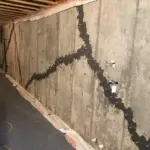
To determine the right foundation crack repair method, you must first identify the shape of the crack.
1. Vertical Foundation Cracks These run straight up and down or slightly on a diagonal. They are the most common type of home foundation cracks.
- Cause: Natural settling of the house footing or concrete shrinkage.
- The Risk: Low structural risk, but high water risk. These are the #1 entry point for basement leaks.
- The Fix: Polyurethane Injection.
2. Horizontal Foundation Cracks These run sideways along the wall, often in the middle third.
- Cause: Hydrostatic pressure (wet soil) pushing the wall inward.
- The Risk: High. Horizontal foundation cracks often indicate that your wall is bowing or buckling under pressure.
- The Fix: Carbon Fiber Straps or I-Beam reinforcement.
3. Hairline Cracks A hairline crack in the foundation is thin (less than 1/16th inch).
- The Risk: Even a hairline crack can allow water, radon gas, and insects to enter. If left unsealed, freeze/thaw cycles will widen them over time.
| Crack Type | Orientation | Likely Cause | Danger Level | Recommended Fix |
|---|---|---|---|---|
| Vertical | Up & Down | Settling / Shrinkage | Low (Leaks Water) | Polyurethane Injection |
| Diagonal | 45-Degree Angle | Uneven Settling | Medium | Injection (Monitor it) |
| Horizontal | Sideways | Hydrostatic Pressure | High (Structural) | Carbon Fiber Straps |
| Stair-Step | Steps in Brick/Block | Differential Settlement | High | Structural Piering |
| Hairline | < 1/16th inch | Concrete Curing | Low | Sealant (Prevention) |
Foundation Cracks: When to Worry?
Many homeowners ask: “Which foundation cracks are serious and when should I call a pro?”
Use this checklist to assess the danger level:
How can I tell if a horizontal crack in my foundation indicates structural issues?
If you see a horizontal crack, check for “shearing.” Run your hand across the crack. If one side of the wall sticks out further than the other, or if the wall is noticeably bowing inward, this indicates structural failure. You need a structural assessment immediately.
Is the crack getting wider?
Use a pencil to mark the ends of the crack. If the crack grows past your marks or widens over weeks, the foundation is actively moving.
Need a Professional Opinion? Don’t guess. Send us a photo of your crack for a free assessment: Contact us now
How We Fix Basement Cracks
We use distinct methods depending on whether you need basement wall crack repair for waterproofing or structural support.
1. For Leaking Cracks (The Injection Method) For vertical and diagonal cracks, we use high-pressure Polyurethane Injection. The resin expands to fill the entire depth of the wall, sealing the leak from the inside out.
2. For Structural Cracks (The Reinforcement Method) For bowing walls and horizontal cracks, we install Carbon Fiber Straps. These are stronger than steel and lock the wall in place to prevent further movement.
Curious about the cost? See our updated pricing in the [2026 Foundation Repair Cost Guide] (Link to Cost Page).
Common Questions about Foundation Cracks
What are the best DIY steps to fix cracks in a basement wall without causing more damage?
Many homeowners look for how to fix foundation cracks by yourself. While surface plugs (hydraulic cement) are available, they often fail because they do not penetrate the wall. Applying a surface patch can actually trap water inside the wall, causing the concrete to deteriorate faster (spalling). For a permanent fix, pressure injection is required. (Link: Read our full guide on DIY vs. Professional Repair)
Can you go about fixing foundation cracks from the outside?
Yes. Fixing foundation cracks from the outside involves excavating the soil to expose the foundation, filling the crack, and applying a waterproof membrane. This is effective but significantly more expensive than interior injection. It is usually reserved for finished basements where drywall cannot be removed.
What maintenance tips help prevent new foundation cracks from forming?
To prevent hydrostatic pressure from cracking your walls, keep water away from your foundation. Extend your downspouts at least 6 feet from the house, clean your gutters, and ensure your soil grades away from the home.
Ready to Fix Your Wall?
Don’t wait for the next rainstorm. A crack that is leaking today will not heal itself.
- Last Updated: January 2026
- Reviewed By: [Your Name/Head Technician Name], Senior Waterproofing Technician
- Region: Serving Toronto & The Greater Toronto Area


