
Dryshield Basement Waterproofing - The #1 Name in Waterproofing Solutions

Epoxy resin crack injection repair – Your best bet to seal a horizontal structural crack
Epoxy crack injection is a professional method used to seal and bond certain foundation cracks. Dryshield provides epoxy crack injection for foundation cracks that are suitable for epoxy injection after inspection.
At a glance
• Service: epoxy crack injection
• Also searched as: epoxy crack injection repair, epoxy foundation crack injection, crack injection
• Best for: foundation cracks that can be repaired with epoxy injection
• Goal: seal the crack and restore a solid bond through the crack line
• Next step: book a free inspection and written estimate
For full details, visit our basement waterproofing page.
Epoxy crack injection bonds a cracked poured-concrete foundation wall back together from the inside. DryShield uses it when an inspection shows the crack needs structural strength, not just a waterproof seal — typically horizontal cracks and cracks at beam pockets. It costs $750–$1,500 per crack in Toronto and the GTA, depending on the crack’s length, direction and access, and every crack injection is backed by our lifetime transferable warranty.
Lifetime transferable warranty · $5M liability coverage, fully insured · 8-time HomeStars “Best of” · 25+ years in Toronto & the GTA · Free written estimates · 1-800-277-5411
| Your situation | Usually recommended | Why |
|---|---|---|
| Crack is actively leaking water | Polyurethane crack injection | Epoxy needs a dry crack to bond. Polyurethane reacts with water, expands and stays flexible. |
| Horizontal crack | Epoxy crack injection, after a structural inspection | Restores strength through the crack line. A bowing wall may also need carbon fibre reinforcement. |
| Crack at a beam pocket or other load point | Epoxy crack injection | Creates a rigid bond where the wall carries load. |
| Crack that still moves with the seasons | Polyurethane crack injection | A rigid epoxy repair can re-crack if the wall keeps moving. |
| Dry vertical shrinkage crack | Either — usually polyurethane | Most residential shrinkage cracks are non-structural; the inspection confirms which one fits. |
Not sure which applies? A technician confirms the crack type, direction and whether it is leaking before recommending a method. See also how crack injection works.
Epoxy crack injection is used to repair foundation cracks by injecting epoxy along the crack line so the crack is sealed and bonded. Epoxy crack injection is commonly requested for foundation crack injection when the crack conditions are appropriate for epoxy.
Dryshield focuses specifically on epoxy crack injection services. We do not sell products. We provide the inspection, the injection work, and the completed repair.
Epoxy crack injection is recommended when inspection confirms the crack is a good candidate for epoxy injection. During the inspection, we confirm:
the crack location and direction
the crack length and access
whether the crack conditions suit epoxy crack injection
If epoxy crack injection is not the correct match for the crack conditions, we will tell you during the inspection before any work starts.
Seals the crack line through the foundation wall
Creates a strong bond along the crack path
Helps prevent the crack from reopening at the same line
Completed from inside the basement in most cases
Crack inspection
We confirm the crack is suitable for epoxy crack injection and review the repair plan.
Crack preparation
We prepare the crack area so the epoxy crack injection can be completed properly.
Epoxy crack injection
We inject epoxy along the crack path to seal and bond the crack line.
Finish and clean-up
We finish the repair area neatly and leave the workspace clean.
Epoxy crack injection costs $750–$1,500 per crack. Polyurethane injection for a leaking, non-structural crack is lower, at $750–$1,000 per crack. Epoxy is quoted in writing after inspection; the crack injection cost calculator gives a quick estimate for polyurethane repairs.
| Factor | How it affects the price |
|---|---|
| Crack length | Longer cracks need more injection ports and more resin. |
| Crack direction and type | Horizontal and structural cracks take more preparation than a vertical shrinkage crack. |
| Access | A crack behind a finished wall may need a small drywall opening. |
| Number of cracks | Several cracks repaired on one visit are quoted together. |
Epoxy crack injection cost depends on the crack length, crack location, and access. After inspection, Dryshield provides a clear written estimate for epoxy crack injection repair based on your foundation crack.
Dryshield Basement Waterproofing is rated 4.9 / 5 from verified Google reviews across the GTA and Ontario.
On this poured foundation wall, several long diagonal cracks were prepared for epoxy injection. Each crack is capped with epoxy paste, and surface ports are set along its length so the epoxy can be injected port by port and held inside the crack while it cures.
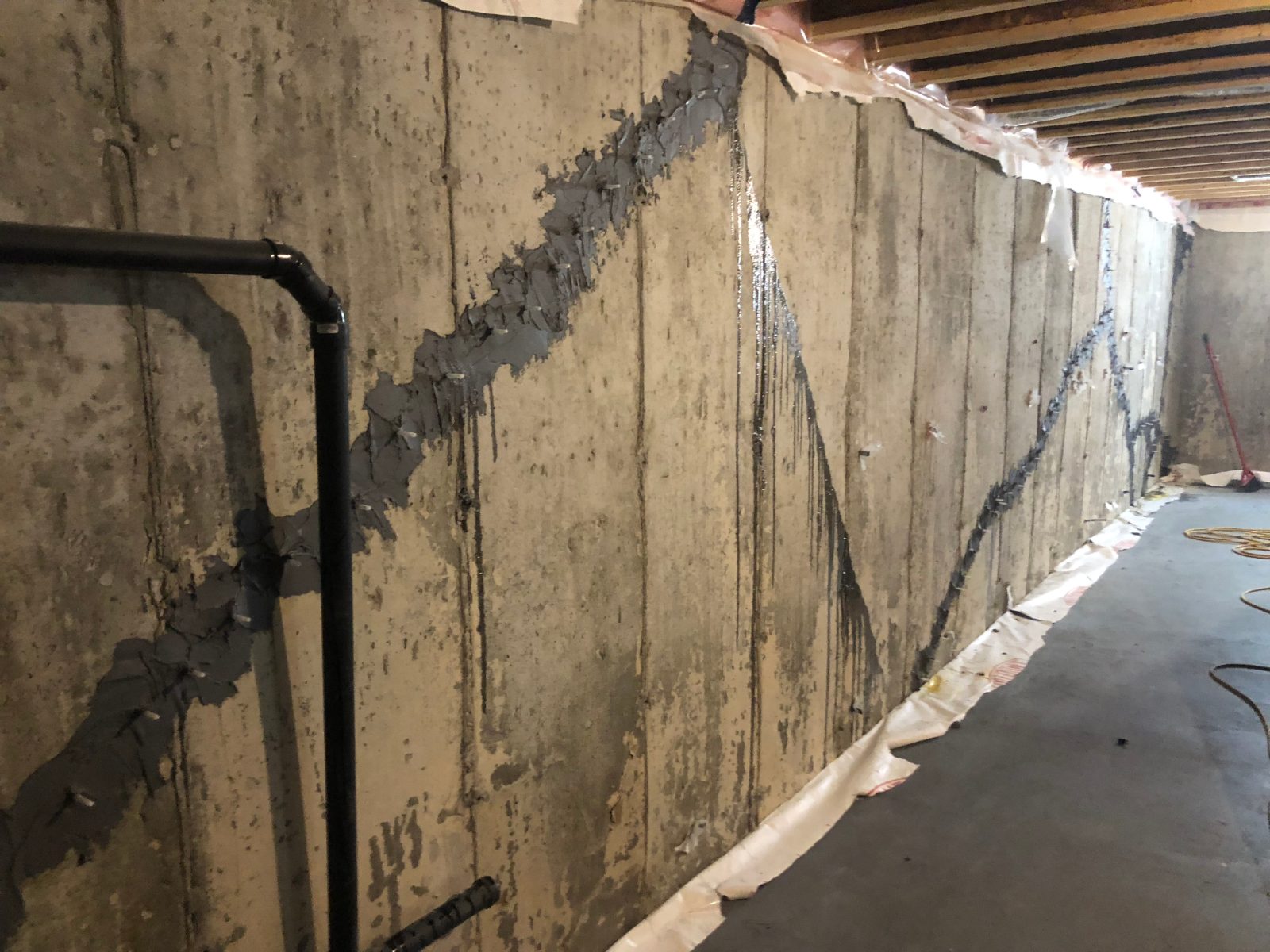
Once the epoxy has cured, the ports are removed and the paste is ground back. Epoxy crack injection costs $750–$1,500 per crack, and every crack injection is backed by our lifetime transferable warranty.
Epoxy is a structural adhesive. Once it cures, it is actually stronger than the concrete itself. Polyurethane is a flexible sealer used primarily for waterproofing (see polyurethane crack injection). If a crack is already leaking, our basement crack repair team will recommend the right method.
Epoxy is used when the structural integrity of the wall is compromised—specifically for cracks that are “moving” or for horizontal cracks caused by pressure.
Standard epoxies do not bond well to wet surfaces. If a crack is actively leaking, it must be dried first, or a moisture-tolerant epoxy must be used.
Yes, epoxy creates a solid, rigid seal that is waterproof. However, if the foundation continues to shift, the rigid epoxy may crack again, whereas polyurethane would flex.
A properly injected epoxy bond is typically 2 to 3 times stronger than the original concrete, effectively “welding” the crack back together.
Technicians clean the crack, attach “ports” (entry points) along the crack, and then seal the surface with a thick epoxy paste to keep the liquid epoxy inside during injection.
It is excellent for both, but it is the preferred method for structural wall repairs where “stapling” or “welding” the concrete is necessary.
Yes, there are different “viscosities” (thicknesses) of epoxy. Thin epoxy is used for hairline cracks, while thick, gel-like epoxy is used for wider gaps.
Initial curing happens within a few hours, but it typically takes 24 hours to reach full structural strength.
Injection ports are small plastic nozzles glued over the crack. They allow the technician to pump the resin into the wall in controlled stages.
Yes, epoxy is frequently used in industrial and commercial settings to repair cracks in concrete pools, water tanks, and dams due to its high strength.
Reviewed by: Jacob Penny Senior Waterproofing Technician, Dryshield Basement Waterproofing
Last updated: December 2025


