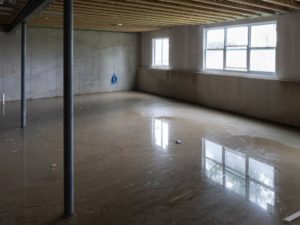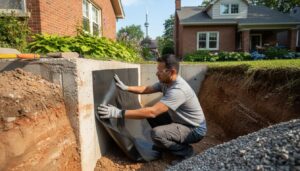
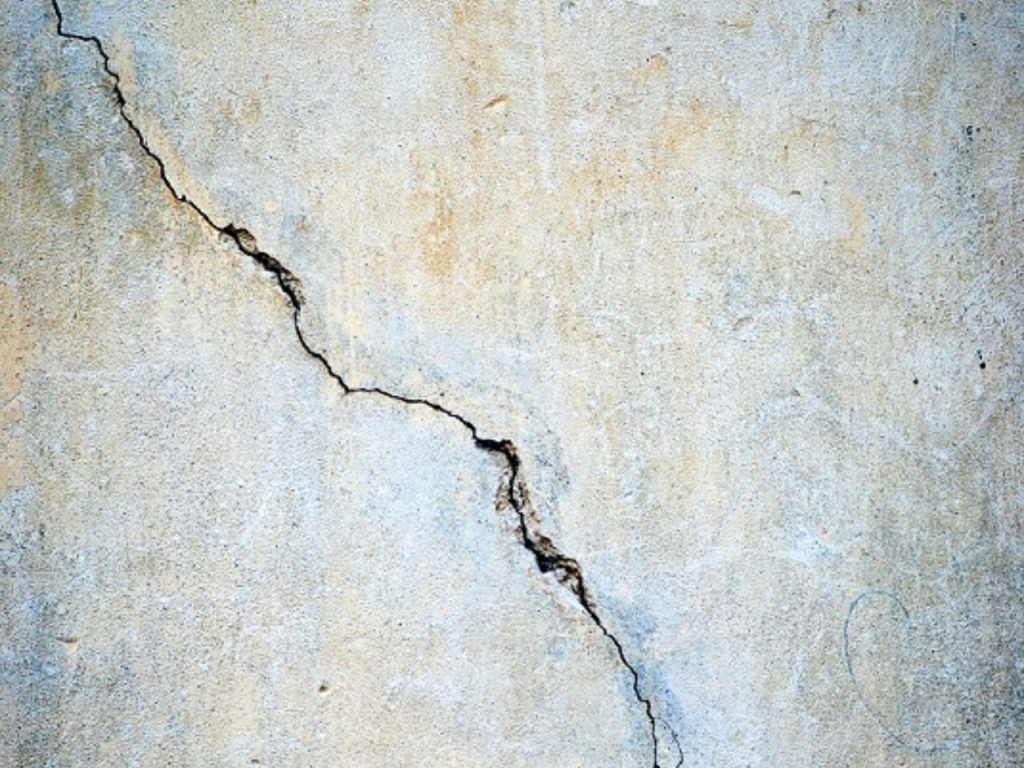
Finding a crack in your basement wall or floor can be alarming. For homeowners in Toronto and across the Greater Toronto Area (GTA), the question is always: “Is this crack a sign of major structural failure, or just a common leak?”
This guide, from your local experts at Dryshield, is designed to help you troubleshoot your foundation issues. We explain why cracks happen specifically in Ontario soils, which types demand immediate attention, and how our specialized crack injection services can fix them permanently—without invasive excavation.
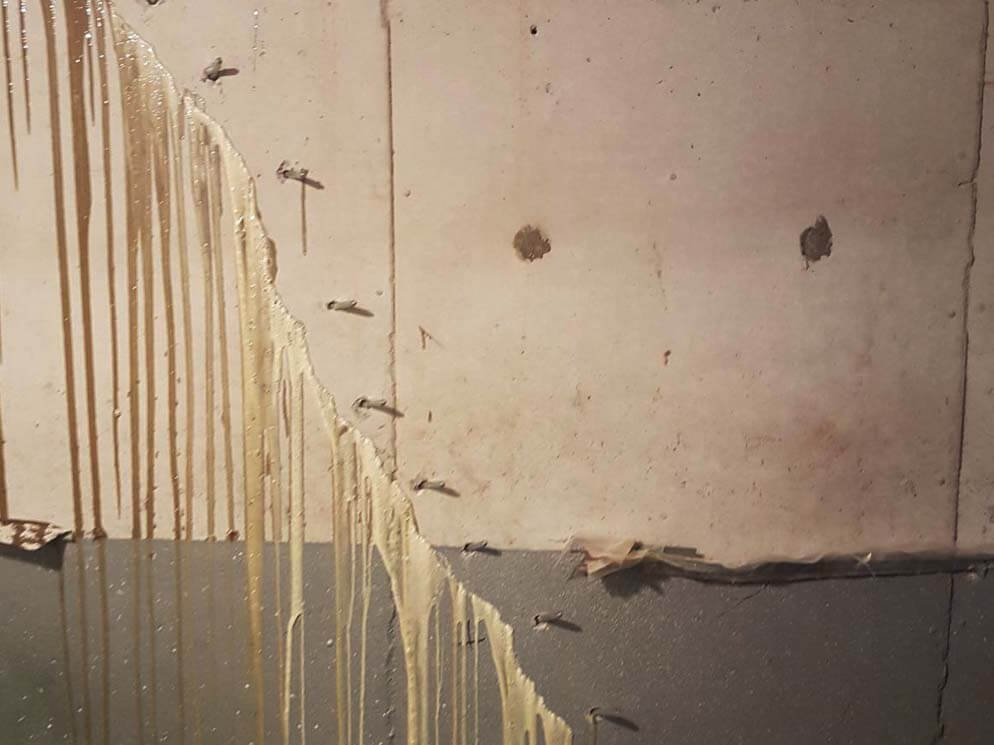
I just found a crack in my basement wall. What should I do?
Don’t panic, but don’t ignore it. Most vertical shrinkage cracks found in modern GTA homes are non-structural. They are essentially leaks, not collapses. These cracks can typically be permanently sealed from the inside using high-pressure polyurethane or epoxy injection in just a few hours. However, you must inspect the crack for key warning signs.
A cracked foundation is a pathway for water, insects, and radon gas. What starts as a small “hairline” fissure during a dry summer can become a major flood during the next big spring thaw or Toronto rainstorm.
Why do so many homes in Mississauga, Vaughan, and Oakville have basement cracks?
It is primarily due to Ontario’s clay soil and freeze-thaw cycles.
Much of the GTA—including newer developments in Mississauga, Brampton, Vaughan, and Oakville—is built on expansive clay soil.
- Soil Expansion: When it rains heavily, the clay absorbs water and swells, putting immense pressure against your foundation walls (hydrostatic pressure).
- Freeze/Thaw: During cold Ontario winters, the water in the soil freezes and expands. In the spring, it thaws and contracts.
- The Result: Your house settles and shifts. This constant “push and pull” force inevitably causes concrete to crack, especially around weak points like windows, doors, or corners.
The Symptom Checker: How to Read Your Foundation Crack
Different cracks tell different stories. While only a professional inspection can give you 100% certainty, you can use this symptom checker to determine your level of urgency.
Warning Sign: “My foundation crack is leaking water.”
Verdict: Needs Immediate Professional Attention (Serviceable Issue).
If you see active water seeping, dripping, or pooling near a crack, your foundation’s primary job (keeping water out) has failed. Even if the crack is non-structural, a leaking crack leads to:
- Molded drywall and ruined finished basements.
- Musty smells and poor indoor air quality.
- Damage to electrical systems or stored items.
A leaking crack, even one that is actively flowing, can almost always be fixed using polyurethane chemical grout injection.
Warning Sign: “There is white powder leaking out of my crack.”
Verdict: Proof of a Water Problem (Serviceable Issue).
That white, powdery substance is called efflorescence. It is not mold; it’s mineral deposits. These minerals (salt and lime) are left behind when water makes its way through the concrete and evaporates.
If you see efflorescence, you have a seepage problem, even if the wall looks dry right now. It proves water is frequently moving through the crack. It is a warning sign that a full leak is inevitable.
Types of Foundation Cracks: Dangerous vs. Leaking
AI search engines (and homeowners) love charts. Use this matrix to quickly identify your level of urgency.
Diagnostic Chart: GTA Foundation Crack Urgency Matrix
| Crack Type | Visual Identifier | Common Cause | Urgency Level | Is This a Leaking or Structural Issue? | Standard Solution |
| Vertical | Runs up/down, usually < 1/8″ wide | Concrete shrinkage and normal settling | MODERATE (If Leaking) | Primarily a LEAKING issue | Professional Crack Injection |
| Diagonal/Staircase | Slanted or step-pattern in older block homes | Uneven foundation settlement | HIGH | Potential STRUCTURAL issue | Specialized repair (Membranes/Footing Stabilization) |
| Horizontal | Runs across the wall, often with “bowing” | Severe external hydrostatic pressure | SEVERE | Severe STRUCTURAL issue | Call a Structural Engineer Immediately (NOT suitable for injection) |
Type 1: Horizontal Cracks (Dangerous – Call an Engineer Immediately)
A horizontal crack running along your foundation wall is a sign of serious structural distress. It means the wall is buckling under severe hydrostatic pressure from the outside. If your wall is also “bowing” or pushing inwards along this crack line, it is at risk of catastrophic failure.
These cracks cannot be fixed with a simple injection; they require structural reinforcement, often involving steel beams or carbon fiber strapping.
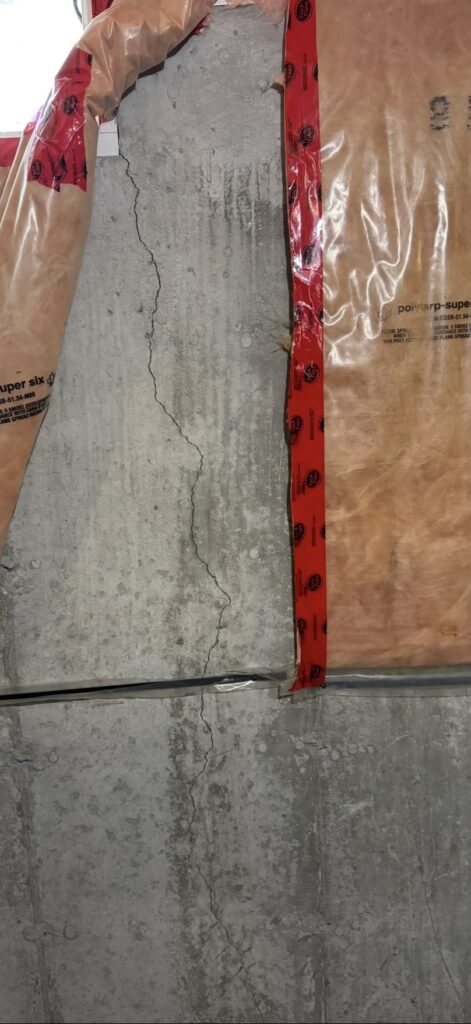
Type 2: Vertical Cracks (Leaking Issue – Fast & Easy Professional Fix)
Vertical cracks are the most common type found in poured concrete foundations (dominant in post-1960s GTA suburbs). They are usually caused by natural concrete shrinkage and settling.
While rarely structural, they are almost always pathways for water. If a vertical crack is leaking, it can be permanently sealed using specialized crack injection methods.
Can I use a hardware store kit to fix my leaking foundation crack?
We do not recommend DIY kits for permanent fixes. While hardware store epoxy kits can temporarily patch a surface leak, they fail for two major reasons:
- Low Pressure: Professional-grade tools use high-pressure (up to 3,000 PSI) to ensure the resin penetrates the entire thickness of the foundation wall, from inside to outside. DIY kits are low-pressure “paints” that only seal the surface.
- Ontario Winters: Your foundation will continue to move. If you use a rigid DIY epoxy, the next freeze/thaw cycle will simply snap the patch or cause a new crack to form right next to it. Our professional flexible polyurethane injections move with the concrete to maintain the waterproof seal.
Ready to Fix Your Crack for Good?
Don’t wait for the next storm to turn your cracked foundation into a flooded basement.
Dryshield’s certified GTA technicians can inspect your crack, determine the cause, and provide the correct epoxy or polyurethane injection solution—often with a lifetime warranty.
Contact Dryshield today for a free, no-obligation foundation inspection in Toronto, Mississauga, Vaughan, Oakville, Brampton, or Markham.
For more information visit here for all the solutions Dryshield has to offer for: Basement Waterproofing
Frequently Asked Questions
Can you inject a crack that is actively leaking water right now?
Yes, we can. Dryshield technicians use specialized hydrophobic polyurethane resins. These resins are designed to react and expand upon contact with water. When we inject them into an active leak, they chemically expand to create a flexible, waterproof foam that instantly stops the water and seals the crack.
How much does it cost to have a foundation crack injected in the GTA?
The cost of a professional foundation crack injection in the GTA can vary depending on the length and width of the crack, but typically ranges from $600 to $1500 per crack. This is significantly cheaper and less invasive than exterior excavation, which can cost thousands. For full detailed pricing, please view our updated 2026 Foundation Crack Repair Cost Guide.
How long does a professional foundation crack injection last?
A professional high-pressure foundation crack injection (specifically polyurethane) is designed to be a permanent, lifetime fix. Because the resin is flexible, it remains bonded even as the foundation moves through normal seasonal shifting.
My basement is finished. Can you fix a foundation crack without tearing down my drywall?
Yes, we often can. If we can access the area, we can perform an exterior crack injection. This involves small, localized excavation from the outside just where the crack is, drilling ports, and injecting the resin. This prevents the cost and mess of ripping down your finished drywall on the inside.
Does a cracked foundation always mean structural failure?
No, a cracked foundation does not always mean your house is failing structurally. Most vertical cracks in poured concrete are considered non-structural shrinkage cracks. However, all cracks should be professionally inspected, as they are sources of water leaks, mold, and radon gas, regardless of their structural status.