|
Getting your Trinity Audio player ready...
|
Heavy spring rains are pushing water through GTA foundations right now. Here’s the fastest, most cost-effective way to stop it — and the new City subsidy that can help pay for it.
Key Takeaways
-
-
- Environment Canada has issued flood warnings for the GTA as of April 14, 2026, with saturated ground and 20+ mm of rainfall overwhelming drainage systems across the region.
-
- Foundation cracks are the #1 entry point for floodwater in poured-concrete basements — the most common foundation type in the GTA.
-
- Crack injection repairs take 2–4 hours with no excavation, costing $750–$1,500 per crack versus $15,000–$25,000+ for exterior waterproofing.
-
- The City of Toronto is nearly doubling its Basement Flooding Protection Subsidy to $6,650 starting May 1, 2026 — up from $3,400.
- Every day you wait after a flood increases the risk of mould growth, structural deterioration, and exponentially higher repair costs.
-
Table of Contents
What’s Happening: Toronto’s April 2026 Flood Risk
On April 14, 2026, Environment Canada issued a special weather statement for Toronto and the Greater Toronto Area, warning of heavy rainfall that could lead to localized flooding. The Toronto and Region Conservation Authority (TRCA) followed with a flood outlook effective through April 16, citing saturated ground conditions, thunderstorms, and widespread rainfall exceeding 20 millimetres.
This isn’t an isolated event. Southern Ontario’s spring thaw cycle creates a predictable but devastating pattern for homeowners every year. Snow and ice that accumulated over the winter melt into the soil at the same time that spring rainstorms deliver heavy precipitation. The ground, still partially frozen or fully saturated from snowmelt, loses its capacity to absorb additional water. That water has to go somewhere — and for tens of thousands of GTA homes, it goes straight through foundation cracks and into the basement.
The City of Toronto’s own Basement Flooding Protection Program estimates that over 20,000 homes are at risk of basement flooding annually. If your basement is taking on water right now, understanding the cause — and the most effective repair option — is critical before the next storm arrives.
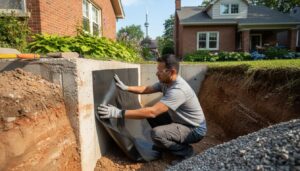
How Floodwater Enters Your Basement Through Foundation Cracks
The vast majority of homes in the GTA are built on poured-concrete foundations. Concrete is an incredibly strong material, but it is not waterproof. As concrete cures, it shrinks — and that shrinkage creates hairline cracks, often within the first year after construction. Over time, Toronto’s aggressive freeze-thaw cycles widen these cracks. Water expands by approximately 9% when it freezes. A crack that measures 1 mm in October can measure 3–4 mm by the following April after a full winter of freeze-thaw action.
When heavy rainfall saturates the soil surrounding your foundation, hydrostatic pressure builds against the walls. This pressure forces water through any available opening. A single foundation crack, even one as narrow as a credit card edge, can allow litres of water per hour into your basement during a sustained rainstorm. Southern Ontario’s clay-heavy soil — particularly in areas like Vaughan, Brampton, Mississauga, and Scarborough — amplifies this effect because clay retains water rather than allowing it to drain away from the foundation.
The result: water enters through the crack, pools on the basement floor, damages stored belongings, and creates the perfect conditions for mould and mildew — which can begin to colonize within 24 to 48 hours of moisture exposure.
7 Warning Signs Your Foundation Was Compromised by Flooding
After a heavy rain event like the one Toronto is experiencing this week, inspect your basement carefully for these indicators that water is entering through a foundation crack:
-
-
- Active water seepage along a wall crack. The most obvious sign. If you can see water trickling or weeping through a visible line in the concrete, you have a crack that needs professional crack injection.
-
- Damp or discoloured patches on basement walls. Water stains that weren’t there before the storm indicate moisture migration through the concrete, even if the crack itself isn’t visible from the interior.
-
- White, powdery residue (efflorescence). This chalky mineral deposit forms when water passes through concrete and evaporates on the surface, leaving dissolved salts behind. It is a reliable indicator of ongoing moisture infiltration.
-
- Musty or damp odour in the basement. If your basement smells different after the rain, moisture has entered. Mould and mildew produce a distinctive musty smell even before visible growth appears.
-
- Peeling paint or bubbling drywall. Moisture behind finished walls causes paint adhesion failure and drywall deterioration. If you have a finished basement and notice these signs, the water source is almost always a foundation crack behind the wall.
-
- Puddles or damp carpet near the base of foundation walls. Water that enters through a crack above the floor line runs down the wall and pools at the base. Check where the wall meets the floor on all exterior-facing walls.
- Rust stains on concrete floors or near metal fixtures. When water reaches metal components — tie rods, steel reinforcement, or hardware embedded in the concrete — rust develops and stains the surrounding area.
-
Don’t ignore these signs. A crack that admits a small amount of water today will admit significantly more after the next freeze-thaw cycle widens it further. The average cost of mould remediation in a Toronto basement ranges from $3,000 to $10,000. A single crack injection repair costs a fraction of that.
Crack Injection Explained: Polyurethane vs. Epoxy
Crack injection is the process of sealing a foundation crack from the inside using specialized resins injected under high pressure. The material fills the entire crack — from the interior surface through the full thickness of the wall to the exterior soil face — creating a permanent, watertight seal. No excavation or exterior digging is required.
There are two primary injection materials, and choosing the right one depends on whether the crack is an active leak or a structural concern.
Polyurethane Injection: For Active Leaks and Water-Stopping
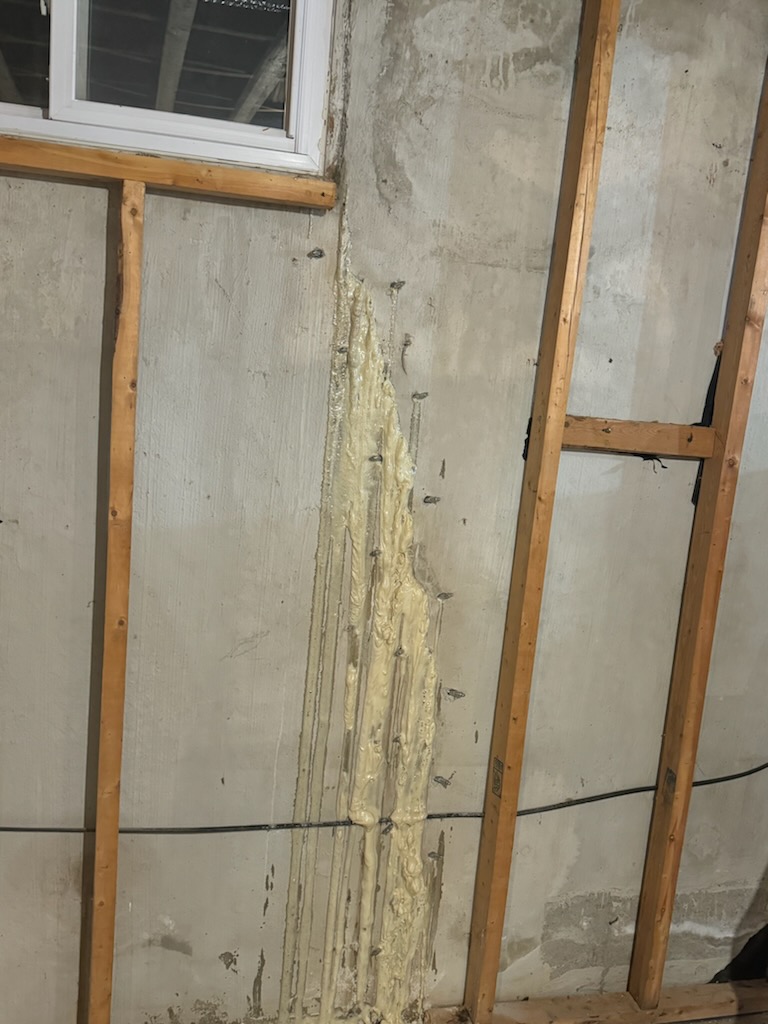
Polyurethane injection is the preferred method when a crack is actively leaking — which is exactly the situation most homeowners face after a flood event. Hygro-phobic polyurethane resin is injected through metal ports drilled into the crack at 45-degree angles, spaced every 6 to 8 inches along the length of the crack.
What makes polyurethane uniquely effective for flood-related repairs is its chemical reaction with water. The resin expands up to 30 times its original volume upon contact with moisture, filling every void and micro-fissure within the crack. The presence of water during injection actually accelerates the curing process — meaning it works better when the crack is wet. The result is a closed-cell foam seal that is flexible enough to move with the natural expansion and contraction of the concrete through seasonal temperature changes.
Epoxy Injection: For Structural Reinforcement
When a crack threatens the structural integrity of the foundation — typically wider cracks or those caused by settlement rather than shrinkage — epoxy injection is the appropriate solution. Two-component epoxy resin cures into a rigid bond that is actually stronger than the surrounding concrete. This effectively welds the crack shut and restores the wall’s original load-bearing capacity.
Epoxy is most commonly used in commercial applications or residential situations where an engineer has identified structural movement. For the majority of homeowners dealing with water intrusion after spring flooding, polyurethane is the recommended solution.
The Process: What to Expect
A professional crack injection repair follows a disciplined sequence. The technician first prepares the area with protective coverings, then cleans the crack surface. Holes are drilled into the crack at alternating 45-degree angles every 6 to 8 inches. Metal injection ports (not plastic — metal ports withstand higher pressure for deeper penetration) are fastened into each hole. The resin is then injected starting from the lowest port and working upward, ensuring complete fill from front to back. The entire process typically takes 2 to 4 hours and is completed entirely from inside the home.
Cost Comparison: Crack Injection vs. Other Repair Methods
For homeowners trying to decide how to address a leaking foundation after flooding, cost is often the deciding factor. Here is how crack injection compares to the alternatives:
| Repair Method | Typical Cost | Duration | Excavation Required? | Disruption Level |
|---|---|---|---|---|
| Crack Injection (Polyurethane) | $750 – $1,500 per crack | 2 – 4 hours | No | Minimal |
| Crack Injection (Epoxy) | $750 – $1,500 per crack | 2 – 4 hours | No | Minimal |
| Interior Drainage System | $2,500 – $6,000+ | 2 – 4 days | Interior floor cut | Moderate |
| Exterior Waterproofing | $150 – $350 per linear foot | 3 – 7 days | Full perimeter excavation | Severe |
| Full Exterior Excavation | $15,000 – $25,000+ | 1 – 2 weeks | Yes — full depth | Severe (landscaping destroyed) |
The numbers speak clearly. If water is entering through an identifiable crack in a poured-concrete foundation, crack injection is the fastest, least invasive, and most cost-effective permanent repair. Left unaddressed, that same crack will likely require a $20,000+ exterior excavation repair within a few years as the damage compounds through successive freeze-thaw cycles.
All DryShield crack injection repairs come with a lifetime transferable warranty. If any seepage returns through a repaired crack, DryShield returns and re-injects at no additional cost.
Toronto’s New $6,650 Basement Flooding Subsidy (May 2026)
Toronto homeowners dealing with basement water issues have a significant financial incentive to act now. The City of Toronto has approved an enhancement to its Basement Flooding Protection Subsidy Program, effective May 1, 2026. The maximum total subsidy per property is increasing from $3,400 to $6,650.
The enhanced program includes increased caps for backwater valve installation (up to $1,250), sump pump installation including alarm and battery backup (up to $1,750), a new $300 subsidy for sump pump battery backup systems, and a new home plumbing assessment subsidy to help identify internal contributors to flooding.
While foundation crack injection itself is not directly covered by this specific City program, the subsidy can offset costs for complementary flood-prevention measures like sump pumps and backwater valves — freeing your budget to address the foundation cracks that are the actual source of water entry. A comprehensive approach that combines crack injection to seal the entry points with a sump pump and backwater valve for broader protection gives your home the strongest possible defence against future flooding.
To check eligibility, visit the City of Toronto Basement Flooding Protection Subsidy Program page. Eligibility requires ownership of a single-family home, duplex, triplex, or fourplex in Toronto with no outstanding municipal debts.
Why Acting Now — Before the Next Storm — Saves You Thousands
The April 2026 flooding is not a one-off event. Toronto’s spring season typically brings multiple heavy rainfall events between April and June, and climate data shows that extreme precipitation events in the GTA are increasing in both frequency and intensity.
Every storm that pushes water through an untreated foundation crack compounds the damage in three ways:
Structural degradation accelerates. Water erodes the concrete matrix around the crack, widening it incrementally. Freeze-thaw cycles exploit the expanded crack further. What starts as a hairline fracture that could be repaired for $750 can become a structural failure requiring $20,000+ in excavation and rebuilding.
Mould colonization begins within 48 hours. Once moisture enters a basement, mould spores — which are always present in the air — land on damp surfaces and begin to grow. Mould remediation in a Toronto basement costs $3,000 to $10,000 depending on the extent of colonization. A finished basement with mould behind the drywall can cost significantly more to fully remediate.
Property value erodes. A history of basement flooding, visible water damage, or disclosed foundation issues reduces a GTA home’s resale value by an estimated 3% to 5%. On a home valued at $1 million — close to the current GTA average — that translates to $30,000 to $50,000 in lost equity. Professional foundation crack repair with a transferable warranty protects and can even enhance your property’s value.
Don’t wait for the next storm to test your foundation.
DryShield provides free on-site inspections for homeowners across Toronto and the Greater Toronto Area. Our certified technicians will assess your foundation, identify every crack and potential entry point, and provide a detailed repair recommendation — at no cost and with no obligation.
Call 1-800-277-5411 to schedule your free inspection, or request a free estimate online.
All crack injection repairs include a lifetime transferable warranty. If it leaks again, we come back — free.
Frequently Asked Questions
Can crack injection be done while the crack is actively leaking?
Yes — in fact, polyurethane injection works best on wet or actively leaking cracks. The resin reacts with water to expand and cure faster, creating a stronger seal. There is no need to wait for the crack to dry out before scheduling a repair.
How quickly can I get a crack injection after my basement floods?
Once floodwater has been removed and the basement is safe to work in, crack injection can be performed immediately. The repair itself takes 2 to 4 hours per crack. DryShield offers rapid-response scheduling for homeowners dealing with active flooding situations.
Will crack injection fix all basement flooding?
Crack injection is the correct solution when water enters through identifiable cracks in a poured-concrete foundation. If water is entering through the cove joint (where the wall meets the floor), through window wells, or from sewer backup, additional measures like an interior drainage system, sump pump, or backwater valve may be needed. A professional inspection will determine the exact source and the right repair.
Does the City of Toronto subsidy cover crack injection?
The City’s Basement Flooding Protection Subsidy Program covers backwater valves, sump pumps, and related plumbing measures. While crack injection is not directly covered under the current program, the subsidy can offset costs for complementary protection, and the combined approach provides the most comprehensive flood defence for your home.
How long does a crack injection repair last?
A properly executed crack injection is designed to last for the remaining lifespan of the foundation. DryShield backs every injection with a lifetime transferable warranty — meaning the coverage follows the home even if you sell it.
Is crack injection better than patching the crack from the outside?
Exterior surface patching only seals the visible face of the crack and does not address the full depth. Water continues to enter and freeze within the concrete, eventually breaking through the surface patch. High-pressure crack injection fills the entire crack from front to back, sealing it permanently through the full thickness of the wall.
What does crack injection cost in Toronto?
Most residential foundation crack injections in the GTA cost between $750 and $1,500 per crack, depending on crack length, accessibility, and the type of resin used. This is a fraction of the cost of exterior waterproofing or excavation, which can run $15,000 to $25,000+.
About DryShield Basement Waterproofing
DryShield is Toronto’s trusted basement waterproofing and foundation repair specialist, serving the Greater Toronto Area with professional crack injection, interior and exterior waterproofing, and comprehensive foundation repair services. Every repair is backed by a lifetime transferable warranty. Call 1-800-277-5411 or visit dryshield.ca for a free estimate.