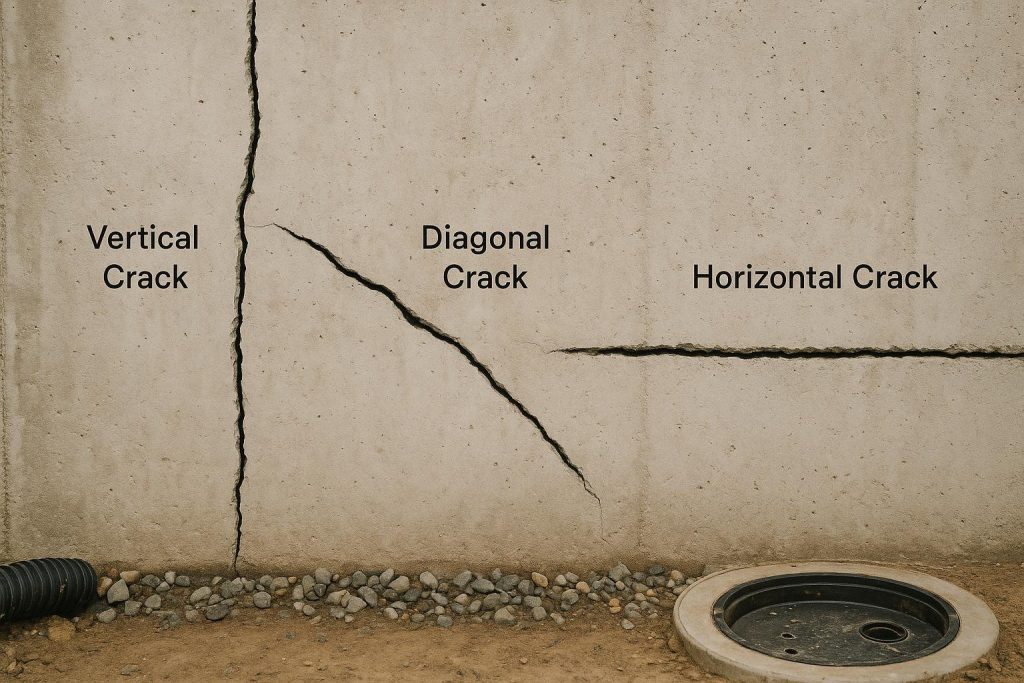
Understanding the types of foundation cracks in your basement wall or floor is the first step toward choosing the right repair. Each crack pattern tells a different story: hairline shrinkage cracks in poured concrete behave very differently from horizontal cracks caused by lateral soil pressure, and the correct fix depends entirely on what caused the crack and how far it has progressed. This guide covers seven crack types common in Ontario homes, explains their causes and severity, and outlines the repair options available.
Whatever type of crack you are looking at, here is how foundation crack repair works at DryShield, from diagnosis to warranty.
- Crack orientation (vertical, diagonal, horizontal, stair-step) is the single fastest indicator of cause and urgency.
- Most non-structural poured-concrete cracks can be sealed with polyurethane or epoxy injection without excavation.
- Horizontal cracks and cracks with displacement require professional assessment before any repair decision.
- Ontario’s freeze-thaw cycles and clay soils accelerate crack growth; early repair is almost always less costly than delayed repair.
- A Lifetime Transferable Warranty is available on qualifying crack injection repairs performed by DryShield.
Definitions & scope
A foundation crack is any fracture in a basement wall, floor slab, or footing that breaks the continuity of the concrete or masonry. Cracks are classified by their geometry (width, length, depth, orientation), their location (wall, floor, cove joint), and whether they show displacement or movement. In Ontario, foundations are most commonly poured concrete, concrete block (CMU), or stone rubble, and each material cracks in characteristic patterns.
The terms structural and non-structural are widely used but require care. A crack is considered structural when it compromises the load-bearing capacity of the wall or when it shows horizontal displacement, significant bowing, or progressive widening. Non-structural cracks allow water infiltration but do not immediately threaten the wall’s integrity. This guide focuses on water-entry cracks and the waterproofing repairs used to seal them. For cracks that may be structural, a licensed structural engineer should assess the wall before any repair work begins. See our companion guide on how to tell if a foundation crack is structural for detailed warning signs.
The scope of this guide excludes underpinning, wall anchors, carbon-fibre straps, and other structural reinforcement methods. It also excludes backwater valves. The repair methods discussed are crack injection, exterior membrane application, and interior drainage management.
Why this matters
Ontario’s climate creates conditions that are particularly hard on foundations. The province experiences an average of 50 to 100 freeze-thaw cycles per winter season in many regions, and clay-rich soils expand when wet and contract when dry, exerting cyclic lateral pressure on basement walls. Hydrostatic pressure from snowmelt and spring rain pushes water through even hairline cracks under significant force.
Left untreated, a small crack that admits a trickle of water can widen progressively as water freezes inside it, a process called frost wedging. Water infiltration leads to efflorescence, mold growth, and deterioration of interior finishes. Over time, chronic moisture can compromise the concrete itself through carbonation and rebar corrosion in reinforced walls.
From a practical standpoint, an active crack in a basement wall is a disclosure item in an Ontario real estate transaction. Buyers and their inspectors routinely flag foundation cracks, and an unrepaired crack can affect sale price or insurability. Conversely, a professionally repaired crack with documented warranty coverage is a positive disclosure.
Understanding which type of crack you have determines whether the fix is a same-day injection job or a multi-day excavation project. Misidentifying a horizontal crack as a simple shrinkage crack and applying a surface patch, for example, addresses none of the underlying pressure and may mask a worsening condition. Accurate identification is therefore not just academic; it directly affects repair cost, durability, and safety.
For broader context on how water enters basements through cracks and other pathways, see the Foundation Waterproofing Complete Homeowner’s Guide.
Your options
Hairline cracks
What it is: A hairline crack is less than 0.2 mm wide and typically runs vertically or at a slight angle in a poured-concrete wall. These are extremely common in Ontario homes and usually appear within the first few years after construction as concrete cures and shrinks.
How it works: Concrete shrinks slightly as it cures. If the shrinkage stress exceeds the tensile strength of the concrete at a given point, a fine crack forms. These cracks are typically shallow and do not pass fully through the wall, though they can deepen over time with freeze-thaw cycling.
Best for monitoring when: The crack is dry, shows no staining, and has not changed width over several months of observation.
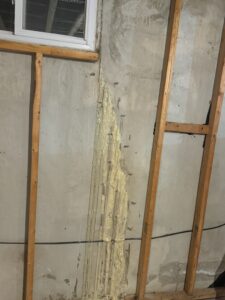
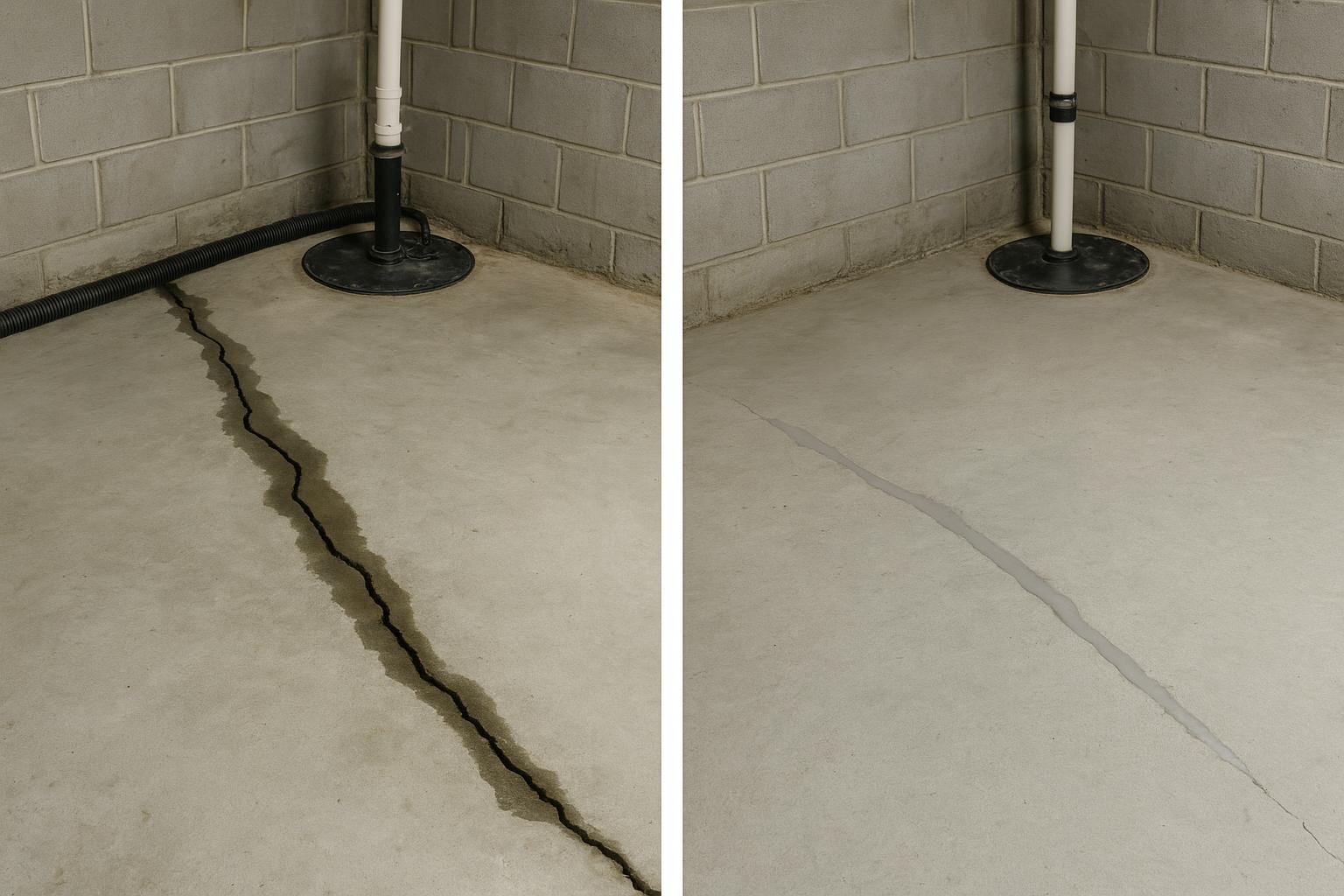
Repair: When a hairline crack shows moisture or active seepage, low-viscosity polyurethane foam injection is the standard repair. The foam expands to fill the full depth of the crack and cures to a flexible, waterproof seal. See Polyurethane Crack Injection for method details.
Limitations: Surface-only patching with hydraulic cement does not seal the full depth of the crack and is not a durable waterproofing solution.
Vertical cracks
What it is: A vertical crack runs straight up and down, or within about 30 degrees of vertical, through a poured-concrete wall. It is the most common crack type seen in Ontario basements.
How it works: Differential settlement, concrete shrinkage, and thermal expansion and contraction all produce vertical tension cracks. The crack typically runs from near the top of the wall toward the footing, though it may not extend the full height.
Best for: Polyurethane injection when the crack is actively leaking or shows staining. Epoxy injection when structural bonding of the concrete is also a goal, though epoxy is rigid and less suitable for walls subject to ongoing minor movement.
Limitations: A vertical crack that is wider at the top than the bottom may indicate differential settlement and warrants professional assessment. Injection seals the crack but does not address the underlying settlement if that is ongoing.
The Foundation Crack Diagnosis: Vertical vs. Horizontal page provides a quick visual reference.
Diagonal cracks
What it is: A diagonal crack runs at an angle, typically from a corner of a window or door opening, or from a corner of the wall. It may be narrow at one end and wider at the other.
How it works: Diagonal cracks most often result from differential settlement, where one part of the foundation settles more than another, or from stress concentration at re-entrant corners (window openings are a classic location). They can also result from shrinkage in combination with restraint at the corners of the wall.
Best for: Polyurethane injection when the crack is stable and leaking. If the crack is wider than 6 mm or shows vertical displacement (one side higher than the other), a structural engineer should assess it before injection.
Limitations: Diagonal cracks that are actively widening are a warning sign of ongoing settlement and should not be injected without understanding the root cause.
Horizontal cracks
What it is: A horizontal crack runs across the wall, typically at or near mid-height. It is the most serious crack pattern in a poured-concrete or concrete-block wall.
How it works: Horizontal cracks are caused by lateral soil pressure exceeding the wall’s bending resistance. In Ontario, saturated clay soils, frost pressure, and improperly backfilled excavations are common causes. The wall is essentially being pushed inward from outside.
Best for: Immediate professional assessment. Horizontal cracks indicate that the wall is under bending stress. If the wall shows inward bowing, the situation is urgent.
Limitations: Crack injection alone is not an appropriate repair for a horizontal crack in a bowing wall. Structural reinforcement (outside the scope of this guide) is required first. Water sealing may follow structural repair.
Important: Do not delay assessment of a horizontal crack. See how to tell if a foundation crack is structural.
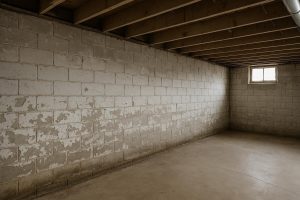
Stair-step cracks (concrete block and brick)
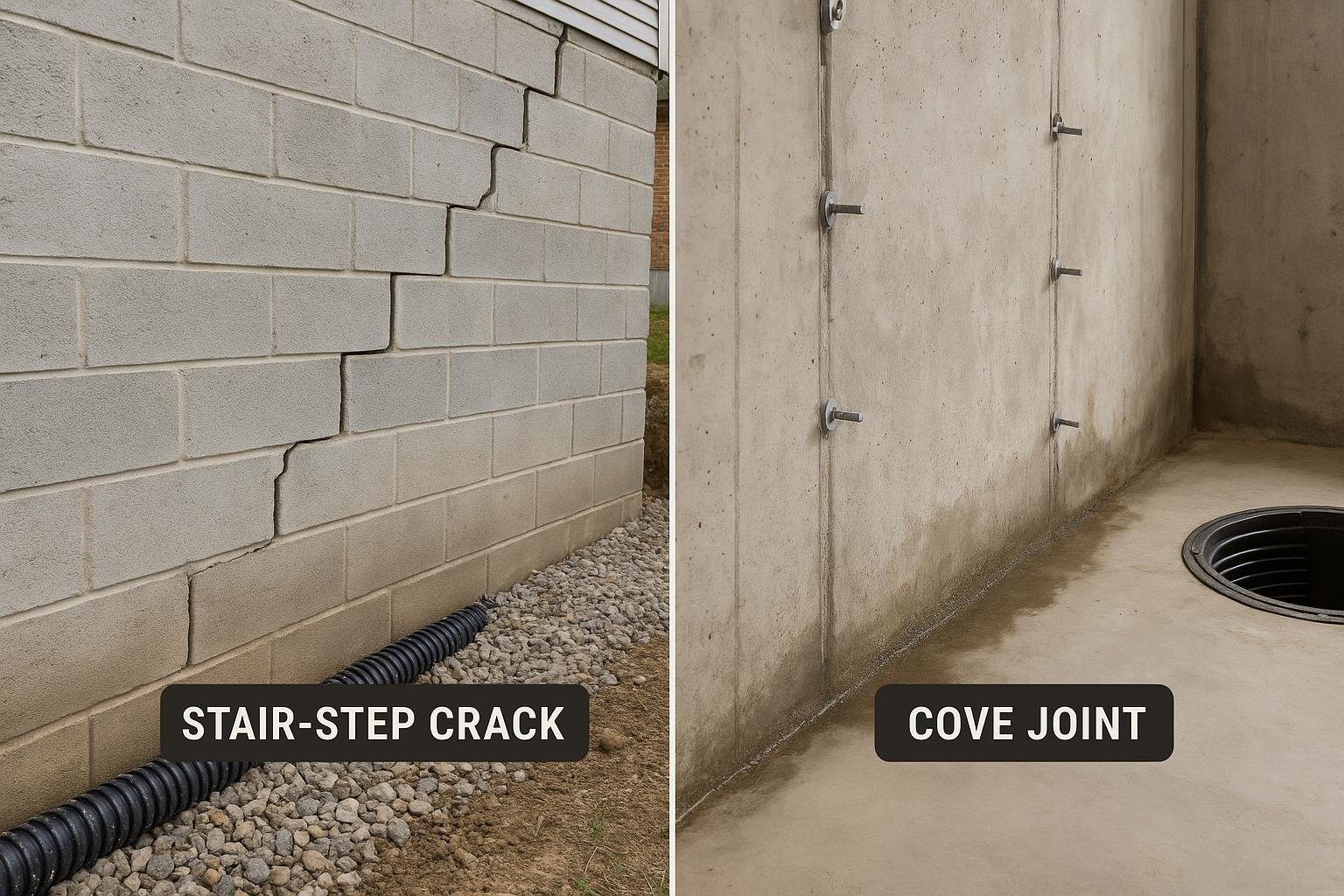
What it is: A stair-step crack follows the mortar joints in a concrete block (CMU) or brick foundation, stepping diagonally down the wall in a staircase pattern.
How it works: Mortar joints are the weakest plane in a block or brick wall. Differential settlement, frost heave, or lateral pressure causes the wall to crack along these joints rather than through the blocks themselves. Stair-step cracks are the block-wall equivalent of diagonal cracks in poured concrete.
Best for: Tuckpointing and repointing of mortar joints for minor cases. Polyurethane injection can be used at the interior face to create a water seal. Exterior excavation and membrane application addresses the water source directly.
Limitations: Block walls are inherently more porous than poured concrete, and stair-step cracks in block walls that are also bowing require structural assessment. See the companion guide on why poured concrete cracks differently than cinder block.
Floor slab cracks
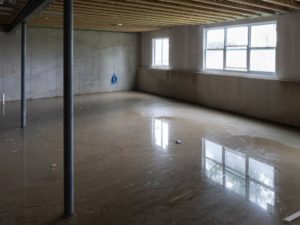
What it is: Cracks in the basement floor slab, ranging from hairline shrinkage cracks to wider cracks that admit water under hydrostatic pressure.
How it works: Basement floor slabs in Ontario are typically 3 to 4 inches thick and are not structurally connected to the foundation walls. They crack from concrete shrinkage, differential settlement of the sub-base, and upward hydrostatic pressure when the water table rises above the underside of the slab.
Best for: Polyurethane injection for isolated leaking floor cracks. Interior drainage systems (interior weeping tile) are the appropriate solution when water is entering along the full perimeter or through multiple floor cracks due to hydrostatic pressure. See Floor Crack Injections and How to Stop Water From Seeping Through Your Basement Floor.
Limitations: Injecting a floor crack does not relieve hydrostatic pressure beneath the slab. If pressure is the cause, additional cracks may form nearby after injection.
Cove joint cracks
What it is: The cove joint is the cold joint where the basement floor slab meets the foundation wall. It is not a structural bond; the slab was poured separately from the wall footing. Water seeping in at this joint is one of the most common basement leak locations in Ontario.
How it works: Because the slab and wall are separate pours, there is always a potential gap at this joint. When the water table rises, hydrostatic pressure forces water through this gap. The gap can widen with seasonal movement.
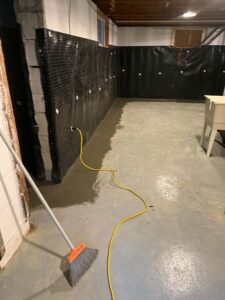
Best for: Interior drainage channel installed at the cove joint, directing water to a sump pump. This is a management approach rather than a seal, because sealing a joint under active hydrostatic pressure is rarely durable long-term.
Limitations: Cove joint leaks driven by hydrostatic pressure are difficult to seal permanently from the interior. Exterior waterproofing that reduces hydrostatic pressure at the wall is the most complete solution but involves excavation. See Exterior vs Interior Perimeter Waterproofing.
Options compared
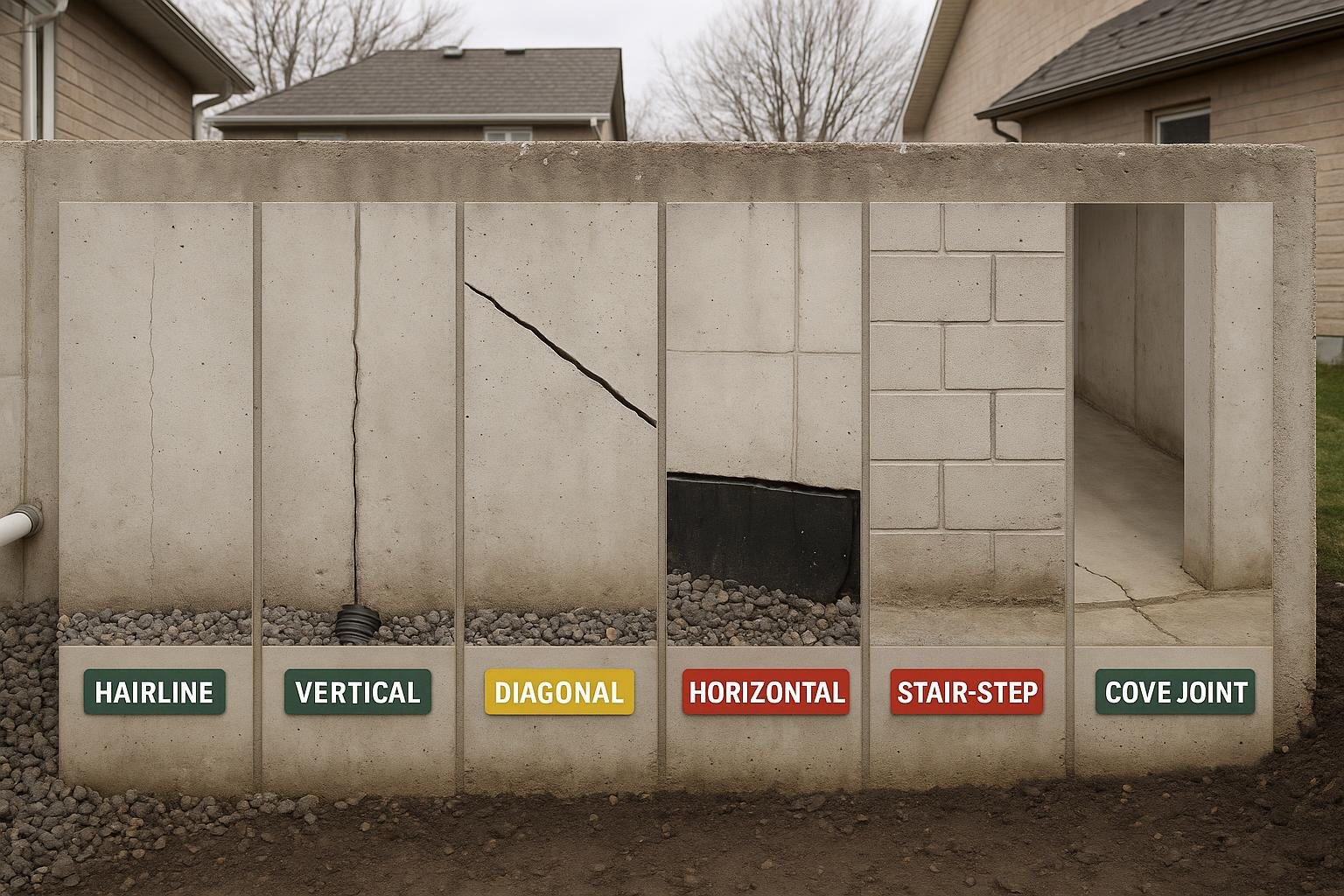
| Crack type | Typical cause | Severity | Primary repair approach | Durability / limitations |
|---|---|---|---|---|
| Hairline (vertical) | Concrete shrinkage during cure | Low (monitor if dry) | Polyurethane injection when leaking | Long-lasting when fully injected; surface patch is not durable |
| Vertical | Shrinkage, settlement, thermal movement | Low to moderate | Polyurethane or epoxy injection | Excellent when crack is stable; re-injection possible if crack re-opens |
| Diagonal | Differential settlement, corner stress | Moderate (assess if widening) | Polyurethane injection; engineer review if displaced | Good if settlement is complete; ongoing settlement requires monitoring |
| Horizontal | Lateral soil / frost pressure | High; potentially structural | Structural assessment first; waterproofing after stabilization | Injection alone is not appropriate; bowing walls need reinforcement |
| Stair-step (block/brick) | Settlement, frost heave, lateral pressure | Moderate to high | Repointing + injection or exterior membrane | Block walls remain porous; exterior membrane most complete solution |
| Floor slab | Shrinkage, sub-base settlement, hydrostatic pressure | Low to moderate | Injection for isolated cracks; interior drainage for pressure-driven leaks | Injection does not relieve pressure; drainage system manages ongoing water |
| Cove joint | Hydrostatic pressure at cold joint | Moderate (common, persistent) | Interior drainage channel to sump pump | Sealing under active pressure rarely durable; drainage is preferred management |
The table above shows that crack orientation is the most reliable first indicator of cause and urgency. Vertical and hairline cracks are the most amenable to injection repair and carry the best long-term outcome when treated before they widen. Horizontal cracks stand apart because they signal a structural loading condition, not just a water-entry point. Cove joint and floor cracks driven by hydrostatic pressure are best managed with drainage rather than sealed, because the pressure will find a new path if the original entry point is blocked without relieving the pressure source.
How to choose
Use the following framework to match your crack to the right repair path.
Choose polyurethane crack injection if: you have a vertical or diagonal crack in a poured-concrete wall that is leaking or stained, the wall shows no inward bowing or displacement, and the crack width is less than approximately 6 mm. This is the most common scenario in Ontario basements and is typically a same-day repair. DryShield’s crack injection service covers this repair and is backed by a Lifetime Transferable Warranty on qualifying work.
Choose epoxy injection if: you need structural bonding of the concrete in addition to waterproofing, the crack is in a dry or low-moisture environment, and there is no ongoing wall movement. Epoxy is rigid and bonds the crack faces together. It is less suitable than polyurethane for walls subject to seasonal movement. See the comparison at Epoxy vs Polyurethane Crack Injection.
Choose interior drainage (weeping tile + sump pump) if: water is entering at the cove joint, along the full wall-floor perimeter, or through multiple floor cracks under hydrostatic pressure. Injection of individual cracks will not resolve a pressure-driven perimeter leak. An interior weeping tile system collects and redirects water before it reaches the living space.
Choose exterior waterproofing if: you want to address the water source directly, the wall has multiple cracks or is a block wall with pervasive porosity, or you are already excavating for another reason. Exterior membrane application stops water at the outside face of the wall. This is the most comprehensive solution but also the most disruptive and costly. See Exterior Basement Waterproofing Services.
Get a structural engineer’s assessment first if: the crack is horizontal, the wall shows any inward bowing, the crack has vertical displacement (one side higher than the other), or the crack is widening rapidly. Do not inject or patch these cracks without professional guidance.
Monitor without immediate repair if: the crack is a dry hairline with no staining, no change in width over several months, and no evidence of water entry. Document the crack width with a pencil mark and date, and re-check seasonally.
Costs & timelines
The following describes cost drivers for foundation crack repair in Ontario. Verified price ranges for crack injection are published at Crack Injection Cost for Foundation Repair and the Crack Injection Cost in Southern Ontario (2026) page. Prices are not reproduced here because they are subject to change; consult those pages for current approximate ranges.
| Driver | Why it matters | Effect on cost |
|---|---|---|
| Repair method | Injection is far less labour-intensive than excavation | Injection is lowest; exterior excavation is highest |
| Crack length and depth | More injection ports, more material, more time | Longer and deeper cracks cost more |
| Number of cracks | Each crack is a separate repair; volume discounts may apply | Multiple cracks increase total cost |
| Access and interior finishing | Finished walls, insulation, or stored items must be moved or cut | Finished basements add labour cost |
| Foundation material | Block and stone walls require different techniques than poured concrete | Block and stone typically cost more to seal |
| Excavation depth | Deeper foundations require more excavation time and shoring | Deeper walls increase exterior repair cost significantly |
| Season and access | Frozen ground limits exterior work; tight lots limit equipment access | Winter exterior work and tight access add cost |
Interior crack injection is typically a single-visit repair completed in a few hours per crack. Exterior excavation repairs are multi-day projects. Interior drainage systems fall between these extremes in both cost and timeline. For a broader view of waterproofing costs, see Foundation Waterproofing Cost: What Ontario Homeowners Pay in 2026.
Risks & common mistakes
Applying hydraulic cement or caulk as a permanent fix. Surface patching materials do not penetrate the full depth of the crack. Water pressure will eventually dislodge a surface patch, and the underlying crack continues to grow. This is the most common DIY mistake and often delays proper repair while the crack worsens.
Ignoring a horizontal crack. Horizontal cracks in basement walls are the one crack type where delay carries genuine structural risk. A wall that is bowing inward under soil pressure will continue to move until it is stabilized. The longer stabilization is delayed, the more extensive and costly the repair becomes.
Injecting a crack without diagnosing the cause. Injecting a crack that is caused by ongoing differential settlement may produce a repair that re-cracks within a season. The cause of movement should be understood before injection, particularly for diagonal cracks that are still widening.
Sealing a cove joint under active hydrostatic pressure. Rigid sealants applied to the cove joint under pressure will be pushed out or bypassed. Water under pressure finds the next available path. The correct approach is to manage the water with drainage rather than attempt a rigid seal.
Painting over efflorescence without addressing the crack. White chalky deposits (efflorescence) on basement walls are a sign of water moving through the concrete and depositing minerals. Painting over them without sealing the source traps moisture in the wall and can accelerate deterioration. See Removing White Chalky Efflorescence From Basement Walls.
Assuming all cracks are the same. A homeowner who has successfully monitored a dry hairline crack for years may apply the same low-urgency judgment to a new horizontal crack. Each crack type must be evaluated on its own characteristics.
Delaying repair because the crack is not currently leaking. A dry crack can become an active leak the first time hydrostatic pressure rises above a threshold. In Ontario, that threshold is often crossed during spring snowmelt. Early repair is almost always less disruptive and less costly than emergency repair during an active leak event. See Emergency Leaky Basement Repair for Wall Cracks.
How the process works
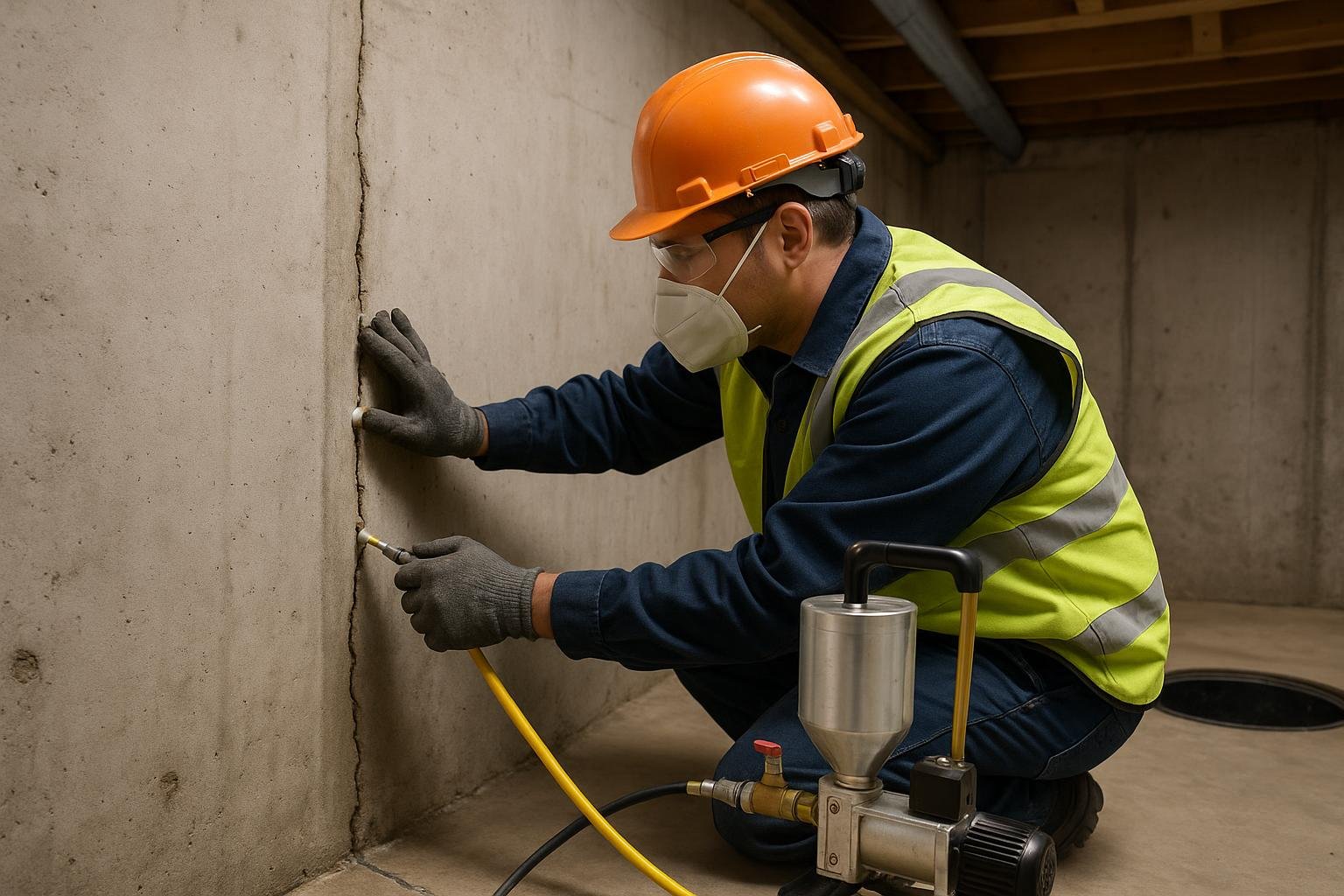
The following steps describe a typical interior polyurethane crack injection repair, which is the most common foundation crack repair performed in Ontario basements.
- Inspection and diagnosis. A technician examines the crack, measures its width and length, checks for displacement or bowing, and identifies whether it is active (leaking) or dormant. The wall material and foundation type are confirmed. The technician determines whether injection is appropriate or whether further assessment is needed.
- Surface preparation. The crack face is cleaned of loose material, efflorescence, paint, and any previous patching. Clean concrete is required for injection ports to bond correctly.
- Port installation. Plastic injection ports are bonded to the crack face at intervals along its length. Port spacing depends on crack width and wall thickness; tighter spacing is used for narrower cracks to ensure full penetration.
- Crack face sealing. The surface of the crack between ports is sealed with an epoxy paste or surface sealant. This forces the injected material to travel through the full depth of the crack rather than escaping at the surface.
- Injection. Polyurethane foam or epoxy resin is injected under low pressure through each port in sequence, starting at the lowest port and moving upward. The technician monitors for material appearing at the next port, confirming that the section is filled, before moving on.
- Port removal and surface finishing. After the material has cured, ports are removed and the surface is finished. The wall face may be left with a visible but sealed crack line.
- Documentation and warranty. The repair is documented and, on qualifying work, a Lifetime Transferable Warranty is issued. The homeowner is advised on monitoring and any follow-up steps if additional cracks are present.
Frequently asked questions
How do I know if a foundation crack is serious?
The most reliable indicators of a serious crack are horizontal orientation, inward bowing of the wall, vertical displacement (one side of the crack higher than the other), rapid widening, or active water entry under pressure. Vertical and hairline cracks in poured concrete are generally lower urgency but should still be sealed when they show moisture. When in doubt, have a professional assess the crack before deciding on a repair approach. Our guide on how to tell if a foundation crack is structural provides detailed criteria.
Can I repair a foundation crack myself?
DIY crack injection kits are available for small, stable, non-structural cracks, but they have significant limitations. Consumer-grade kits typically cannot achieve the injection pressure or port spacing needed to fill a crack through the full wall thickness. Surface patching with hydraulic cement or caulk is not a durable waterproofing solution. For any crack that is actively leaking, showing displacement, or located in a block or stone wall, professional repair is strongly recommended. The Foundation Crack Repair Services page outlines what a professional assessment involves.
What is the difference between polyurethane and epoxy crack injection?
Polyurethane foam expands to fill the crack, cures to a flexible waterproof seal, and is the preferred material for walls subject to seasonal movement or active water entry. Epoxy resin is rigid, bonds the crack faces together, and is used when structural bonding is also a goal. Epoxy requires a dry crack for proper adhesion and is not suitable for actively leaking cracks. The detailed comparison is at Epoxy vs Polyurethane Crack Injection.
How long does crack injection last?
A properly performed polyurethane injection into a stable crack is designed to be a permanent repair. The injected foam bonds to the concrete and remains flexible, accommodating minor seasonal movement without re-cracking. DryShield offers a Lifetime Transferable Warranty on qualifying crack injection repairs, which means the warranty transfers to a new owner if the home is sold. If a crack re-opens due to new movement or settlement, re-injection is possible. See the Lifetime Transferable Warranty page for terms.
Why is my basement floor cracking and leaking?
Basement floor cracks that admit water are most often caused by hydrostatic pressure from a high water table pushing upward against the underside of the slab. Ontario’s clay soils and spring snowmelt create conditions where the water table can rise significantly above the slab level. Isolated floor cracks can be injected, but when water is entering along the full perimeter or through multiple cracks, an interior drainage system is the appropriate solution. See How to Stop Water From Seeping Through Your Basement Floor and Floor Crack Injections.
What causes stair-step cracks in a block foundation?
Stair-step cracks follow the mortar joints in a concrete block or brick foundation because mortar is weaker than the blocks themselves. The most common causes are differential settlement (one section of the foundation sinking more than another), frost heave, and lateral soil pressure. Minor stair-step cracking with no displacement is common in older block foundations and can be addressed with repointing and interior injection. Significant displacement or bowing requires structural assessment. The guide on why poured concrete cracks differently than cinder block explains the underlying mechanics.
Does home insurance cover foundation crack repair in Ontario?
Standard Ontario home insurance policies generally do not cover foundation crack repair when the cause is gradual water seepage, settlement, or normal wear. Coverage may apply in specific circumstances such as sudden and accidental water damage, but this varies significantly by policy and insurer. The detailed breakdown is at Does Home Insurance Cover Basement Waterproofing and Foundation Cracks in Ontario?. Always review your specific policy and consult your insurer before assuming coverage.
How much does foundation crack repair cost in Ontario?
Cost depends primarily on the repair method, crack length, number of cracks, and whether excavation is required. Interior polyurethane injection is the least costly method. Exterior excavation and membrane application is the most costly. Current approximate price ranges for crack injection in Southern Ontario are published at Crack Injection Cost for Foundation Repair. For a broader cost overview including interior drainage and exterior waterproofing, see Foundation Waterproofing Cost: What Ontario Homeowners Pay in 2026.
If you have identified a crack in your foundation wall or floor and are not certain of its cause or urgency, the most useful next step is a professional assessment. DryShield has served Toronto, the GTA, and Ontario cottage country for over 25 years. Visit the Foundation Crack Repair Services page or use the Basement Leak Diagnostic Tool to describe your situation and get guidance on the right repair path. Qualifying repairs are backed by a Lifetime Transferable Warranty.