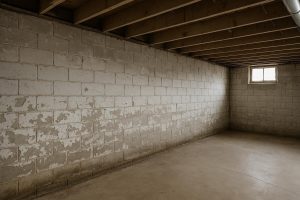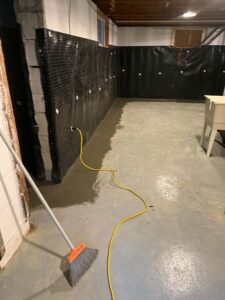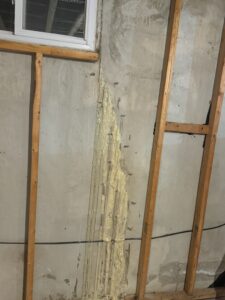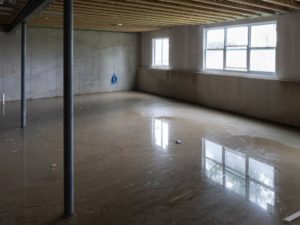
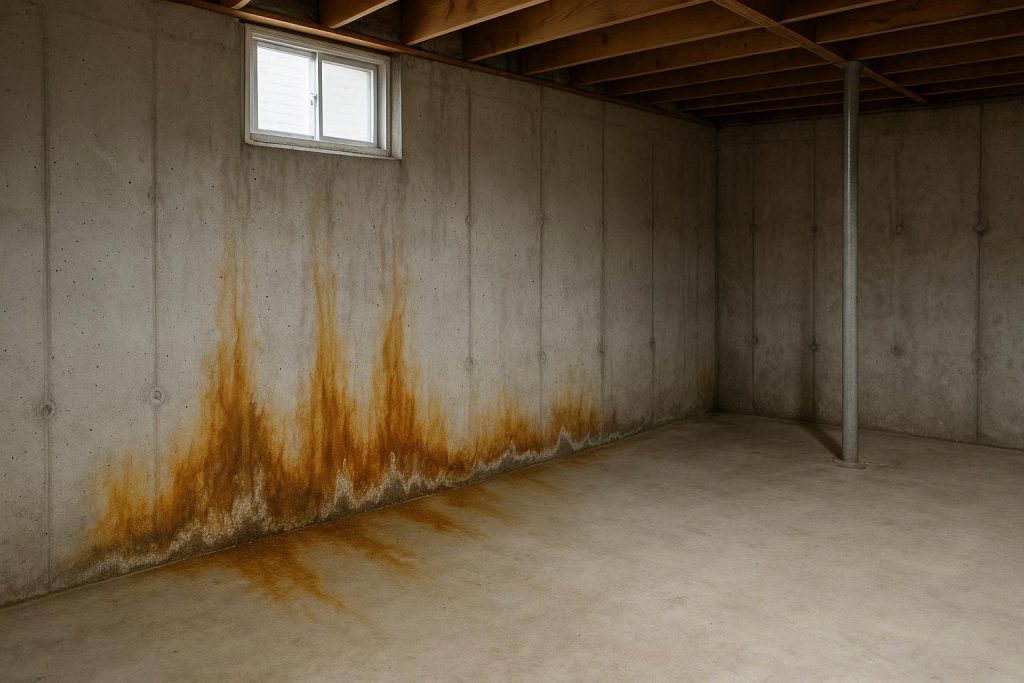
Water stains on basement walls are almost always a sign that liquid water has moved through or across your foundation, not just condensation. In Toronto and the broader GTA, the most common culprit is hydrostatic pressure from the heavy clay soil pushing groundwater against the wall until it finds a path through a crack, a cold joint, or a failed parging coat. Stop the source first: get the exterior grading away from the house and call a waterproofing professional before the next rain event.
How urgent is this?
Monitor: A single faint tide mark, dry to the touch, no active seepage and no musty odour. Watch it through the next rain.
Act soon: Staining along the base of the wall, white efflorescence deposits, or a damp smell. Book an inspection within a few weeks.
Act now: Visible water running or weeping through the wall, staining that has grown since you last checked, or any stain accompanied by a crack wider than a hairline.
Key Takeaways
- Stains low on the wall or at the floor-wall joint almost always point to hydrostatic pressure and failed or silted weeping tile, which is extremely common in older Toronto homes.
- A single injected crack typically costs $600 to $900; a full interior weeping-tile system or exterior waterproofing runs considerably more and depends on linear footage and excavation depth.
- Painting over stains with a masonry sealer is not a fix. It traps moisture and can cause spalling.
- Toronto clay soil holds water against your foundation long after rain stops, so the pressure window is longer than most homeowners expect.
Confirm it is actually a moisture intrusion stain
A true water intrusion stain is typically yellow-brown, rust-coloured, or grey-white. It follows the path water took: down from a crack, along a mortar joint, or spreading outward from the floor-wall joint. The stain may have a hard mineral crust (efflorescence) at its edge where dissolved salts were left behind as the water evaporated. Run your hand across it: if the surface feels powdery or chalky, that mineral deposit confirms liquid water passed through the concrete or block.
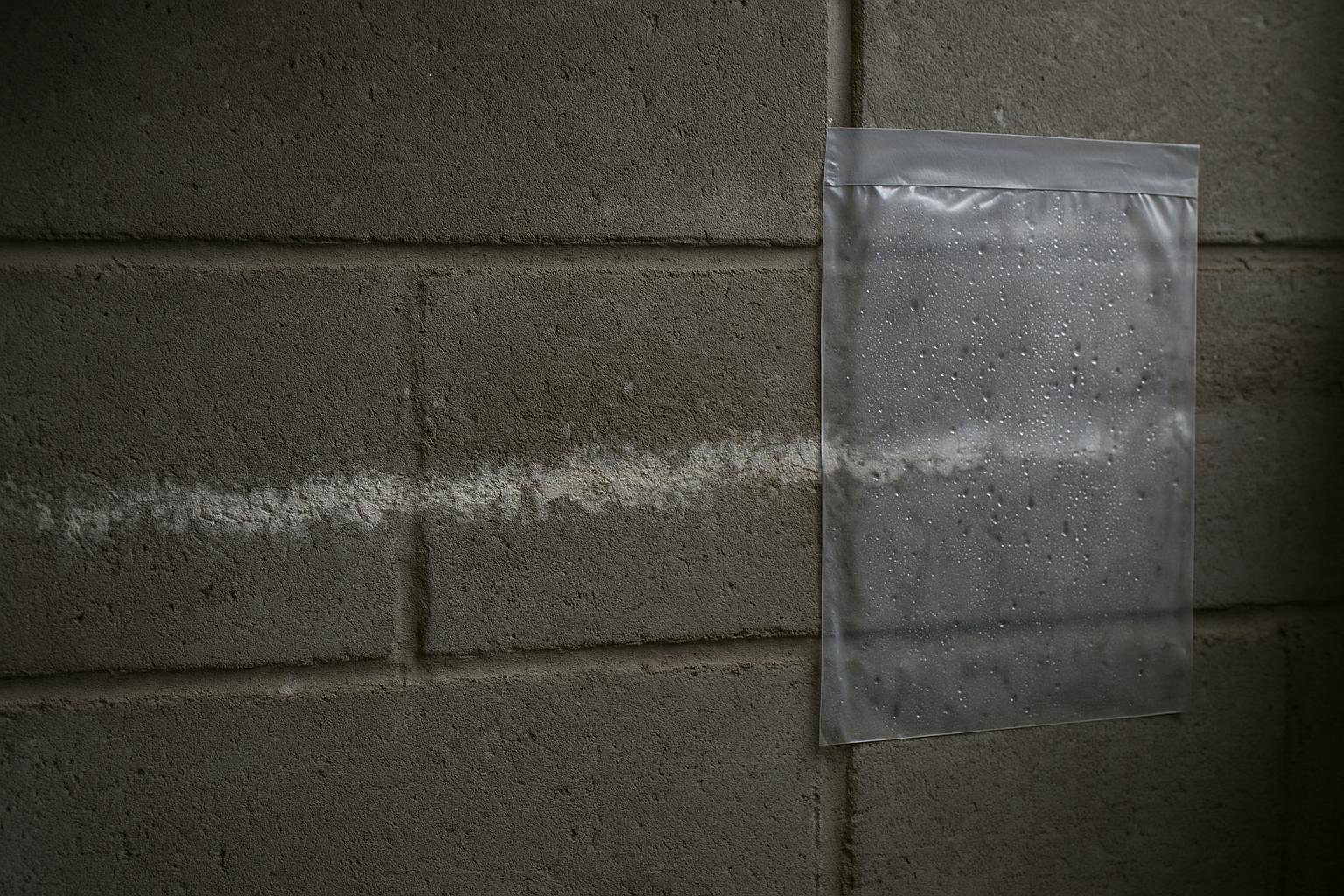
Press a piece of plastic sheeting against the stained area and tape all four edges. Leave it for 24 hours. If moisture collects on the wall side of the plastic, water is coming through the foundation. If it collects on the room side, the source is interior condensation, which is a different problem entirely.
Problems it gets confused with
Condensation forms when warm, humid interior air contacts a cool concrete wall. It looks like sweating and usually appears in summer. Unlike intrusion staining, condensation does not leave a tide mark and disappears when you run a dehumidifier. Efflorescence alone, without any damp feel, can also be mistaken for a stain. It is a mineral deposit left by water that has already dried, so it tells you water passed through at some point but does not confirm active leaking today. Rust streaks from embedded rebar or a metal pipe chase are another common lookalike. These are orange-red and originate from a fixed point rather than spreading from a joint or crack.
Causes, ranked
1. Hydrostatic pressure through the wall or floor-wall joint
This is the leading cause in Toronto and the GTA. Heavy clay soil retains water for days after rain or snowmelt, building pressure against the foundation wall. When that pressure exceeds the wall’s resistance, water forces through the porous concrete or block. The telltale sign is staining that appears or worsens within 24 to 48 hours of a heavy rain, concentrated at the base of the wall or at the cove joint where the wall meets the floor. Spring thaw and summer downpours are the two peak windows when this pressure spikes.
2. Failed or silted-up weeping tile
Original weeping tile in many Toronto homes was installed decades ago using clay or concrete pipe that collapses and silts over time. When the drain no longer carries water away from the footing, groundwater has nowhere to go except up and through the wall. Staining tends to be broad and low, often wrapping around multiple walls. A camera inspection of the drain line will confirm whether the tile is blocked or crushed.
3. Foundation crack (vertical or diagonal)
Poured concrete walls shrink as they cure, producing vertical cracks that are common in Toronto homes built between the 1960s and 1990s. Water tracks down the crack and leaves a narrow, vertical stain. The telltale sign is a stain that is taller than it is wide and aligns with a visible crack line. A crack wider than 0.3 mm that is actively wet needs prompt attention. You can learn more about crack types in the foundation crack diagnosis guide.
4. Failed exterior parging or membrane
The original rubberised membrane or parging coat on the exterior face of the foundation degrades over 20 to 30 years. Once it fails, water contacts bare concrete directly. Staining from this cause is often patchy and appears on the upper half of the wall, near grade level, rather than at the base.
5. Poor grading or blocked eavestroughs
If the ground slopes toward the house or downspouts discharge within a metre of the foundation, surface water pools against the wall and infiltrates through any gap. The stain typically appears on one wall only, on the side where the grade problem exists, and worsens immediately after rain rather than hours later.
Water stains on basement walls: cause and solution table
| Cause | Telltale sign | Appropriate fix | Urgency |
|---|---|---|---|
| Hydrostatic pressure through wall | Low staining, worsens 24-48 hrs after rain | Interior weeping tile to sump, or exterior membrane and new drain tile | Act soon to Act now |
| Failed or silted weeping tile | Broad low staining on multiple walls | Weeping tile replacement (interior or exterior route) | Act soon |
| Vertical foundation crack | Narrow vertical stain aligned with a crack | Low-pressure polyurethane crack injection | Act now if actively wet |
| Failed exterior parging or membrane | Patchy staining on upper wall near grade | Excavation, new rubberised membrane, dimple board | Act soon |
| Poor grading or blocked eavestroughs | One-wall staining, immediate after rain | Regrade soil, extend downspouts, clear gutters | Monitor after correction |
Use this table as a starting point, not a final diagnosis. A single wall can have more than one active cause, and the fix for each is different. For example, correcting the grade will reduce surface-water entry but will not address a silted weeping tile that is already failing under the footing.
What you can safely check yourself
- Check the grade. Stand at the foundation wall and look at the soil slope. It should fall away from the house at least 6 inches over the first 10 feet. If it slopes toward the wall, that is a contributing factor you can address with topsoil before calling anyone.
- Inspect downspouts. Confirm every downspout has an extension that carries water at least 1.8 metres from the foundation. Blocked or short downspouts are a common and easy-to-fix contributor.
- Run the plastic-sheet test. As described above, tape a sheet of plastic to the stained area for 24 hours to distinguish intrusion from condensation.
- Photograph and date the stain. Take a photo with a ruler or coin for scale. Check again after the next heavy rain. Growth in the stain confirms active intrusion.
- Check the sump pit. If you have a sump pump, lift the lid and look for standing water. If the float is stuck or the pump is not cycling, the drainage system is not working.
What NOT to do
Do not apply hydraulic cement or a masonry waterproofing paint directly over a stained wall and consider the job done. These products can slow visible seepage temporarily, but they do not address the pressure behind the wall. Water will find the next weakest point, often the floor-wall joint, and the trapped moisture can cause the concrete surface to spall and the paint to bubble and peel within one or two seasons.
Do not ignore water stains on basement walls that are growing. In Toronto clay-soil conditions, a small seepage point can widen quickly once freeze-thaw cycles work on it through winter. A crack that costs $600 to $900 to inject today can become a wall section requiring full excavation if left for two or three more winters.
How a professional diagnoses it
A qualified waterproofing inspector starts with a visual sweep of all four walls, the floor, and the floor-wall joint, noting the location, colour, and pattern of every stain. They probe the concrete surface for soft spots that indicate ongoing moisture saturation. They check the exterior grade and downspout discharge points and, where access allows, inspect the window wells and any visible weeping tile cleanouts.
Where a crack is present, the inspector measures its width and checks for horizontal displacement, which would indicate a structural concern rather than a simple shrinkage crack. A moisture meter is used to map the wet zone behind the wall surface. If the weeping tile is suspected to be blocked, a camera scope through a cleanout or a small exploratory dig at the footing confirms its condition. The CMHC’s guidance on residential moisture and foundation performance aligns with this diagnostic sequence and is a useful reference for homeowners who want to understand what inspectors are looking for.
The result of the inspection is a written scope that identifies each cause separately and prices the fix on a linear-foot basis so you know exactly what you are paying for before any work begins.
Temporary vs permanent fixes
| Approach | What it does | Realistic lifespan | Typical cost range (Ontario) |
|---|---|---|---|
| Hydraulic cement plug | Stops active flow at one point | 1 to 3 seasons | DIY material cost only |
| Polyurethane crack injection | Seals the crack full depth, flexible cure tolerates movement | Long-term if crack is stable | $600 to $900 per crack |
| Interior weeping tile and sump | Intercepts water at the footing and pumps it out | 20-plus years with pump maintenance | Varies by linear footage; see cost guide |
| Exterior waterproofing membrane | Stops water at the source before it contacts the wall | Lifetime with proper installation | $6,000 to $9,000 for an average Toronto semi or detached |
Polyurethane injection is the right permanent fix for an isolated vertical crack. It cures flexible, so it tolerates the seasonal foundation movement that is normal in Toronto clay. Epoxy injection is reserved for structural cracks where the wall needs to be re-bonded, not just sealed. For broad, low staining that points to failed weeping tile or persistent hydrostatic pressure, injection alone is not enough. An interior drain system or full exterior waterproofing is the appropriate long-term answer. For a detailed breakdown of what each approach costs, the basement leak repair cost guide for Toronto covers the main variables.
A full exterior waterproofing job on an average Toronto semi or detached runs roughly $6,000 to $9,000 depending on linear footage, excavation depth, and site access. The final figure always depends on a site inspection.
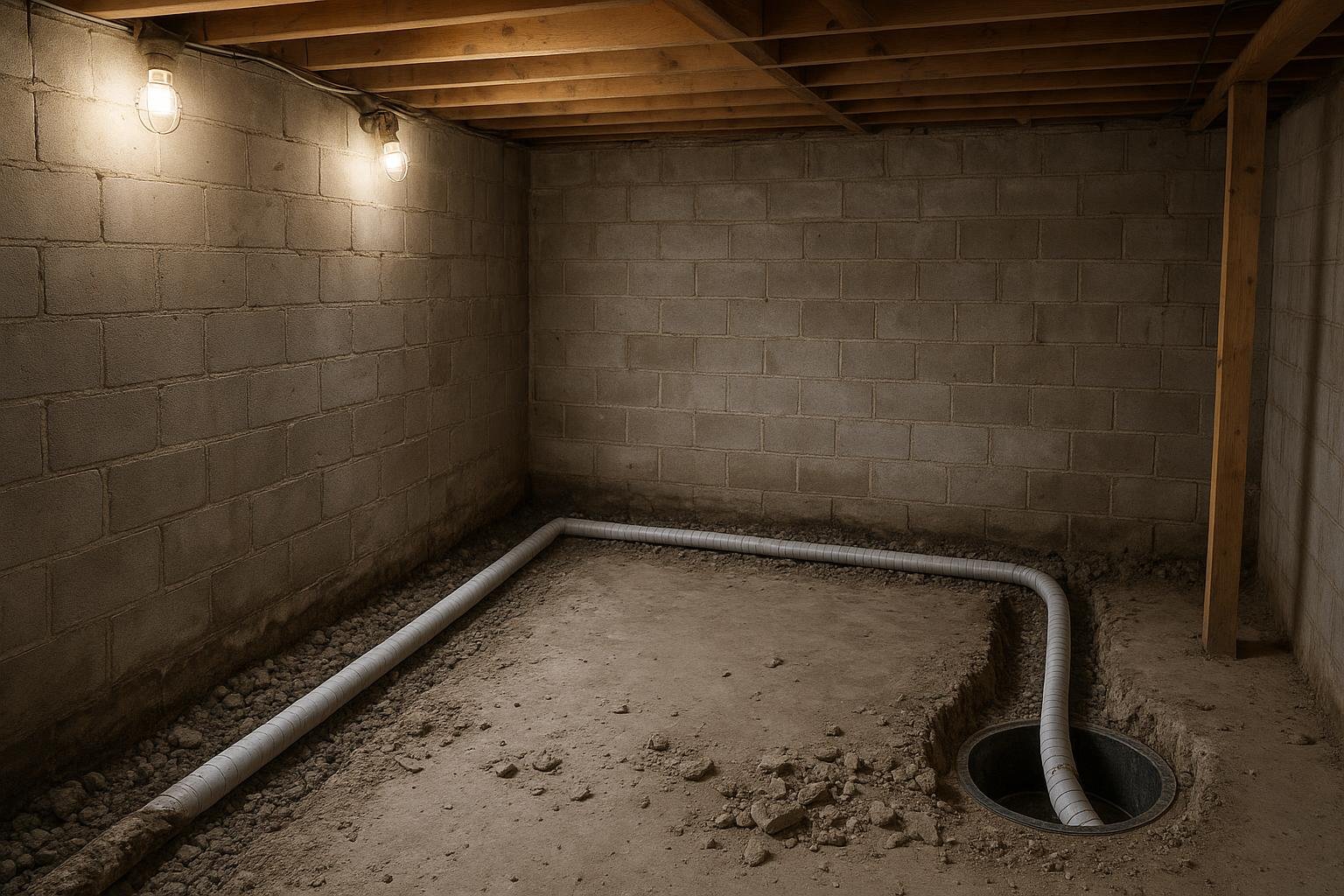
Interior weeping tile is often the more practical route for finished basements or properties with limited exterior access. The process involves jackhammering the perimeter slab, installing a new drain channel to a sump basin, fitting a vapour barrier up the wall, and re-pouring the concrete. It does not stop water from entering the wall, but it captures and removes it before it can cause damage at floor level. For homeowners weighing both routes, the interior vs exterior waterproofing comparison explains the trade-offs clearly.
Older Toronto homes commonly have original clay or concrete weeping tile that has fully silted up. If your home was built before 1980 and you have never had the drain system inspected, assume it is no longer functioning at full capacity.
If you are unsure which cause applies to your basement, the basement leak diagnostic tool can help you narrow it down before booking an inspection. For a full picture of what a professional assessment covers and what the repair process looks like from start to finish, the wet basement master guide is the most complete resource on the site. Our wet basement repair services page outlines every solution available to Toronto homeowners.
Frequently asked questions
Are water stains on basement walls dangerous?
The stain itself is not dangerous, but what caused it may be. Active moisture intrusion promotes mould growth within 24 to 48 hours on organic materials like wood framing and drywall. Persistent hydrostatic pressure can also widen cracks over time. Treat any growing or recurring stain as a warning that the underlying problem needs attention, not just the surface mark.
Can I just paint over the stains?
Masonry paint or a waterproofing sealer applied over a stain will not stop water from coming through the wall. It may slow visible seepage for a season, but the pressure behind the wall remains. The paint will eventually bubble, peel, or allow water to push through at a different point. Address the source first, then clean and repaint if you want a finished look.
How much does it cost to fix the cause of basement wall staining in Toronto?
A single foundation crack sealed by polyurethane injection typically runs $600 to $900. An interior weeping-tile system or full exterior waterproofing on a Toronto semi or detached home generally falls in the $6,000 to $9,000 range depending on linear footage and site conditions. Every job is priced after a site inspection because access, soil depth, and the number of problem areas all affect the final figure.
Why do the stains keep coming back after I clean them?
Stains return because the water source has not been stopped. Cleaning removes the mineral deposit or discolouration but does nothing to the crack, failed membrane, or blocked weeping tile that allowed water through in the first place. Each rain or snowmelt event pushes more water through the same path, leaving a fresh deposit when it dries.
Is the white crust around the stain the same problem?
Yes. White or grey crust is efflorescence, the mineral salts carried by water as it moves through concrete and left behind when the water evaporates. It confirms that liquid water has passed through the wall at that point. Efflorescence on its own does not mean water is actively coming through right now, but it is reliable evidence that it has, and likely will again.
Do I need exterior excavation or can the fix be done from inside?
It depends on the cause. An isolated vertical crack can be sealed from the interior using low-pressure polyurethane injection without any digging. Failed weeping tile can be replaced with an interior drain system that also avoids excavation. Full exterior waterproofing, which involves excavating to the footing, applying a rubberised membrane, installing dimple board, and laying new weeping tile in clear stone, is the most thorough option and is the right choice when the exterior membrane has failed or when multiple causes are present.
If your Toronto basement has staining that keeps returning, or if you want to know exactly what is causing it before spending money on a fix, book a free on-site assessment with the DryShield Team. The inspection includes a moisture reading, a written scope, and a clear explanation of your options with no obligation to proceed.