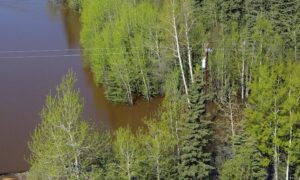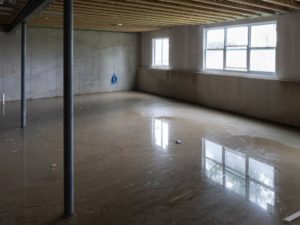
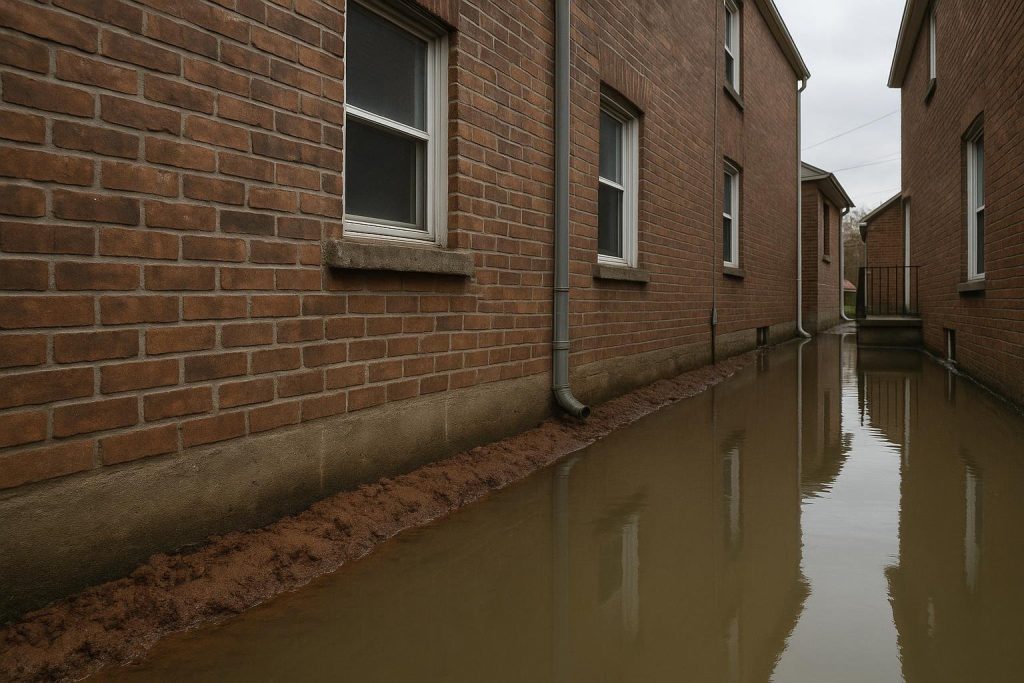
Water pooling around foundation walls is one of the clearest early warnings that hydrostatic pressure is building against your home. If you see standing water sitting against the base of your Toronto home after rain or spring thaw, the first step is to check whether your lot grade slopes toward the house and whether your downspout extensions are discharging at least two metres away from the wall.
In the GTA, heavy clay soil holds water against foundation walls far longer than sandy or loam soils. That sustained contact is what converts surface pooling into basement seepage.
Key Takeaways
- Water pooling around foundation walls is a drainage problem first and a waterproofing problem second.
- Toronto’s clay-heavy soil means water drains slowly, so even moderate rain can create sustained hydrostatic pressure.
- Failed or silted-up weeping tile is the most common underlying cause in homes built before 1980.
- Grading and downspout fixes can reduce the problem, but they rarely eliminate it once the weeping tile has failed.
How urgent is this?
- Monitor: Water disperses within a few hours of rain stopping, no visible seepage inside, no efflorescence on walls.
- Act soon: Water sits for 12 or more hours, damp patches appear on interior walls, or you notice a musty smell in the basement.
- Act now: Active water entry through cracks or the floor-wall joint, visible mould, or horizontal cracking in the foundation wall.
Confirm It Is Actually This
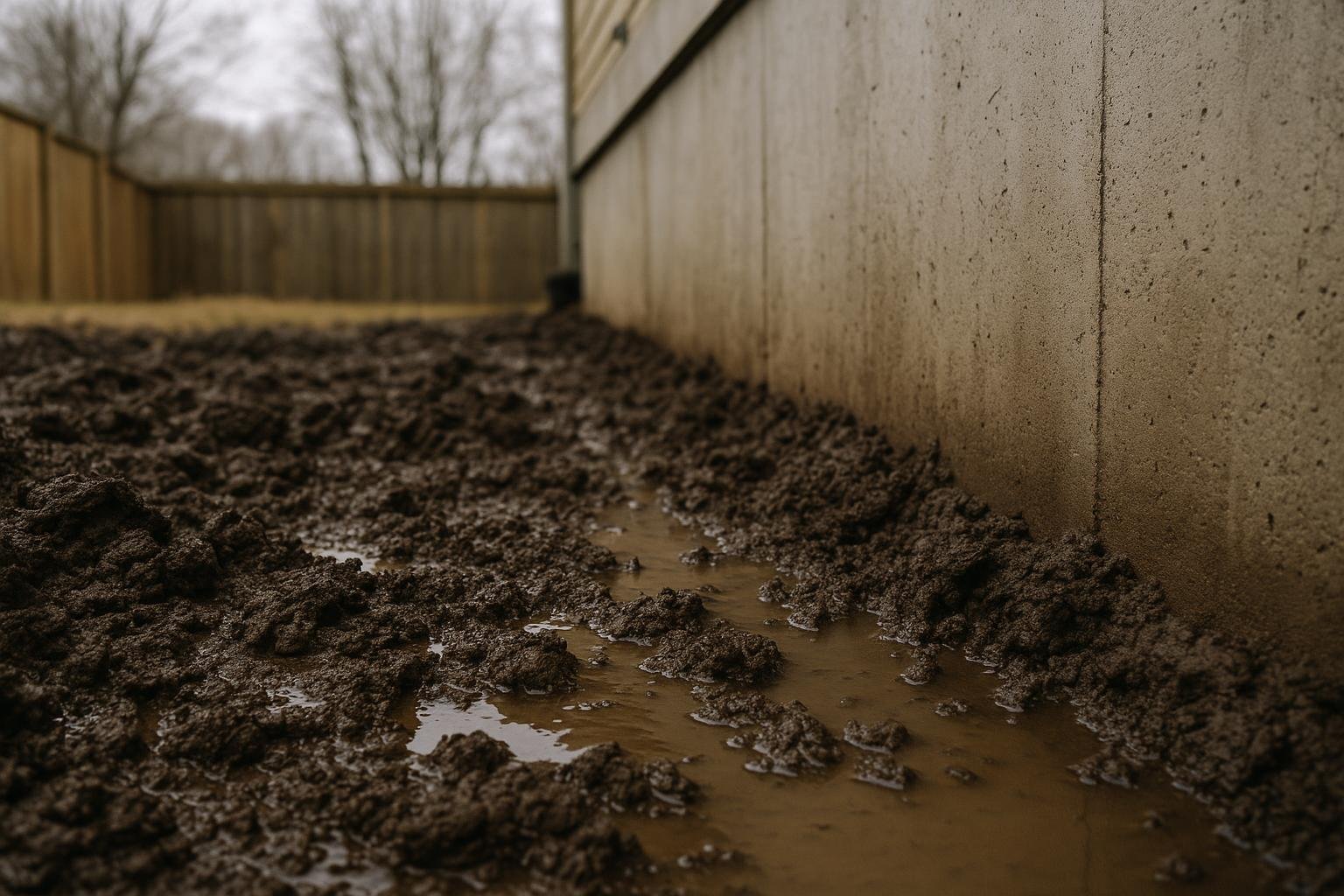
Pooling at the foundation looks like a ring of standing water or saturated soil running along the base of the exterior wall, typically appearing within minutes of heavy rain or during spring thaw. The water may be clear or slightly muddy. It does not drain away quickly the way water on a well-graded lawn would.
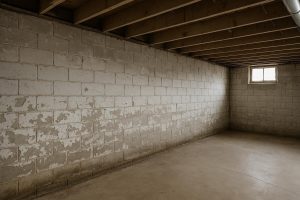
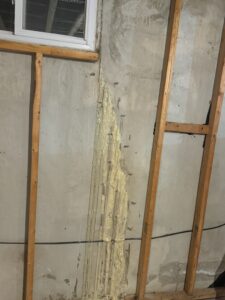
Inside, the corresponding signs are damp patches low on the basement wall, a white chalky crust called efflorescence where mineral salts have been carried through the concrete, or a persistent earthy smell. In older Toronto homes, you may also see rust staining near the floor-wall joint where the original weeping tile has corroded and backed up.
The symptom is distinct from a burst pipe or condensation because it tracks directly with rainfall events and thaw periods. It worsens in April and May, which are the two peak failure windows for GTA foundations, and again after heavy summer downpours.
Problems It Gets Confused With
Surface runoff from a neighbour’s property can look identical to foundation pooling but originates from a different lot grade. Check whether the water appears even when your own downspouts are dry.
A broken or leaking exterior hose bib or irrigation line can create a persistent wet patch at the base of the wall that has nothing to do with drainage. Turn off all water sources and observe whether the pooling continues during dry weather.
Condensation on the exterior of a cold foundation wall can wet the surrounding soil slightly, but this is usually limited to a narrow band and disappears once temperatures equalise. True pooling covers a wider area and correlates with precipitation, not temperature swings alone.
Causes, Ranked
1. Failed or Silted-Up Weeping Tile
Weeping tile installed around the footing is the primary drainage system for a residential foundation. In Toronto homes built before 1980, the original tile was often clay or concrete pipe that has since cracked, collapsed, or filled with silt and root intrusion. When the tile can no longer carry water away from the footing, it backs up and saturates the soil at grade level. The telltale sign is pooling that appears even during moderate rain and does not improve after grading corrections.
2. Negative Lot Grade
The ground around the foundation should slope away at a minimum of 5 percent for the first 1.5 metres, as specified in the Ontario Building Code. Soil settlement over decades causes many Toronto lots to develop a slight bowl shape against the wall. The telltale sign is pooling that forms a crescent shape on one or two sides of the house, usually the north or east face where sun exposure is lowest and soil dries more slowly.
3. Blocked or Undersized Downspout Extensions
A standard eavestroughing system can direct hundreds of litres of water per hour toward the foundation if the downspout terminates at the wall rather than extending away from it. Leaf debris, ice, or a missing extension elbow are common culprits. The telltale sign is pooling that appears directly below a downspout outlet and worsens during heavy rain but clears quickly once the rain stops.
4. Deteriorated Parging or Exterior Membrane
The rubberised membrane and parging coat applied to the exterior of the foundation wall are the first physical barrier against water entry. When parging cracks or the membrane delaminates, water that pools at grade can penetrate directly into the block or poured concrete. The telltale sign is efflorescence or damp patches on the interior wall that appear within 24 hours of pooling outside.
5. High Seasonal Water Table
During spring thaw in the GTA, the water table rises significantly as frozen ground releases accumulated snowmelt. Foundations in low-lying areas of Toronto, Scarborough, and Etobicoke are particularly exposed. The telltale sign is pooling that appears even without recent rainfall, typically in March and April, and may be accompanied by water seeping up through the basement floor rather than through the walls.
Water Pooling Around Foundation: Cause to Solution Table
| Cause | Telltale Sign | Appropriate Fix | Urgency |
|---|---|---|---|
| Failed weeping tile | Pooling persists after grading is corrected; interior damp patches low on wall | Excavate to footing, install new perforated weeping tile bedded in clear stone | Act soon to act now |
| Negative lot grade | Crescent-shaped pooling on one or two sides; clears within hours on other sides | Regrade with compacted fill sloping away at 5 percent minimum | Act soon |
| Blocked downspout | Pooling directly below outlet; clears quickly after rain stops | Clean or extend downspout minimum 2 metres from wall | Monitor after fix |
| Deteriorated membrane or parging | Efflorescence or damp patches on interior wall within 24 hours of pooling | Exterior excavation, hydraulic cement parging, new rubberised membrane, dimpled drainage board | Act soon |
| High seasonal water table | Pooling without recent rain; water seeping through floor | Interior weeping tile to sump basin with sump pump; vapour barrier up the wall | Act now |
The table above shows that most causes require a different fix. Downspout and grading corrections are low-cost first steps worth trying, but if pooling continues after those changes, the weeping tile or membrane is almost certainly the root cause and will need professional attention. For a detailed breakdown of what each repair costs, see our guide to foundation waterproofing costs for Ontario homeowners.
What You Can Safely Check Yourself
- Walk the perimeter after rain. Note exactly where water pooling around foundation walls occurs and how long it takes to drain. Take photos with timestamps.
- Check downspout extensions. Confirm each one discharges at least two metres from the foundation and is not blocked by leaves or a missing elbow.
- Inspect the lot grade. Stand at the wall and look along the soil line. If the ground slopes toward the house anywhere, that area needs fill.
- Look at interior walls at the same time. Damp patches, efflorescence, or rust staining low on the wall confirm that exterior pooling is already reaching the foundation.
- Check the window wells. Blocked or missing window well drains are a common secondary pooling point that homeowners often overlook.
What NOT to Do
Do not apply hydraulic cement or masonry sealant to the interior wall as a substitute for fixing the exterior drainage. Sealing the inside face traps hydrostatic pressure behind the wall, which can cause spalling, crack propagation, or in severe cases, inward wall movement.
Do not excavate along the foundation yourself. Digging near footings without shoring is dangerous and can undermine the structural support of the wall. This work requires proper equipment and an experienced crew.
Do not ignore water pooling around foundation walls because the basement is currently dry. Clay soil in the GTA can hold water against a wall for weeks before it finds a path through. By the time you see seepage inside, the membrane and parging may already be significantly compromised.
How a Professional Diagnoses It
A qualified waterproofing contractor begins with a free on-site inspection that covers both the exterior grade and the interior basement walls. The inspector looks at the slope of the soil, the condition of any visible parging, and the location and age of the downspout outlets.
Inside, the inspector checks for efflorescence, rust staining, active seepage, and the condition of any existing sump pit. A moisture meter reading on the lower wall confirms whether water is migrating through the concrete even when no visible pooling is present.
Where the weeping tile is suspected to have failed, the inspector will note the age of the home and the construction type. Most Toronto homes built before 1980 have original clay or concrete weeping tile that is at or past its service life. The CMHC guidance on residential foundation drainage confirms that these systems typically require replacement after 30 to 40 years. The inspection results in a written scope with linear-foot pricing so you know exactly what is proposed before any work begins.
Temporary vs Permanent Fixes
Temporary measures can reduce the immediate risk while you plan a permanent repair. Extending downspouts, adding compacted fill against the wall, and clearing window well drains can reduce the volume of water reaching the foundation. These steps are worth doing right away.
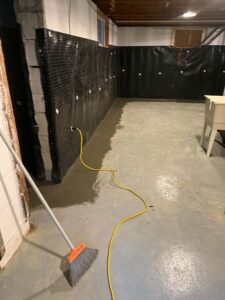
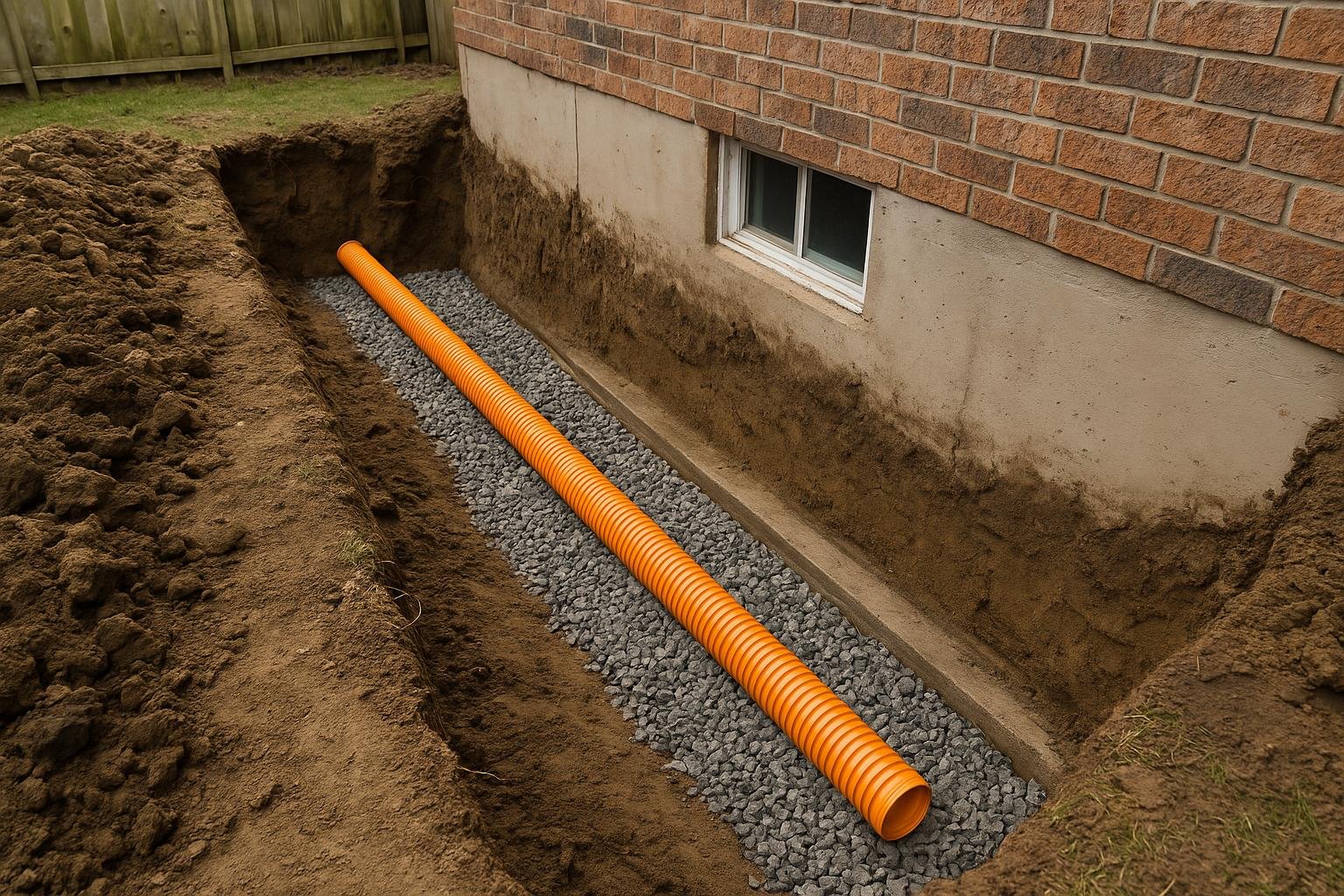
Permanent fixes address the root cause. For failed weeping tile, that means excavating to the footing, applying hydraulic cement parging to any voids, installing a new rubberised membrane, placing dimpled drainage board against the wall, laying new perforated weeping tile bedded in clear stone, and backfilling with corrected grade. This is the exterior waterproofing process used on Toronto semi-detached and detached homes, and it typically runs in the $6,000 to $9,000 range depending on linear footage, depth of excavation, and site access. The final figure always depends on a site inspection.
| Approach | What It Does | Typical Cost Range | How Long It Lasts |
|---|---|---|---|
| Downspout extension and regrading | Reduces water volume reaching the wall | $200 to $1,500 depending on scope | Ongoing maintenance required |
| Interior weeping tile and sump pump | Intercepts water that enters and drains it away | Below exterior cost; varies by perimeter length | Long-term with pump maintenance |
| Full exterior waterproofing | Stops water at the wall before it can enter | $6,000 to $9,000 for average Toronto home | Decades; backed by transferable warranty |
The choice between interior and exterior approaches depends on access, budget, and the condition of the existing membrane. Our guide to exterior versus interior perimeter waterproofing walks through the trade-offs in detail. For homes where water pooling around foundation walls is already causing seepage, the exterior waterproofing service addresses the problem at its source by removing water before it ever contacts the wall. If you are unsure which approach fits your situation, the basement leak diagnostic tool can help you narrow it down before booking an inspection.
Frequently Asked Questions
How quickly can pooling water damage a foundation?
Sustained pooling can begin to degrade parging and membrane coatings within one to two seasons. In Toronto’s clay soil, water held against the wall maintains hydrostatic pressure continuously, which accelerates crack formation and seepage. The damage is cumulative, so earlier action always costs less than waiting.
Can I fix pooling water around my foundation myself?
Grading corrections and downspout extensions are reasonable DIY tasks. Anything involving excavation near the footing, membrane application, or weeping tile replacement requires professional equipment and expertise. Improper excavation near a footing is a structural risk and should never be attempted without proper shoring.
Does pooling water always mean my weeping tile has failed?
Not always. Grading problems and blocked downspouts can cause pooling even when the weeping tile is intact. However, if pooling persists after you correct the grade and extend the downspouts, failed or silted weeping tile is the most likely remaining cause, particularly in Toronto homes built before 1980.
Will regrading alone solve the problem?
Regrading helps by directing surface water away from the wall, but it does not address subsurface drainage. If the weeping tile is silted up or the membrane is deteriorated, water moving through the soil will still reach the foundation regardless of how well the surface is graded.
How much does it cost to fix water pooling around a foundation in Toronto?
Simple grading and downspout work can cost $200 to $1,500. Full exterior waterproofing with new weeping tile on an average Toronto semi-detached or detached home typically runs $6,000 to $9,000, depending on linear footage, excavation depth, and access. A site inspection is needed for an accurate quote. See our Toronto basement leak repair cost guide for a full breakdown.
Is there a City of Toronto subsidy for this kind of work?
Yes. The City of Toronto offers a Basement Flooding Protection Subsidy that may cover a portion of eligible work including downspout disconnection, backwater valve installation, and sump pump installation. Eligibility and amounts vary, so check the current program terms directly with the City before budgeting your repair.
If water is pooling against your foundation and you are not sure what is driving it, a free on-site assessment is the fastest way to get a clear answer. The DryShield Team inspects the exterior grade, the condition of the membrane and parging, and the interior wall for signs of seepage, then provides a written scope with no obligation. Book your free assessment and find out exactly what your foundation needs.