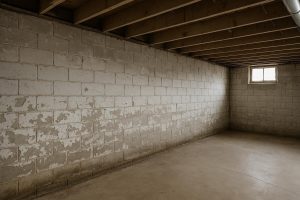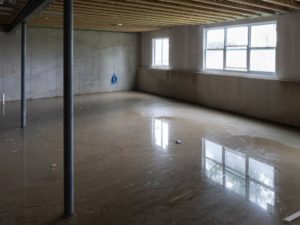
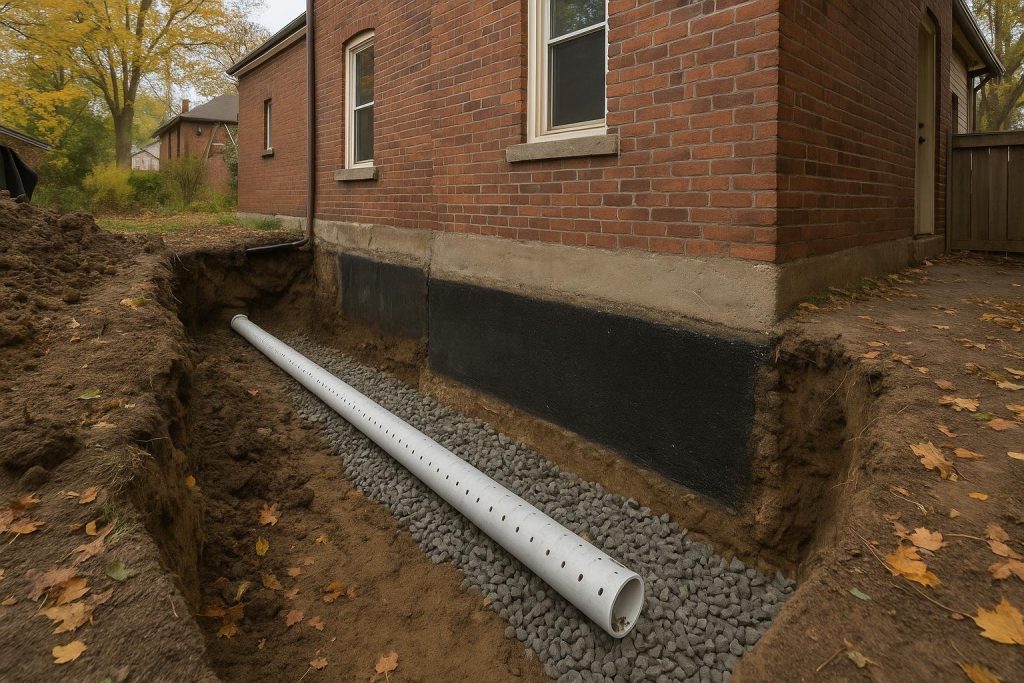
Weeping tile failure is the most common reason Toronto homeowners find water along the base of their basement walls. The original perforated pipe buried at your footing was designed to carry groundwater away from the foundation, but in Toronto’s heavy clay soil it silts up over decades and stops working entirely. If you are seeing water at the floor-wall joint, efflorescence on the lower wall, or a persistently damp perimeter, the drainage system beneath your slab is the first place to investigate.
Key Takeaways
- Most Toronto homes built before the 1980s have clay or concrete drainage pipe that is fully silted and no longer draining.
- Hydrostatic pressure in GTA clay soil forces water through the footing joint when the drainage system fails.
- Spring thaw and heavy summer rain are the two peak failure windows when a blocked system reveals itself.
- Interior replacement typically costs less than exterior excavation and can be done year-round.
Interior weeping tile replacement, including a new sump basin and pump, typically falls in the range that is below full exterior waterproofing. The final figure depends on linear footage and basement depth, confirmed at a free on-site inspection.
Confirm it is actually a weeping tile problem
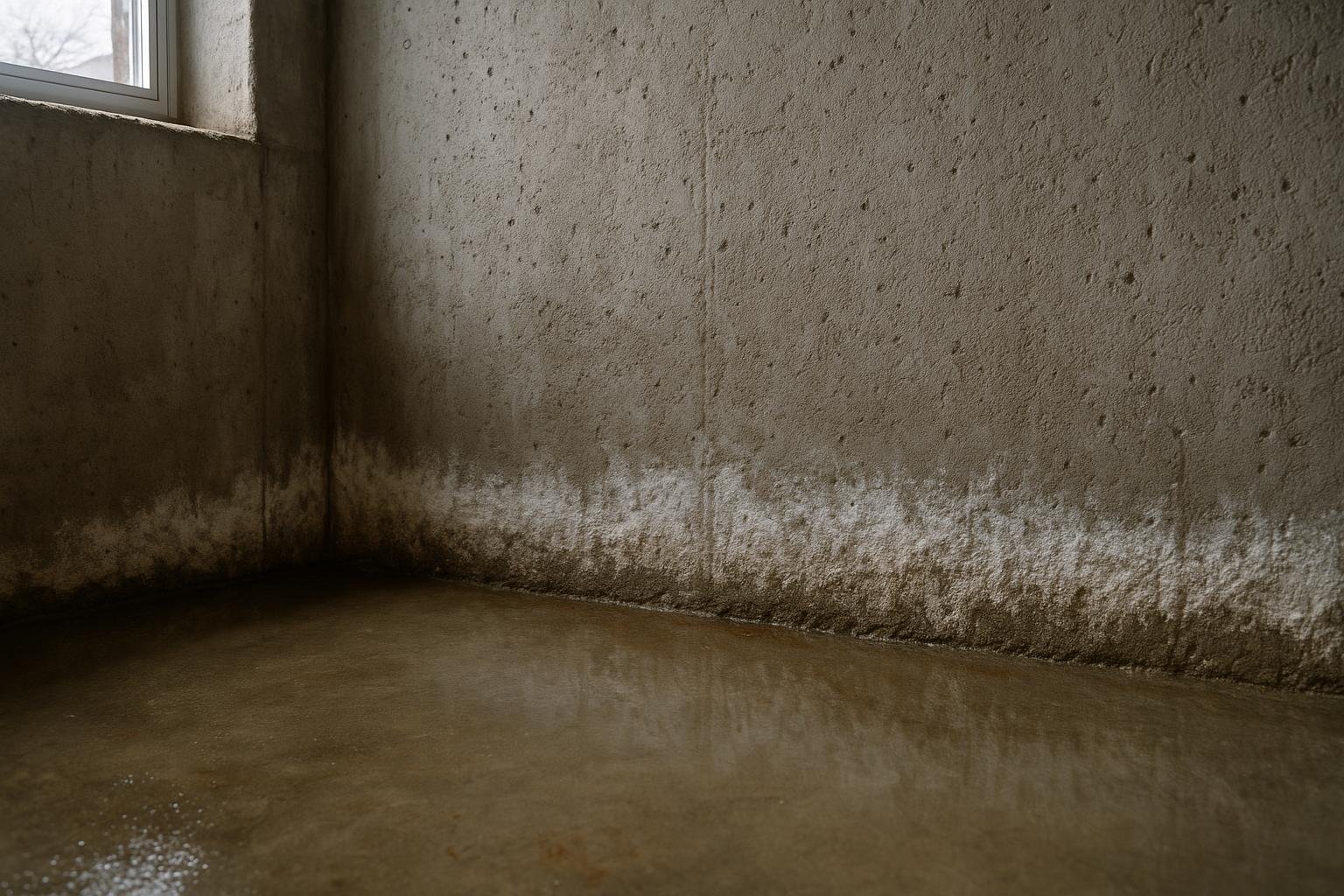
The clearest sign is water appearing at the very base of the wall, right at the floor-wall joint, rather than partway up the wall or through a visible crack. You may also see a white mineral crust (efflorescence) at the same height, which forms when water carrying dissolved salts evaporates against the concrete. In older Toronto homes, a musty smell that worsens after rain or snowmelt is another reliable indicator.
The symptom is consistent around the perimeter rather than isolated to one wall. If water appears only on the north wall after rain, a crack or window well is more likely the entry point. Perimeter seepage that shows up on multiple walls, especially after the spring thaw, points squarely at drainage failure below the slab.
Problems it gets confused with
Floor-wall joint seepage is sometimes mistaken for a foundation crack leak. The difference is location: crack leaks appear at a specific point on the wall and often show a visible hairline, while drainage failure produces a continuous damp line along the entire base. Condensation on cold walls can also look like seepage but disappears when humidity is controlled indoors. If you are unsure, the wet basement perimeter leak guide walks through how to tell the two apart. High indoor humidity causing wall sweating is a ventilation problem, not a waterproofing one, and treating it as drainage failure wastes money.
Causes, ranked
1. Silted or collapsed original weeping tile
Most Toronto homes built before 1980 have either clay-bell or concrete-segment drainage tile at the footing. Both types allow fine soil particles to enter over time. GTA clay is particularly fine-grained, and after 40 or 50 years the pipe is often completely blocked. Water that once drained freely now pools against the footing and builds hydrostatic pressure until it finds a path inside. Telltale sign: perimeter seepage that appears every spring and worsens each year.
2. Root intrusion into the drainage pipe
Tree and shrub roots seek moisture and will grow into any gap in older weeping tile. Once inside, roots expand and crush the pipe, blocking flow entirely. This is common in mature Toronto neighbourhoods where large trees sit close to the house. Telltale sign: seepage concentrated near one corner of the basement, close to a large tree or hedge.
3. Failed or undersized sump pump
Even a functioning drainage pipe cannot protect the basement if the sump pump cannot keep up with inflow. A pump that runs continuously during a storm but cannot lower the pit level is undersized or failing. Telltale sign: water in the basement only during heavy rain or rapid snowmelt, with the sump pit visibly full.
4. No drainage board or gravel bed
On exterior systems, the weeping tile must sit in a bed of clear stone and be protected by a dimpled drainage board so that soil does not press directly against the membrane. Without these layers, clay migrates into the pipe within a few years. Telltale sign: a relatively new exterior system that is already failing, or a system installed without a proper membrane.
5. Negative grade directing water toward the foundation
If the soil around the house has settled so that it slopes toward the wall rather than away from it, every rainfall delivers surface water directly to the footing. Even a working drainage system can be overwhelmed. Telltale sign: water appears only during or immediately after rain, not during dry periods or snowmelt.
Cause to solution table
| Cause | Telltale sign | Appropriate fix | Urgency |
|---|---|---|---|
| Silted or collapsed original drainage tile | Perimeter seepage every spring, worsening each year | Interior weeping tile replacement to sump basin | Act soon |
| Root intrusion | Seepage near one corner, large tree nearby | Camera inspection, pipe replacement at affected section | Act soon |
| Failed or undersized sump pump | Pit overflows during heavy rain, pump runs constantly | Pump replacement or upgrade; add battery backup | Act now |
| No drainage board or gravel bed | New exterior system already leaking | Excavate, re-install with proper clear stone and membrane | Act soon |
| Negative grade | Water only during or right after rain | Grade correction and downspout extension | Monitor |
The table above is a starting point, not a diagnosis. Silted tile and a failing sump pump often occur together in older Toronto homes, so fixing only one may not stop the water. A proper inspection with a moisture meter and, where needed, a drain camera gives you a clear picture before any work begins.
Toronto’s spring thaw and summer downpours are the two windows when a failing drainage system reveals itself. If your basement is dry in January but wet in April, the drainage pipe, not the wall itself, is almost certainly the problem.
What you can safely check yourself
- Walk the perimeter after rain. Note whether water pools against the foundation wall or drains away from it. Pooling within 30 cm of the wall is a grading problem that compounds any drainage failure.
- Check your downspout extensions. Downspouts that discharge within 1.5 metres of the wall deliver concentrated roof runoff directly to the footing. Extend them to at least 1.8 metres.
- Test the sump pump. Pour a bucket of water into the pit. The pump should activate within seconds and clear the water quickly. A slow or non-responsive pump needs immediate attention. The sump pump sensor testing guide explains the full procedure.
- Look for efflorescence at the floor-wall joint. A white mineral crust at the very base of the wall confirms that water has been moving through that joint repeatedly.
- Check window wells. A clogged window well can flood and send water through the window frame, mimicking weeping tile failure.
What NOT to do
Do not apply hydraulic cement or waterproofing paint to the floor-wall joint as a permanent fix. These products cannot withstand sustained hydrostatic pressure and will fail within one or two seasons, sometimes pushing off in chunks and leaving the joint more exposed than before.
Do not ignore a sump pit that runs continuously. A pump cycling every few minutes is already working at its limit. If the power fails during a storm, the basement floods. Install a battery backup before the next heavy rain, not after.
Do not excavate around the foundation yourself. Digging near a footing without shoring is dangerous, and disturbing the soil incorrectly can increase hydrostatic pressure rather than relieve it.
How a professional diagnoses it
A proper inspection starts above ground. The technician checks grade slope, downspout discharge points, and window well drainage before going inside. Inside, a moisture meter is used along the base of each wall to map where water is actively moving through the concrete, distinguishing drainage failure from condensation or a crack leak.
Where the source is unclear, a drain camera can be fed into the sump pit or a cleanout to inspect the condition of the existing drainage pipe. In Toronto homes, the camera frequently shows a pipe that is 80 to 100 percent blocked with clay sediment or crushed by root growth. This finding changes the recommended fix from a patch to a full replacement.
The inspection concludes with a written scope that includes linear-foot pricing so you know the full cost before any work begins. CMHC’s homeowner guidance on basement moisture and drainage aligns with this diagnostic approach, recommending that the source of water entry be confirmed before any repair method is chosen.
Temporary vs permanent fixes
| Fix | What it does | Realistic lifespan | Best for |
|---|---|---|---|
| Hydraulic cement at floor-wall joint | Plugs visible gap temporarily | 1 to 3 seasons | Buying time before a proper repair |
| Grade correction and downspout extension | Reduces surface water reaching footing | Ongoing with maintenance | Supplementing a drainage system, not replacing it |
| Interior perimeter drainage with sump basin | Intercepts groundwater before it enters, routes it to pump | 25 years or more with pump maintenance | Homes where exterior excavation is impractical |
| Exterior perimeter drainage with membrane | Stops water at the wall, new drainage at footing | Lifetime with proper backfill and grade | Full exterior waterproofing projects |
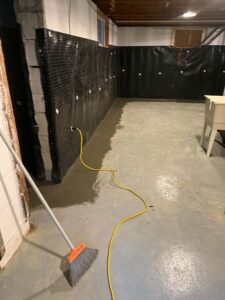
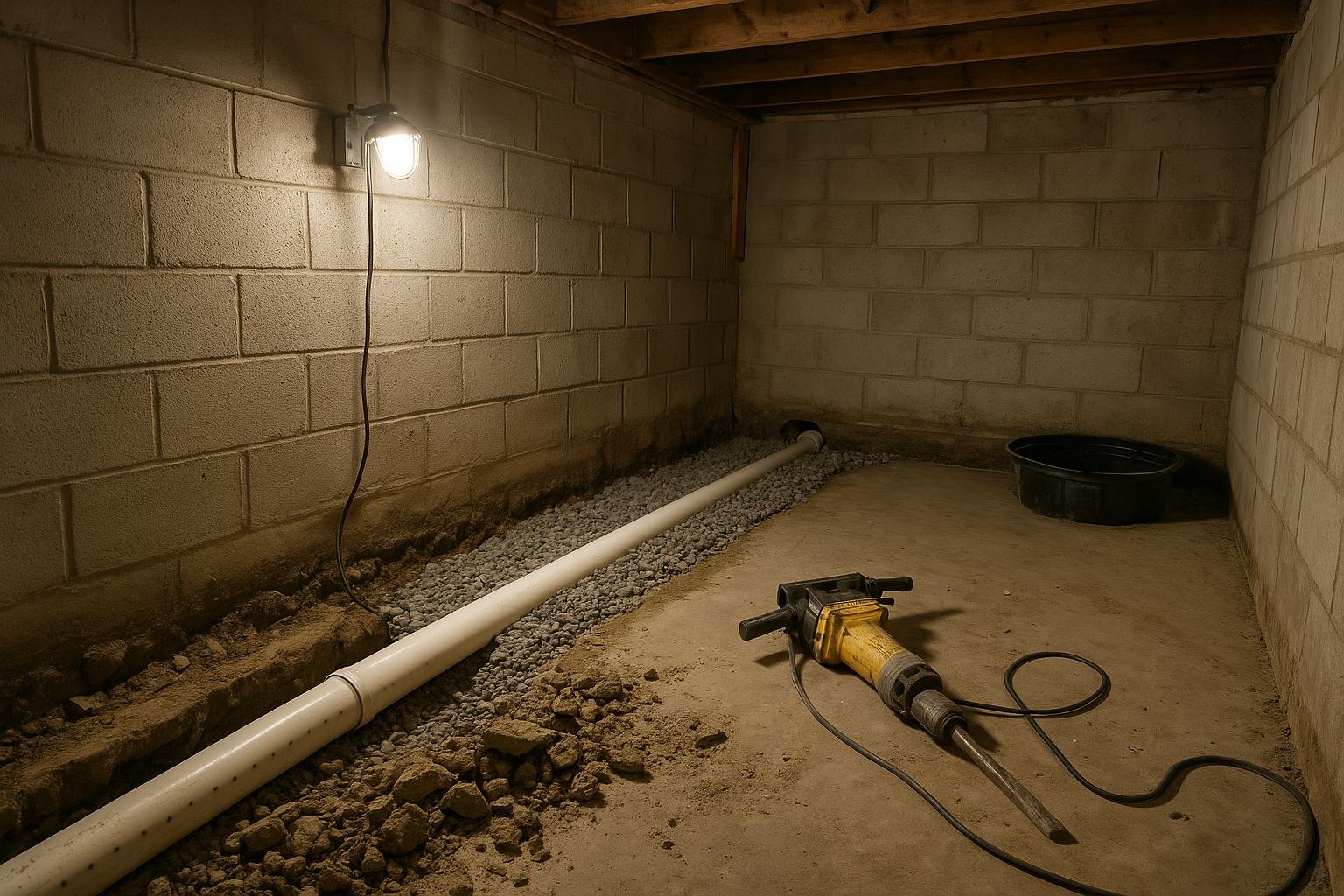
Interior replacement is the most common solution in Toronto because it avoids excavating through finished landscaping, driveways, and narrow side yards. The process involves jackhammering a perimeter channel inside the slab, installing new perforated pipe bedded in clear stone, routing it to a new sump basin, and re-pouring the concrete. A vapour barrier is run up the wall to direct any seepage into the channel rather than onto the floor. For homes where exterior access is practical, full excavation to the footing allows a rubberised membrane and new drainage board to be installed, which is the most comprehensive solution available. You can review what each approach costs in the basement leak repair cost guide for Toronto.
For a broader look at how interior and exterior methods compare, the interior basement waterproofing solutions page covers the full range of options available for Toronto homes. The dedicated weeping tile installation and replacement service page explains the step-by-step process and what to expect on installation day.
Frequently asked questions
How long does weeping tile last in Toronto?
Original clay-bell and concrete-segment pipe installed before 1980 has a functional lifespan of roughly 30 to 50 years in GTA clay soil. Modern perforated PVC pipe wrapped in a filter sock lasts significantly longer, but still requires a working sump pump to function. If your home is more than 40 years old and has never had drainage work done, the original system is likely at or past the end of its useful life.
Can I replace weeping tile without digging up the yard?
Yes. Interior replacement is the standard approach for most Toronto semi-detached and detached homes. The perimeter channel is cut inside the basement slab, so the yard, driveway, and landscaping are not disturbed. Exterior replacement requires full excavation to the footing and is typically reserved for homes undergoing a complete exterior waterproofing project at the same time.
What does weeping tile replacement cost in Toronto?
Interior drainage replacement, including a new sump basin and pump, generally costs less than full exterior waterproofing of an average Toronto home, which runs roughly $6,000 to $9,000 depending on linear footage, excavation depth, and site access. The exact figure for an interior system depends on the perimeter length and basement configuration, confirmed at a free on-site inspection.
Does the City of Toronto offer any subsidy for drainage work?
The City of Toronto Basement Flooding Protection Subsidy Program covers a portion of the cost for eligible work including sump pump installation and downspout disconnection. Eligibility depends on your address and the specific work being done. The Toronto basement flooding subsidy page has current details on what is covered.
Is a wet basement covered by home insurance?
Standard home insurance policies in Ontario typically do not cover gradual water damage from a failed drainage system. Overland water coverage and sewer backup riders may cover sudden flooding events, but a slow seepage problem caused by silted drainage pipe is usually classified as a maintenance issue. Check your policy wording carefully before assuming coverage applies.
How do I know if my sump pump is keeping up?
Pour a bucket of water into the pit and time how quickly the pump activates and clears the water. If the pump runs for more than 30 seconds to clear a single bucket, or if the pit level rises faster than the pump can lower it during a storm, the pump is undersized or failing. A battery backup unit is essential for Toronto homes where power outages often coincide with the heaviest storms.
If water is appearing at the base of your basement walls, the right next step is a free on-site assessment. DryShield’s team inspects the drainage system, checks the sump pit, and provides a written scope with pricing before any work begins. Book your assessment through the contact page and get a clear answer on what your home actually needs.