r
A leaky basement Mississauga homeowners encounter most often traces back to one root cause: hydrostatic pressure from the heavy clay soil that blankets most of the city pushing groundwater against foundation walls. Understanding that root cause is what separates a lasting repair from a temporary patch. This guide walks through every proven fix, what each one costs, and how to choose the right approach for your home.
Key Takeaways
- Mississauga’s clay-heavy soil holds water against foundations far longer than sandy or loamy ground, making hydrostatic pressure the dominant leak driver.
- Spring thaw and summer downpours are the two peak failure windows; acting before either season limits damage.
- A single injected crack typically costs $600 to $900; a full exterior waterproofing system on an average semi or detached runs roughly $6,000 to $9,000, depending on linear footage and excavation depth.
- Interior weeping-tile systems are a proven alternative when exterior excavation is impractical, and they typically come in below the exterior price range.
- All final figures depend on a site inspection because access, footing depth and existing drainage all shift the scope.
Definitions and Scope
A basement leak is any unwanted water entry below grade, whether it appears as a trickle through a wall crack, seepage across the floor, or a damp film on block or poured-concrete walls. The term covers everything from a hairline shrinkage crack admitting a few drops after heavy rain to a failed weeping-tile system that floods the floor every spring.
Scope matters because the correct fix depends entirely on where water is entering and why. A crack in a poured-concrete wall is a different problem from water rising through a floor joint, which is again different from a saturated block wall weeping through its mortar. Mississauga homes built between the 1960s and 1990s often have original clay-pipe weeping tile that has silted up completely, so what looks like a wall crack problem is actually a drainage failure. Identifying the true entry point before committing to a repair method is the first step any qualified contractor should take.
Why Leaky Basement Mississauga Problems Are So Common
Mississauga sits on a thick deposit of Leda clay and glacial till that extends across most of the western GTA. This soil type absorbs rainfall slowly and holds it against foundation walls for days after a storm, sustaining hydrostatic pressure long after the sun returns. That sustained pressure is what forces water through cracks, cold joints and deteriorated parging rather than the rainfall event itself.
Two seasons drive the majority of calls. Spring thaw saturates the ground before it can drain, and the freeze-thaw cycle widens existing cracks by a measurable amount each year. Summer convective storms, which have grown more intense across the GTA over the past decade, overwhelm older weeping-tile systems that were sized for lighter historical rainfall. Homes in the older Port Credit, Lakeview and Cooksville neighbourhoods are particularly exposed because their original drainage infrastructure is now 50 to 60 years old.
Ignoring a wet basement in this soil environment is not a neutral choice. Sustained moisture degrades parging, corrodes rebar in poured walls, and creates the conditions for mould growth inside the wall cavity. The Canada Mortgage and Housing Corporation (CMHC) notes that persistent basement moisture is one of the leading contributors to indoor air-quality problems in Canadian homes. Acting early, before a hairline crack becomes a structural concern, is almost always cheaper than waiting.
For a full overview of waterproofing options specific to this city, the Mississauga foundation crack repair and basement waterproofing service page covers the complete range of solutions available locally.
Signs of Failure by Entry Point
| What You See | Likely Entry Point | Most Probable Cause | Recommended First Step |
|---|---|---|---|
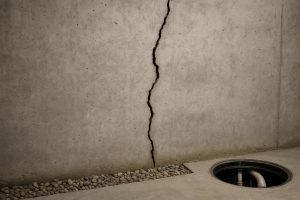
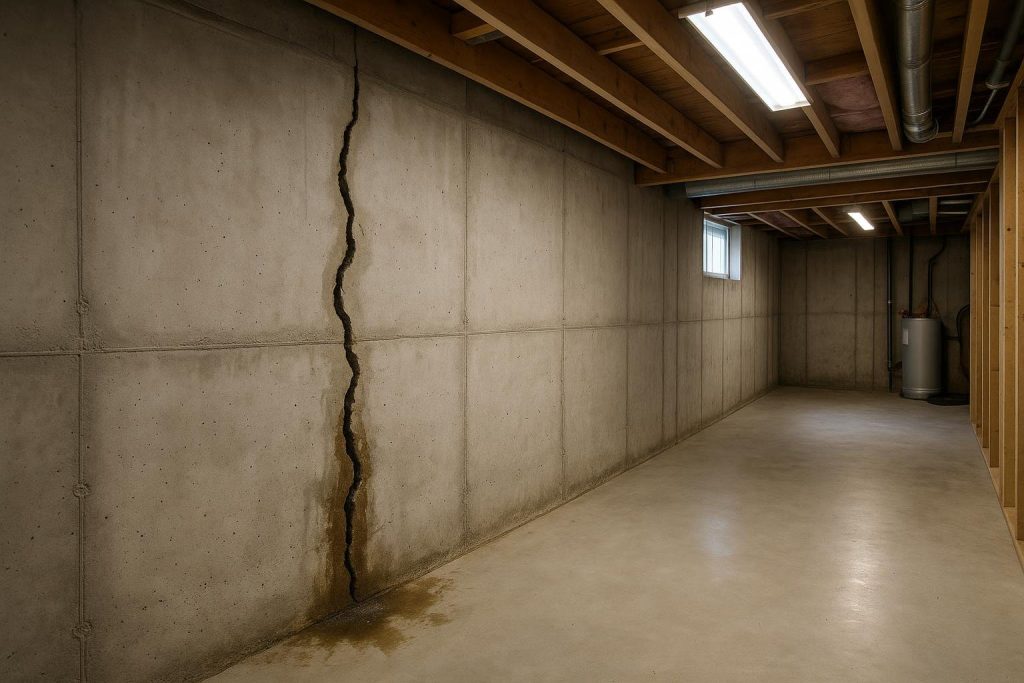
| Water trickling from a single vertical or diagonal line | Poured-wall shrinkage crack | Hydrostatic pressure through crack | Polyurethane crack injection |
| Seepage along the floor-wall joint | Footing or floor-wall cold joint | Failed or silted weeping tile | Interior weeping-tile system assessment |
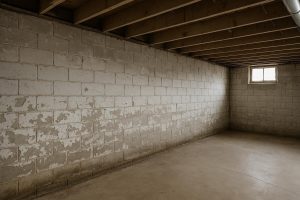
| Damp film across a wide wall section | Block mortar joints or porous parging | Saturated block wall, no membrane | Exterior waterproofing or interior drainage |
| Water pooling on floor after heavy rain | Multiple points or floor slab | High water table, failed drainage | Full drainage assessment |
| Horizontal crack with inward bowing | Mid-wall lateral pressure zone | Soil pressure exceeding wall capacity | Structural engineer review before any waterproofing |
Matching the visible symptom to the correct entry point is the most important diagnostic step for any leaky basement Mississauga homeowner. The table above is a starting framework; a site inspection confirms the actual source before any repair commitment is made.
Your Options for Fixing a Leaky Basement in Mississauga
Polyurethane Crack Injection
Low-pressure polyurethane injection is the standard repair for a single active crack in a poured-concrete wall. Ports are bonded to the crack face at regular intervals, and a flexible polyurethane resin is pumped in under low pressure until it fills the full depth of the crack and cures in place. Because the cured foam remains slightly flexible, it tolerates the seasonal foundation movement that Mississauga’s clay soil causes without re-opening.
Best for: isolated vertical or diagonal shrinkage cracks in poured walls, particularly where the crack is actively weeping. Not suitable for horizontal cracks, which signal lateral soil pressure and require structural assessment, or for block foundations where water is entering through multiple mortar joints.
Epoxy Crack Injection
Epoxy injection uses the same port-and-paste method but delivers a rigid, high-strength bond rather than a flexible seal. It is reserved for structural cracks where the two faces of the wall need to be re-bonded, not just waterproofed. Epoxy does not tolerate movement, so it is the wrong choice for a crack that is still actively cycling with temperature.
Best for: dormant structural cracks confirmed by an engineer as requiring re-bonding. Limitations include brittleness under ongoing movement and the need for a completely dry crack face before injection.
Interior Weeping Tile System
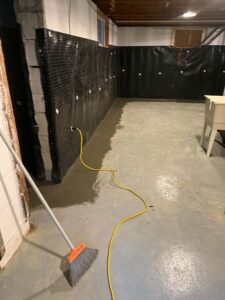
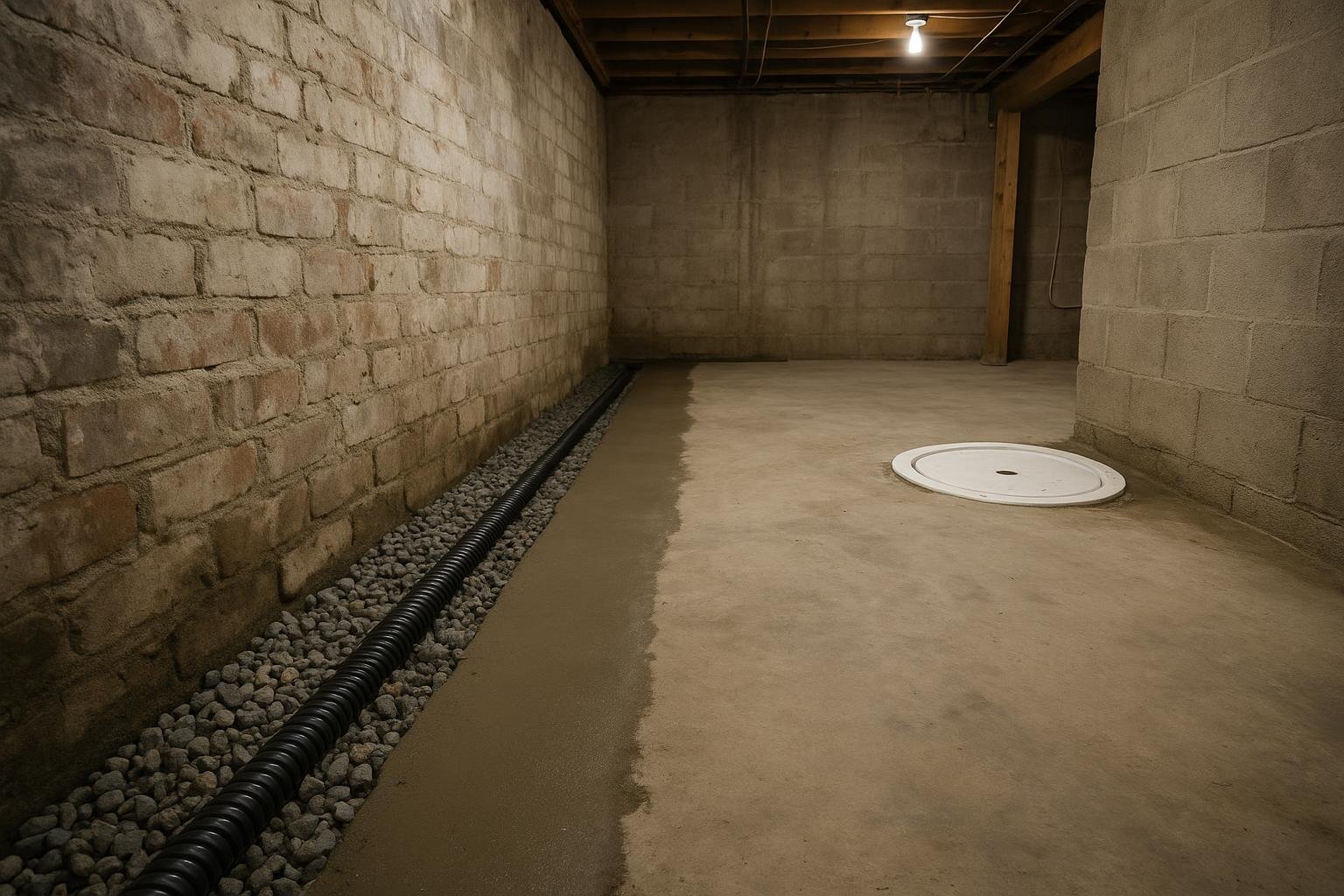
Where water is entering along the footing or through the floor-wall joint, an interior drainage system is often the most practical solution. The perimeter concrete is jackhammered, a perforated weeping-tile channel is installed at footing level and bedded in clear stone, and all flow is directed to a sump basin. A vapour barrier is then run up the wall and sealed to the new channel. The sump pump discharges water away from the foundation.
Best for: homes where exterior excavation is blocked by a deck, driveway, landscaping or a shared wall, and for situations where water is entering at the footing rather than through a discrete crack. Interior systems manage water rather than stopping it at the source, which is an important distinction.
Exterior Waterproofing with Membrane and New Weeping Tile
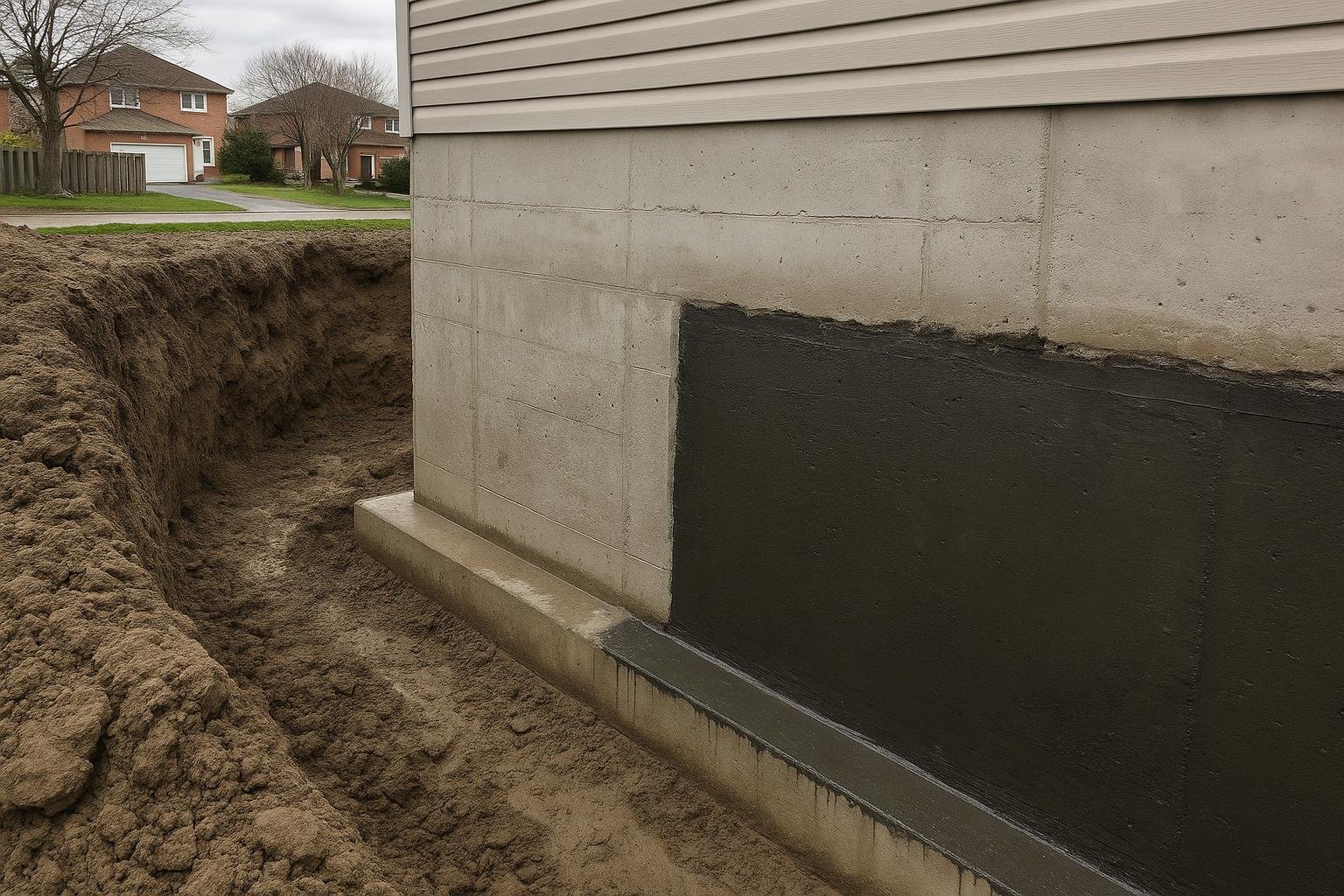
Full exterior waterproofing is the most comprehensive solution. The soil is excavated to the footing, voids in the foundation wall are filled with hydraulic cement parging, a rubberised waterproofing membrane is applied to the full wall height, a dimpled drainage board is placed over the membrane to protect it and direct water downward, new weeping tile is laid at footing level in a bed of clear stone, and the trench is backfilled with corrected grade to direct surface water away. This approach stops water at the wall rather than collecting it inside.
Best for: homes with failed original weeping tile, widespread wall deterioration, or repeated interior flooding that interior systems have not resolved. Limitations include cost, disruption to landscaping and driveways, and the need for adequate access around the perimeter.
Sump Pump Installation or Replacement
A sump pump is not a waterproofing method on its own, but it is a critical component of both interior and exterior systems. A correctly sized pump with a battery backup removes water that collects in the sump basin before it can rise to floor level. In Mississauga’s clay soil, where the water table rises quickly after heavy rain, a pump without backup power is a liability during the storms that cause the most flooding.
Best for: any home with an interior drainage system, and as a standalone upgrade for homes that already have a weeping-tile system but an aging or undersized pump. See the sump pump installation service page for sizing and backup options.
Exterior Grading and Downspout Correction
Negative grade (ground that slopes toward the foundation) and downspouts that discharge within two metres of the wall are responsible for a meaningful share of Mississauga basement leaks, particularly in newer subdivisions where settlement has reversed the original slope. Correcting grade and extending downspouts is low-cost and should always be done alongside any waterproofing repair to reduce the volume of water reaching the wall.
Best for: supplementary correction in every case, and as a standalone fix only when the leak is clearly surface-water driven and the foundation itself is sound.
Options Compared
| Method | Best For | Typical Lifespan | Relative Cost | Disruption |
|---|---|---|---|---|
| Polyurethane crack injection | Single active poured-wall crack | Long-term if crack is stable | Lowest ($600-$900 per crack) | Minimal, interior access only |
| Epoxy crack injection | Dormant structural crack needing re-bonding | Permanent if crack does not re-open | Low to moderate | Minimal, interior access only |
| Interior weeping tile + sump | Footing-level entry, blocked exterior access | 20+ years with pump maintenance | Moderate | Moderate (jackhammer, concrete re-pour) |
| Exterior waterproofing + membrane | Failed weeping tile, widespread wall deterioration | 25+ years | Highest ($6,000-$9,000 average) | High (excavation, landscaping disruption) |
| Sump pump upgrade | Aging pump, no battery backup | 7-10 years per pump | Low to moderate | Low |
| Grade and downspout correction | Surface-water contribution | Ongoing maintenance | Very low | Minimal |
The table shows that no single method suits every situation. Crack injection is the right starting point for a discrete wall crack, but it will not resolve a leaky basement Mississauga homes develop when the original weeping tile has silted up and seepage is widespread. Exterior waterproofing delivers the most durable result but at the highest cost and disruption. Most Mississauga homes with a chronic wet basement end up combining two methods: for example, exterior membrane work on the most exposed wall combined with an interior system on the side blocked by a driveway.
How to Choose the Right Fix for a Leaky Basement in Mississauga
Choose polyurethane crack injection if you have a single identifiable crack in a poured-concrete wall that leaks during or after rain, the rest of the wall is dry, and the crack is vertical or diagonal. This is the fastest and most affordable path to a dry wall.
Choose an interior weeping-tile system if water is entering along the floor-wall joint or across the floor slab, exterior access is blocked by a structure or shared wall, or you have a block foundation with widespread mortar-joint seepage. Interior systems are also the right choice when the budget does not stretch to full excavation but the drainage problem is too widespread for crack injection alone.
Choose full exterior waterproofing if the original weeping tile has failed or silted up, the wall shows widespread deterioration or failed parging, you have had repeated interior flooding that interior measures have not resolved, or you want the most permanent solution available. The exterior vs. interior perimeter waterproofing comparison guide goes deeper on this decision.
Always add grade correction and downspout extensions regardless of which primary method you choose. Reducing the volume of surface water reaching the wall makes every other repair more effective and longer-lasting.
A site inspection is the only reliable way to confirm which method applies to your home. The entry point visible inside the basement is often not where water is actually breaching the wall.
Costs and Timelines
| Cost Driver | Why It Matters | Approximate Impact |
|---|---|---|
| Linear footage of wall treated | Exterior and interior systems are priced per linear foot of perimeter | Primary variable; longer walls cost more |
| Excavation depth | Deeper footings require more soil removal and shoring | Significant; adds time and equipment cost |
| Access restrictions | Decks, driveways, fences and neighbouring structures limit machine access | Can add hand-digging labour cost |
| Existing drainage condition | Fully silted clay-pipe weeping tile requires full removal and replacement | Moderate to significant |
| Wall material and condition | Block walls with widespread deterioration need more parging and prep | Moderate |
| Number of cracks injected | Each crack is a discrete repair at $600-$900 | Additive; three cracks equals three fees |
As a general orientation: a single injected crack runs $600 to $900. A full exterior waterproofing job on an average Mississauga semi or detached home typically falls in the $6,000 to $9,000 range, depending on the drivers above. Interior weeping-tile systems generally come in below the exterior range. These are approximate bands based on completed work in the GTA; the final figure for any specific home depends on a site inspection. For a broader cost breakdown, the basement waterproofing cost guide covers the full range of variables across Southern Ontario.
Crack injection pricing ($600-$900 per crack) and exterior waterproofing pricing ($6,000-$9,000 for an average home) are approximate ranges. Access, footing depth and wall condition all shift the final number. Always get a written scope with linear-foot pricing after an on-site assessment.
Mississauga Neighbourhood Risk Profile
| Neighbourhood | Typical Era Built | Common Foundation Type | Primary Leaky Basement Mississauga Risk |
|---|---|---|---|
| Port Credit | 1940s to 1960s | Block and early poured concrete | Silted clay-pipe weeping tile, mortar-joint seepage |
| Lakeview | 1950s to 1970s | Poured concrete and block | Failed original weeping tile, high seasonal water table |
| Cooksville | 1960s to 1980s | Poured concrete | Shrinkage cracks, deteriorated parging |
| Streetsville | 1970s to 1990s | Poured concrete | Cold-joint seepage, aging sump systems |
| Erin Mills / Churchill Meadows | 1990s to 2000s | Poured concrete | Settlement-reversed grade, downspout discharge near wall |
Neighbourhood age and foundation type strongly predict which leaky basement Mississauga repair is most likely to apply. Older areas such as Port Credit and Lakeview almost always require drainage system replacement, while newer subdivisions more often need grade correction and crack injection. A site inspection confirms the specific condition regardless of neighbourhood.
Risks and Common Mistakes
The most common mistake Mississauga homeowners make is treating the symptom rather than the source. Applying hydraulic cement or a crystalline coating to the interior face of a leaking wall can slow seepage temporarily, but it does nothing to relieve the hydrostatic pressure driving water through the wall. When pressure builds high enough, it bypasses the patch or forces water through a new point.
A second frequent error is skipping the sump pump battery backup. Mississauga’s most damaging basement floods happen during summer storms that also knock out power. A primary pump without backup is useless precisely when it is needed most.
Choosing epoxy injection for an active or moving crack is another costly mistake. Epoxy cures rigid. In Mississauga’s clay soil, where foundations shift slightly with every freeze-thaw cycle, a rigid repair in a moving crack will fracture and re-open. Polyurethane is the correct material for any crack that is still cycling.
Neglecting downspout discharge is a mistake that undermines otherwise sound waterproofing work. A downspout discharging at the foundation wall can deliver hundreds of litres per hour directly against the membrane or wall during a storm, overwhelming any drainage system.
Horizontal cracks in a basement wall are a different category from vertical or diagonal cracks. They signal lateral soil pressure against the wall and require structural assessment before any waterproofing work begins. Do not inject a horizontal crack without an engineer’s review.
Finally, hiring a contractor who does not offer a written warranty is a risk specific to this trade. Waterproofing work is hidden once complete, and a warranty is the only mechanism that holds a contractor accountable if the repair fails. For guidance on vetting contractors, the Mississauga basement waterproofing guide covers what to look for in a local contractor.
How the Process Works
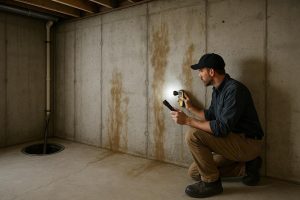
- Free on-site inspection and moisture assessment. A technician examines the foundation wall, floor, and exterior grade, identifies all entry points, and checks the condition of the existing weeping tile and sump system. This step determines which repair method is appropriate.
- Written scope with linear-foot pricing. You receive a detailed written quote that specifies the method, the materials, the linear footage or number of cracks covered, and the warranty terms. No work begins without your written approval.
- Preparation and access. For exterior work, the trench is excavated to the footing. For interior work, the perimeter concrete is jackhammered. For crack injection, ports are bonded to the wall face.
- Core repair work. Exterior: hydraulic cement parging of voids, rubberised membrane application, dimpled drainage board installation, new weeping tile bedded in clear stone. Interior: weeping tile to sump basin, vapour barrier up the wall, concrete re-pour. Crack injection: low-pressure resin fill from the lowest port upward until resin appears at the next port.
- Drainage and sump connection. New weeping tile connects to the sump basin or a gravity outlet. The sump pump and any battery backup are tested before the trench or floor is closed.
- Backfill and grade correction. Exterior trenches are backfilled and the grade is corrected to slope away from the wall. Interior concrete is re-poured and finished.
- Final inspection and warranty documentation. The completed work is reviewed, the warranty is issued in writing, and any maintenance requirements (pump testing, downspout checks) are explained.
Frequently Asked Questions
What is the most common cause of a leaky basement in Mississauga?
Hydrostatic pressure from the city’s clay-heavy soil is the most common cause of a leaky basement Mississauga homeowners report. Clay holds rainwater and snowmelt against foundation walls for days after a storm, and that sustained pressure forces water through cracks, cold joints and deteriorated parging. Surface water from negative grade and poorly routed downspouts makes the problem worse.
Can I fix a leaking basement crack myself?
DIY hydraulic cement or polyurethane foam from a hardware store can slow a minor seep temporarily, but these products do not fill the full depth of a crack and do not bond reliably under active water pressure. A professional low-pressure injection fills the crack from the interior face to the exterior face and cures with a flexible bond that tolerates foundation movement. For a crack that is actively leaking, professional injection is the reliable option.
How long does crack injection take?
A single crack injection typically takes two to four hours from port installation to cleanup. The polyurethane resin reaches working strength within 24 hours, though full cure takes slightly longer. There is no excavation and no concrete work, so the home is not disrupted. You can review crack injection cost details to understand what the investment covers.
Is interior or exterior waterproofing better for a leaky basement Mississauga home?
Exterior waterproofing stops water at the wall and is the more permanent solution, but it requires excavation and is not always feasible. Interior weeping-tile systems are highly effective at managing water that reaches the footing and are the right choice when access is blocked or the budget does not support full excavation. Many Mississauga homes benefit from a combination of both approaches on different walls.
How much does fixing a leaky basement Mississauga cost?
A single injected crack runs approximately $600 to $900. A full exterior waterproofing system on an average semi or detached home typically falls in the $6,000 to $9,000 range, depending on linear footage, footing depth and access. Interior weeping-tile systems generally come in below the exterior range. All figures depend on a site inspection because every foundation is different.
Will waterproofing my basement increase my home’s resale value?
A dry, warranted basement is a material selling point in the Mississauga market, where buyers and their home inspectors look closely at foundation condition. A transferable warranty on a completed waterproofing system removes a common buyer objection and can support a stronger offer. Leaving a known leak unaddressed typically results in a price reduction or a condition on closing.
How do I know if my weeping tile has failed?
Signs of failed weeping tile include water seeping along the floor-wall joint rather than through a discrete crack, water appearing across a wide section of the floor after rain, and a sump pump that runs continuously during wet weather. Older Mississauga homes with original clay-pipe weeping tile from the 1960s and 1970s should be assessed, as these systems commonly silt up completely after 40 to 50 years of service.
Does Mississauga have any subsidy programs for basement waterproofing?
The City of Mississauga has offered a Basement Flooding Protection Subsidy Program that covers a portion of the cost of certain flood-protection measures, including sump pump installation and backwater valve installation. Program details and eligibility change periodically, so check the City of Mississauga’s Basement Flooding Protection Subsidy Program page for the current terms before starting any work.
What is the difference between polyurethane and epoxy crack injection?
Polyurethane cures flexible and is the correct choice for any crack that is actively leaking or still moving with seasonal temperature changes. Epoxy cures rigid and bonds the two faces of the crack back together structurally. Epoxy is reserved for dormant structural cracks confirmed by an engineer as needing re-bonding. Using epoxy in a moving crack will cause the repair to fracture and re-open.
How do I find a reliable waterproofing contractor in Mississauga?
Look for a contractor who provides a free on-site inspection, delivers a written scope with line-item pricing before any work begins, and backs completed work with a written warranty. Ask specifically whether the warranty is transferable to a future buyer, as this is a meaningful distinction. Avoid any contractor who quotes over the phone without seeing the foundation or who pressures you to sign on the same day as the inspection.
If you are dealing with a leaky basement Mississauga and want a clear diagnosis before committing to a repair, contact the DryShield Team for a free on-site inspection. We will identify every entry point, explain your options in plain language, and provide a written quote with no obligation. Visit the DryShield homepage to request your assessment.