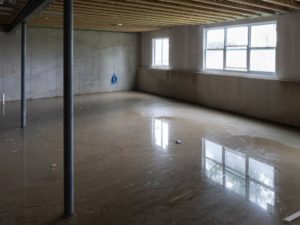
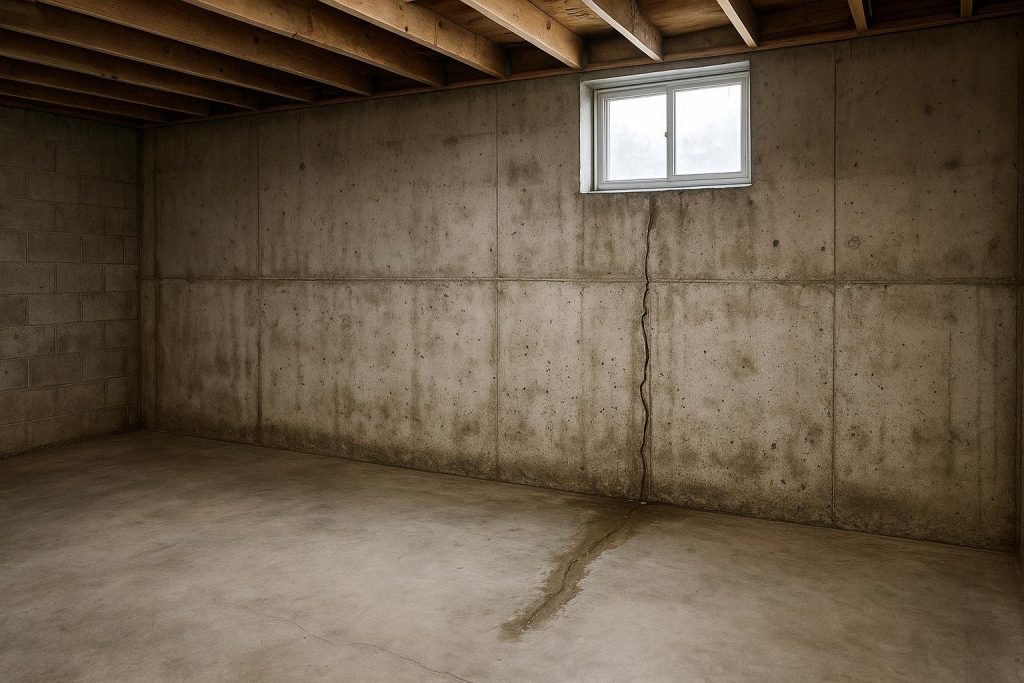
A leaky basement Barrie homeowners encounter most often traces back to hydrostatic pressure building up against the foundation wall, not simply rain finding a gap. Barrie sits on a mix of sandy glacial till and pockets of heavier clay-bearing soil, and when spring snowmelt or a heavy summer downpour saturates that ground, water is pushed laterally and downward against the footing with considerable force. Understanding that root cause is what separates a lasting repair from a temporary patch.
Key Takeaways
- Hydrostatic pressure from Barrie’s seasonal freeze-thaw cycle is the leading driver of foundation leaks, not surface water alone.
- A single injected foundation crack typically costs $600 to $900; a full interior weeping-tile system or exterior waterproofing job runs higher and depends on linear footage and access.
- Spring thaw and intense summer thunderstorms are Barrie’s two peak failure windows, so inspections before April are strongly recommended.
- Older homes in Barrie’s established neighbourhoods frequently have original weeping tile that has silted up completely and no longer drains.
- The correct fix depends on where water enters: wall crack, floor-wall joint, or through a porous block wall each calls for a different method.
Definitions and Scope
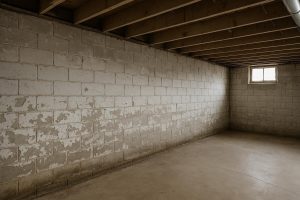
A leaky basement is any condition where water enters the below-grade living space, whether as a visible stream through a crack, as seepage through a porous wall, or as moisture wicking up through the floor slab. The term covers everything from a hairline crack that lets in a cupful of water during heavy rain to a fully saturated perimeter that floods the floor.
Foundation waterproofing addresses the source of that entry. The main methods used in Barrie are: polyurethane or epoxy crack injection, interior weeping-tile systems with a sump pump, exterior excavation with a rubberised membrane and new weeping tile, and parging repairs to deteriorated block or stone walls. Each method targets a specific failure mode, and choosing the wrong one wastes money without solving the problem.
This guide covers residential foundations in the Barrie area, including poured concrete walls, concrete block, and older stone foundations common in the city’s pre-1970 housing stock. Commercial applications are a separate discipline handled under commercial waterproofing services.
Why Leaky Basement Barrie Conditions Are More Common Than You Might Expect
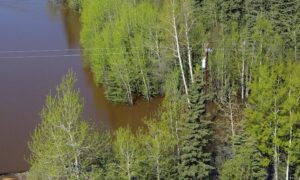
Barrie’s position at the southern end of Georgian Bay gives it one of the heaviest snowfall accumulations in Ontario outside of the Snowbelt proper. That snowpack melts rapidly in March and April, and the ground is often still frozen below the surface, so meltwater has nowhere to go except sideways into the soil immediately surrounding the foundation. A leaky basement Barrie homeowners discover in spring is almost always the result of this seasonal saturation cycle.
The freeze-thaw cycle itself is destructive. Water that has seeped into a hairline crack in a poured concrete wall expands roughly nine percent when it freezes overnight, widening the crack incrementally each season. After several winters, what started as a shrinkage crack becomes a through-wall gap that admits water freely during the next thaw.
Barrie also experienced significant residential construction booms in the 1970s, 1980s, and again in the 2000s. Homes from the earlier periods commonly have clay-pipe or corrugated plastic weeping tile that is now 40 to 50 years old. That original drainage layer silts up over time, loses its ability to carry water away from the footing, and hydrostatic pressure builds until the wall gives way at its weakest point.
Spring thaw and summer thunderstorms are Barrie’s two peak failure windows. A pre-April inspection is the single most effective step a homeowner can take to avoid an emergency call in May.
The Canada Mortgage and Housing Corporation (CMHC) notes that moisture control at the foundation level is one of the most critical factors in long-term building durability. Barrie’s climate amplifies every one of the risk factors CMHC identifies: high seasonal precipitation, freeze-thaw cycling, and aging drainage infrastructure. You can review CMHC’s guidance on foundation moisture at cmhc-schl.gc.ca.
Your Options for Fixing a Leaky Basement in Barrie
Polyurethane Crack Injection
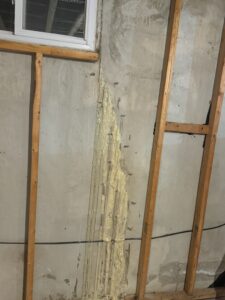
Low-pressure polyurethane injection is the standard repair for a single vertical or diagonal crack in a poured concrete wall. A technician drills ports along the crack at regular intervals, pastes surface caps over them, then injects two-part polyurethane foam under low pressure. The foam expands to fill the full depth of the crack and cures flexible, which matters in Barrie because the foundation continues to experience minor seasonal movement. A rigid filler would simply re-crack at the same location.
Epoxy injection is reserved for structural cracks where the wall needs to be re-bonded and rigidity is required. Polyurethane is the right choice for non-structural cracks that are leaking water. The repair is done entirely from the interior, so no excavation is needed. Best for: a single active crack in a poured concrete wall. Limitation: does not address the drainage conditions outside the wall, so if hydrostatic pressure is high, a second crack may open nearby. When a leaky basement Barrie property has only one identifiable crack, this is usually the most cost-effective starting point.
Interior Weeping Tile System with Sump Pump
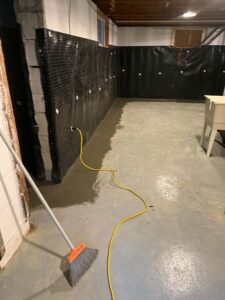
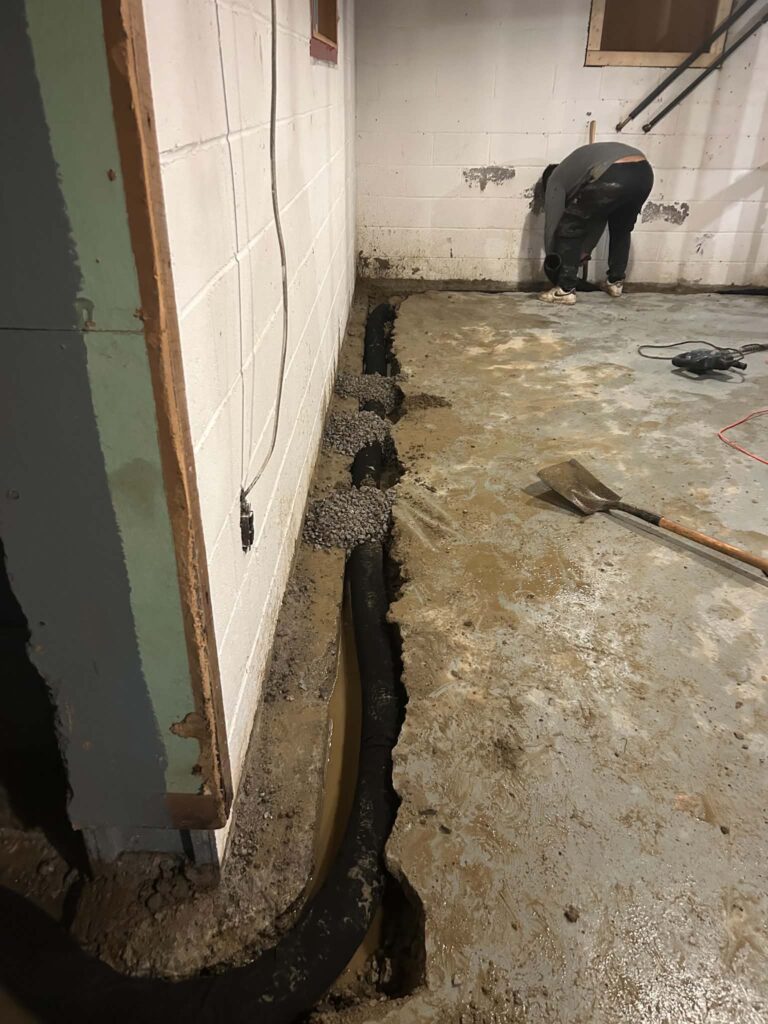
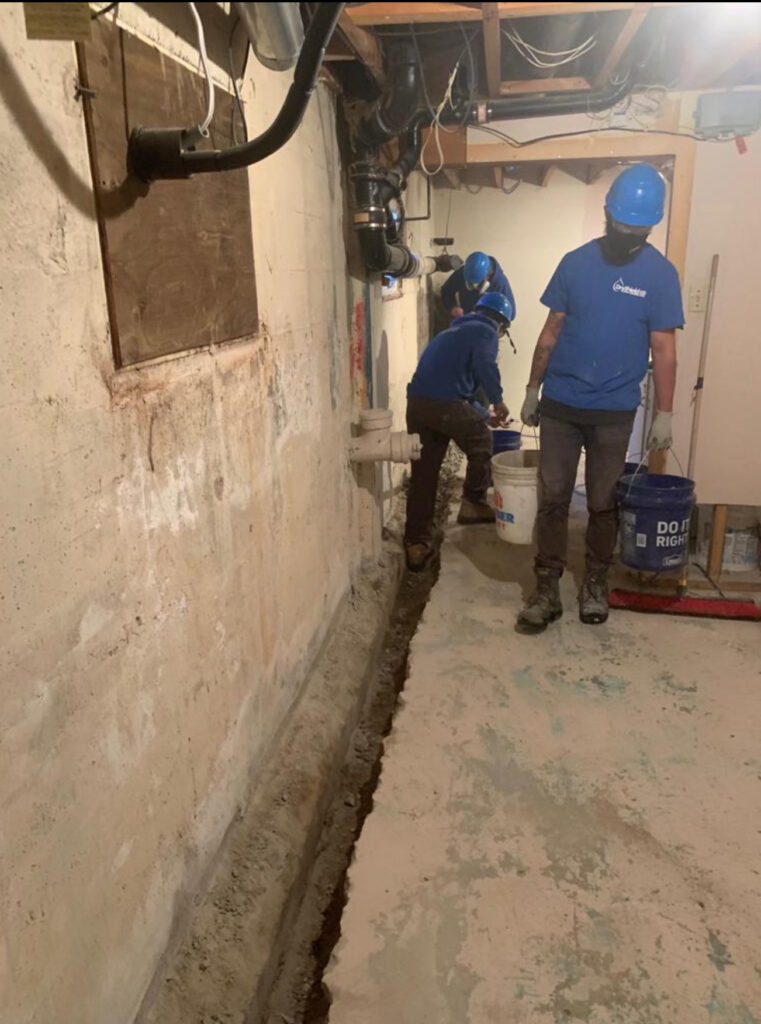
Where water is entering at the floor-wall joint or through multiple points along the perimeter, an interior drainage system is often the most practical solution for a leaky basement Barrie situation. The perimeter concrete is jackhammered, a channel is dug to the footing level, and perforated weeping tile is laid in clear stone and directed to a sump basin. A sump pump then ejects the collected water away from the building. A vapour barrier is run up the wall and sealed to prevent soil gases from entering.
This method manages water that has already passed through the wall rather than stopping it at the exterior. It is less disruptive than full excavation and can be completed without disturbing landscaping or driveways. Best for: homes with multiple entry points, block walls, or where exterior access is restricted. Limitation: the exterior wall remains wet, which can affect parging and masonry over time.
Exterior Waterproofing with Membrane and New Weeping Tile
Exterior waterproofing is the most comprehensive solution for a leaky basement Barrie home can have. The soil is excavated to the footing, voids in the wall are filled with hydraulic cement and parging, a rubberised membrane is applied to the full height of the wall, a dimpled drainage board is placed over the membrane to protect it and create a drainage plane, and new weeping tile bedded in clear stone is installed at the footing. The trench is then backfilled and the grade is corrected to direct surface water away from the building.
This approach stops water before it contacts the wall. It is the only method that also addresses deteriorated original weeping tile at the footing. Best for: homes with failed exterior drainage, severe hydrostatic pressure, or where the wall itself is deteriorating. Limitation: requires excavation, which means disruption to landscaping, decks, or driveways, and a higher investment than interior methods.
Parging and Masonry Repair
Older Barrie homes with poured concrete, concrete block, or stone foundations often have deteriorated parging, the cement-based coating applied to the exterior face of the wall above grade. When parging cracks or falls away, surface water runs directly down the wall face and into the soil at the footing. Repairing or replacing the parging is a necessary step in any exterior waterproofing job and can also be done as a standalone repair where the underlying wall is still sound.
Best for: above-grade wall deterioration where the below-grade drainage is still functioning. Limitation: parging alone does not address below-grade hydrostatic pressure or failed weeping tile.
Sump Pump Installation or Replacement
A sump pump is the active component of any interior drainage system. In Barrie, where spring thaw can deliver large volumes of water over a short period, a properly sized pump with a battery backup is essential. A pump that is undersized, aging, or without backup power will fail at the worst possible moment. Sump pump installation is often paired with an interior weeping-tile system but can also be added to an existing system where the pump has reached the end of its service life.
Best for: homes that already have a drainage channel but lack a functioning pump, or where the existing pump is more than seven to ten years old. Limitation: a pump requires power and periodic maintenance; a battery backup unit adds resilience but also adds cost.
Options Compared
| Method | Best For | Typical Lifespan | Relative Cost | Disruption |
|---|---|---|---|---|
| Polyurethane crack injection | Single active crack in poured concrete | Long-term if crack is non-structural | Lowest | Minimal, interior only |
| Interior weeping tile + sump pump | Multiple entry points, block walls, restricted exterior access | Decades with pump maintenance | Moderate | Interior floor disruption, 1-2 days |
| Exterior waterproofing + membrane + new weeping tile | Failed exterior drainage, severe hydrostatic pressure | Longest, addresses root cause | Highest | Excavation, landscaping disruption |
| Parging repair | Above-grade wall deterioration | 10-20 years depending on exposure | Low to moderate | Minimal |
| Sump pump installation/replacement | Existing drainage system needing active component | 7-12 years per pump unit | Low to moderate | Minimal |
The table above shows that no single method is universally best. Crack injection is the right starting point for a straightforward single-crack leak, but if the weeping tile at the footing has silted up, injection alone will not prevent new cracks from forming as hydrostatic pressure continues to build. Exterior waterproofing addresses the most failure modes in one scope of work, which is why it carries the highest investment. Interior systems are a practical middle ground when excavation is not feasible.
How to Choose the Right Fix for a Leaky Basement Barrie Home
Choose polyurethane crack injection if you have one or two identifiable cracks in a poured concrete wall, the cracks are non-structural (vertical or diagonal, not horizontal), and water entry is clearly linked to those specific locations. This is the fastest and most affordable path to a dry basement when the problem is genuinely isolated.
Choose an interior weeping-tile system if water is entering at the floor-wall joint along multiple walls, if you have a concrete block or stone foundation where injection is not practical, or if exterior excavation is blocked by a deck, addition, or neighbouring structure. Interior systems are also appropriate when the homeowner needs a solution with minimal exterior disruption.
Choose exterior waterproofing if the original weeping tile has failed, if you are seeing efflorescence or mineral staining across a wide section of wall (indicating long-term water migration through the wall), or if a previous interior repair has not held. Exterior work is the only method that replaces the drainage layer at the footing and applies a membrane to stop water before it contacts the wall.
Choose parging repair as a companion to any exterior work, or as a standalone fix when the above-grade wall face is crumbling but the below-grade drainage is confirmed to be functioning. Never rely on parging alone to stop a leaky basement Barrie property is experiencing below grade.
For a broader look at how these decisions play out across the Simcoe County region, the Simcoe County basement waterproofing guide covers local soil and drainage conditions in detail. You can also use the Barrie foundation repair and waterproofing service page to understand the full scope of work available in this area.
Costs and Timelines
| Cost Driver | Why It Matters | Approximate Range (CAD) |
|---|---|---|
| Number of cracks to inject | Each crack is a separate repair with its own materials and labour | $600 to $900 per crack |
| Linear footage of interior weeping tile | More perimeter = more jackhammering, pipe, stone and concrete re-pour | Varies by perimeter; site inspection required |
| Depth of excavation for exterior work | Deeper footings mean more soil removal and longer labour time | Included in exterior job total |
| Exterior access and obstacles | Decks, fences, or tight lot lines add time and equipment cost | Site-specific premium |
| Full exterior waterproofing (average semi/detached) | Excavation to footing, membrane, drainage board, new weeping tile, backfill | Approximately $6,000 to $9,000 |
| Sump pump installation | Pump sizing, basin, discharge line, battery backup option | Varies; confirm at inspection |
Every figure above is a starting-point range. The final cost depends on a site inspection that confirms the foundation type, the depth of the footing, the condition of existing drainage, and the accessibility of the work area. A single injected crack at $600 to $900 is genuinely the most affordable fix when that is all that is needed. Full exterior waterproofing of an average Barrie detached home typically falls in the $6,000 to $9,000 range, with the final number driven by linear footage and excavation depth. Interior weeping-tile systems generally fall below the exterior range. Always ask for a written scope with linear-foot pricing so you can compare quotes accurately.
A written scope with linear-foot pricing is the clearest way to compare quotes from different contractors. If a quote is a single lump sum with no breakdown, ask for the detail before you sign.
Risks and Common Mistakes
| Symptom | Likely Cause | Correct Fix |
|---|---|---|
| Water along floor-wall joint after heavy rain | Failed or silted weeping tile at footing | Interior weeping tile or exterior excavation |
| Wet streak down wall from a single point | Through-wall crack, often a shrinkage crack | Polyurethane crack injection |
| White powdery deposits (efflorescence) across wall | Long-term water migration through porous wall | Exterior membrane or interior drainage system |
| Horizontal crack mid-wall | Lateral soil pressure, potentially structural | Structural assessment first, then waterproofing |
| Damp floor slab, no visible wall entry | Hydrostatic pressure through floor, high water table | Interior drainage system with sump pump |
The most common mistake Barrie homeowners make is applying hydraulic cement or a brush-on waterproofing paint to the interior wall face and expecting it to hold. These products can slow seepage temporarily, but they do not address the hydrostatic pressure pushing water through the wall. When that pressure exceeds the bond strength of the coating, the coating fails and the underlying problem is unchanged. A leaky basement Barrie property has will not be resolved by surface coatings alone.
A second frequent error is ignoring a horizontal crack. Horizontal cracks in a concrete block or poured wall indicate lateral soil pressure acting on the wall, which is a structural concern, not just a waterproofing one. A horizontal crack should be assessed by a qualified contractor before any waterproofing work begins. Injecting a horizontal crack without addressing the structural cause can give a false sense of security.
Delaying repairs is also costly. A crack that admits water in spring will widen through the next freeze-thaw cycle. What costs $600 to $900 to inject today may require a section of wall to be rebuilt if left for several more winters.
Brush-on waterproofing paints are not a substitute for drainage. They may slow seepage for a season, but hydrostatic pressure will eventually push water through any coating applied to the interior face of a wet wall.
How the Process Works
- Free on-site inspection and moisture assessment. A technician visits the property, identifies all entry points, checks the condition of existing weeping tile where accessible, and assesses the exterior grade and drainage around the foundation.
- Written scope with linear-foot pricing. You receive a clear breakdown of what work is proposed, which sections of wall or floor are included, and what the cost drivers are. No surprises at invoice time.
- Preparation and protection. Interior contents near the work area are protected. For exterior work, the excavation zone is marked and any utilities are located before digging begins.
- Core repair work. For crack injection: ports are drilled, paste caps applied, and polyurethane is injected under low pressure. For exterior work: excavation to the footing, hydraulic cement parging of voids, rubberised membrane application, dimpled drainage board, new weeping tile in clear stone. For interior systems: perimeter concrete is jackhammered, weeping tile is laid to the sump basin, vapour barrier is installed up the wall, and concrete is re-poured.
- Backfill and grade correction. Exterior excavations are backfilled in lifts and the grade is corrected to slope away from the foundation, reducing surface water accumulation at the wall.
- Final inspection and documentation. The completed work is reviewed with the homeowner. For full waterproofing systems, warranty documentation is provided. DryShield’s lifetime transferable warranty applies to qualifying interior and exterior systems, which is a meaningful asset if you sell the home.
Frequently Asked Questions
What causes a leaky basement in Barrie specifically?
Hydrostatic pressure from Barrie’s heavy spring snowmelt and clay-bearing soils is the primary cause of a leaky basement Barrie homeowners report. Water saturates the ground around the foundation, and pressure pushes it through the path of least resistance: shrinkage cracks, the floor-wall joint, or porous block mortar. The freeze-thaw cycle widens existing cracks each winter, and original weeping tile installed 40 or more years ago is often fully silted and no longer draining.
How do I know if I need crack injection or a full waterproofing system?
If water is entering through one or two identifiable cracks in a poured concrete wall and the rest of the basement is dry, crack injection is usually the right starting point. If water is coming in at the floor-wall joint, through multiple wall sections, or through a block or stone wall, a drainage system is more appropriate. A site inspection is the only reliable way to confirm which applies to your leaky basement Barrie situation.
How much does it cost to fix a leaky basement in Barrie?
A single injected crack typically costs $600 to $900. Full exterior waterproofing of an average Barrie detached home runs approximately $6,000 to $9,000 depending on linear footage, footing depth, and site access. Interior weeping-tile systems generally fall below the exterior range. Every quote should be based on a site inspection and presented with a linear-foot breakdown.
Can I fix a leaky basement myself?
Surface-applied hydraulic cement can slow an active drip temporarily, but it does not address the hydrostatic pressure causing the leak. DIY crack fillers available at hardware stores are not formulated for the low-pressure injection method that fills the full depth of a through-wall crack. For anything beyond a surface cosmetic repair, a professional inspection is the appropriate first step.
How long does basement waterproofing take in Barrie?
A single crack injection is typically completed in a few hours. An interior weeping-tile system along one or two walls can be done in one to two days. Full exterior waterproofing of a standard residential foundation takes two to three days depending on linear footage and excavation conditions. Weather can affect exterior timelines in early spring when the ground is still partially frozen.
Will waterproofing affect my home’s resale value?
A documented, warranted waterproofing system is a positive disclosure in a real estate transaction. Buyers and their inspectors look for evidence of past or ongoing moisture issues, and a transferable warranty on the repair removes that concern. A wet basement, by contrast, is one of the most common reasons a sale price is negotiated down or a deal falls through.
Is exterior or interior waterproofing better for Barrie homes?
Exterior waterproofing addresses the root cause by stopping water before it contacts the wall and replacing failed weeping tile at the footing. Interior systems manage water that has already passed through the wall. Exterior is the more comprehensive solution, but interior systems are appropriate when excavation is not feasible due to access constraints or budget. Many Barrie homes benefit from a combination: exterior membrane on the most exposed wall and an interior system on the remaining perimeter.
What is the best time of year to waterproof a basement in Barrie?
Interior work can be done year-round. Exterior excavation is most practical from late spring through early autumn when the ground is not frozen and conditions are stable. Scheduling an inspection in late winter or early spring, before the thaw arrives, means you can have exterior work booked and completed before the peak failure window in April and May.
Does Barrie’s soil type affect which waterproofing method I need?
Yes. Barrie’s soil varies across the city: sandy glacial till drains relatively quickly and reduces sustained hydrostatic pressure, while pockets of heavier clay-bearing soil hold water against the foundation wall for days after a rain event. Homes on clay-heavy lots are more likely to need a full drainage solution rather than crack injection alone. A site inspection that includes an assessment of the soil conditions around your foundation will confirm which applies to your leaky basement Barrie property.
What should I look for when hiring a waterproofing contractor in Barrie?
Look for a contractor who provides a written scope with linear-foot pricing, offers a transferable warranty, and can clearly explain which method they are recommending and why. Be cautious of quotes that are a single lump sum with no breakdown, or contractors who recommend the most expensive solution without first confirming the source of the leak. The guide to choosing a reliable waterproofing contractor covers the full checklist of questions to ask before you sign.
If your Barrie basement is showing signs of moisture, a free on-site inspection is the right first step. DryShield has served Barrie and the surrounding Simcoe County area for over 25 years, and every inspection includes a written scope so you know exactly what is proposed and why. Request your inspection today and get a clear answer before the next thaw arrives.