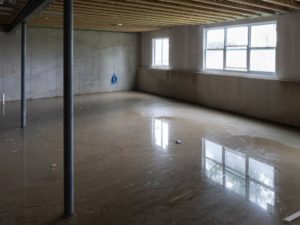
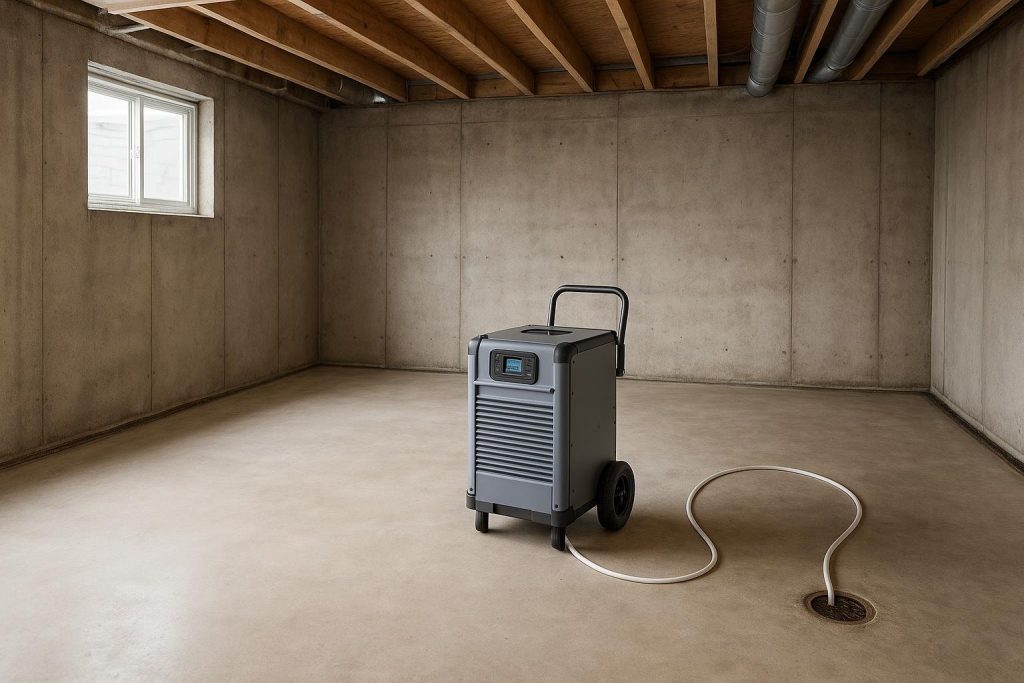
Basement dehumidification is the process of mechanically removing excess moisture from basement air to keep relative humidity below the threshold where mould, rot and structural damage occur. It is a necessary part of a complete moisture management plan, but it works best when the source of water entry has already been controlled. This guide explains how dehumidification works, which equipment options exist, how to choose among them, and when a waterproofing solution must come first.
- Target basement relative humidity is generally 30 to 50 percent; above 60 percent, mould growth risk rises sharply.
- A dehumidifier treats airborne moisture; it cannot stop liquid water entering through cracks, failed weeping tile or a high water table.
- Whole-home and ducted systems outperform portable units in large or persistently damp basements.
- Pairing dehumidification with waterproofing and proper drainage addresses root causes rather than symptoms.
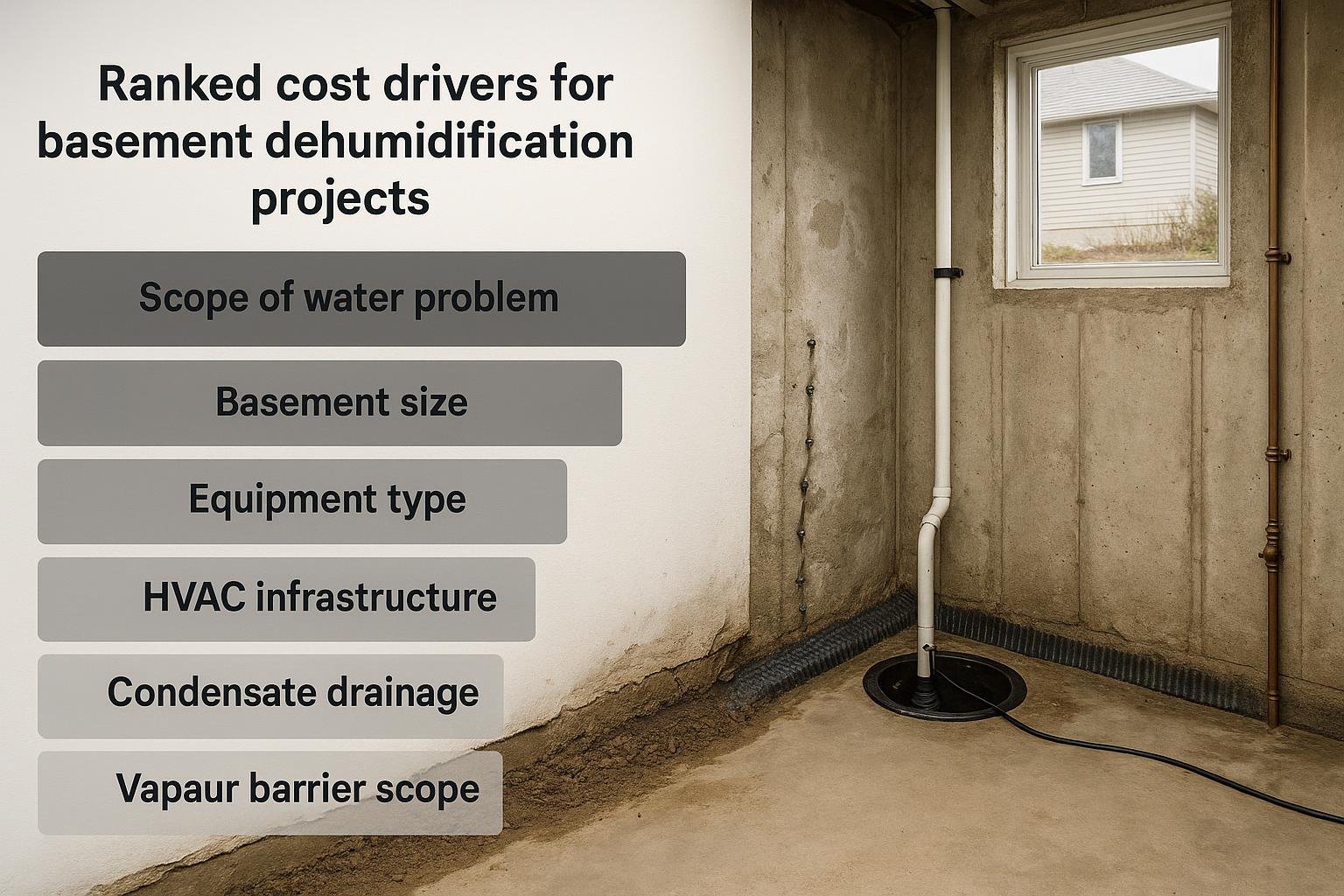
- Cost drivers include basement size, existing HVAC infrastructure, drainage requirements and the severity of the underlying moisture source.
Definitions & scope
Relative humidity (RH) is the percentage of water vapour in air relative to the maximum it can hold at a given temperature. When warm, humid air contacts a cool basement wall or floor, it releases moisture as condensation. Sustained high RH feeds mould colonies, degrades wood framing, corrodes metal fasteners and causes efflorescence on concrete.
Basement dehumidification refers specifically to equipment and strategies that extract water vapour from basement air. It is distinct from waterproofing, which prevents liquid water from entering the structure, and from drainage management, which redirects groundwater away from the foundation. All three disciplines overlap: a wet basement almost always requires some combination of source control, drainage and humidity management to achieve a lasting dry environment.
Health Canada’s indoor air quality guidance and the Canada Mortgage and Housing Corporation (CMHC) both recommend maintaining indoor RH between 30 and 55 percent year-round to limit biological growth and protect building materials. Basements are the most challenging zone because they are below grade, surrounded by soil that retains moisture, and often poorly ventilated.
Why this matters
Ontario’s climate creates persistent basement moisture pressure from multiple directions. Spring snowmelt and rain events raise the water table rapidly, pushing hydrostatic pressure against foundation walls. Summer brings warm, humid outdoor air that condenses on cool below-grade surfaces. Freeze-thaw cycling through autumn and winter widens hairline cracks, creating new pathways for both liquid water and vapour.
Uncontrolled basement humidity has measurable consequences for a home. Health Canada guidance notes that mould can begin colonising porous materials within 24 to 48 hours of sustained high moisture. Wood framing, subfloor sheathing and stored belongings are all at risk. Chronic dampness also accelerates corrosion of steel reinforcement inside poured concrete walls, which can eventually affect structural integrity.
From a home-value perspective, a visibly damp or musty basement is one of the most commonly cited deficiencies in pre-sale home inspections across the GTA. Buyers and their inspectors look for staining, efflorescence, mould and odour. Addressing moisture proactively protects both the structure and resale value.
Dehumidification alone is not a substitute for structural waterproofing when liquid water is entering the space. Running a dehumidifier against an active leak simply overworks the equipment and masks a worsening problem. The correct sequence is: stop the water source, manage drainage, then maintain humidity with mechanical equipment.
Your options
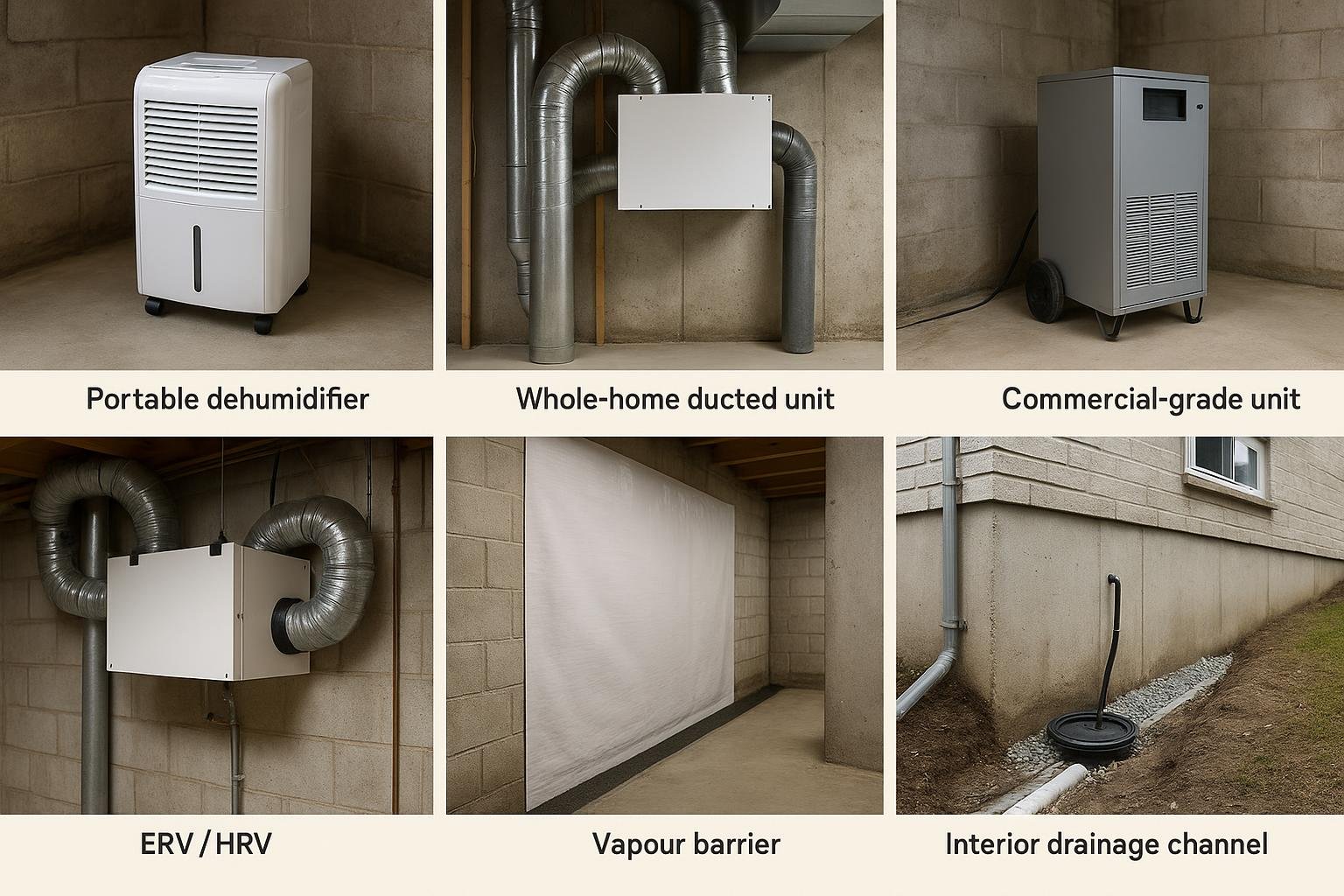
Portable refrigerant dehumidifiers
A portable refrigerant dehumidifier draws basement air across a cold evaporator coil. Moisture condenses on the coil and drips into a collection bucket or drains through a hose. Units are rated in litres per day (L/day) of moisture removal at a standard test condition.
How it works: A compressor cools the evaporator coil below the dew point of the incoming air. Condensed water is collected or gravity-drained. A fan then passes the now-drier air over a warm condenser coil before returning it to the room, which also adds a small amount of heat to the space.
Best for: Basements with mild seasonal humidity, smaller finished spaces, or as a supplemental unit in a specific zone.
Limitations: Portable units lose efficiency below approximately 16°C; some models shut off automatically in cold basements. Bucket emptying is required unless a drain is nearby. They do not address the source of moisture and can be overwhelmed by active seepage.
Whole-home ducted dehumidifiers
A whole-home dehumidifier is installed in-line with or alongside the existing HVAC system. It conditions air drawn from return ducts and distributes dry air through supply registers throughout the house, including the basement.
How it works: The unit uses the same refrigerant cycle as a portable model but at a larger scale, with a built-in humidistat that signals the system to run only when RH exceeds the set point. Condensate drains to a floor drain or condensate pump.
Best for: Homes with forced-air HVAC, larger basements, finished living spaces below grade, and households where consistent whole-home humidity control is a priority.
Limitations: Requires professional installation and integration with existing ductwork. Higher upfront cost than portable units. Not practical in homes without central forced-air systems.
Stand-alone basement dehumidifiers (commercial-grade)
These are high-capacity units designed specifically for below-grade environments. They operate efficiently at lower temperatures than standard portable units and are built for continuous-duty operation.
How it works: Similar refrigerant cycle to portable units, but with low-temperature-rated compressors, larger coil surface areas and integrated condensate pumps. Many include digital humidistats and remote monitoring capability.
Best for: Unfinished or semi-finished basements with persistent high humidity, crawl spaces, and situations where a whole-home system is not feasible.
Limitations: Still requires a drain or condensate pump. Does not address liquid water entry. Ongoing energy cost is higher than a portable unit due to continuous operation.
Energy recovery ventilators (ERVs) and heat recovery ventilators (HRVs)
An ERV or HRV exchanges stale, humid indoor air with fresh outdoor air while recovering most of the thermal energy in the outgoing air stream. In winter, this prevents the incoming cold air from dramatically raising heating costs.
How it works: Two air streams pass through a heat-exchange core. The outgoing warm, humid air transfers heat (and in an ERV, some moisture) to the incoming fresh air. The net effect is improved ventilation and reduced indoor humidity without large energy penalties.
Best for: Tightly sealed, well-insulated homes where insufficient fresh-air exchange is the primary driver of high humidity. Often paired with a dehumidifier for year-round control.
Limitations: Less effective at removing moisture during hot, humid Ontario summers when outdoor air is itself very humid. Not a standalone solution for basements with active moisture ingress.
Vapour barriers and encapsulation
In crawl spaces and unfinished basements, a heavy-duty polyethylene vapour barrier installed over the floor and lower walls blocks ground moisture from evaporating into the air. Encapsulation takes this further by sealing the entire crawl space envelope.
How it works: A minimum 6-mil (ideally 10 to 20 mil reinforced) polyethylene sheet is lapped up walls and sealed at seams and penetrations. This dramatically reduces the volume of moisture the dehumidifier must handle.
Best for: Crawl spaces, dirt-floor basements, and any below-grade space where ground evaporation is a significant moisture source.
Limitations: Does not stop liquid water entry. Must be combined with drainage if any water accumulates on the floor. Requires careful installation to avoid trapping moisture behind the barrier.
Interior drainage systems paired with dehumidification
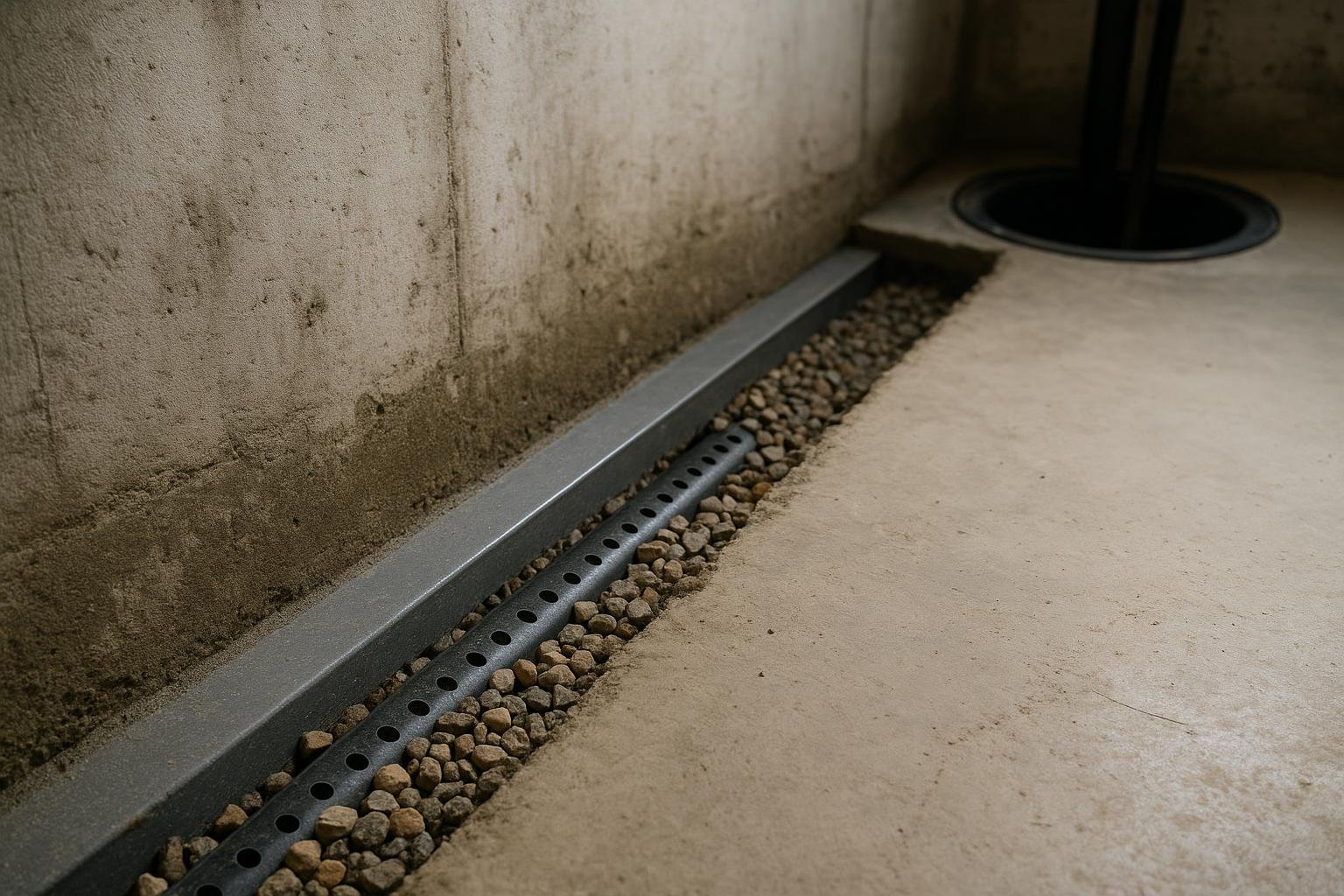
When liquid water enters through the floor-wall joint or through wall cracks, an interior perimeter drainage channel (weeping tile system) collects that water and directs it to a sump pump. Removing standing and seeping water before it evaporates dramatically reduces the load on any dehumidification equipment.
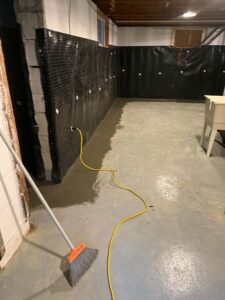
How it works: A channel is cut along the interior perimeter of the basement floor. Perforated pipe is installed and covered with gravel and a membrane. Water that enters the wall or floor-wall joint is intercepted and routed to a sump pit, where a pump discharges it away from the foundation.
Best for: Basements with chronic seepage, high water tables, or failed exterior weeping tile where full exterior excavation is not practical.
Limitations: Does not stop water from entering the wall itself; it manages water after entry. Requires a functioning sump pump with a reliable power source or battery backup.
Options compared
| Option | Best for | Typical considerations | Durability / limitations |
|---|---|---|---|
| Portable refrigerant dehumidifier | Mild seasonal humidity, small spaces | Low upfront cost; bucket emptying or drain hose needed; loses efficiency below ~16°C | 5 to 10 year lifespan; may be overwhelmed by active seepage |
| Whole-home ducted dehumidifier | Forced-air homes, finished basements | Professional install required; integrates with HVAC; higher upfront cost | 10 to 15+ year lifespan; consistent whole-home control |
| Commercial-grade basement unit | Persistent high humidity, unfinished spaces | Low-temp rated; continuous duty; integrated condensate pump | Long service life; higher ongoing energy use |
| ERV / HRV | Tight, well-insulated homes | Improves air quality; less effective in humid summer outdoor air | 15 to 20 year lifespan; best as complement, not sole solution |
| Vapour barrier / encapsulation | Crawl spaces, dirt floors | Reduces ground evaporation load; must be paired with drainage if water pools | Durable if properly installed; does not stop liquid entry |
| Interior drainage + sump pump | Active seepage, high water table | Addresses liquid water before it evaporates; requires sump pump maintenance | Long-lasting system; pump requires periodic testing and eventual replacement |
No single option addresses every moisture pathway. Portable and commercial-grade dehumidifiers handle airborne vapour but are overwhelmed by liquid water entry. Interior drainage systems manage seepage but do not reduce condensation from humid air. ERVs improve ventilation but are limited in high outdoor-humidity conditions. The most durable outcomes combine source control (waterproofing and drainage) with mechanical humidity management (dehumidification). Vapour barriers are a cost-effective first layer in crawl spaces and unfinished basements but must be part of a broader system.
How to choose
The right approach depends on diagnosing the actual moisture source before selecting equipment. Use the following framework:
Choose a portable or commercial-grade dehumidifier if your basement is dry to the touch, no water stains or efflorescence are visible on walls, and humidity rises only during humid summer months or after the space is occupied. This is a condensation problem, and mechanical dehumidification is the primary fix.
Choose a whole-home ducted dehumidifier if you have a forced-air HVAC system, a finished basement used as living space, and you want integrated, automatic humidity control across the entire home without managing a separate appliance.
Choose an ERV or HRV if your home is tightly sealed (built or renovated after 2012 to high energy-efficiency standards) and poor air exchange is the diagnosed cause of elevated humidity. Pair it with a dehumidifier for summer months.
Choose vapour barrier or encapsulation if you have a crawl space or unfinished basement with a dirt or bare concrete floor and ground evaporation is a significant moisture contributor. This reduces the load on any dehumidification equipment.
Choose interior drainage with a sump pump if you see water entering at the floor-wall joint, along the base of walls, or through floor cracks. Dehumidification alone will not solve active liquid water entry. A sump pump installation paired with interior weeping tile intercepts water before it evaporates and overwhelms any dehumidifier.
Choose exterior waterproofing if walls show horizontal cracking, bowing, or significant seepage through the wall face. Exterior excavation, membrane application and new weeping tile address the source directly. See the exterior vs interior perimeter waterproofing comparison for a detailed breakdown.
When in doubt, a professional moisture assessment that includes a humidity reading, visual inspection of walls and floor, and a review of drainage conditions will identify which combination of solutions is appropriate.
Costs & timelines
No verified current price data has been supplied to this page. The following describes cost drivers only, ranked by typical impact. For Ontario-specific ranges, consult the basement waterproofing cost guide.
| Cost driver | Why it matters | Relative impact |
|---|---|---|
| Scope of underlying water problem | Active seepage requiring drainage or waterproofing adds significant cost before dehumidification equipment is even considered | Highest |
| Basement size and layout | Larger or compartmentalised spaces require higher-capacity units or multiple units | High |
| Equipment type and capacity | Commercial-grade and whole-home ducted systems cost more than portable units; installation labour varies accordingly | High |
| Existing HVAC infrastructure | Ducted systems require compatible forced-air systems; retrofitting ductwork adds cost | Medium |
| Drainage and condensate management | If no floor drain exists near the unit, a condensate pump or new drain line is required | Medium |
| Vapour barrier or encapsulation scope | Crawl space encapsulation cost varies with square footage, access difficulty and barrier grade | Low to medium |
Timeline for equipment installation is typically one day for portable or commercial-grade units and one to two days for whole-home ducted systems. If interior drainage work is required first, that scope typically takes two to four days depending on basement perimeter length. Exterior waterproofing projects are longer and depend on excavation depth and length of wall treated.
Risks & common mistakes
Running a dehumidifier against an active leak. This is the most common error. A dehumidifier cannot keep up with liquid water entering through a crack or failed weeping tile. The equipment runs continuously, wears out prematurely and the underlying problem worsens. If water is visibly entering the space, address the source first. See the basement wet repair guide for a structured approach.
Undersizing the unit. Dehumidifier capacity is rated in litres per day under controlled laboratory conditions. Real-world performance in a cold, damp basement is lower. Choosing a unit rated for a smaller space than your actual basement means the equipment runs at maximum continuously and still may not reach the target RH.
Setting the humidistat too low in winter. Targeting very low RH (below 30 percent) in winter can cause wood framing and trim to dry out and crack, and can increase static electricity. A winter set point of 30 to 40 percent is generally appropriate.
Neglecting the condensate drain. A full collection bucket causes the unit to shut off automatically. If no one empties it, humidity climbs again. Connecting the unit to a floor drain or installing a condensate pump eliminates this failure mode.
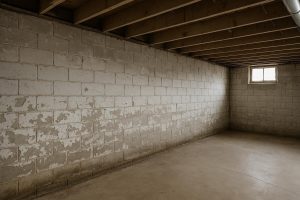
Ignoring efflorescence and staining as early warnings. White chalky deposits on basement walls indicate that water is moving through the concrete and depositing minerals. This is a sign of active moisture migration, not just condensation. Dehumidification will not stop this process. Efflorescence on basement walls warrants a waterproofing assessment.
Skipping vapour barrier in crawl spaces. A dehumidifier placed in a crawl space without a ground vapour barrier must work against continuous evaporation from exposed soil. Installing a proper barrier first dramatically reduces the moisture load and improves equipment efficiency.
Assuming a new dehumidifier solves a mould problem. If mould is already established, it must be physically remediated before humidity control will prevent regrowth. Lowering humidity stops new growth but does not kill or remove existing colonies.
How the process works
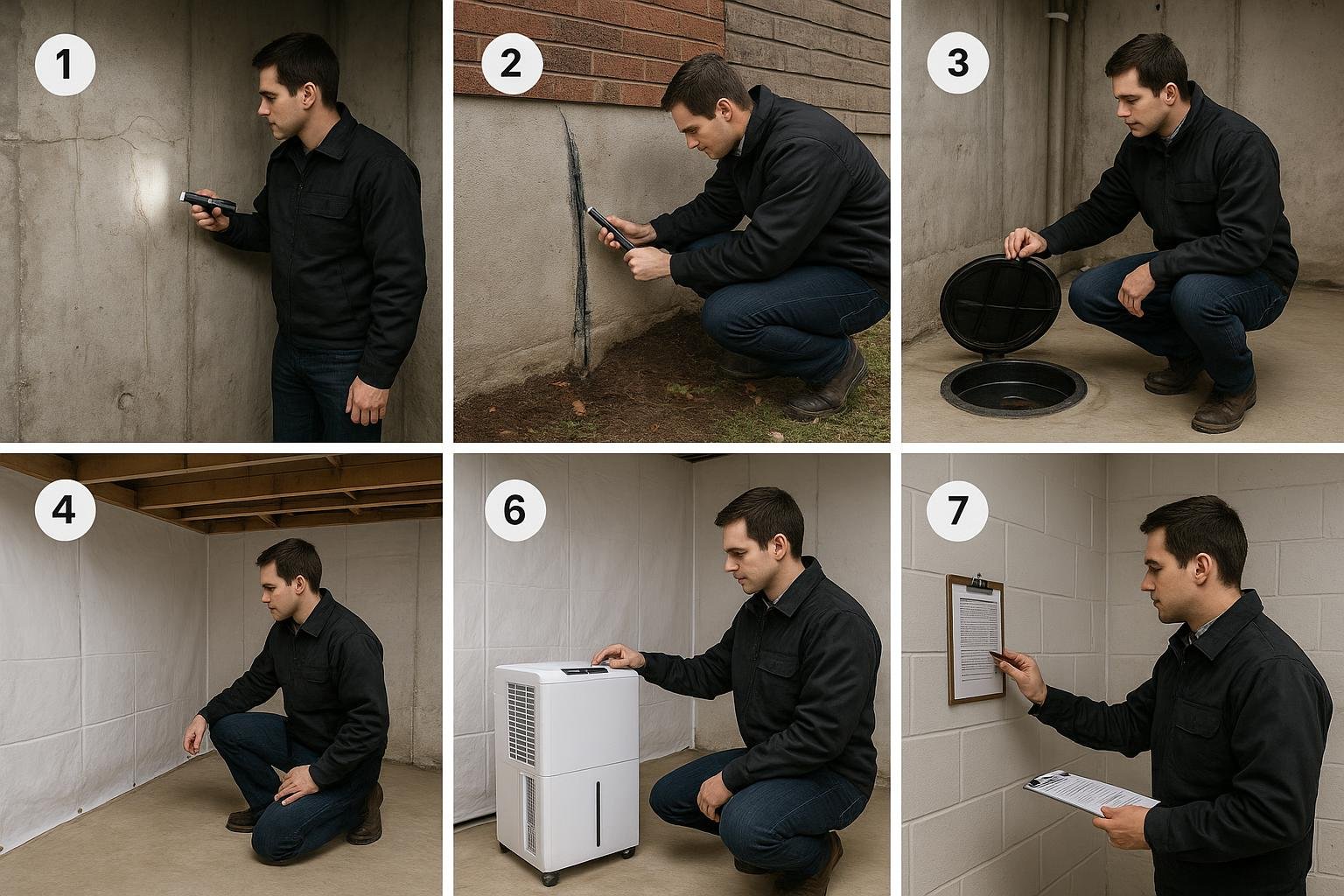
- Moisture source assessment. A technician inspects walls, floor, floor-wall joints and visible cracks to distinguish between condensation, seepage and vapour migration. A hygrometer reading establishes current RH. This step determines whether dehumidification alone is sufficient or whether waterproofing must come first.
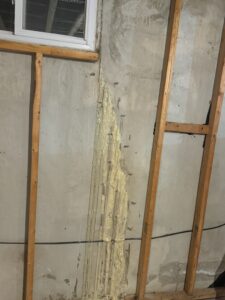
- Source control (if required). Active cracks are sealed using polyurethane crack injection or epoxy. Failed weeping tile is repaired or replaced. Exterior grading and downspout extensions are reviewed. This step eliminates liquid water entry before equipment is installed.
- Drainage confirmation. The sump pit and pump are inspected or installed. Interior drainage channels are confirmed to be clear and functional. A condensate drain location is identified for the dehumidification equipment.
- Equipment selection and installation. The appropriate unit type and capacity is selected based on basement size, temperature range and existing HVAC. The unit is positioned, connected to a drain, and the humidistat is set to the target RH (typically 45 to 50 percent for a basement).
- Vapour barrier installation (if applicable). In crawl spaces or unfinished basements with exposed soil or bare concrete floors, a reinforced polyethylene barrier is installed before the dehumidifier is commissioned.
- Commissioning and baseline measurement. The system is run for 24 to 48 hours and RH is measured at multiple points to confirm the unit is achieving the target. Adjustments to humidistat settings or drainage are made as needed.
- Maintenance schedule established. The homeowner is advised on filter cleaning intervals, condensate pump testing, and annual inspection of the drainage system and sump pump. A sump pump with battery backup is recommended for basements where power outages during storm events are a risk.
Frequently asked questions
What relative humidity level should I target in my basement?
Health Canada and CMHC recommend maintaining indoor relative humidity between 30 and 55 percent year-round. For basements specifically, a target of 45 to 50 percent during summer and 30 to 40 percent during winter is practical. Above 60 percent, mould growth risk increases significantly. Below 30 percent in winter, wood materials can dry out and crack.
Can a dehumidifier fix a wet basement?
A dehumidifier manages airborne moisture but cannot stop liquid water from entering through cracks, failed weeping tile or a high water table. If water is visibly seeping into your basement, the source must be addressed through waterproofing or drainage repair first. Running a dehumidifier against an active leak overworks the equipment and masks a worsening structural problem.
How large a dehumidifier do I need for my basement?
Capacity is rated in litres of moisture removed per day. The appropriate size depends on your basement’s square footage, ceiling height, how damp the space is, and the ambient temperature. Manufacturers publish sizing charts, but real-world performance in a cold basement is lower than laboratory ratings. When in doubt, choose a unit rated for a larger space than your actual square footage, and ensure it is rated for low-temperature operation.
Where should I place a basement dehumidifier?
Position the unit in a central location with at least 15 to 30 cm of clearance on all sides for airflow. Avoid placing it directly against a cold exterior wall where condensation may form on the unit itself. Connect it to a floor drain or condensate pump so it can run continuously without requiring manual bucket emptying. In a large or compartmentalised basement, a second unit or a whole-home system may be needed.
How is basement dehumidification different from waterproofing?
Waterproofing prevents liquid water from entering the structure through membranes, drainage systems and crack repair. Dehumidification removes water vapour from the air after it has entered the space, whether through evaporation, condensation or residual seepage. Both are often needed together. Waterproofing addresses the source; dehumidification maintains a healthy indoor environment once the source is controlled.
Will a dehumidifier help with musty basement odours?
Musty odours are typically caused by mould or mildew growth, which requires sustained high humidity to thrive. Lowering RH below 50 percent will slow or stop new mould growth and reduce odour over time. However, if mould is already established on walls, framing or stored materials, it must be physically remediated. Dehumidification alone will not eliminate an existing mould colony or its odour.
Do I need a dehumidifier if I already have interior waterproofing?
Interior drainage and sump systems manage liquid water entry but do not control humidity from condensation or vapour migration through concrete. In most Ontario basements, some level of mechanical dehumidification is still beneficial even after interior waterproofing is installed, particularly during humid summer months. The two systems complement each other rather than substitute for one another.
How often should I service a basement dehumidifier?
Clean or replace the air filter every one to three months depending on dust levels. Inspect and clean the evaporator and condenser coils annually. Test the condensate pump (if installed) monthly by pouring water into the reservoir. Check the humidistat calibration annually. A commercial-grade or whole-home unit should be inspected by a qualified HVAC technician at least once per year.
Can I use a dehumidifier in an unheated cottage basement in winter?
Standard refrigerant dehumidifiers lose efficiency and may shut down below approximately 16°C. If the cottage basement is unheated in winter, a standard unit will not function effectively. Desiccant dehumidifiers operate at lower temperatures but consume more energy. For seasonal cottages, the priority is typically closing the space correctly to prevent freeze-thaw damage and moisture accumulation, rather than running mechanical dehumidification through the winter. See the seasonal cottage foundation protection guide for closure best practices.
When should I call a professional instead of buying a dehumidifier?
Call a professional when you see water stains, efflorescence, active seepage, cracks in foundation walls, or mould growth. These signs indicate that liquid water or vapour is entering through the structure, not just condensing from air. A professional assessment will identify whether crack injection, interior drainage, exterior waterproofing or a combination is required before dehumidification equipment is installed. Starting with a dehumidifier in these situations delays necessary repairs and can allow damage to worsen.
If you are unsure whether your basement moisture is a condensation issue or a structural water entry problem, DryShield’s team serves Toronto, the GTA and Ontario cottage country and can assess your specific situation. Visit the basement leak diagnostic tool to begin identifying your problem, or contact DryShield to arrange an inspection. For context on what waterproofing work typically involves and costs, the basement wet repair guide and the foundation waterproofing cost guide are useful starting points.