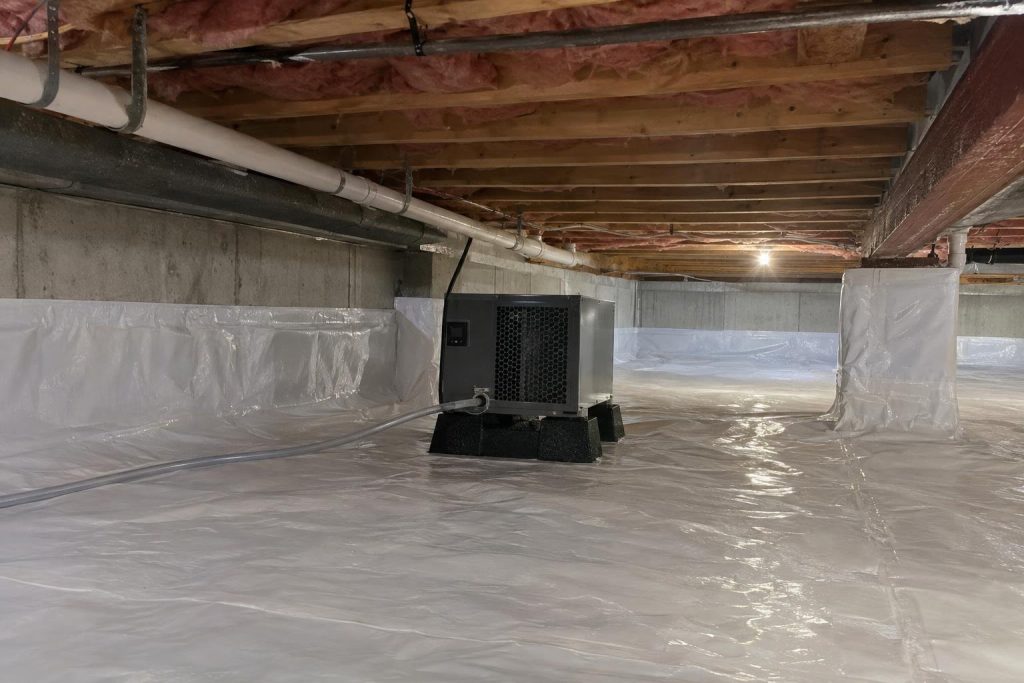
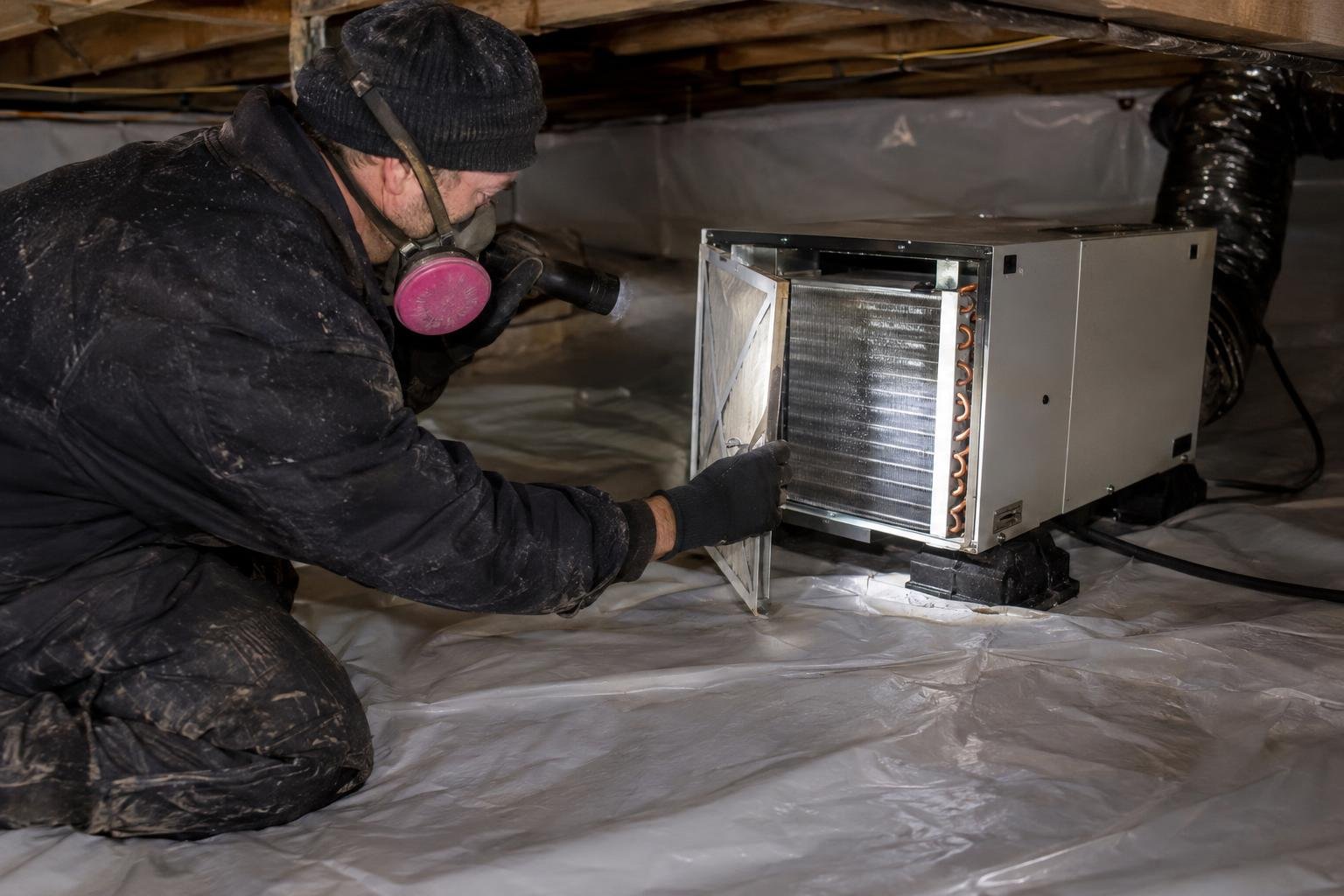
A crawl space dehumidifier is a mechanical appliance that extracts excess moisture from the air beneath your home, reducing relative humidity to a level that discourages mould growth, wood rot and pest activity. Unlike a standard portable unit, a purpose-built crawl space dehumidifier operates in low-clearance, unheated conditions and typically drains continuously to a sump or exterior point. It is one tool in a broader moisture-management strategy that may also include vapour barriers, encapsulation and drainage improvements.
- Crawl space humidity above roughly 60 percent relative humidity (RH) creates conditions favourable to mould and wood decay.
- A dehumidifier treats airborne moisture; it does not stop liquid water entry from the soil or foundation walls.
- Sizing is measured in litres per day (L/day) or pints per day and must match the crawl space volume and moisture load.
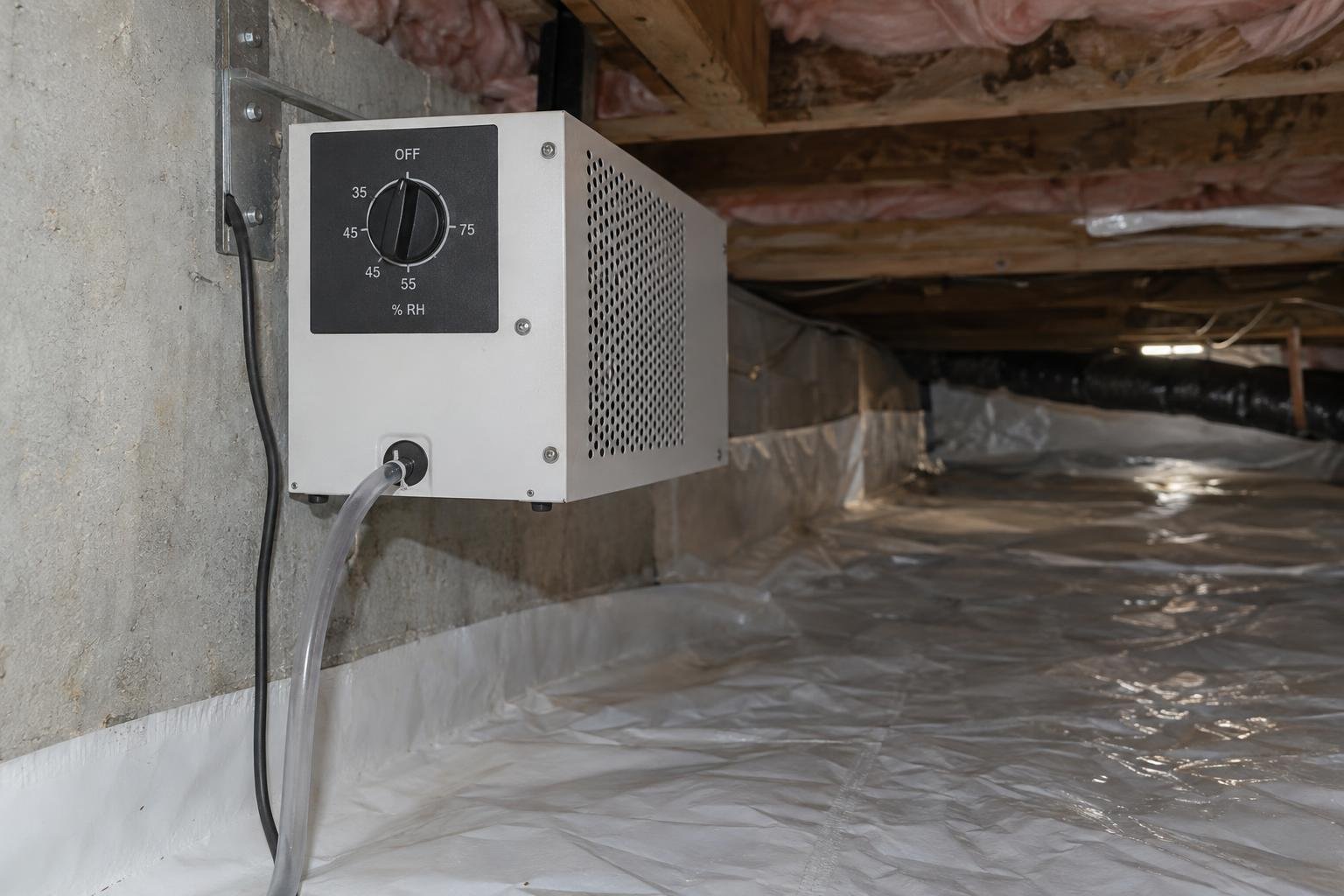
- Continuous drainage and a built-in humidistat are essential features for an unattended crawl space installation.
- In many Ontario crawl spaces, a dehumidifier works best as part of a complete encapsulation system rather than as a standalone fix.
Definitions & scope
A crawl space dehumidifier is a refrigerant-cycle or desiccant appliance designed specifically for the conditions found beneath a house: low clearance (typically 45 cm to 120 cm), temperatures that can drop near freezing in winter, high ambient humidity, and limited access for maintenance. Refrigerant-cycle models are the most common for Ontario crawl spaces with moderate to warm seasonal temperatures; desiccant models can operate at lower temperatures but consume more energy.
Capacity is rated in litres or pints of water removed per 24 hours under standard test conditions. Because real-world crawl spaces are cooler and more humid than laboratory conditions, manufacturers and industry guidance generally recommend selecting a unit rated higher than a simple volume calculation would suggest. The target operating range for a healthy crawl space is typically 50 to 55 percent RH, though some guidance sets the upper acceptable limit at 60 percent RH.
Scope of this guide covers unit types, sizing, placement, drainage, maintenance, integration with vapour barriers and encapsulation, cost drivers, and the decision of when a dehumidifier alone is sufficient versus when structural or drainage work must come first. It does not cover whole-house or basement dehumidifiers, which operate under different conditions.
Why this matters
Ontario’s climate creates persistent crawl space moisture challenges. Spring snowmelt and summer humidity drive ground moisture upward through bare soil floors by a process called vapour diffusion. Warm, humid outdoor air entering through foundation vents condenses on cooler crawl space surfaces in summer, a counterintuitive effect that has led many building scientists to recommend closing or conditioning crawl spaces rather than ventilating them. Health Canada and the Canada Mortgage and Housing Corporation (CMHC) both identify elevated indoor humidity and mould as indoor air quality concerns.
Moisture that accumulates in a crawl space does not stay there. It migrates upward into the living area, raising whole-house humidity, promoting mould on floor joists and subfloor sheathing, and accelerating the decay of wood structural members. Insulation batts between joists absorb moisture, lose R-value and can harbour mould colonies that are invisible from above. Pests including carpenter ants and certain wood-boring beetles are attracted to damp wood.
In cottage country and seasonal properties across Ontario, crawl spaces are often left unheated and unmonitored for months. Without active moisture control, a single winter or spring season can produce significant structural damage. A properly sized and maintained crawl space dehumidifier, integrated with a vapour barrier or full encapsulation, is the primary mechanical defence against these outcomes.
For more on the full range of crawl space moisture problems, see Crawl Space Moisture & Mould: Problems and Solutions and Wet Crawl Space: Causes, Urgency and How to Fix It.
Your options
Purpose-built crawl space refrigerant dehumidifier
What it is and how it works: A compact refrigerant-cycle unit engineered for low-clearance installation. Warm, moist air passes over a cold evaporator coil; moisture condenses and drains away while drier air is returned to the space. Most units include a built-in humidistat, auto-restart after power interruption, and a condensate pump or gravity drain connection.
Best for: Crawl spaces with moderate to high humidity caused by vapour diffusion from soil or humid outdoor air intrusion, where liquid water entry has already been addressed. Effective year-round in conditioned or semi-conditioned crawl spaces; less effective when temperatures drop below approximately 5°C without a low-temperature kit.
Limitations: Does not address liquid water entry. Requires a continuous drain path. Energy consumption is ongoing. Performance drops significantly at low temperatures without supplemental heating or a low-ambient kit.
Desiccant dehumidifier
What it is and how it works: Uses a rotating wheel coated with a moisture-absorbing material (typically silica gel) rather than refrigerant coils. Moisture is adsorbed from the airstream and then driven off by a regeneration heater into an exhaust stream vented outside. Operates effectively at temperatures well below freezing.
Best for: Unheated crawl spaces in colder Ontario climates, seasonal cottages where winter temperatures in the crawl space drop below 5°C, or situations where a refrigerant unit would ice up.
Limitations: Higher energy consumption than refrigerant units at moderate temperatures. Requires an exhaust duct to the exterior. Higher purchase cost. Less common, so local service availability may be limited.
Portable consumer-grade dehumidifier
What it is and how it works: A standard household dehumidifier placed in the crawl space. Operates on the same refrigerant-cycle principle as a purpose-built unit but is designed for conditioned interior spaces.
Best for: Temporary use or very mild moisture conditions in a crawl space that is close to conditioned space temperatures.
Limitations: Not rated for low temperatures; coils ice up readily. Requires manual bucket emptying unless gravity-drained. Shorter service life in crawl space conditions. Warranty typically void in unconditioned spaces. Generally not recommended as a permanent solution.
Crawl space encapsulation with integrated dehumidifier
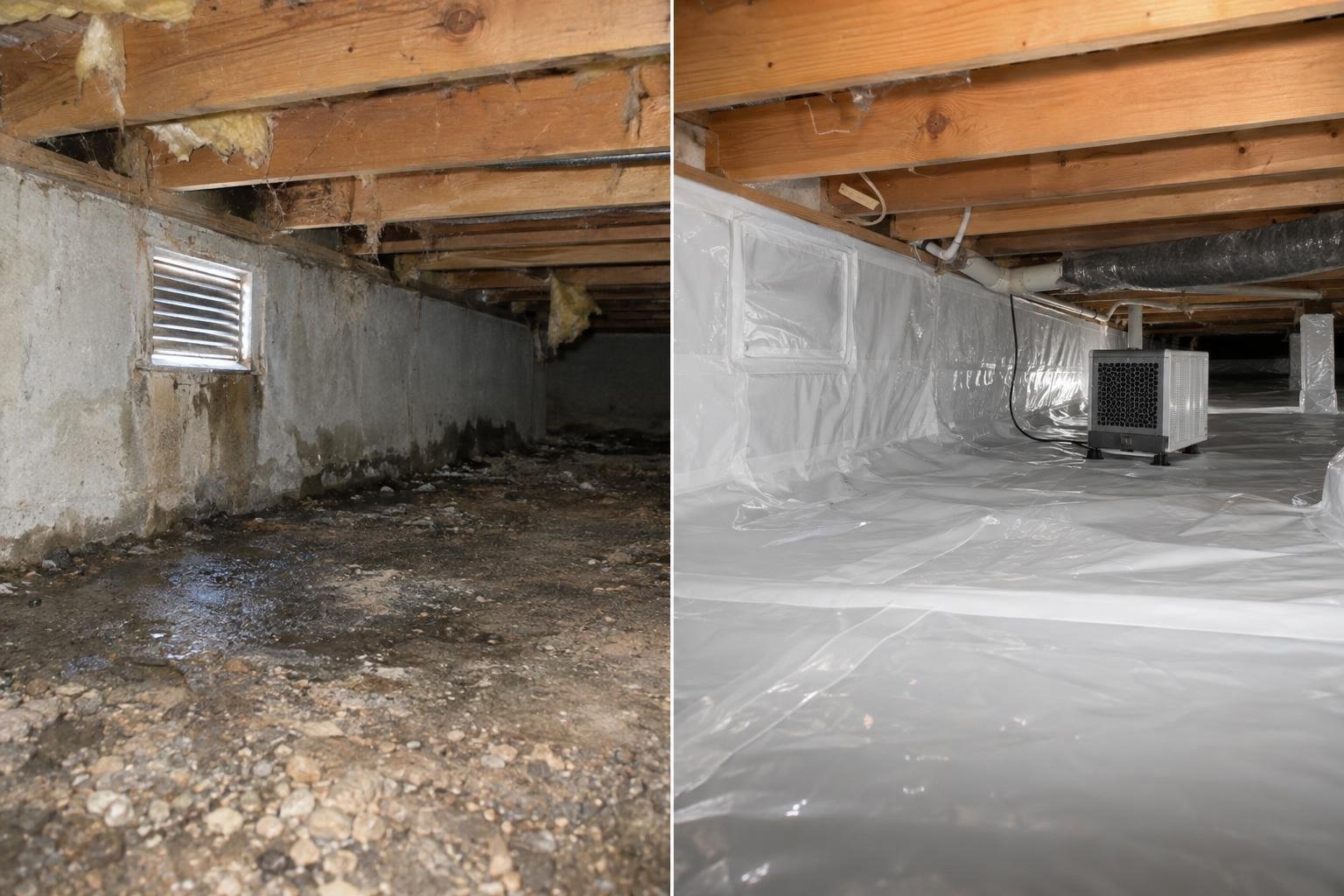
What it is and how it works: A heavy-duty polyethylene or reinforced vapour barrier is sealed to walls, piers and penetrations, converting the crawl space into a semi-conditioned encapsulated environment. A purpose-built dehumidifier is then installed inside the sealed space. The barrier dramatically reduces the moisture load the dehumidifier must handle, allowing a smaller unit to maintain target humidity levels more efficiently.
Best for: Crawl spaces with significant vapour diffusion from bare soil, homes where crawl space air quality affects the living area, and situations where long-term performance and energy efficiency are priorities. This is the approach most often recommended by building science practitioners for Ontario conditions.
Limitations: Higher upfront cost than a dehumidifier alone. Requires professional installation for the encapsulation component. Any liquid water entry must be resolved before encapsulation. See Crawl Space Encapsulation and Is Crawl Space Encapsulation Worth It? for a full analysis.
Passive ventilation (vented crawl space)
What it is and how it works: Foundation vents allow outdoor air to circulate through the crawl space, theoretically carrying moisture away. This was the standard approach for decades under older building codes.
Best for: Historically specified; still present in many existing Ontario homes.
Limitations: Building science research has shown that in humid climates, venting introduces warm, moist summer air that condenses on cooler crawl space surfaces, often worsening moisture conditions. The CMHC has documented this effect. Passive ventilation alone is not considered a reliable moisture control strategy in most Ontario conditions and is not a substitute for active dehumidification or encapsulation.
Crawl space conditioning (supply air from HVAC)
What it is and how it works: A small supply register from the home’s HVAC system delivers conditioned air to the encapsulated crawl space, maintaining temperature and humidity similar to the living area. Sometimes combined with a dehumidifier for peak summer loads.
Best for: Fully encapsulated crawl spaces in homes with forced-air HVAC, where the system has sufficient capacity.
Limitations: Requires HVAC system assessment and balancing. Not suitable for homes with hydronic heat only. May affect HVAC efficiency calculations. Requires encapsulation first.
Options compared
| Option | Best for | Typical considerations | Durability / limitations |
|---|---|---|---|
| Purpose-built refrigerant dehumidifier | Moderate to high vapour-diffusion moisture, conditioned or semi-conditioned crawl space | Continuous drain required; humidistat essential; low-temp kit needed below ~5°C | 5-10+ year service life with maintenance; performance drops at low temps |
| Desiccant dehumidifier | Unheated or very cold crawl spaces, seasonal cottages | Exhaust duct to exterior required; higher energy use | Effective at sub-zero temps; higher operating cost |
| Portable consumer unit | Temporary or mild conditions only | Manual emptying unless drained; warranty often void in crawl space | Short service life in crawl space conditions; not recommended long-term |
| Encapsulation + dehumidifier | High vapour load, air quality concerns, long-term performance | Higher upfront investment; liquid water must be resolved first | Most durable system; barrier lasts 20+ years with proper installation |
| Passive ventilation | Legacy systems only; not recommended as primary strategy | No energy cost; no active control | Often worsens summer moisture; not reliable in Ontario climate |
| HVAC conditioning | Fully encapsulated crawl space with forced-air HVAC | Requires system capacity assessment; encapsulation prerequisite | Effective when properly balanced; depends on HVAC maintenance |
The table highlights that no single option suits every crawl space. A purpose-built refrigerant dehumidifier is the most practical standalone choice for most Ontario homeowners with moderate moisture problems and a crawl space that stays above freezing. Where temperatures drop significantly, a desiccant unit or supplemental heating becomes necessary. For homes where crawl space air quality affects the living area or where vapour diffusion from bare soil is severe, encapsulation combined with a dehumidifier delivers the most reliable long-term outcome. Passive ventilation should not be relied upon as a primary moisture control strategy in Ontario’s climate.
How to choose
Choose a purpose-built refrigerant crawl space dehumidifier if: your crawl space stays above approximately 5°C year-round or during the months when moisture is highest; you have already addressed any liquid water entry; the crawl space has a vapour barrier on the soil floor; and you want a cost-effective, low-maintenance solution for ongoing humidity control.
Choose a desiccant dehumidifier if: your crawl space is unheated and temperatures drop well below freezing in winter; you have a seasonal cottage that is unoccupied for extended periods; or a refrigerant unit has previously iced up or underperformed in your specific space.
Choose encapsulation with an integrated dehumidifier if: your crawl space has a bare soil floor with significant vapour diffusion; you notice musty odours, high whole-house humidity, or mould on floor joists; you want the most durable and energy-efficient long-term system; or you are preparing the home for sale and want a documented, warrantied solution. See Crawl Space Encapsulation vs. Vapour Barrier for help distinguishing these approaches.
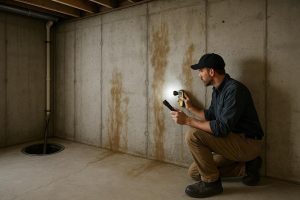
Do not rely on a dehumidifier alone if: there is visible liquid water entry through the foundation walls or floor; the crawl space floods seasonally; or there is active mould growth that requires remediation before moisture control equipment is installed. In those cases, address the water source first. Resources such as How to Stop Water Seeping Through Foundation Walls and Waterproofing a Basement: Your Complete Homeowner’s Guide can help you identify the right upstream fix.
Sizing decision: As a general starting point, industry guidance suggests selecting a unit rated for the crawl space volume with a generous safety margin to account for real-world conditions being more demanding than laboratory test conditions. A contractor assessment of actual moisture load, soil conditions and seasonal temperature range is the most reliable basis for sizing.
Costs & timelines
No verified current price data for Ontario crawl space dehumidifier installations has been supplied to this guide. The following describes cost drivers only; actual quotes will vary by contractor, region, unit specification and site conditions. Obtain written estimates before committing.
| Cost driver | Why it matters | Relative impact |
|---|---|---|
| Unit capacity (L/day rating) | Higher-capacity units cost more to purchase; undersizing leads to continuous operation and early failure | High |
| Unit type (refrigerant vs. desiccant) | Desiccant units typically carry a higher purchase price and installation complexity | High |
| Drain line installation | Gravity drain to sump or exterior is simplest; condensate pump adds cost if gravity is not available | Moderate |
| Electrical circuit | A dedicated circuit is recommended; adding one increases cost if not already present | Moderate |
| Crawl space access and clearance | Very low clearance or difficult access increases labour time significantly | Moderate to high |
| Encapsulation scope | If encapsulation is done at the same time, the combined project cost is higher but the per-component cost may be lower than two separate mobilizations | High (if applicable) |
| Ongoing energy consumption | A crawl space dehumidifier runs continuously during high-humidity months; energy cost is a real operating expense | Moderate (lifetime) |
Installation of a purpose-built unit in an accessible crawl space with an existing drain path is generally a one-day task. Adding a drain line, electrical circuit, or encapsulation extends the timeline. Seasonal timing matters: addressing moisture before summer humidity peaks or before spring snowmelt is preferable to reactive installation after damage has occurred.
Risks & common mistakes
Using a consumer-grade portable unit long-term. Standard household dehumidifiers are not designed for crawl space temperatures, humidity levels or the continuous-drain requirement. Coils ice up, buckets overflow, and units fail prematurely. This is one of the most common and costly mistakes homeowners make.
Undersizing the unit. A dehumidifier that runs at or near 100 percent duty cycle without reaching the target humidity set point is undersized. It will wear out faster and never adequately protect the space. Real-world crawl space conditions are consistently more demanding than the standard test conditions used to rate unit capacity.
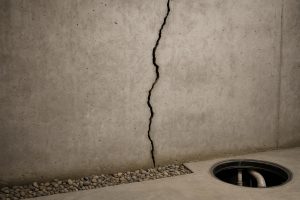
Installing a dehumidifier without addressing liquid water entry. A dehumidifier cannot remove standing water or stop active seepage through foundation walls. Running a dehumidifier in a space with active water entry will overload the unit, void warranties and mask a problem that will worsen over time. Resolve drainage and waterproofing issues first.
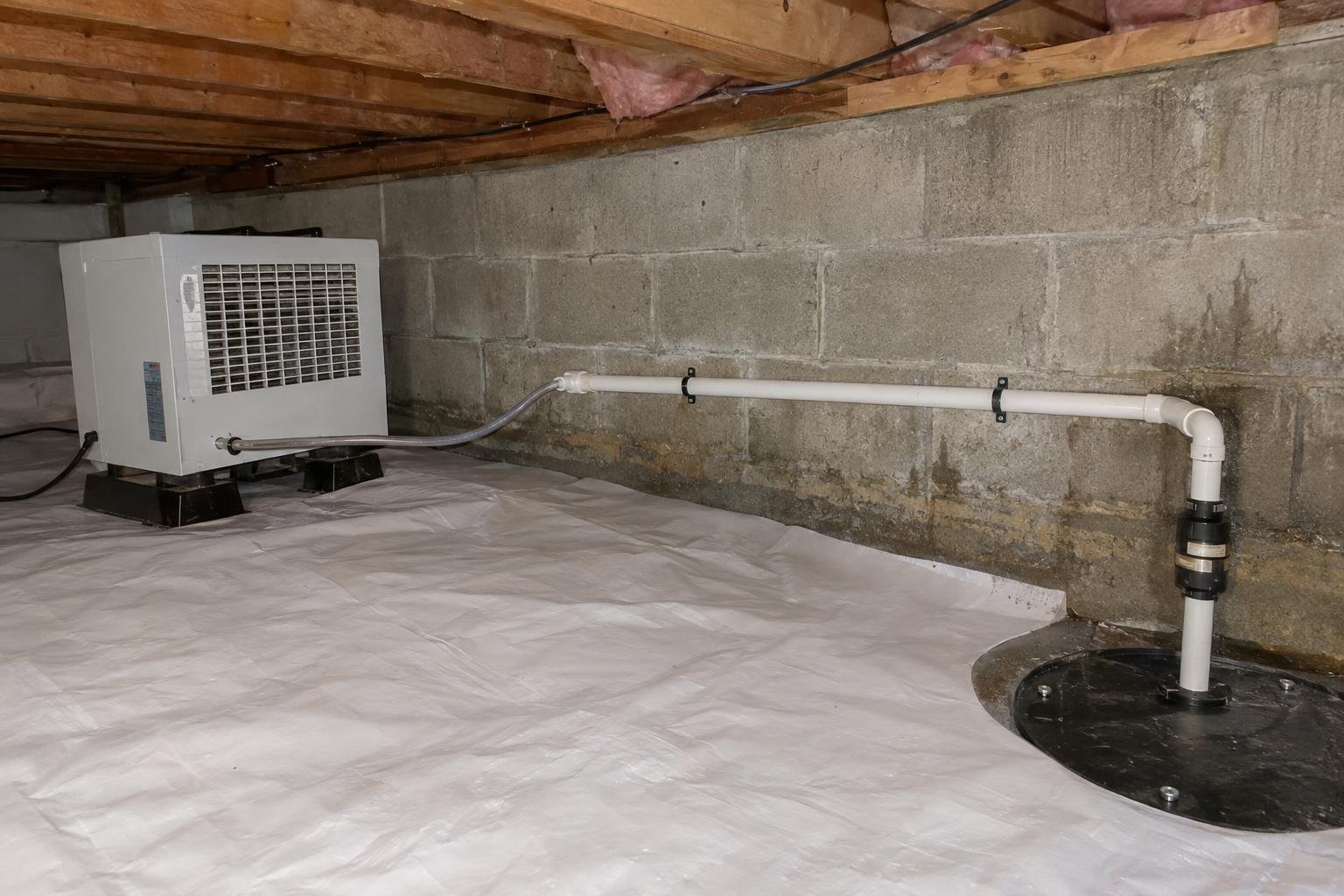
No continuous drain path. A unit with a reservoir that fills and shuts off provides no protection once the reservoir is full. A gravity drain to a sump pit or condensate pump to the exterior is essential for unattended operation.
Skipping the humidistat or setting it incorrectly. Without a humidistat, the unit runs continuously regardless of conditions, wasting energy and shortening equipment life. Setting the target too high (above 60 percent RH) allows mould-favourable conditions to persist; setting it too low wastes energy and can over-dry wood framing in some conditions.
Neglecting maintenance. Coils, filters and drain lines require periodic cleaning. A clogged drain line causes water to back up and potentially overflow into the crawl space. Dirty coils reduce efficiency. Most manufacturers specify inspection intervals; follow them.
Assuming a dehumidifier eliminates the need for a vapour barrier. Without a barrier over the soil floor, the dehumidifier must continuously remove moisture evaporating from the ground. A vapour barrier dramatically reduces this load and allows the unit to maintain target humidity with far less energy and run time. For a comparison of approaches, see Crawl Space Encapsulation vs. Vapour Barrier.
Ignoring mould before installation. Installing a dehumidifier in a crawl space with existing mould growth does not remediate the mould. Active mould colonies must be treated before moisture control equipment is installed. See Mold in Your Basement: Causes, Urgency and How to Fix It for guidance on when professional remediation is needed.
How the process works
- Assessment. A technician inspects the crawl space for liquid water entry, existing vapour barriers, mould, structural damage, clearance, drain options and electrical availability. Moisture readings are taken at multiple points. Any active water entry or mould is documented before equipment selection.
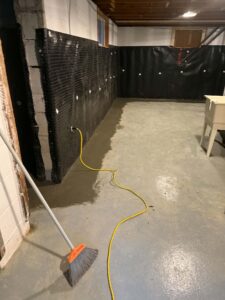
- Prerequisite work. Liquid water issues are resolved first (drainage improvements, crack injection, sump pump installation as needed). Existing mould is remediated. A vapour barrier is installed or upgraded if not already present.
- Unit selection and positioning. The dehumidifier is sized to the crawl space volume and moisture load. Placement is chosen to maximize air circulation; in larger crawl spaces, ducted distribution may be used to ensure even coverage.
- Drain and electrical installation. A continuous drain line is routed to a sump pit, floor drain or exterior point. A dedicated electrical circuit is confirmed or installed. The unit is connected and the humidistat is set to the target RH (typically 50 to 55 percent).
- Commissioning and baseline reading. The unit is run and initial humidity readings are recorded. The technician confirms the drain is flowing correctly and the unit cycles as expected.
- Homeowner handover. Maintenance intervals, filter cleaning procedures, drain line inspection and humidistat settings are explained. Warranty documentation is provided.
- Follow-up monitoring. Humidity should be checked periodically, especially at the start of each high-humidity season. Smart dehumidifiers with Wi-Fi monitoring allow remote tracking, which is particularly valuable for seasonal or unoccupied properties.
Frequently asked questions
What relative humidity level should a crawl space dehumidifier maintain?
Most building science guidance targets 50 to 55 percent relative humidity in a crawl space. Staying below 60 percent RH is generally considered the minimum threshold for discouraging mould growth on wood surfaces. Setting the humidistat lower than 50 percent wastes energy without meaningful additional benefit in most cases, and very low humidity can cause wood framing to dry and shrink excessively over time.
Can I use a regular basement dehumidifier in my crawl space?
A standard consumer-grade dehumidifier is not recommended for permanent crawl space use. These units are designed for conditioned interior spaces and are not rated for the low temperatures, high humidity and continuous-drain requirements of a crawl space. Coils ice up at temperatures below approximately 18°C, performance drops sharply, and the unit’s service life is significantly shortened. A purpose-built crawl space dehumidifier is a better long-term investment.
How big a dehumidifier do I need for my crawl space?
Sizing depends on the crawl space floor area, ceiling height, soil moisture load, vapour barrier condition, and seasonal temperature range. Industry guidance consistently recommends selecting a unit with capacity above what a simple volume calculation suggests, because real-world crawl space conditions are more demanding than laboratory test ratings. A professional assessment of your specific space is the most reliable way to determine the correct size. Undersizing is a common and costly mistake.
Does a crawl space dehumidifier work without encapsulation?
A dehumidifier can reduce crawl space humidity without encapsulation, but it will work much harder and consume significantly more energy because it must continuously remove moisture evaporating from bare soil. A vapour barrier over the soil floor dramatically reduces the moisture load. Full encapsulation, which seals the barrier to walls and penetrations, reduces the load further. In most Ontario crawl spaces, a dehumidifier combined with at least a ground-level vapour barrier performs far better than a dehumidifier alone. See Is Crawl Space Encapsulation Worth It? for a cost-benefit analysis.
How often does a crawl space dehumidifier need maintenance?
Maintenance requirements vary by model, but most manufacturers recommend inspecting and cleaning the air filter every one to three months during active operation, checking the drain line for blockages at the same interval, and cleaning the evaporator coils annually. In a crawl space environment, dust, debris and biological growth can accumulate faster than in a conditioned interior space. Following the manufacturer’s schedule and keeping a maintenance log is the best way to protect the unit’s service life and warranty.
Will a crawl space dehumidifier stop mould from growing?
Maintaining relative humidity below 60 percent removes one of the key conditions mould requires to grow and spread. However, a dehumidifier does not kill or remove existing mould colonies. If mould is already present on joists, sheathing or insulation, professional remediation is required before or alongside dehumidifier installation. Controlling humidity after remediation helps prevent recurrence. For more on mould in below-grade spaces, see Mold in Your Basement: Causes, Urgency and How to Fix It.
Should I close my crawl space vents if I install a dehumidifier?
Building science research, including work published by the CMHC, has shown that open foundation vents often worsen crawl space moisture in humid climates because warm, moist summer air condenses on cooler crawl space surfaces. If you are installing a dehumidifier as part of an encapsulated or conditioned crawl space, closing the vents and sealing the crawl space is generally recommended. This should be done as part of a planned encapsulation project, not simply by plugging vents without addressing the overall moisture management strategy.
How long does a crawl space dehumidifier last?
A purpose-built crawl space dehumidifier that is correctly sized, properly installed with a continuous drain, and maintained according to the manufacturer’s schedule can reasonably be expected to last five to ten or more years. Units that are undersized, allowed to run with clogged drains or filters, or operated outside their rated temperature range will fail sooner. Warranty terms vary by manufacturer and should be reviewed before purchase.
Is a crawl space dehumidifier enough, or do I also need waterproofing?
A dehumidifier addresses airborne moisture only. If your crawl space has liquid water entry through foundation walls, floor cracks, or poor perimeter drainage, a dehumidifier cannot solve that problem and will be overwhelmed trying to compensate. Waterproofing or drainage improvements must come first. Once liquid water entry is controlled, a dehumidifier manages the residual vapour-diffusion moisture. If you are unsure of the source of your crawl space moisture, a professional inspection is the right starting point. Related resources include French Drain vs Weeping Tile and Interior vs Exterior Weeping Tile.
If you have questions about your crawl space moisture situation or want to discuss whether a dehumidifier, encapsulation, or a combined approach is right for your home, the DryShield team serves Toronto, the GTA and Ontario cottage country and is available to assess your space. Visit our Crawl Space Encapsulation page or use the contact page to get in touch.