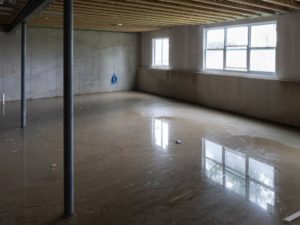
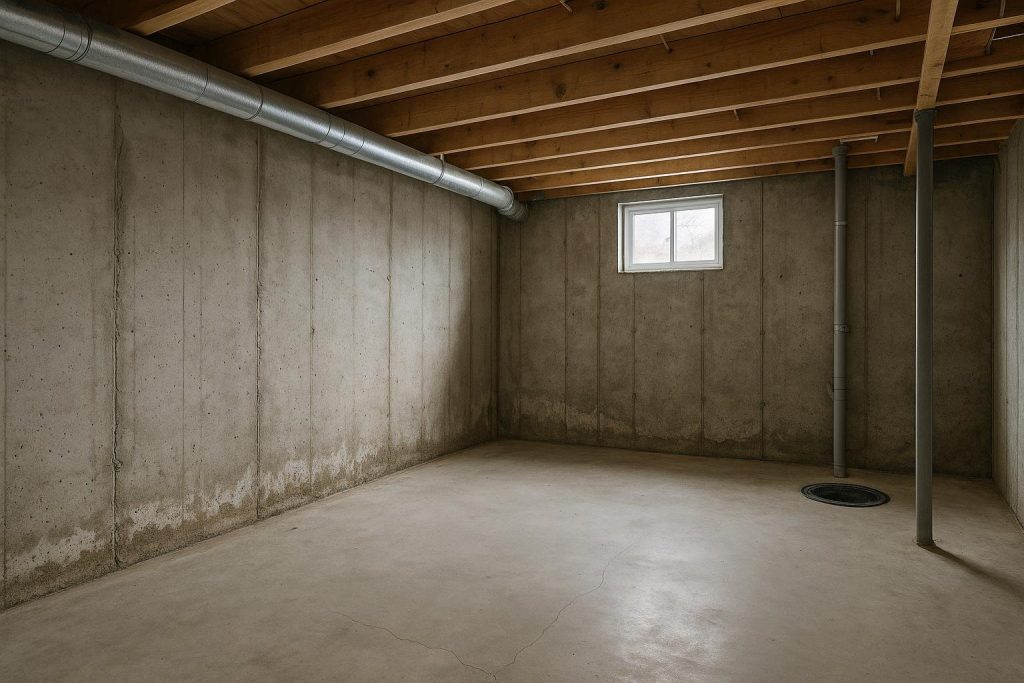
Basement leak repair Springwater homeowners need most often traces back to hydrostatic pressure building against foundation walls during spring snowmelt and heavy summer rain. Springwater Township sits on a mix of sandy loam and clay-rich till that drains unevenly, meaning water can pool against a footing for days after a storm and force its way through any crack or joint in the foundation wall.
Key Takeaways
- Hydrostatic pressure from Springwater’s variable soils is the most common root cause of a wet basement, not surface water alone.
- A single foundation crack injected with polyurethane typically costs $600 to $900; a full interior weeping tile system or exterior waterproofing runs considerably more and depends on a site inspection.
- Spring snowmelt and July-August downpours are the two peak failure windows for Springwater foundations.
- Older homes in Springwater’s rural hamlets often have original clay weeping tile that has silted up completely and no longer drains.
- The right repair method depends on where water enters, the foundation type, and how much disruption you can accept.
Definitions and Scope
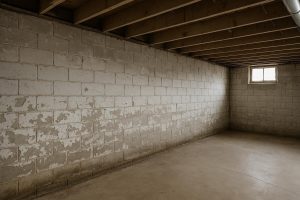
A basement leak is any unwanted water entry below grade, whether it seeps through a hairline crack in a poured concrete wall, pushes up through a floor joint, or weeps through a block foundation. The repair scope depends on the entry point and the pressure driving the water.
Springwater Township covers a wide area from Midhurst in the south to Elmvale in the north, with properties ranging from newer subdivisions on sandy fill to century farmhouses on stone or block foundations. Each foundation type responds differently to water, and each soil condition creates a different pressure profile against the wall. A proper diagnosis must account for both before any basement leak repair Springwater technicians recommend can begin.
The core trade terms you will encounter: hydrostatic pressure is the force water exerts against a buried wall; weeping tile is a perforated pipe at the footing that collects and redirects that water; a sump pump receives the collected water and discharges it away from the building; a rubberised membrane applied to the exterior face of the wall blocks water before it reaches the concrete; and polyurethane crack injection fills a crack from the inside with a flexible, waterproof foam that tolerates seasonal foundation movement.
Why Basement Leak Repair Springwater Properties Need Matters
Springwater’s geography creates conditions that accelerate foundation water problems. The Oro Moraine to the east and the sandy outwash plains around Elmvale produce highly variable drainage. In some areas, water moves quickly through coarse sand and gravel; in others, a thin clay layer sits just below the topsoil and acts as a perched water table that directs runoff straight toward foundation walls.
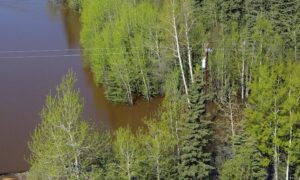
Spring thaw is the most dangerous season. Snowpack across Simcoe County can be substantial, and when temperatures rise quickly in March and April, the ground is still frozen below the surface. Meltwater has nowhere to go except laterally, and it finds the path of least resistance: the disturbed backfill zone around your foundation. That is where hydrostatic pressure peaks.
Ignoring a small crack or a damp corner is rarely a stable situation. Water that enters repeatedly causes efflorescence, spalling concrete, and eventually mould growth on framing and insulation. For a broader look at how waterproofing fits into Simcoe County homes generally, the Simcoe County basement waterproofing guide covers the regional picture in detail. The Canada Mortgage and Housing Corporation also publishes guidance on moisture control in residential foundations at cmhc-schl.gc.ca, which is worth reading alongside any contractor quote.
Your Options for Basement Leak Repair in Springwater
Polyurethane Crack Injection
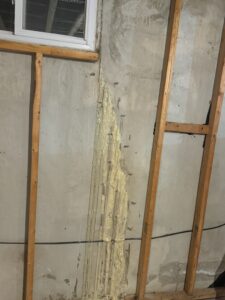
Low-pressure polyurethane injection is the standard repair for a single non-structural crack in a poured concrete wall. A technician drills ports along the crack at intervals, pastes surface caps over them, then injects expanding polyurethane foam that fills the crack from the footing up to the wall surface. The foam cures flexible, so it accommodates the minor seasonal movement that is normal in Ontario foundations without re-cracking.
This method works best when the crack is isolated, the wall is otherwise sound, and there is no sign of ongoing hydrostatic pressure overwhelming the entire perimeter. It is not appropriate for horizontal cracks, which indicate lateral soil pressure and may require structural assessment, or for block foundations where water migrates through mortar joints across a wide area.
Epoxy Crack Injection
Epoxy injection is used when a crack is structural and the two sides of the wall must be re-bonded into a single rigid unit. Epoxy cures rigid and achieves compressive strengths that exceed the original concrete. The trade-off is that a rigid repair in a wall that still moves seasonally can re-crack adjacent to the repair line. For this reason, epoxy is reserved for cracks where structural re-bonding is the priority, not waterproofing alone.
Interior Weeping Tile System
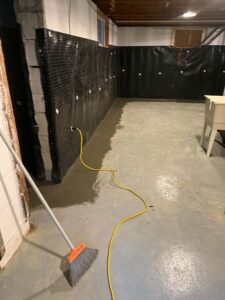
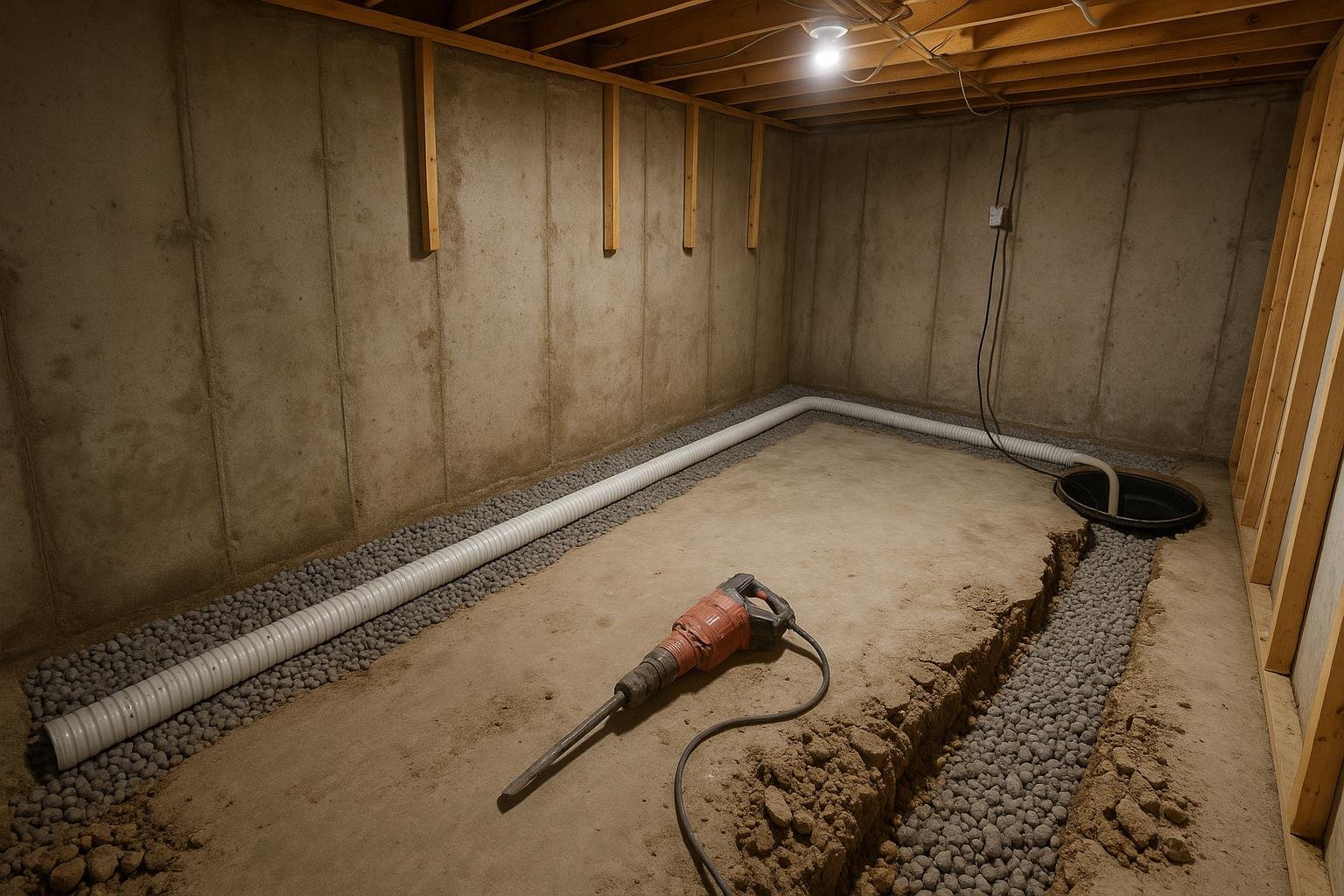
Where water enters along the perimeter at the wall-floor joint, or where hydrostatic pressure is too high for crack injection alone to hold, an interior weeping tile system manages the water rather than blocking it. The perimeter concrete is jackhammered, a perforated pipe is laid in clear stone at the footing level, and everything drains to a sump basin where a pump discharges the water outside. A vapour barrier is run up the wall and sealed to the pipe, keeping the finished space dry.
This approach works in almost any foundation type and does not require excavation. The limitation is that it manages water entry rather than stopping it at the source, so the exterior face of the wall continues to experience hydrostatic pressure.
Exterior Waterproofing
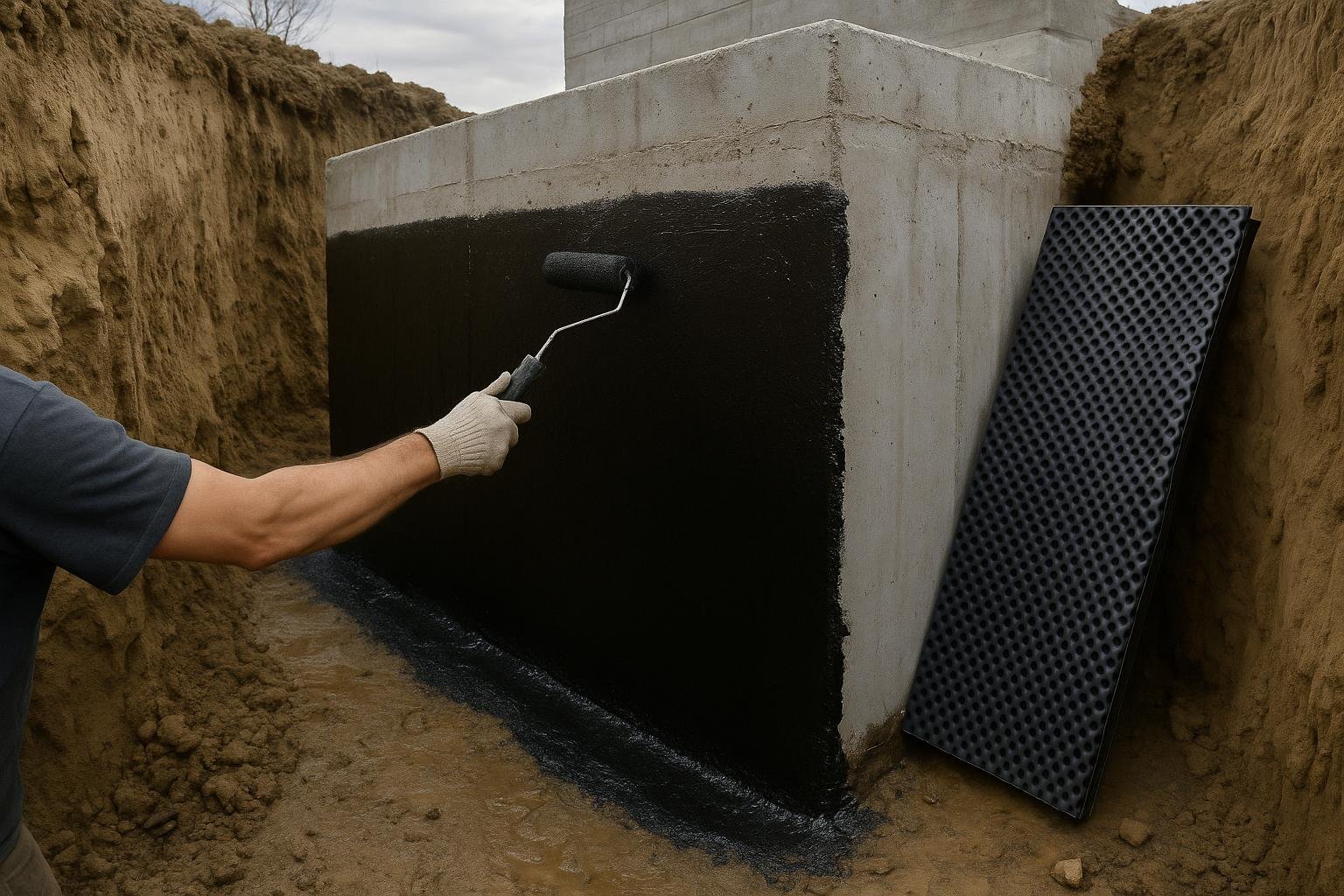
Full exterior waterproofing addresses the problem at its source. Excavation exposes the foundation wall to the footing. Any voids or cracks are filled with hydraulic cement and parging. A rubberised membrane is applied to the wall face, followed by a dimpled drainage board that protects the membrane and channels water downward. New weeping tile bedded in clear stone is installed at the footing, and the trench is backfilled with the grade corrected to slope away from the building.
This is the most comprehensive solution and carries the longest service life, but it requires excavation around the perimeter, which means disruption to landscaping, decks, or driveways. For Springwater rural properties with good access, this is often the preferred long-term fix for basement leak repair Springwater homeowners face year after year.
Sump Pump Installation or Replacement
A sump pump is often the final component of an interior or exterior system, but it can also be installed as a standalone upgrade where a basin already exists but the pump is undersized or aging. In Springwater, where power outages during spring storms are not uncommon, a battery backup unit is worth serious consideration. A pump that fails during a thaw event can result in significant water damage before anyone notices.
Weeping Tile Replacement
Many Springwater homes built before the 1980s have original clay or concrete weeping tile that has either collapsed or silted up entirely. When the original drainage system no longer functions, water has no outlet and hydrostatic pressure builds until it finds a crack. Replacing failed weeping tile, either from the interior or as part of an exterior dig, restores the drainage the system was designed to provide.
Options Compared
| Method | Best For | Typical Lifespan | Relative Cost | Disruption |
|---|---|---|---|---|
| Polyurethane crack injection | Single non-structural crack in poured concrete | Long-term if foundation is stable | Lowest | Minimal, interior access only |
| Epoxy crack injection | Structural cracks requiring wall re-bonding | Permanent if no further movement | Low to moderate | Minimal, interior access only |
| Interior weeping tile system | Perimeter seepage, high hydrostatic pressure | 25 years or more with pump maintenance | Moderate | Moderate, jackhammer perimeter slab |
| Exterior waterproofing | Comprehensive protection, failed membrane | Lifetime with proper membrane | Highest | High, full excavation required |
| Sump pump installation | Complement to weeping tile, backup protection | 7 to 10 years per pump unit | Low to moderate | Low, basin excavation only |
| Weeping tile replacement | Failed or silted original drainage pipe | 25 to 40 years | Moderate to high | High if exterior, moderate if interior |
The table shows that no single method suits every situation. Crack injection is fast and affordable for an isolated problem, but it will not solve a perimeter drainage failure. Exterior waterproofing is the most thorough option but also the most disruptive and expensive. Most Springwater homes with chronic wet basements end up needing a combination: crack injection for any active wall cracks, plus an interior or exterior drainage system to manage ongoing hydrostatic pressure.
How to Choose the Right Repair
Choose polyurethane crack injection if you have one or two visible vertical cracks in a poured concrete wall, the rest of the wall is dry, and the crack appeared after a specific event like a hard frost or a nearby excavation. This is the fastest and most cost-effective fix when the problem is genuinely isolated.
Choose an interior weeping tile system if water enters along the base of the wall or at the wall-floor joint across more than one wall, if the basement has a history of seasonal flooding, or if exterior excavation is not practical because of a deck, finished landscaping, or a shared property line. Interior systems are also the right call when the foundation is block rather than poured concrete, because block walls allow water to migrate through every mortar joint.
Choose exterior waterproofing if the original membrane has failed, if the weeping tile at the footing is confirmed to be collapsed or silted, or if you want the most comprehensive long-term solution and have the access and budget for excavation. Rural Springwater properties with open yard space around the foundation are good candidates.
Choose sump pump replacement or upgrade if the existing pump is more than seven years old, has cycled heavily during recent thaw seasons, or if you have no battery backup and experience power outages. A failed pump during a spring thaw is one of the most common causes of sudden basement flooding in this region. When evaluating basement leak repair Springwater options, the pump is often the last line of defence.
A single foundation crack injected with polyurethane typically costs $600 to $900. A full exterior waterproofing job on an average Springwater home runs roughly $6,000 to $9,000 depending on linear footage, depth of excavation, and site access. Every final figure depends on a site inspection.
Costs and Timelines
| Cost Driver | Why It Affects Price | Approximate Impact |
|---|---|---|
| Linear footage of affected perimeter | More wall means more pipe, membrane, and labour | Primary driver for weeping tile and exterior jobs |
| Depth of excavation | Deeper footings require more excavation time and shoring | Significant on older homes with deep foundations |
| Site access | Tight access limits equipment; hand-digging costs more | Can add materially to exterior waterproofing cost |
| Foundation type | Block foundations require more prep than poured concrete | Moderate increase for block or stone |
| Number of cracks | Each crack requires individual port-and-paste injection | $600 to $900 per crack, approximately |
| Existing drainage condition | Fully silted weeping tile adds removal and disposal cost | Moderate to significant depending on extent |
Crack injection is the most predictable cost: one crack, one visit, a defined price range. Interior weeping tile systems scale with perimeter length and the condition of the existing slab. Exterior waterproofing is the most variable because excavation depth, access constraints, and the state of the original membrane all affect the final number. For a detailed breakdown of what Ontario homeowners pay across repair types, the basement leaking repair cost guide covers the full range. Always get a written scope with linear-foot pricing before any work begins.
Springwater homes on rural lots often have deeper footings than newer suburban builds, which increases excavation time and cost for exterior waterproofing. Confirm footing depth during the inspection.
Risks and Common Mistakes
| Symptom | Likely Cause | Correct Fix |
|---|---|---|
| Water at wall-floor joint after rain | Hydrostatic pressure overwhelming footing drainage | Interior weeping tile to sump, or exterior waterproofing |
| Vertical crack weeping during thaw | Shrinkage crack opened by freeze-thaw cycling | Polyurethane crack injection |
| Horizontal crack in block wall | Lateral soil pressure, possible structural concern | Structural assessment before any waterproofing |
| White powder on wall surface | Efflorescence from mineral-laden water migrating through concrete | Identify and seal entry point; treat surface after |
| Sump pump running constantly | High water table or failed exterior drainage | Inspect weeping tile; consider exterior waterproofing |
The most common mistake Springwater homeowners make is applying hydraulic cement or waterproofing paint to the interior wall surface and expecting it to hold. These products can slow minor seepage temporarily, but they cannot resist sustained hydrostatic pressure. When pressure builds, the patch fails, often taking a section of the wall surface with it.
A second frequent error is replacing a sump pump without investigating why it is running so hard. A pump that cycles every few minutes during dry weather is a sign that the weeping tile is directing more water than it should, or that the exterior membrane has failed and water is reaching the footing in volume. Replacing the pump without addressing the source just delays the next failure.
Skipping a proper inspection and choosing a repair method based on cost alone is also risky. Crack injection on a wall that has a failed drainage system behind it will not stay dry. The water will find the next weakest point. For a look at how to identify what your specific crack pattern means, the foundation crack troubleshooting guide is a useful starting point.
Never apply hydraulic cement or masonry paint over a crack and consider the job done. These are surface treatments, not waterproofing systems. They will not hold against sustained hydrostatic pressure.
How the Repair Process Works
- Free on-site inspection and moisture assessment. A technician walks the perimeter inside and out, checks the grading, locates any visible cracks, tests for moisture with a meter, and identifies whether the water source is hydrostatic pressure, surface runoff, or a plumbing issue.
- Written scope with linear-foot pricing. You receive a clear proposal showing exactly what work will be done, which materials will be used, and how the price is calculated. No vague estimates.
- Preparation and access. For crack injection, ports are drilled and surface caps are pasted. For interior systems, the perimeter slab is jackhammered and debris is removed. For exterior work, excavation begins at the foundation wall and continues to the footing.
- Core repair work. Cracks are injected, membrane is applied, weeping tile is installed in clear stone, or the interior drainage channel is laid to the sump basin. Hydraulic cement is used to fill any voids before membrane application on exterior jobs.
- Drainage and waterproofing layers. On exterior jobs, dimpled drainage board is applied over the membrane to protect it and channel water to the new weeping tile. On interior jobs, a vapour barrier is run up the wall and sealed to the drainage channel.
- Backfill, grade correction, and cleanup. Exterior trenches are backfilled and the grade is corrected to slope away from the building. Interior concrete is re-poured over the new drainage system. The site is left clean.
- Final walkthrough and warranty documentation. The completed work is reviewed with the homeowner. DryShield’s lifetime transferable warranty is documented and explained, covering the waterproofing system for as long as you own the home.
For homeowners who want to understand what a full interior repair involves before booking an inspection, the guide on how to fix a leaking basement from the inside walks through the interior method in detail. Basement leak repair Springwater projects of every type are covered by DryShield’s service area, which spans all of Simcoe County.
Frequently Asked Questions
How do I know if my Springwater basement leak needs crack injection or a full drainage system?
If water enters through one or two visible vertical cracks in a poured concrete wall and the rest of the basement is dry, crack injection is usually the right starting point. If water appears along the base of multiple walls, at the wall-floor joint, or during every heavy rain regardless of where cracks are, a drainage system is the more appropriate solution. A site inspection is the only reliable way to confirm which applies to your home.
What causes basement leaks in Springwater specifically?
Springwater’s soil varies from sandy loam to clay-rich till depending on location. Clay-heavy areas hold water against foundation walls for extended periods after rain or snowmelt, building hydrostatic pressure that forces water through cracks and joints. Sandy areas drain faster but can channel large volumes of water toward the foundation during heavy events. Spring thaw and summer downpours are the two peak risk windows.
How much does basement leak repair cost in Springwater?
A single crack injected with polyurethane typically costs $600 to $900. An interior weeping tile system covering the full perimeter generally costs less than a full exterior waterproofing job, which runs roughly $6,000 to $9,000 for an average home depending on linear footage, footing depth, and site access. Every final number depends on a site inspection and a written scope.
Can I repair a basement leak myself?
Surface-applied hydraulic cement or masonry sealers are available at hardware stores, but they cannot resist sustained hydrostatic pressure and typically fail within one or two seasons. Crack injection requires specialised low-pressure equipment and the correct polyurethane or epoxy formulation. Interior drainage systems require jackhammering, proper pipe bedding, and a correctly sized sump basin. Professional repair is the only approach that addresses the root cause reliably.
How long does a basement leak repair take?
Crack injection on a single crack is typically completed in a few hours. An interior weeping tile system covering a full perimeter usually takes one to two days. Full exterior waterproofing, including excavation and backfill, generally takes two to four days depending on the size of the home and site conditions. Your written scope will include a timeline estimate.
Does basement waterproofing come with a warranty in Springwater?
DryShield provides a lifetime transferable warranty on waterproofing systems, meaning the coverage transfers to the next owner if you sell the home. Crack injection carries its own warranty. Warranty terms should be reviewed in writing before any work begins, and you should confirm exactly what is and is not covered.
What happens if I ignore a basement leak?
A small crack that weeps seasonally will typically widen over time as freeze-thaw cycling works the edges apart. Ongoing moisture promotes mould growth on wood framing, insulation, and drywall, which creates an air quality problem and a costly remediation job. Sustained hydrostatic pressure can eventually cause wall deflection, particularly in block foundations. Early repair is almost always less expensive than waiting.
Is exterior or interior waterproofing better for Springwater homes?
Exterior waterproofing addresses the problem at the source and is the most comprehensive solution, but it requires excavation and is not always practical on properties with limited access or finished landscaping. Interior systems manage water effectively without excavation and suit most foundation types. The right choice depends on your foundation type, the source of the water entry, your site conditions, and your budget. A site inspection will clarify which approach makes sense for your specific home.
If you are dealing with basement leak repair Springwater situations and want a clear answer on what is causing it and what it will cost to fix, contact DryShield for a free on-site inspection. A technician will assess the foundation, identify the water source, and provide a written scope with no obligation. Serving Springwater, Midhurst, Elmvale, and all of Simcoe County.