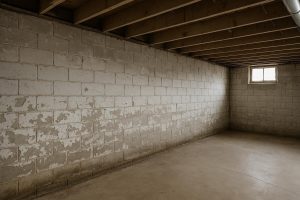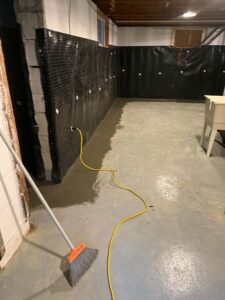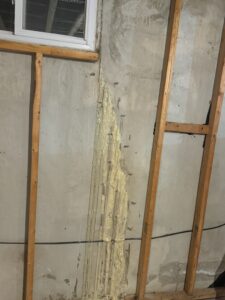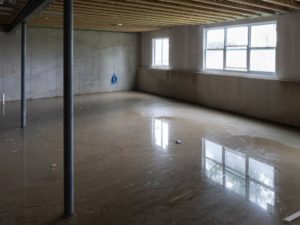
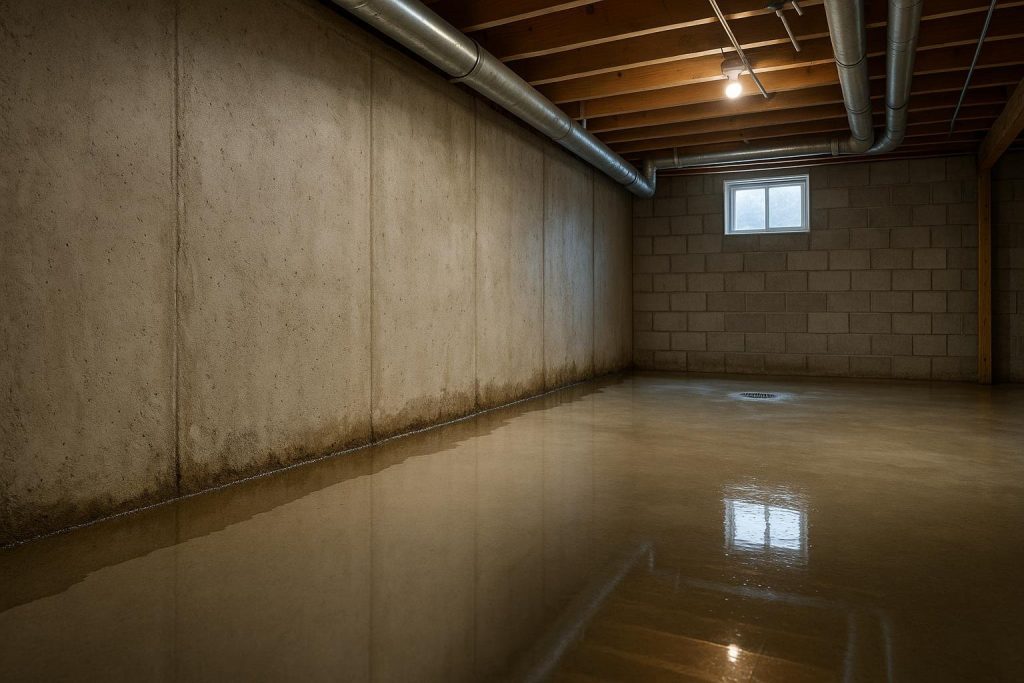
Foundation crack repair Springwater homeowners need most often involves low-pressure polyurethane injection, though the right method depends on crack type, wall material and how much water is actively entering the home. Springwater Township sits in Simcoe County on a mix of sandy loam and clay-rich till, and the freeze-thaw cycle here is severe enough that poured-concrete foundations crack regularly, especially in homes built on sloped lots near Midhurst, Minesing and Elmvale.
Key Takeaways
- Most non-structural cracks in poured concrete walls are fixed with interior polyurethane injection, typically in the $600 to $900 range per crack.
- Springwater’s freeze-thaw cycle and mixed soil conditions accelerate crack formation, particularly in homes on sloped or poorly drained lots.
- Structural cracks, horizontal cracks and cracks with active displacement require an engineer’s assessment before any repair begins.
- Interior injection is the least disruptive option; exterior excavation is reserved for cracks that cannot be sealed from inside or where the membrane has failed.
- A free on-site inspection is the only reliable way to confirm the repair method and get an accurate price.
Definitions and Scope
A foundation crack is any break in the wall or footing of a home’s structural base. In Springwater, the vast majority of residential foundations are poured concrete, though older farmhouses in the rural parts of the township sometimes have block or stone foundations. Cracks are classified by orientation, width and whether they show displacement or active water infiltration.
Vertical cracks are the most common type in poured concrete and usually result from concrete shrinkage or hydrostatic pressure building up against the wall. Diagonal cracks often follow stress lines from window corners or footing transitions. Horizontal cracks are the most serious category because they indicate lateral soil pressure pushing the wall inward, which is a structural concern that goes beyond simple sealing.
Scope matters because the repair method for a hairline shrinkage crack is completely different from the repair needed for a crack that has shifted or is actively bowing. Getting the diagnosis right before any product touches the wall is the most important step in the whole process.
Why This Matters for Springwater Homeowners
Foundation crack repair Springwater properties require is shaped heavily by local climate. Springwater Township experiences some of the heaviest snowfall accumulation in Simcoe County, and the spring thaw is the single highest-risk period for foundation water entry. Snow melt saturates the ground quickly, and where drainage is poor or the grade slopes toward the house, water pools against the foundation wall. Hydrostatic pressure, not rainfall alone, is the root cause of most wet basements in this area.
The soil profile in Springwater is variable. Lots near Barrie’s southern edge tend to sit on compacted clay that holds water against the wall for weeks after a thaw. Properties further into the township toward Elmvale and Minesing often have sandier soil that drains faster but allows frost to penetrate deeper, creating more aggressive freeze-thaw cycling at the footing level.
Springwater’s average frost depth exceeds 1.2 metres in a typical winter. Foundations that were not built with adequate drainage at the footing are especially vulnerable to crack formation as the ground heaves and settles each season.
Older homes in the township, particularly those built before the 1980s, commonly have original weeping tile made from clay or perforated clay pipe that has silted up completely. When the weeping tile fails, water that should drain away from the footing instead builds up and finds the path of least resistance, which is usually an existing crack or a cold joint in the wall. For a broader look at how these issues play out across Simcoe County, the Simcoe County basement waterproofing guide covers the regional picture in detail.
Your Options for Foundation Crack Repair
Low-Pressure Polyurethane Injection
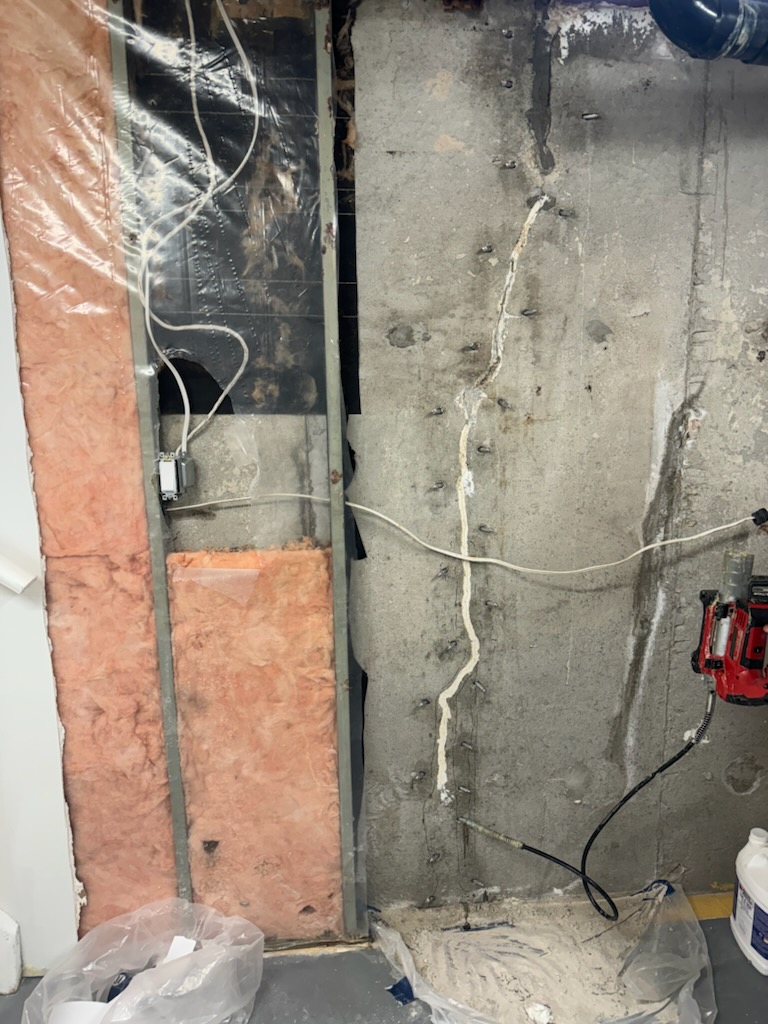
Polyurethane injection is the standard repair for non-structural cracks in poured concrete walls. A technician drills or taps injection ports into the crack at regular intervals, pastes a surface seal over the face of the crack, then injects two-part polyurethane foam under low pressure. The foam expands to fill the full depth of the crack from the interior face to the exterior face of the wall, then cures flexible. That flexibility is important in Springwater because the foundation continues to move slightly with seasonal frost heave, and a rigid fill would re-crack under that movement.
Best for: vertical and diagonal cracks in poured concrete with no structural displacement. Limitations: does not address the source of hydrostatic pressure; if the weeping tile has failed, injection alone will not prevent new cracks from forming elsewhere.
Epoxy Crack Injection
Epoxy injection uses the same port-and-paste method but fills the crack with a rigid, high-strength adhesive rather than flexible foam. Epoxy re-bonds the two faces of the crack and restores the wall’s tensile strength across that plane. It is appropriate only when the crack is structural and the wall needs to be re-bonded, not simply sealed against water entry.
Best for: structural cracks where wall integrity must be restored, confirmed by an engineer. Limitations: epoxy is rigid and will not tolerate further movement; if the underlying cause of the crack is not corrected, the repair will fail and the wall may crack again nearby.
Exterior Crack Excavation and Membrane Repair
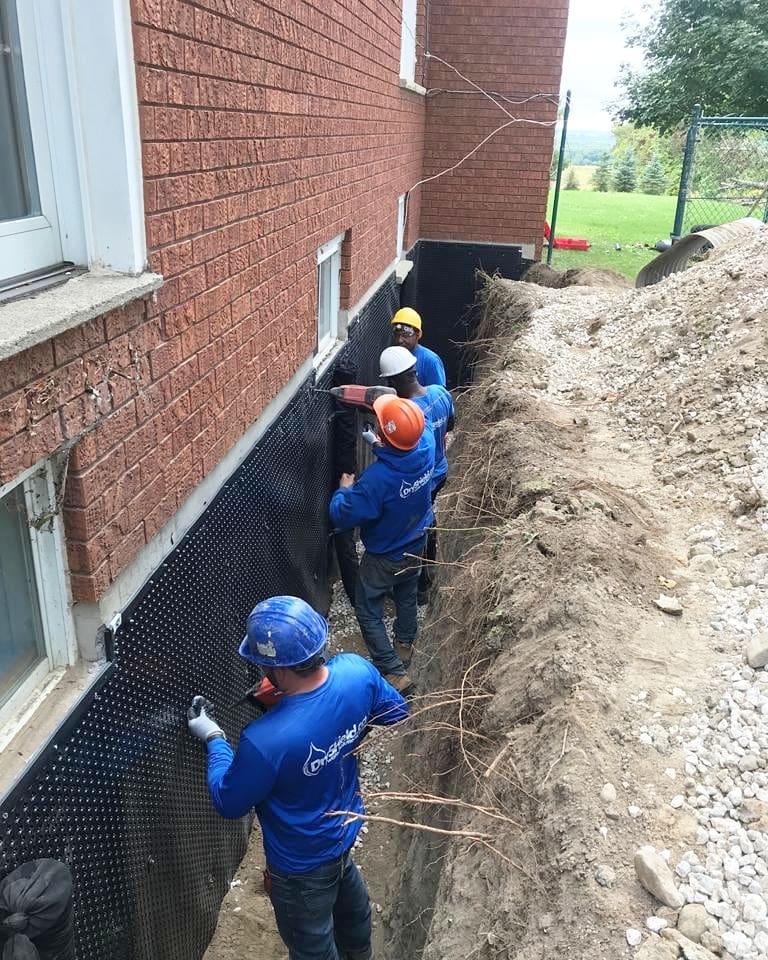
When a crack cannot be reliably sealed from the interior, or when the exterior waterproofing membrane has failed at that location, the correct fix is to excavate down to the footing, clean and hydraulic-cement any voids, apply a new rubberised membrane, install a dimpled drainage board over it, and backfill with clear stone graded away from the wall. This is the most thorough repair available and addresses both the crack and the drainage conditions around it.
Best for: cracks with failed exterior membranes, recurring leaks that have not responded to interior injection, or situations where the footing itself needs inspection. Limitations: higher cost and disruption; excavation is not always possible where landscaping, driveways or structures are directly adjacent to the wall.
Interior Weeping Tile and Sump System
Where multiple cracks exist or where hydrostatic pressure is the underlying problem, an interior perimeter weeping tile system manages water that enters the wall rather than trying to stop it at the crack. A technician jackhammers the concrete floor around the perimeter, installs a weeping tile channel that drains to a sump basin, fits a sump pump, applies a vapour barrier up the wall face, and re-pours the concrete. This system does not seal the crack but controls the water so it cannot damage the interior.
Best for: homes with multiple cracks, failed original weeping tile, or chronic hydrostatic pressure that makes exterior work impractical. Limitations: does not stop water from entering the wall itself; the sump pump requires power and periodic maintenance.
Parging and Surface Sealing
Parging is the application of a cement-based coating over the exterior face of the foundation wall, sometimes used on block or stone foundations to fill surface voids. Surface sealers applied from the interior are sometimes marketed as crack repair but they address only the surface and do not fill the crack through the wall’s full thickness. Neither approach is a substitute for injection or excavation on an actively leaking crack.
Best for: cosmetic surface preparation on block foundations before a membrane is applied. Limitations: not a standalone repair for any crack that is leaking or structurally compromised.
Options Compared
| Method | Best For | Typical Lifespan | Relative Cost | Disruption |
|---|---|---|---|---|
| Polyurethane injection | Non-structural vertical/diagonal cracks, poured concrete | Long-term if cause addressed | Low ($600-$900 per crack) | Minimal, interior only, no excavation |
| Epoxy injection | Structural cracks requiring wall re-bonding | Permanent if movement stops | Low to moderate | Minimal, interior only |
| Exterior excavation and membrane | Failed membrane, recurring leaks, footing inspection | 25+ years with proper drainage | High ($6,000-$9,000 for full wall) | High, landscaping and grade disturbed |
| Interior weeping tile and sump | Multiple cracks, chronic hydrostatic pressure | Ongoing with pump maintenance | Moderate to high | Moderate, floor jackhammered, re-poured |
| Parging and surface sealing | Cosmetic prep on block or stone walls | Short without membrane over top | Low | Low |
For most Springwater homeowners dealing with a single vertical crack in a poured concrete wall, polyurethane injection is the right starting point. It is fast, minimally disruptive and cost-effective. Exterior excavation becomes the correct choice when the crack is recurring, when the original membrane has failed, or when the inspection reveals footing damage. Interior weeping tile makes sense when the problem is systemic rather than isolated to one crack. To understand how injection and full waterproofing compare in more detail, the guide on when crack injection works versus full waterproofing is a useful reference.
How to Choose the Right Repair
When evaluating foundation crack repair Springwater options, start with the crack orientation and whether the wall shows any displacement. Choose polyurethane injection if the crack is vertical or diagonal, the wall shows no displacement, and water entry is limited to that one location. This is the appropriate first response for the majority of Springwater homes where a single shrinkage or frost-heave crack has opened up.
Choose epoxy injection if an engineer has assessed the crack and confirmed that the wall needs structural re-bonding. Do not choose epoxy simply because the crack is wide; width alone does not determine structural status.
Choose exterior excavation if injection has been attempted and the crack continues to leak, if the inspection reveals that the original rubberised membrane has delaminated, or if the crack runs close to the footing where interior access is limited. Homes in Springwater with clay-heavy soil and no dimpled drainage board on the exterior wall are strong candidates for this approach.
Choose an interior weeping tile system if there are three or more active cracks, if the original weeping tile is confirmed to have failed, or if the sump basin is absent or undersized. This approach manages water rather than stopping it at the wall, so it works well when the volume of infiltration is too high for injection alone to control.
A horizontal crack anywhere on the foundation wall is a structural warning sign. Stop, do not attempt a DIY repair, and call a professional for an assessment before the wall moves further.
The Canada Mortgage and Housing Corporation’s guidance on residential foundation moisture recommends addressing drainage and grading as part of any crack repair, not as an afterthought. Correcting the grade so water runs away from the wall at a minimum 5% slope over the first 1.5 metres is one of the most cost-effective steps a Springwater homeowner can take alongside any repair method.
Costs and Timelines
| Cost Driver | Why It Affects Price | Approximate Impact |
|---|---|---|
| Number of cracks | Each crack requires its own ports, materials and labour time | $600-$900 per crack for injection |
| Crack depth and width | Wider or deeper cracks consume more material and take longer to fill | Moderate upward pressure on per-crack cost |
| Excavation depth | Deeper footings require more digging, shoring and backfill | Significant; deeper footings add time and equipment cost |
| Linear footage of wall | Exterior and interior perimeter systems are priced per linear foot | Full exterior on average home: $6,000-$9,000 |
| Access constraints | Decks, driveways or fences adjacent to the wall slow excavation | Can add meaningfully to exterior job cost |
| Weeping tile condition | Failed tile requires full replacement, not just cleaning | Adds to interior system cost |
A single polyurethane injection in Springwater typically falls in the $600 to $900 range, depending on crack length and depth. Full exterior waterproofing of an average detached home runs roughly $6,000 to $9,000, depending on linear footage, excavation depth and site access. These are ranges drawn from completed work in the region; the final figure for any specific property depends on a site inspection. For a broader breakdown of what drives repair costs across Ontario, the crack injection cost guide covers the key variables in detail.
Risks and Common Mistakes
| Symptom | Likely Cause | Correct Fix |
|---|---|---|
| Crack leaks again after injection | Injection did not fill full depth, or new crack opened nearby | Re-inspect; address weeping tile or drainage if systemic |
| White mineral deposits around crack | Efflorescence from water carrying calcium through the wall | Injection to stop water path; efflorescence itself is cosmetic |
| Crack wider at top than bottom | Settlement or differential footing movement | Engineer assessment before any repair |
| Horizontal crack with inward bow | Lateral soil pressure exceeding wall capacity | Structural engineer, possible wall anchoring or underpinning |
| Damp wall with no visible crack | Condensation, or water seeping through porous concrete | Moisture test to distinguish condensation from infiltration |
The most common mistake Springwater homeowners make is applying hydraulic cement or a surface plug to a leaking crack without filling it through the full wall thickness. Surface plugs fail quickly under hydrostatic pressure and can mask the crack’s location, making professional repair harder later. A second frequent error is treating the crack without correcting the grade or drainage around the house, so water continues to press against the wall and opens a new crack nearby. Injection is a repair, not a drainage solution; both must be addressed together for a lasting result.
Ignoring a crack that is actively widening is the highest-risk mistake of all. A crack that grows by more than a millimetre over a single winter season warrants an engineer’s assessment, not a DIY patch. The guide on how to tell if a foundation crack is structural explains the warning signs in plain language.
How the Process Works
- Free on-site inspection and moisture assessment. A technician visits the property, examines every visible crack, checks for efflorescence and staining, probes the wall for moisture, and assesses the exterior grade and drainage conditions around the foundation.
- Written scope with method and pricing. Based on the inspection, a written scope identifies each crack, the recommended repair method, and a fixed or linear-foot price so there are no surprises on completion.
- Surface preparation. For injection work, the crack face is cleaned and injection ports are set at intervals along the crack. For exterior work, excavation begins and the wall face is cleaned back to bare concrete.
- Repair execution. Polyurethane or epoxy is injected under low pressure until the material appears at the next port, confirming the crack is filled. For exterior work, hydraulic cement fills voids, a rubberised membrane is applied, a dimpled drainage board is installed, and new weeping tile is bedded in clear stone.
- Backfill and grade correction. Exterior jobs are backfilled and the grade is corrected to direct surface water away from the wall. Interior jobs are finished with a concrete re-pour over the new weeping tile channel.
- Final inspection and documentation. The completed repair is inspected, photographed and documented. Work covered by a warranty is registered at this stage.
Frequently Asked Questions
How much does foundation crack repair cost in Springwater?
A single polyurethane injection typically costs $600 to $900 in the Springwater area, depending on crack length and depth. Full exterior waterproofing of an average detached home runs roughly $6,000 to $9,000 depending on linear footage, excavation depth and site access. These are ranges; the exact figure for your home depends on a site inspection.
Is polyurethane injection a permanent fix?
Polyurethane injection fills the crack through the full wall thickness and cures flexible, so it tolerates the seasonal movement that is normal in Springwater’s freeze-thaw climate. The repair holds long-term provided the underlying drainage conditions are also addressed. If hydrostatic pressure continues to build against the wall, new cracks can form in adjacent locations even after the original crack is sealed.
What is the difference between polyurethane and epoxy injection?
Polyurethane cures flexible and is used to seal non-structural cracks against water entry. Epoxy cures rigid and re-bonds the two faces of the crack, restoring structural strength across that plane. Epoxy is appropriate only when an engineer has confirmed the crack is structural and the wall needs to be re-bonded. Using epoxy on a crack that continues to move will cause the repair to fail.
Can I repair a foundation crack myself?
DIY hydraulic cement plugs and surface sealers do not fill the crack through the full wall thickness and typically fail within one or two freeze-thaw cycles. Low-pressure injection kits are available at hardware stores but require correct port spacing and pressure control to work properly. For any crack that is actively leaking or wider than 3 mm, a professional assessment is the safer and more cost-effective starting point.
How do I know if my crack is structural?
Horizontal cracks, cracks with visible inward displacement, and cracks that are wider at one end than the other are the most common indicators of a structural problem. Vertical hairline cracks that run straight and show no displacement are usually non-structural shrinkage cracks. When in doubt, a professional inspection is the only reliable way to confirm the classification before any repair is attempted.
Does Springwater’s soil type affect how cracks form?
Yes. Clay-rich soil in parts of Springwater holds water against the foundation wall for extended periods after a thaw, increasing hydrostatic pressure. Sandy loam areas drain faster but allow deeper frost penetration, which causes more aggressive heave at the footing level. Both conditions accelerate crack formation compared with well-drained, frost-stable soils, and both require that drainage be corrected alongside any foundation crack repair Springwater professionals carry out.
Will fixing the crack stop my basement from leaking?
Crack injection stops water from entering through that specific crack. If the weeping tile has failed or if the grade directs water toward the foundation, water will find another path and the basement may continue to leak elsewhere. A complete solution addresses the crack, the drainage at the footing, and the grade around the house. The inspection will identify whether the crack is the only entry point or part of a larger drainage problem.
How long does a crack injection repair take?
A single crack injection is typically completed in two to four hours, including port installation, injection and surface finishing. The polyurethane cures within 24 hours and the wall can be painted or covered after that. Exterior excavation jobs take one to three days depending on wall length and access conditions. Interior weeping tile installations typically take two to three days for an average Springwater home.
If you have noticed a crack in your foundation wall, a damp patch on the basement wall, or signs of water entry after the spring thaw, the right next step is a free on-site inspection. Foundation crack repair Springwater homeowners can rely on is available from DryShield, which serves Springwater Township and the surrounding Simcoe County area. Contact the team to arrange a no-obligation assessment and written scope for your home.