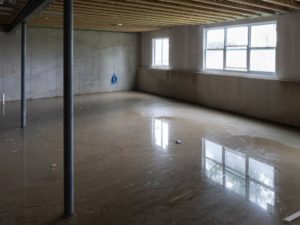
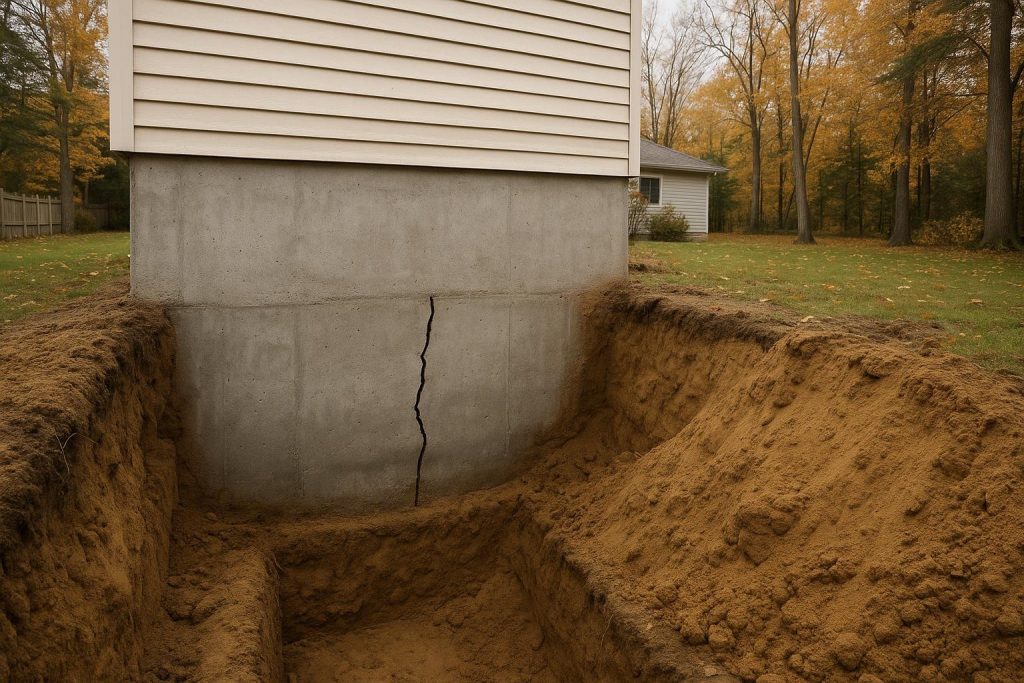
Foundation crack repair Innisfil homeowners need most often comes down to one of three methods: low-pressure polyurethane injection for non-structural cracks, an interior weeping-tile system for chronic hydrostatic pressure, or full exterior waterproofing where the wall face itself has deteriorated. Innisfil sits on a mix of sandy lakeshore soils near Barrie and heavier clay further inland, and that soil variation changes which repair holds up long-term. Getting the diagnosis right before committing to a method is the single most important step.
Key Takeaways
- A single injected crack in Innisfil typically costs in the $600 to $900 range; full exterior waterproofing of an average home runs roughly $6,000 to $9,000 depending on linear footage and excavation depth.
- Polyurethane injection cures flexible, so it tolerates the seasonal freeze-thaw movement common in Simcoe County winters without re-cracking.
- Spring snowmelt and summer downpours are the two peak failure windows for Innisfil foundations, especially on lots with flat or inward-sloping grades.
- Horizontal cracks in block or poured walls signal lateral soil pressure and need a structural assessment before any injection work begins.
- Older Innisfil homes on the lakeshore may have original weeping tile that has silted up completely, making drainage restoration the priority over crack sealing alone.
Definitions and Scope
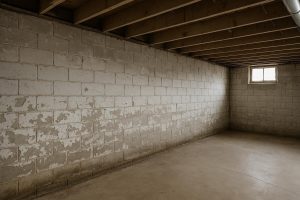
A foundation crack is any break in the poured concrete or concrete-block wall that separates your living space from the surrounding soil. Cracks range from hairline shrinkage lines that formed as the concrete cured decades ago, to active leaking cracks driven open by hydrostatic pressure, to structural cracks caused by differential settlement or lateral soil load. The repair method must match the crack type, not simply the symptom of dampness.
Innisfil’s building stock spans everything from 1960s bungalows near Alcona Beach to newer subdivisions on the south end of the town. Older poured-concrete walls are the most common candidate for polyurethane injection. Block foundations, found in some mid-century homes, require a different approach because mortar joints can fail independently of the block face. This guide covers the full range of options a licensed contractor will present after a proper on-site moisture assessment.
For a broader look at waterproofing and crack repair services available across the town, the Innisfil basement waterproofing and foundation crack repair service page outlines what DryShield covers in this area.
Why This Matters for Innisfil Homes
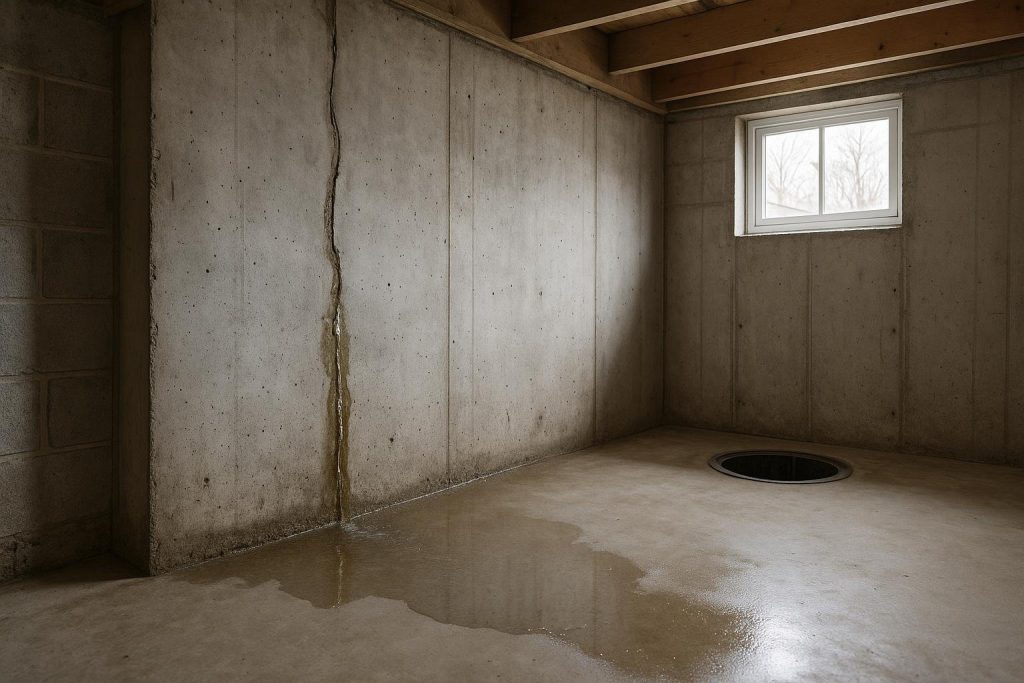
Innisfil’s position on the western shore of Lake Simcoe creates a specific moisture environment. The water table in lakeshore neighbourhoods like Alcona and Stroud sits higher than in inland Ontario clay-belt communities, and sandy or silty soils drain quickly in dry weather but transmit water rapidly toward foundation walls during heavy rain. Inland sections of Innisfil share the Simcoe County clay profile, where water drains slowly and builds sustained hydrostatic pressure against the wall face.
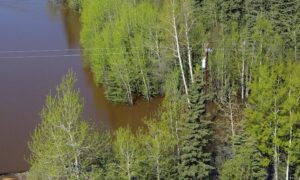
Spring thaw is the highest-risk window. Frost penetrates deeply in Simcoe County winters, and when the ground thaws from the top down, meltwater has nowhere to go until the lower soil layers open up. That trapped water presses against the foundation at exactly the moment when freeze-thaw cycling has already widened any existing cracks. Homeowners who notice a damp patch in February or March are often seeing the result of a crack that has been slowly enlarging since the previous autumn.
Hydrostatic pressure, not rainfall alone, is the root cause of most wet basements in Innisfil. Sealing the visible crack without addressing drainage is a temporary fix at best.
Ignoring a foundation crack also affects resale value. Home inspectors flag active cracks, and buyers in the Innisfil market, which has grown significantly with commuters to Barrie and the GTA, will negotiate hard or walk away when a structural or moisture issue appears in the report. Repair completed before listing, with documentation, removes that leverage entirely.
Crack Types at a Glance
Foundation crack repair Innisfil contractors assess starts with identifying the crack type. The table below maps the four most common crack patterns to their likely cause and the repair method that addresses each one.
| Crack Type | Likely Cause | Recommended Repair |
|---|---|---|
| Vertical crack, uniform width | Concrete shrinkage during original cure | Polyurethane injection (non-structural) |
| Diagonal crack, wider at one end | Differential settlement or corner stress | Polyurethane or epoxy injection after stability confirmed |
| Horizontal crack across wall | Lateral soil pressure, potential wall bowing | Structural assessment first; may require wall reinforcement |
| Floor-wall joint seepage | Hydrostatic pressure at footing level, failed weeping tile | Interior weeping-tile system with sump pump |
Matching the repair to the crack type is the most important decision in any foundation crack repair Innisfil project. A horizontal crack treated with injection alone, without a structural review, is one of the most common and costly mistakes a homeowner can make.
Your Options for Foundation Crack Repair in Innisfil
Low-Pressure Polyurethane Injection
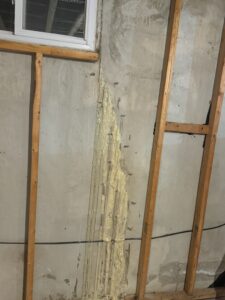
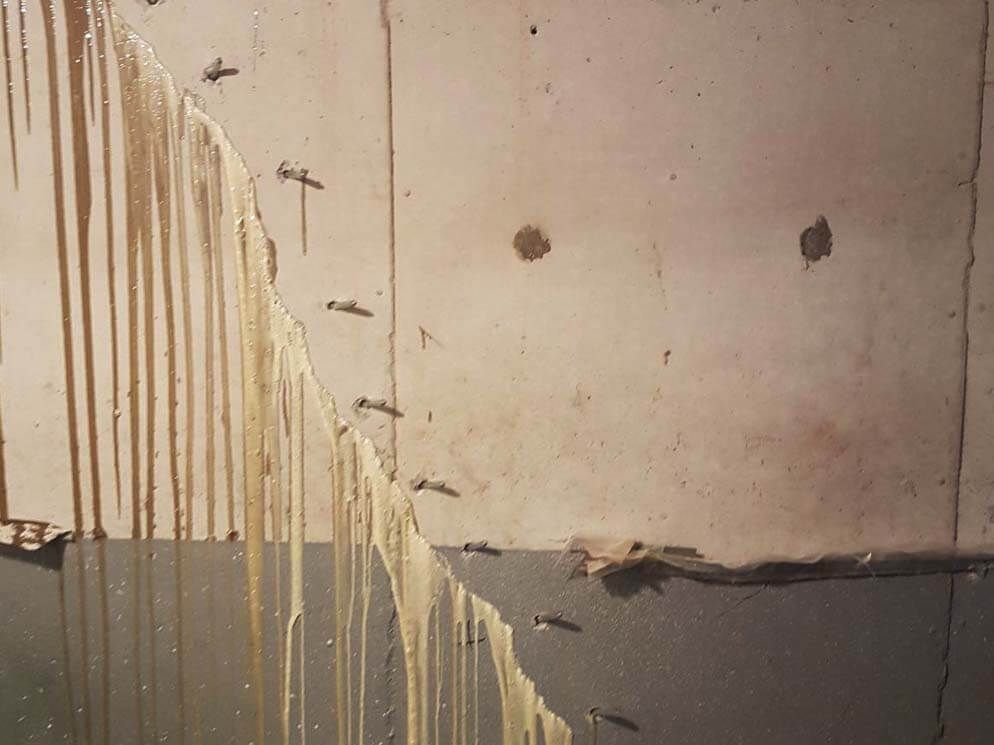
Polyurethane injection is the standard first-line repair for a non-structural vertical or diagonal crack in a poured-concrete wall. A technician drills ports into the crack face at regular intervals, pastes surface ports over the crack, then injects a two-part polyurethane resin at low pressure. The resin expands as it cures, filling the full depth of the crack from the interior face to the exterior membrane. Because the cured material stays flexible, it accommodates the minor seasonal movement that Innisfil foundations experience through freeze-thaw cycles without re-opening.
This method works from the interior, so no excavation is needed. A single crack is typically completed in a few hours. It is best suited for cracks that are stable in width, not actively bowing, and not caused by ongoing settlement. The limitation is that injection does not address the drainage conditions outside the wall, so if hydrostatic pressure is severe, a drainage solution should accompany the injection.
For structural cracks where the two sides of the wall must be re-bonded, epoxy injection is used instead. Epoxy cures rigid and restores tensile strength across the crack plane, but it does not tolerate movement, so it is reserved for cracks that have fully stabilised.
Interior Weeping Tile System
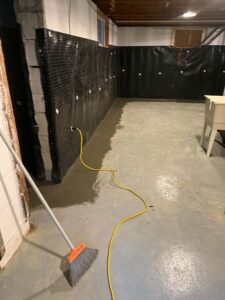
When multiple cracks are present, when the floor-wall joint is leaking, or when hydrostatic pressure is the underlying driver, an interior weeping-tile system addresses the source rather than individual symptoms. The process involves jackhammering a perimeter channel in the basement floor, installing a perforated drain pipe that routes water to a sump basin, fitting a sump pump to discharge water away from the foundation, and re-pouring the concrete over the drain. A vapour barrier is run up the wall face to direct any seepage into the drain channel rather than onto the floor.
This approach is best for finished or partially finished basements where exterior excavation would be highly disruptive, and for homes where the original weeping tile has silted up beyond cleaning. The limitation is that it manages water after it enters the wall rather than stopping it at the exterior face.
Exterior Waterproofing with Membrane and Weeping Tile
Full exterior waterproofing is the most comprehensive repair. The process requires excavating to the footing, applying hydraulic cement parging to any voids in the wall face, coating the wall with a rubberised waterproofing membrane, installing a dimpled drainage board over the membrane to protect it and channel water downward, laying new weeping tile bedded in clear stone at the footing level, and backfilling with corrected grade to direct surface water away from the wall. This method stops water at the exterior face before it ever contacts the foundation wall.
It is the right choice when the exterior membrane has failed, when cracks are numerous or wide, or when the original weeping tile is completely blocked. The limitation is cost and disruption: excavation requires access along the full wall being treated, and landscaping, decks, or driveways in the way add to the scope.
Epoxy Crack Injection for Structural Repairs
Epoxy injection is used specifically when a crack has compromised the structural integrity of the wall and the two sides must be re-bonded. The resin cures to a compressive strength that exceeds the surrounding concrete. This method is appropriate only after a structural engineer has confirmed the crack is stable and no further movement is expected. It is not a substitute for polyurethane in a standard leaking crack because the rigid cure cannot flex with seasonal movement.
Parging and Surface Sealing
Parging, the application of a cement-based coating to the exterior wall face, is sometimes used as a supplementary step during exterior waterproofing to fill surface voids before the membrane goes on. As a standalone repair, surface parging or hydraulic cement plugging from the interior is a short-term measure only. It can stop an active drip temporarily but does not address the crack through the full wall thickness or the water pressure behind it.
Sump Pump Installation or Replacement
A sump pump is not a crack repair on its own, but it is often the final component of a complete interior or exterior waterproofing system. In Innisfil, where spring thaw can deliver large volumes of meltwater in a short window, a properly sized sump pump with a battery backup prevents the basin from overflowing during power outages, which tend to coincide with the same storms that drive basement flooding. If an existing pump is more than seven to ten years old, replacement at the time of any drainage work is worth considering.
Options Compared
| Method | Best For | Typical Lifespan | Relative Cost | Disruption |
|---|---|---|---|---|
| Polyurethane injection | Single non-structural vertical crack, poured concrete | Long-term when crack is stable | Lowest ($600-$900 per crack) | Minimal, interior only, no excavation |
| Epoxy injection | Structural crack requiring wall re-bonding | Permanent if wall is stable | Low to moderate | Minimal, interior only |
| Interior weeping tile and sump | Multiple cracks, floor-wall joint leaks, high hydrostatic pressure | 25+ years with pump maintenance | Moderate | Moderate, jackhammer perimeter floor |
| Exterior waterproofing and membrane | Failed exterior membrane, numerous cracks, blocked original weeping tile | 25+ years | Highest ($6,000-$9,000 average) | High, full excavation to footing |
| Parging / surface sealing | Temporary stop to active drip, supplementary to membrane work | Short-term only | Very low | Minimal |
| Sump pump installation | Final component of interior or exterior drainage system | 7-10 years per pump unit | Low to moderate | Low, basin excavation only |
The table shows that polyurethane injection is the right starting point for most Innisfil homeowners dealing with a single leaking crack in a poured-concrete wall. When the problem involves multiple entry points or a drainage failure, the cost difference between injection and a full interior system is justified by the scope of protection. Exterior waterproofing is the most disruptive and most expensive option, but it is the only method that stops water before it contacts the wall, which matters most when the exterior membrane has already broken down.
How to Choose the Right Repair
Choose polyurethane injection if you have a single vertical or diagonal crack in a poured-concrete wall, the crack is not bowing inward, and the rest of the basement is dry. This is the most cost-effective foundation crack repair Innisfil homeowners can pursue, and when done correctly it holds through freeze-thaw seasons without re-opening.
Choose epoxy injection if a structural engineer has assessed the crack and confirmed that wall re-bonding is needed and that no further movement is expected. Do not use epoxy in a crack that is still widening seasonally.
Choose an interior weeping-tile system if you have seepage at the floor-wall joint, water coming through multiple cracks, or a basement that gets wet every spring regardless of which individual cracks have been patched before. This is also the right choice when exterior excavation is blocked by a deck, finished landscaping, or a neighbouring structure.
Choose full exterior waterproofing if the wall has widespread cracking, the original exterior membrane has visibly failed, or the weeping tile at the footing is completely silted up and cannot be cleared. Homes in older Innisfil neighbourhoods near the lakeshore that were built before modern drainage standards are the most common candidates.
If you are unsure which category your crack falls into, the foundation crack diagnosis guide on this site walks through vertical versus horizontal crack patterns and what each typically signals.
A free on-site inspection is the only reliable way to confirm which method is appropriate. Crack width, crack orientation, wall type, soil conditions, and drainage all factor into the recommendation.
Costs and Timelines
| Cost Driver | Why It Affects Price | Approximate Range Impact |
|---|---|---|
| Number of cracks | Each injected crack is priced per port and linear foot of crack length | $600-$900 per crack for injection |
| Excavation depth | Deeper footings require more labour and equipment time for exterior work | Significant upward pressure on exterior jobs |
| Linear footage of wall | Interior and exterior systems are priced per linear foot of treated wall | Drives total cost of full-perimeter jobs |
| Access constraints | Decks, driveways, or landscaping over the wall face add removal and reinstatement cost | Can add materially to exterior quotes |
| Soil type | Sandy lakeshore soil excavates faster than dense clay; clay jobs take longer | Moderate effect on labour hours |
| Sump pump specification | Battery backup, alarm systems, and higher-capacity pumps cost more than basic units | Adds to interior system total |
As a general guide, a single polyurethane-injected crack in Innisfil falls in the $600 to $900 range. A full interior weeping-tile system with sump pump typically costs less than a full exterior job. Exterior waterproofing of an average semi-detached or detached home runs roughly $6,000 to $9,000 depending on linear footage, excavation depth, and site access. Every figure here depends on a site inspection because no two foundations present the same conditions. The foundation crack injection versus waterproofing guide covers the decision in detail.
Timeline for injection work is typically one day or less. Interior drainage systems usually take two to three days for an average basement. Exterior waterproofing, including excavation, membrane application, new weeping tile, and backfill, generally takes three to five days depending on wall length and access.
Risks and Common Mistakes
The most common mistake Innisfil homeowners make is patching a crack with hydraulic cement or a tube of off-the-shelf sealant from a hardware store. Surface plugging does not penetrate the full depth of the crack, and it cannot flex with seasonal movement. The patch typically fails within one or two freeze-thaw cycles, and the underlying crack is often wider by the time a contractor is called.
A second frequent error is treating the symptom without addressing drainage. Injecting a crack in a wall that is under constant hydrostatic pressure from a failed weeping-tile system will not produce a lasting result. The water will find the next weak point, which may be the floor-wall joint or a different section of wall.
Horizontal cracks in a foundation wall are not a DIY repair. They indicate lateral soil pressure and require a structural assessment before any injection or sealing work begins.
Waiting is also a risk. A hairline crack that admits only minor seepage in spring can widen over successive winters as water freezes inside the crack and expands. What would have been a $700 injection repair can become a $7,000 exterior job if the wall face deteriorates to the point where the membrane must be replaced. Canada Mortgage and Housing Corporation (CMHC) notes that early intervention on foundation moisture issues consistently costs less than remediation after water damage has spread to framing and insulation.
Finally, choosing a contractor based on price alone without verifying experience with the specific method is a risk. Polyurethane injection done at too high a pressure can blow out ports and leave voids in the crack. Exterior membrane work done without proper footing drainage leaves the membrane vulnerable to hydrostatic uplift. Always ask for a written scope that specifies the method, materials, and warranty terms before work begins.
How the Process Works
- Free on-site inspection and moisture assessment. A technician visits the property, examines all visible cracks, checks for efflorescence and staining patterns, assesses the grade around the foundation, and identifies whether the problem is structural, drainage-related, or a combination. No work is scoped until this step is complete.
- Written scope with linear-foot or per-crack pricing. You receive a written proposal specifying the method, the materials, the warranty, and the price. For injection work this is typically per crack; for drainage systems it is per linear foot of treated wall.
- Preparation and access. For injection, ports are drilled and pasted along the crack. For exterior work, excavation begins to the footing. For interior systems, the perimeter floor is jackhammered to expose the footing drain channel.
- Core repair work. Polyurethane or epoxy resin is injected under controlled pressure for crack work. For exterior jobs, hydraulic cement parging fills voids, the rubberised membrane is applied, and the dimpled drainage board is installed. For interior systems, weeping tile is laid to the sump basin and the vapour barrier is fitted up the wall.
- Drainage and backfill. New weeping tile bedded in clear stone is installed at the footing for exterior jobs. The sump pump is connected and tested for interior systems. Exterior excavations are backfilled with grade correction to direct surface water away from the wall.
- Final inspection and documentation. The completed work is reviewed with the homeowner, warranty documentation is provided, and any follow-up recommendations (such as downspout extensions or window-well drains) are noted in writing.
Frequently Asked Questions
How do I know if my Innisfil foundation crack is structural?
A horizontal crack running across a block or poured-concrete wall is the clearest warning sign of lateral soil pressure and needs a structural assessment before any repair. Vertical cracks that are wider at the top than the bottom, or cracks accompanied by visible wall bowing, also warrant an engineer’s review. Hairline vertical cracks that are uniform in width and dry between rain events are usually non-structural shrinkage cracks. If you are unsure, a professional inspection is the only reliable way to confirm.
Can polyurethane injection be done in winter in Innisfil?
Interior polyurethane injection can be performed year-round because the work happens inside the conditioned space of the basement. The resin requires a minimum substrate temperature to cure properly, so the wall surface must be above freezing. Exterior excavation work is generally not done in frozen ground, making winter the preferred season for injection-only repairs and spring through autumn the window for exterior waterproofing.
How long does a polyurethane crack injection last?
When the crack is stable and the injection fills the full depth of the wall, polyurethane injection provides a long-term seal. The flexible cure means it moves with the foundation through seasonal freeze-thaw cycles rather than re-cracking. If the underlying cause of the crack is not addressed, new cracking can develop adjacent to the repaired area over time.
What is the difference between polyurethane and epoxy injection?
Polyurethane cures flexible and is used for leaking non-structural cracks where the foundation still experiences minor seasonal movement. Epoxy cures rigid, bonding the two sides of the crack back together at a strength that exceeds the surrounding concrete. Epoxy is reserved for structural cracks that have fully stabilised and where wall re-bonding is the goal. Using epoxy in a crack that still moves seasonally will cause the repair to fail.
Will my home insurance cover foundation crack repair in Innisfil?
Most standard Ontario home insurance policies do not cover foundation crack repair as a maintenance item. Coverage may apply if a sudden and accidental event, such as a burst pipe, caused the damage. Gradual water infiltration through a crack is typically excluded. Review your policy wording or speak with your broker before assuming coverage exists.
How much does foundation crack repair cost in Innisfil?
Foundation crack repair Innisfil pricing starts at roughly $600 to $900 for a single polyurethane-injected crack. A full interior weeping-tile system with sump pump costs more and depends on the linear footage of wall treated. Full exterior waterproofing of an average Innisfil home runs roughly $6,000 to $9,000 depending on excavation depth, wall length, and site access. Every quote depends on a site inspection because soil conditions, crack count, and access constraints all affect the final figure.
How do I tell if my weeping tile has failed?
Signs of failed weeping tile include water seeping in at the floor-wall joint rather than through a specific crack, a basement that gets wet every spring even after individual cracks have been patched, and efflorescence (white mineral deposits) running along the base of the wall. A contractor can confirm weeping-tile failure by camera inspection of the drain or by observing where water enters during a controlled test. Many Innisfil homes built before the 1980s have original clay or fibre tile that has silted up completely.
Does foundation crack repair affect my home’s resale value in Innisfil?
Completed and documented foundation crack repair Innisfil buyers encounter on a disclosure is a far less significant finding than an active, unrepaired crack. Buyers in the Innisfil market, which attracts a mix of permanent residents and commuters from Barrie and the GTA, are increasingly sophisticated about foundation condition. Repair before listing removes a common negotiating point and can prevent a deal from falling through at the inspection stage.
What causes foundation cracks in Innisfil specifically?
The two main causes in Innisfil are concrete shrinkage during the original cure, which produces hairline vertical cracks that may not leak for years, and hydrostatic pressure from seasonal water-table fluctuation. Lakeshore areas near Alcona experience higher water tables than inland sections of the town. Freeze-thaw cycling in Simcoe County winters widens existing cracks each year. Flat or inward-sloping grades that direct surface water toward the foundation are a contributing factor on many residential lots.
Is a sump pump necessary after crack injection?
Not always. If the crack is isolated, the drainage around the foundation is functioning, and the repair is done correctly, a sump pump is not automatically required. However, if the inspection reveals that the original weeping tile is failing or that the property sits in a low-lying area with seasonal water-table rise, adding a sump pump as part of the foundation crack repair Innisfil scope provides a safety margin. A battery-backup unit is worth considering given the power outages that can accompany the same spring storms that drive basement flooding.
For related guidance on how Simcoe County soil and drainage conditions affect basement waterproofing decisions across the broader region, the Simcoe County basement waterproofing guide covers the full picture. You can also use the basement leak diagnostic tool to help identify what type of problem you are dealing with before booking an inspection.
If you have noticed a crack in your Innisfil foundation wall, or if your basement gets wet every spring, the right next step is a free on-site inspection. DryShield serves Innisfil and the surrounding Simcoe County area and can assess your foundation, explain your options in plain language, and provide a written quote with no obligation. Contact the team to book your inspection and get a clear answer on what your foundation actually needs.