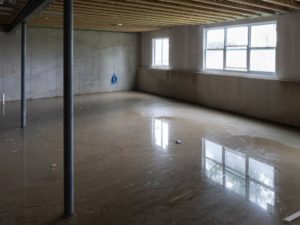
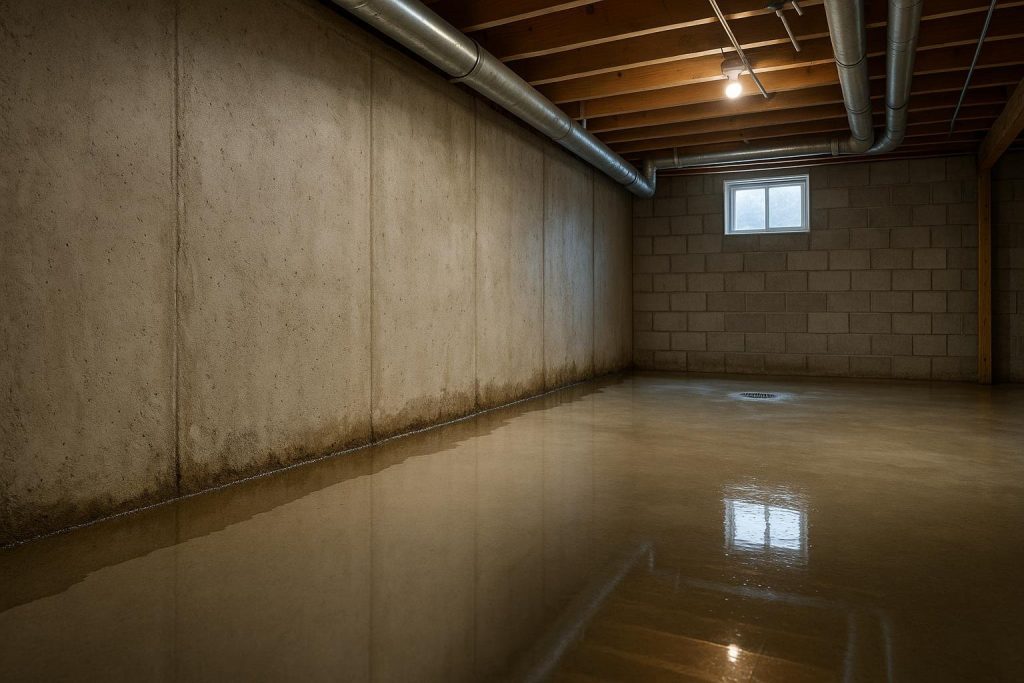
Basement flooding Innisfil homeowners experience most often traces back to three local conditions: the heavy clay and sandy-loam soils that dominate the lakeshore corridor, a water table that rises sharply each spring as Lake Simcoe snowmelt saturates the ground, and original weeping tile systems that are now decades old and fully silted. Understanding which of these is driving water into your home determines which fix will actually work long-term.
Key Takeaways
- Hydrostatic pressure from Innisfil’s high spring water table is the most common root cause of basement flooding Innisfil properties face, not surface runoff alone.
- Failed or silted weeping tile is the single most frequent finding on older Innisfil properties.
- Interior weeping tile with a sump pump is often the most practical fix when exterior excavation is restricted by landscaping or lot lines.
- A single injected foundation crack typically costs $600 to $900; a full interior drainage system costs less than full exterior waterproofing, which runs roughly $6,000 to $9,000 for an average home.
- Spring thaw and heavy summer downpours are the two peak failure windows in this area.
What Basement Flooding in Innisfil Actually Means
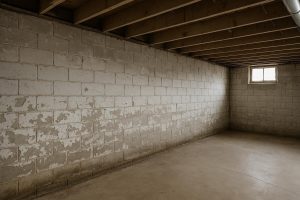
Basement flooding Innisfil residents report can mean anything from a damp patch on the wall after heavy rain to several centimetres of standing water after the spring thaw. The distinction matters because each symptom points to a different entry path. Water seeping through a vertical crack in the foundation wall is a different problem from water wicking up through the floor slab, and both differ from water backing up through a floor drain when the municipal storm system is overwhelmed.
Innisfil sits on the western shore of Lake Simcoe in Simcoe County. The town has grown rapidly, with many newer subdivisions built on land that was farmfield or wetland within living memory. That development history means drainage patterns have changed, and some lots that drain well in dry summers become saturated zones in April. Older homes near the lakeshore, particularly in the Alcona and Cookstown corridors, commonly have original clay-pipe weeping tile that was installed in the 1970s and 1980s and has long since collapsed or filled with silt and root intrusion.
For a broader look at waterproofing options across the county, the Simcoe County basement waterproofing guide covers regional soil and drainage patterns in detail.
Why Innisfil Basements Flood
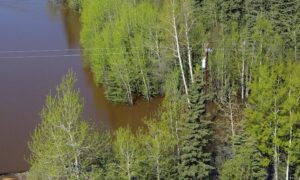
The root cause in most basement flooding Innisfil cases is hydrostatic pressure. When the water table rises in spring or after a sustained summer downpour, water presses against the exterior face of the foundation wall and footing from every direction. Poured concrete is not inherently waterproof; it is porous, and any shrinkage crack, cold joint, or tie-hole becomes a pathway once pressure builds. Clay-heavy soils hold that water against the wall for days after the rain stops, which is why a basement can stay wet long after the sky clears.
A second common cause is grade failure. Over time, soil around the foundation settles and slopes toward the house rather than away from it. Downspouts that discharge too close to the wall add concentrated water at exactly the wrong spot. Both problems funnel surface water toward the footing rather than away from it.
The Canada Mortgage and Housing Corporation (CMHC) notes that proper grading and functional drainage are the first line of defence for any basement, and that interior drainage systems are a proven secondary measure when exterior conditions cannot be fully corrected. See the CMHC website for homeowner guidance on moisture management.
Sump pump failure is a third trigger. Many Innisfil homes have a sump pit but the pump is undersized, lacks a battery backup, or has never been tested. When the pump fails during the exact storm that overwhelms the drainage system, basement flooding Innisfil homeowners dread follows within hours. If you are unsure whether your sump system is functioning correctly, the Innisfil waterproofing and foundation crack repair service page outlines what a professional inspection covers.
Your Options for Stopping a Flooded Basement
Polyurethane Crack Injection
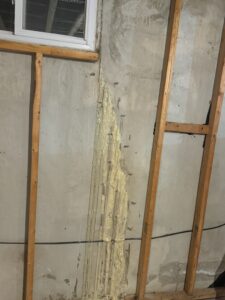
Low-pressure polyurethane injection seals an active crack from the interior without excavation. A technician drills ports along the crack, pastes them in place, and injects expanding polyurethane foam that follows the crack through the full thickness of the wall. The cured material stays flexible, which matters in Innisfil because seasonal freeze-thaw movement is real and a rigid repair would re-crack. Best for: a single vertical or diagonal shrinkage crack that is the only entry point. Limitation: it does not address hydrostatic pressure at the footing or a failed drainage system.
Interior Weeping Tile System with Sump Pump
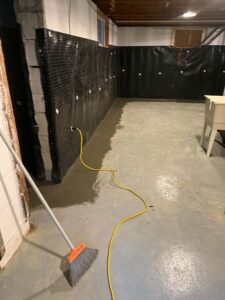
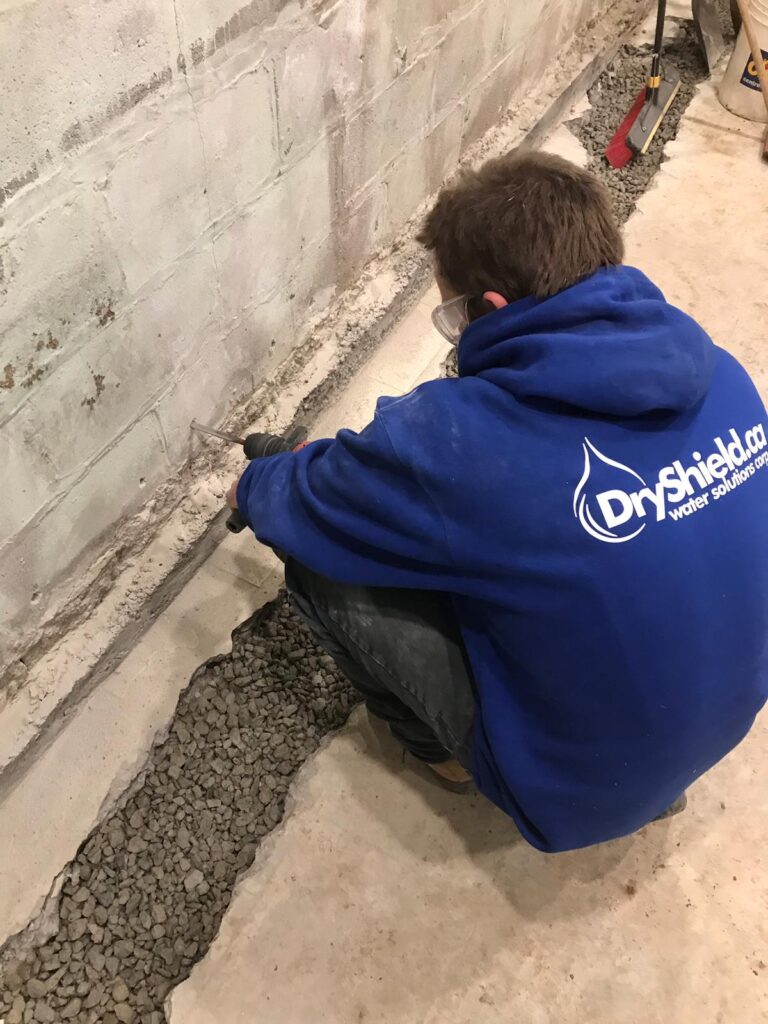
The perimeter of the basement floor is jackhammered, a slotted drainage pipe is installed at footing level and bedded in clear stone, and the system drains to a sump basin where a pump discharges water away from the house. A vapour barrier is then applied up the wall and the concrete is re-poured. This approach manages hydrostatic pressure by intercepting water before it can pond on the floor. Best for: homes where exterior excavation is impractical, lots with limited side clearance, or properties where the exterior membrane has already failed. Limitation: it manages water rather than stopping it at the source.
Exterior Waterproofing
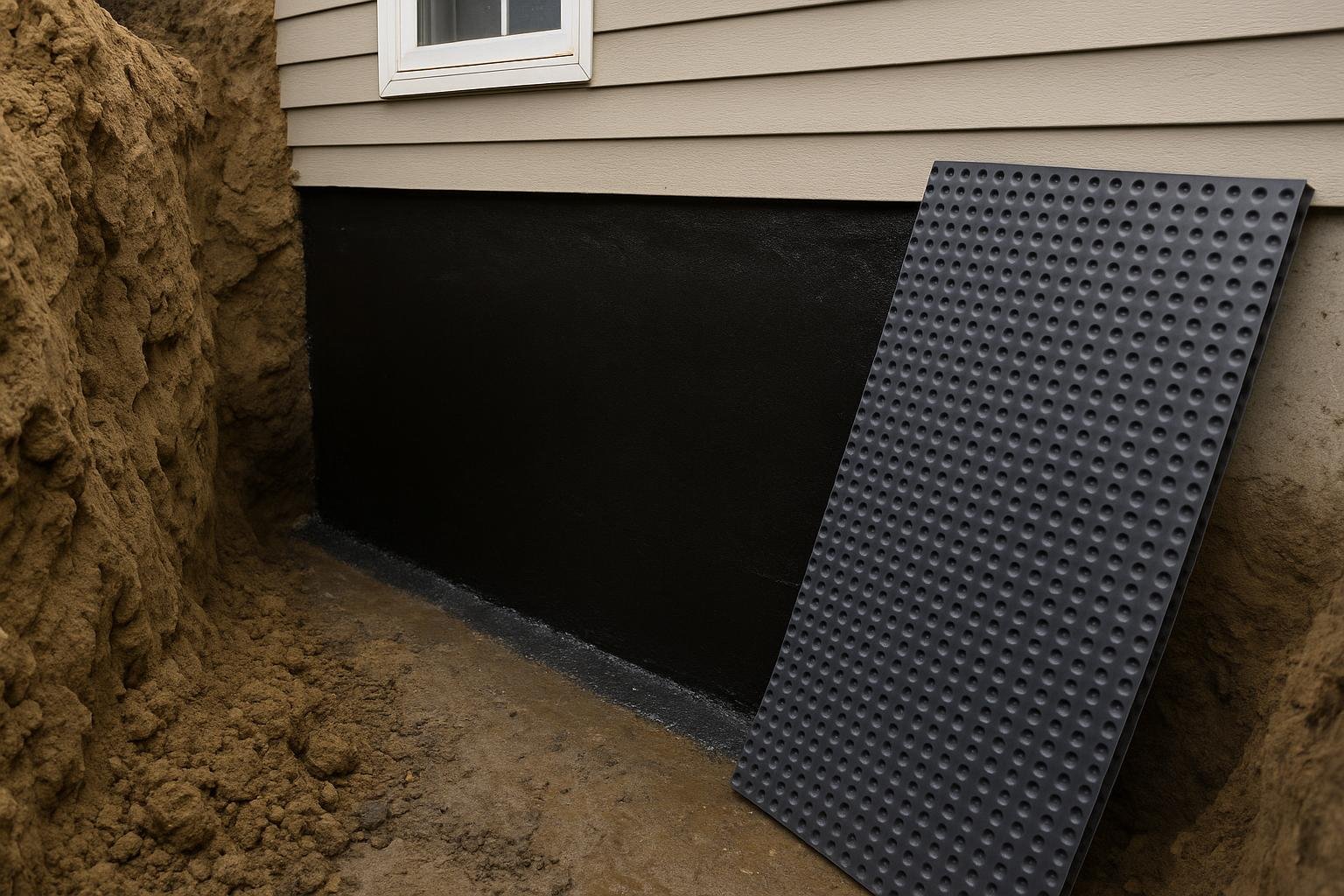
The foundation is excavated to the footing, voids are filled with hydraulic cement parging, a rubberised membrane is applied to the wall face, a dimpled drainage board protects the membrane, new weeping tile is bedded in clear stone at the footing, and the trench is backfilled with grade correction. This is the most complete solution because it stops water at the exterior face before it contacts the wall. Best for: homes with accessible perimeter, failed original weeping tile, or where interior work has already been attempted without lasting success. Limitation: excavation is disruptive and costs more than interior methods.
Sump Pump Upgrade or Installation
If a sump pit exists but the pump is undersized or lacks a battery backup, upgrading the pump is a fast, lower-cost intervention. A battery backup unit keeps the system running during power outages, which often coincide with the worst storms. Best for: homes where the drainage system is intact but the pump is the weak link. Limitation: a pump alone cannot compensate for a completely failed weeping tile system or an unsealed crack.
Epoxy Crack Injection
Epoxy injection is used specifically for structural cracks where the wall must be re-bonded and load-bearing capacity restored. Unlike polyurethane, epoxy cures rigid and achieves compressive strengths that match or exceed the original concrete. Best for: horizontal cracks or stair-step cracks in block foundations where structural integrity is the concern. Limitation: rigid epoxy is not appropriate for non-structural shrinkage cracks because seasonal movement will re-open the repair.
Grade Correction and Downspout Extension
Re-grading the soil around the foundation so it slopes away at a minimum of 6 inches over 10 feet, combined with extending downspouts at least 2 metres from the wall, can meaningfully reduce surface water reaching the footing. Best for: homes where grading has settled and surface water is a confirmed contributor. Limitation: grade work alone rarely solves a flooding problem caused by a high water table or failed weeping tile.
Options Compared
| Method | Best For | Typical Lifespan | Relative Cost | Disruption |
|---|---|---|---|---|
| Polyurethane crack injection | Single shrinkage crack, active leak | Long-term if crack is stable | Lowest ($600-$900 per crack) | Minimal, interior only |
| Interior weeping tile + sump | Hydrostatic pressure, failed drainage | 25+ years with pump maintenance | Moderate | Moderate, jackhammer perimeter |
| Exterior waterproofing | Complete solution, failed exterior membrane | Lifetime with proper membrane | Highest ($6,000-$9,000 average) | High, full excavation |
| Sump pump upgrade | Functional system, undersized pump | 7-10 years per pump | Low | Minimal |
| Epoxy crack injection | Structural cracks, block foundations | Long-term if structurally stable | Low to moderate | Minimal, interior only |
| Grade correction | Surface water, settled soil | Ongoing maintenance required | Low | Exterior landscaping only |
The table above shows that no single method suits every situation. Crack injection is the right starting point when one crack is the only entry point. Interior drainage handles persistent hydrostatic pressure without excavation. Exterior waterproofing is the most thorough answer when the original membrane and weeping tile have failed, which is common in Innisfil homes built before 1990. A proper on-site inspection is the only reliable way to confirm which method, or combination, applies to your specific foundation.
How to Choose the Right Fix
Choose polyurethane crack injection if water enters through a single identifiable crack in a poured concrete wall, the crack is vertical or diagonal, and the rest of the wall and floor are dry. This is the fastest and most cost-effective solution when the crack is the only problem.
Choose an interior weeping tile system if basement flooding Innisfil-style appears along the base of multiple walls or seeps up through the floor, especially after the spring thaw or a heavy rain. This pattern indicates hydrostatic pressure at the footing level rather than a single crack. Interior drainage is also the right call when lot lines, decks, or driveways make exterior excavation impractical.
Choose exterior waterproofing if the home is older, the original weeping tile is known to be failed or silted, and you want the most permanent solution. Exterior work stops water before it contacts the wall and is the only method that replaces the drainage layer at the footing from the outside.
Choose a sump pump upgrade if your existing interior drainage system is functional but the pump is more than seven years old, lacks a battery backup, or has no alarm. In Innisfil, where power outages during spring storms are not unusual, a battery backup unit is a practical necessity rather than an optional upgrade.
A flooded basement in Innisfil during the spring thaw is almost always a drainage failure, not just bad luck. The fix that lasts is the one that addresses the drainage path, not just the symptom.
Costs and Timelines
| Cost Driver | Why It Affects Price | Approximate Range |
|---|---|---|
| Linear footage of affected perimeter | More wall to treat means more material and labour | Priced per linear foot |
| Depth of excavation | Deeper footings require more digging time and shoring | Significant factor in exterior jobs |
| Access restrictions | Decks, fences, driveways, or narrow side yards increase labour | Can add 15-30% to exterior cost |
| Number of cracks to inject | Each crack is a separate injection job | $600-$900 per crack (approximate) |
| Sump pump specification | Battery backup, horsepower rating, alarm system | Varies by pump grade |
| Concrete re-pour after interior work | Perimeter must be restored after weeping tile installation | Included in interior system scope |
As a general reference, a single foundation crack injected from the interior typically falls in the $600 to $900 range. A full exterior waterproofing job on an average Innisfil semi-detached or detached home runs roughly $6,000 to $9,000, depending on linear footage, excavation depth, and site access. Interior weeping tile systems typically cost less than exterior work. Every figure here is approximate; the final number depends on a site inspection because no two foundations are identical. For a broader look at what drives waterproofing costs across Ontario, the foundation waterproofing cost guide breaks down pricing by method and region.
Crack injection at $600 to $900 per crack is the lowest-cost intervention available. If a single crack is the only entry point, fixing it promptly costs far less than remediating water damage after a flood event.
Risks and Common Mistakes
| Symptom | Likely Cause | Correct Fix |
|---|---|---|
| Water along base of walls after spring thaw | Hydrostatic pressure, failed weeping tile | Interior drainage system or exterior waterproofing |
| Water through a single vertical crack | Shrinkage crack in poured concrete | Polyurethane crack injection |
| Water seeping up through floor slab | High water table, no drainage at footing | Interior weeping tile to sump basin |
| Water after heavy rain only, dries quickly | Poor grading or downspout discharge too close | Grade correction, downspout extension |
| Sump pit full but pump not running | Pump failure or power outage | Pump replacement, battery backup installation |
The most common mistake Innisfil homeowners make is applying a surface-level fix to a drainage problem. Hydraulic cement patched over a crack will hold temporarily, but if hydrostatic pressure is the root cause, water will find the next weak point. Painting the interior wall with a waterproofing paint is similarly ineffective against active pressure; the paint will blister and peel within one or two seasons.
A second frequent error is ignoring a slow seep. A crack that produces only a small damp patch in October can become an active flow by April when the water table peaks. Addressing it before winter is always less expensive than addressing it after basement flooding Innisfil homeowners face in spring.
Skipping a battery backup on the sump pump is a third avoidable mistake. Innisfil’s worst flooding events tend to coincide with the storms that also knock out power. A pump that stops working at the worst possible moment provides no protection at all.
Never assume a dry summer means the problem is solved. Innisfil’s water table rises every spring regardless of the previous summer’s rainfall. A drainage system that is marginal in August can fail completely in April.
How the Repair Process Works
- Free on-site inspection and moisture assessment. A technician examines the foundation walls, floor, sump pit, and exterior grade. Moisture readings are taken and the source of entry is identified before any scope is written.
- Written scope with linear-foot pricing. You receive a written proposal that specifies the method, the materials, and the cost. No work begins without your approval.
- Preparation and access. For interior work, the perimeter concrete is jackhammered and debris is removed. For exterior work, excavation proceeds to the footing using equipment sized for the site access available.
- Core repair. Cracks are injected, membrane is applied, or weeping tile is installed depending on the agreed scope. Hydraulic cement parging fills any voids at the footing before membrane application on exterior jobs.
- Drainage and waterproofing layers. New weeping tile is bedded in clear stone and connected to the drainage outlet. On exterior jobs, a dimpled drainage board is installed over the membrane before backfill.
- Reinstatement. Interior concrete is re-poured. Exterior trenches are backfilled and grade is corrected so the soil slopes away from the foundation.
- Final inspection and documentation. The completed work is reviewed, the sump pump is tested, and warranty documentation is provided.
For more detail on what to look for when evaluating a wet basement before calling a contractor, the wet basement and basement leak master guide walks through the full diagnostic process step by step.
Frequently Asked Questions
Why does my Innisfil basement flood every spring but stay dry the rest of the year?
The spring thaw raises the water table around Lake Simcoe faster than the soil can drain. Hydrostatic pressure peaks in March and April, pushing water through any crack, cold joint, or gap in the footing. Basement flooding Innisfil homeowners see each spring is almost always a drainage system that is marginal rather than completely failed. Addressing the weeping tile or installing a sump system before the next thaw will break the annual cycle.
Can I fix a basement flood myself?
Surface-level steps like extending downspouts and re-grading soil are reasonable DIY tasks. Injecting a foundation crack or installing a weeping tile system requires professional equipment and experience. An improperly injected crack can trap water behind the repair, and a weeping tile system installed at the wrong depth will not intercept water at the footing where pressure is highest.
How long does crack injection take?
A single crack injection typically takes two to four hours from start to finish, including port installation, injection, and cleanup. The polyurethane cures within 24 hours. The basement is accessible again the same day in most cases.
Will my home insurance cover basement flooding in Innisfil?
Standard home insurance policies in Ontario typically exclude damage from groundwater seepage and hydrostatic pressure. Overland water coverage and sewer backup riders are available as add-ons and may cover some flooding scenarios. Review your policy wording carefully and speak with your broker. Waterproofing the foundation is generally not covered as a repair cost, but the damage it prevents may be.
How do I know if my weeping tile has failed?
Signs include water appearing consistently along the base of the foundation walls rather than through a specific crack, a sump pit that fills rapidly during rain, and a basement that was dry for years but has become progressively wetter over time. A camera inspection of the weeping tile can confirm whether it is silted, crushed, or root-invaded.
Is exterior waterproofing always better than interior?
Exterior waterproofing stops water at the source and is the most complete solution. Interior drainage manages water that has already entered the wall assembly. For many Innisfil homes dealing with basement flooding, interior drainage is the more practical choice because lot lines, driveways, or decks restrict excavation access. Both methods are legitimate; the right one depends on the site conditions confirmed during inspection.
How long does a full exterior waterproofing job take?
An average residential exterior waterproofing job in Innisfil takes two to four days depending on the linear footage being treated, excavation depth, and site access. Interior weeping tile installation on a typical perimeter is usually completed in one to two days. Crack injection is a same-day service in most cases.
What is the difference between polyurethane and epoxy injection?
Polyurethane injection is used for non-structural shrinkage cracks. It expands to fill the crack and cures flexible, tolerating seasonal foundation movement. Epoxy injection is used for structural cracks where the wall needs to be re-bonded; it cures rigid and achieves high compressive strength. Using epoxy on a non-structural crack is a mistake because seasonal movement will re-open a rigid repair.
Does a sump pump need maintenance?
Yes. The pump float should be tested annually by pouring water into the pit and confirming the pump activates and discharges correctly. The pit should be cleared of debris. Battery backup units need their batteries replaced every three to five years. A pump that has not been tested is an unknown quantity when you need it most.
How do I get a quote for basement waterproofing in Innisfil?
DryShield offers a free on-site inspection for Innisfil homeowners. A technician visits the property, assesses the foundation and drainage conditions, and provides a written scope with pricing before any work is committed. There is no obligation to proceed. The Innisfil service page has contact details to book an inspection.
If your Innisfil basement has flooded or you are seeing the early signs of water intrusion, a free on-site inspection is the right first step. DryShield has served Simcoe County homeowners for over 25 years and carries a lifetime transferable warranty on qualifying work. Contact the team to book your assessment and get a written scope before the next spring thaw arrives.