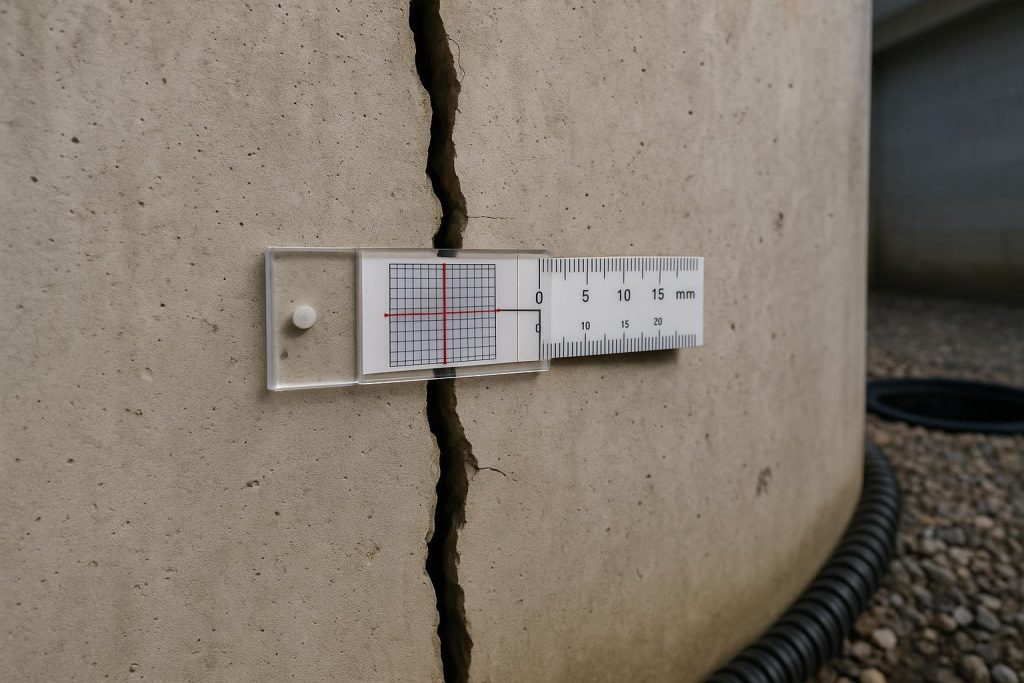
A foundation crack getting wider over weeks or months is one of the clearest signs that something is actively changing in your foundation, not simply settling from years past. Your first step is to measure the crack precisely, record the date, and photograph it so you have a baseline before deciding on a repair approach. Most widening cracks in poured-concrete walls are caused by freeze-thaw cycling, hydrostatic pressure, or progressed shrinkage, and many can be sealed permanently with polyurethane crack injection. However, a crack that grows quickly, runs horizontally, or is accompanied by wall bowing requires a structural engineer’s assessment before any injection work begins.
Key takeaways
- Document crack width with a crack monitor gauge or pencil marks and dated photos before drawing any conclusions.
- Seasonal movement of 0.5–1 mm is common in Ontario’s freeze-thaw climate; growth beyond that warrants professional review.
- Horizontal cracks signal lateral soil pressure and are a structural concern; vertical and diagonal cracks are more often non-structural.
- Polyurethane injection can permanently seal an active, non-structural crack; a structurally compromised wall needs engineering input first.
- Early action limits repair scope; a crack left to widen allows water infiltration that accelerates further deterioration.
Confirm it’s actually this
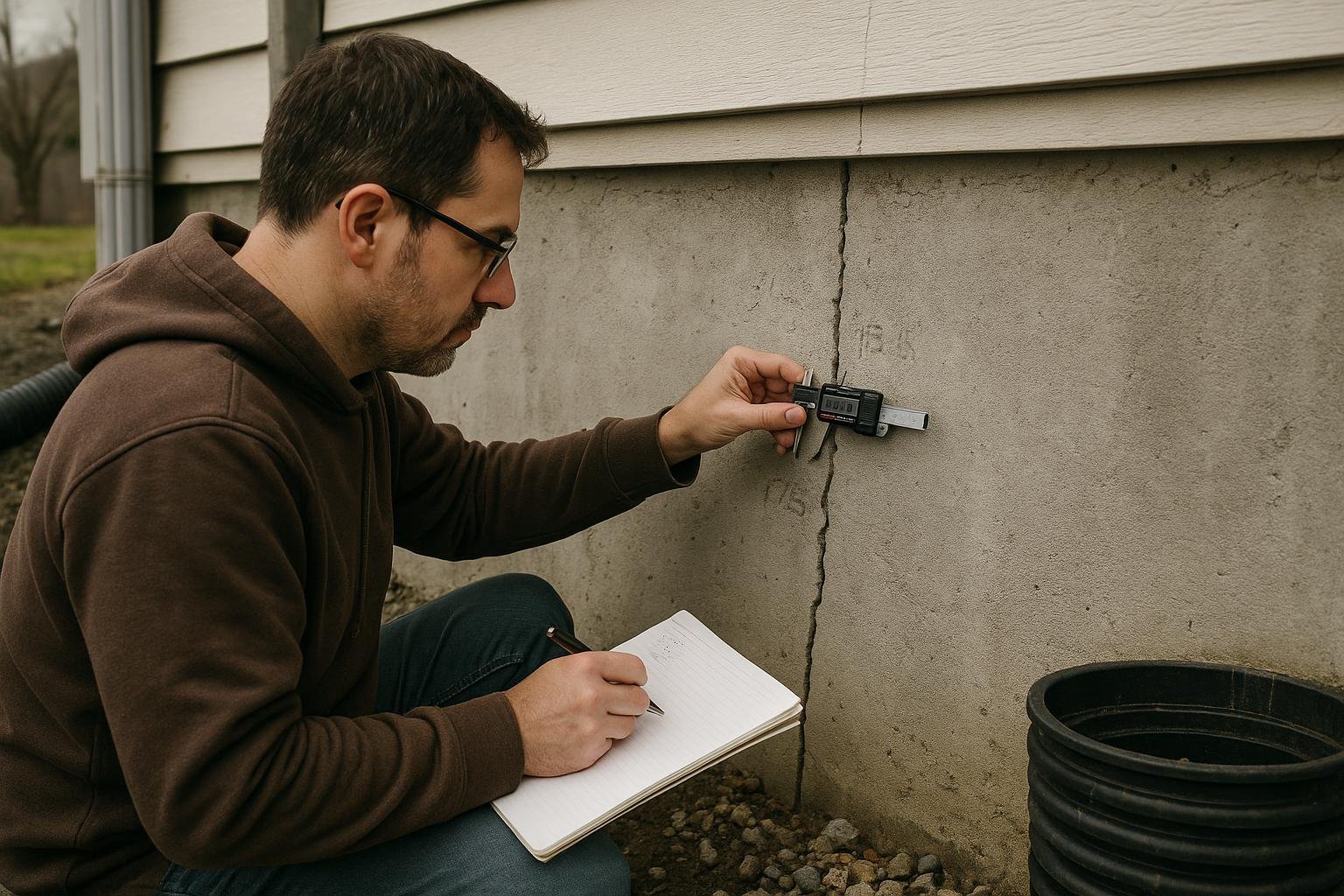
A widening foundation crack is distinguished from a static crack by change over time. When you first notice a crack, mark both ends with a pencil line and note the date. Measure the width at the widest point using a crack gauge or a digital caliper, and photograph the crack with a ruler or coin for scale.
Return every two to four weeks. A crack that is genuinely getting wider will show measurable growth across multiple readings. Look for secondary signs: fresh concrete dust at the base of the wall, new efflorescence alongside the crack, or a gap you can now feel a draft through. These confirm active movement rather than an old, stable crack you simply hadn’t noticed before.
A crack that keeps widening needs a professional assessment; see how our foundation crack repair process starts.
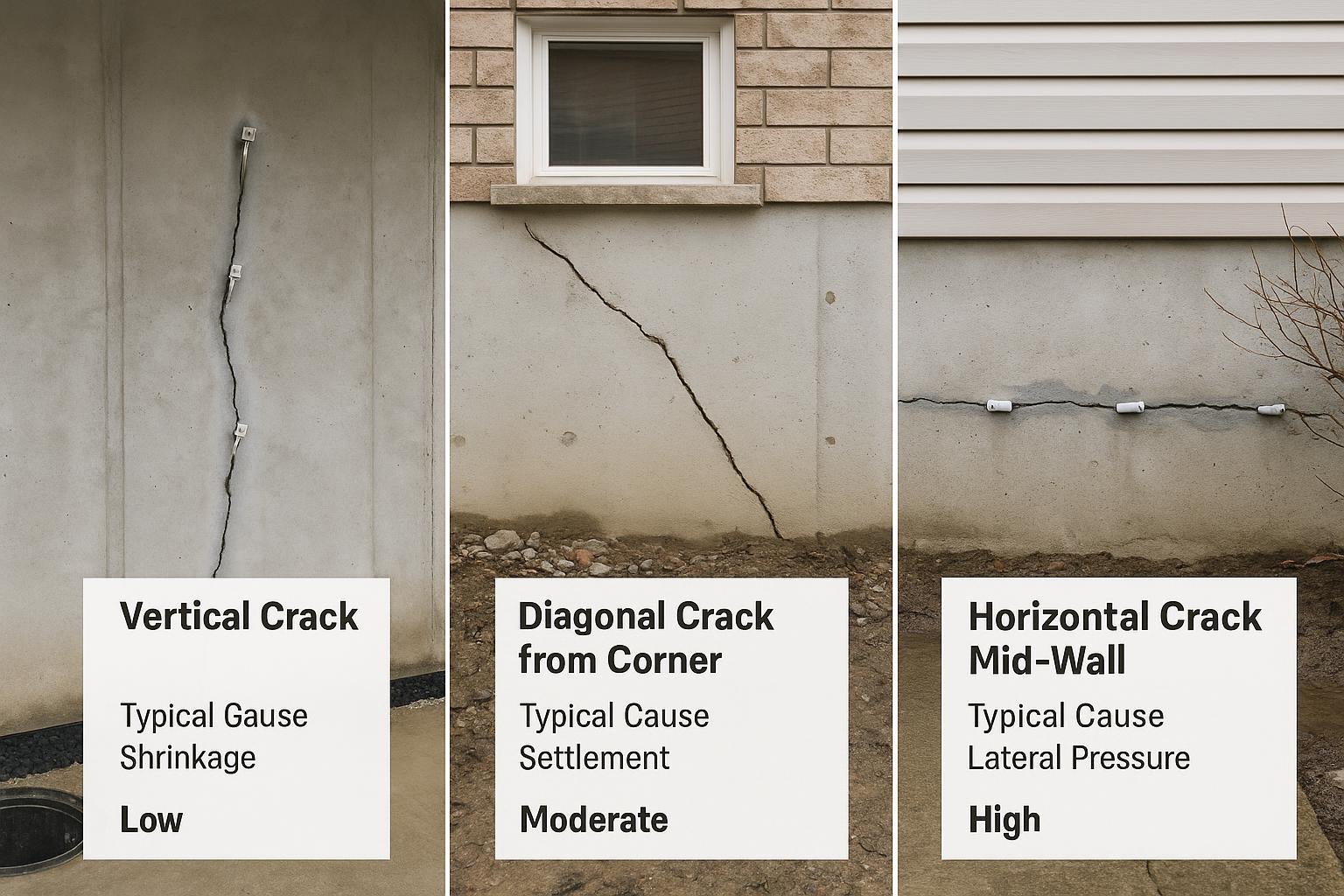
Orientation matters enormously. Vertical cracks run straight up and down; diagonal cracks run at an angle, often from a corner. Both are common in poured concrete. A horizontal crack runs parallel to the ground and is a different category of concern entirely.
Problems it gets confused with
A widening crack is sometimes confused with one that simply looks different under new lighting or after cleaning. Efflorescence can make a hairline crack appear wider than it is; brush it away and re-measure. Paint or drywall finishing over the crack can mask its true width and give a false impression of growth when the coating peels.
Cold joints, horizontal lines where two concrete pours met during construction, are often mistaken for structural cracks. They are typically straight, consistent in depth, and do not widen. Form-tie holes (small round voids left by wall form hardware) are not cracks at all, though they can leak. Confirming the shape and orientation of what you are measuring prevents misdiagnosis.
Causes, ranked
1. Freeze-thaw cycling (most common in Ontario)
Ontario’s climate produces dozens of freeze-thaw cycles each winter. Water that has entered a hairline crack expands roughly 9% when it freezes, wedging the crack open slightly with each cycle. Over a single winter this can widen a crack by a measurable fraction of a millimetre. The telltale sign is a crack that is widest in late winter or early spring and shows concrete spalling or fine debris along its edges.
2. Hydrostatic pressure from saturated soil
After heavy rain or rapid snowmelt, groundwater builds up against the foundation wall. Clay-heavy soils common across the GTA and Ontario cottage country retain this water for extended periods, pushing inward against the concrete. A crack that widens after rain events or spring thaw, and that shows moisture or active seepage, points to hydrostatic pressure as the driver.
3. Concrete shrinkage that has progressed
Poured concrete shrinks as it cures, and shrinkage cracks are normal. Most stabilize within the first few years. However, if the original crack was not sealed, ongoing moisture infiltration and freeze-thaw action can cause a formerly stable shrinkage crack to begin widening again. The telltale sign is a crack that was known and ignored for years and is now measurably wider than at last inspection.
4. Differential settlement
When one section of the foundation sinks more than another, the wall is put under tension and existing cracks widen, or new ones form. Settlement cracks are often diagonal, running from corners of window or door openings, and may be accompanied by sticking doors, sloping floors, or visible gaps between the wall and floor. This cause requires a structural assessment to determine whether settlement is ongoing.
5. Lateral soil pressure (horizontal cracks)
Soil on the exterior exerts inward pressure, especially when saturated or when tree roots are present. If this pressure exceeds the wall’s design capacity, horizontal cracks form, typically mid-wall where bending stress is greatest. The telltale sign is a crack running parallel to the ground, possibly with visible inward displacement of the wall. A widening horizontal crack is a structural warning requiring immediate professional review.
6. Poor drainage or grading
Ground that slopes toward the foundation channels surface water directly against the wall, concentrating moisture and accelerating both hydrostatic pressure and freeze-thaw damage. Cracks near downspout discharge points or in corners where two walls meet are a common indicator. Correcting grading and extending downspouts is a necessary companion to crack repair in these cases.
Cause to solution table
| Cause | Telltale sign | Appropriate fix | Urgency |
|---|---|---|---|
| Freeze-thaw cycling | Widest in late winter; concrete debris at base | Polyurethane crack injection | Act soon |
| Hydrostatic pressure | Widens after rain; damp or weeping crack | Crack injection + drainage improvement | Act soon to Act now |
| Progressed shrinkage crack | Old known crack now measurably wider | Polyurethane crack injection | Act soon |
| Differential settlement | Diagonal crack; sticking doors or sloping floors | Engineer assessment first; injection if stable | Act soon to Act now |
| Lateral soil pressure | Horizontal crack; possible wall bowing | Structural engineer assessment required | Act now |
| Poor drainage / grading | Cracks near downspouts or corners; water pooling | Grading correction + crack injection | Act soon |
Use this table as a starting framework, not a final diagnosis. A single crack can have more than one contributing cause, and the appropriate fix depends on confirming which forces are active. For cracks with any horizontal component or visible displacement, do not proceed with injection until a structural engineer has reviewed the wall.
What you can safely check yourself
- Mark the crack ends. Use a pencil to draw a short line across each end and write today’s date beside it.
- Measure the width. Use a crack gauge card or digital caliper at the widest point. Record the measurement in millimetres alongside the date.
- Photograph with scale. Place a ruler flat against the wall beside the crack and photograph it in consistent lighting. Repeat from the same angle each visit.
- Check for moisture. Run a dry tissue along the crack. Note whether it picks up moisture and whether that appears after rain or only in spring.
- Inspect the exterior grade. Check whether the ground slopes toward or away from the wall at the crack location. Look for downspout discharge points nearby.
- Look for companion signs. Check interior doors and windows near the crack for sticking or gaps. Look at the floor-wall joint for separation and note any new efflorescence.
- Repeat every two to four weeks through at least one full freeze-thaw season before concluding the crack is stable.
What NOT to do
Do not fill a widening crack with hydraulic cement, caulking, or foam backer rod as a permanent fix. These materials do not bond to concrete under active movement and will crack out, sometimes masking the problem and delaying proper repair. Do not paint over the crack before selling a property; this is a disclosure issue and does not stop water entry.
Do not assume a crack is stable after a single measurement. One reading tells you nothing about movement; you need a series of dated measurements. Do not attempt to inject a crack yourself if it is horizontal, if the wall shows any inward displacement, or if you are unsure of the cause. Do not ignore a crack simply because it is not currently leaking; a dry crack that is widening is still an entry point for the next rain or thaw event.
How a professional diagnoses it
A professional inspection begins with a visual survey of the entire foundation perimeter, both interior and exterior where accessible. The technician notes crack orientation, width, length, and any offset between the two sides. They check for efflorescence, staining patterns, and moisture at the crack and at the floor-wall joint.
Width is measured with a calibrated gauge. The technician asks about the crack’s history: when it was first noticed, whether it has been previously repaired, and whether it changes with seasons or rain events. This history is as important as the current measurement.
For cracks with any horizontal component, wall bowing, or signs of displacement, a referral to a structural engineer is the appropriate next step before any repair is recommended. For vertical and diagonal cracks in poured concrete with no displacement, the technician assesses whether the crack is through-wall or surface-only, which determines whether injection is appropriate.
DryShield’s assessment process is described further in our guide on how to tell if a foundation crack is structural. Our basement leak diagnostic tool can also help you characterize what you are seeing before booking a visit.
Temporary vs permanent fixes
Temporary measures can slow water entry while you arrange a professional repair, but they do not stop crack growth or address the underlying cause.
| Approach | What it does | Limitation | Suitable as permanent fix? |
|---|---|---|---|
| Hydraulic cement plug | Stops active water flow temporarily | Cracks out under movement; does not bond long-term | No |
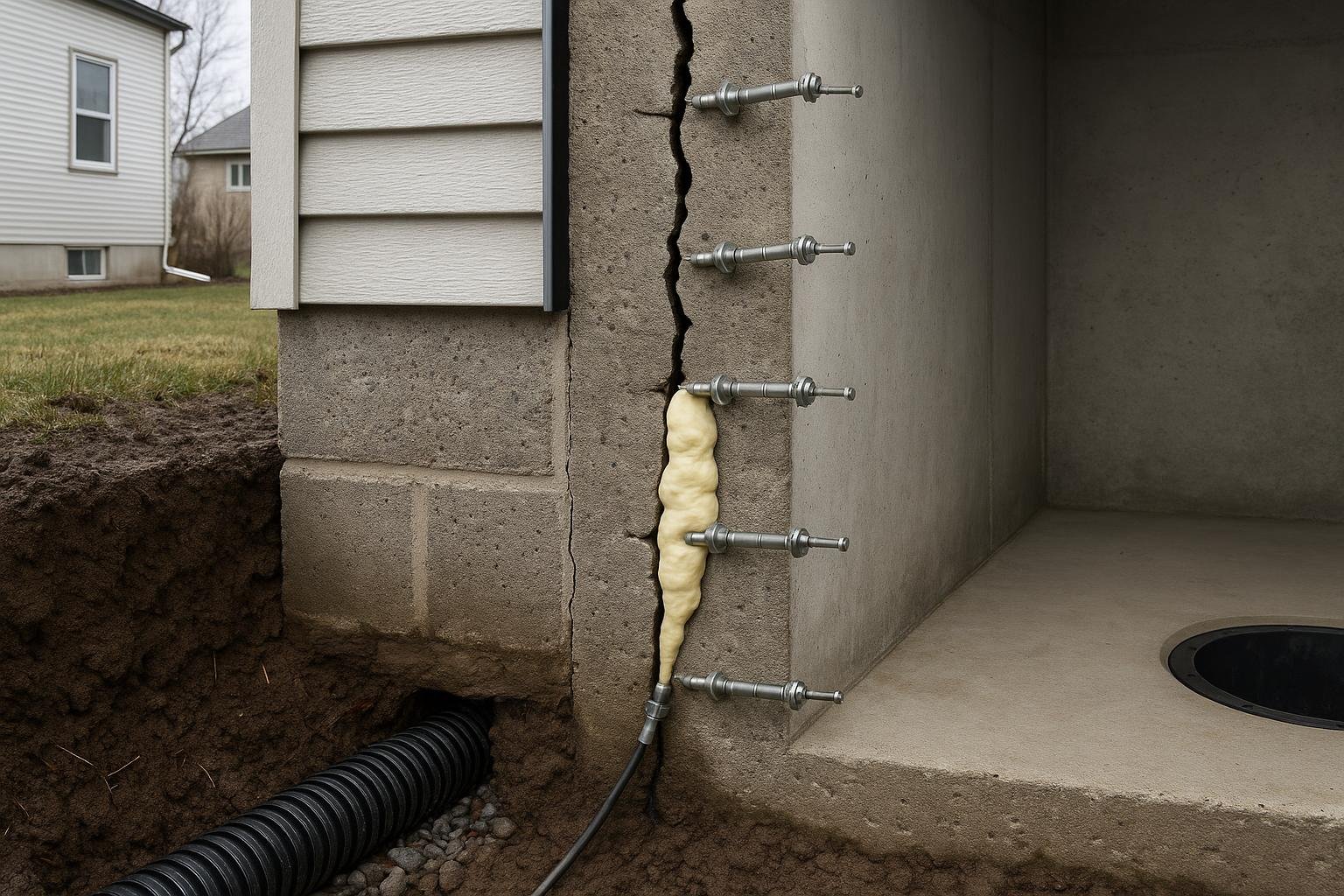
| Polyurethane crack injection | Fills the full crack depth with flexible, waterproof foam | Not appropriate for structural or horizontal cracks without engineering sign-off | Yes, for non-structural cracks |
| Epoxy injection | Bonds crack faces; restores tensile strength | Rigid; not suitable for cracks still experiencing movement | Yes, for stable, dry, non-structural cracks |
| Interior drainage system | Manages water that enters; protects interior | Does not seal the crack or stop water entering the wall | Complementary, not a crack fix |
| Exterior excavation and membrane | Seals crack from outside; installs drainage membrane | Higher cost and disruption; warranted for severe or recurring cases | Yes, for complex cases |
For most widening vertical or diagonal cracks in poured concrete, polyurethane crack injection is the standard permanent repair. It fills the crack through its full depth, remains flexible to accommodate minor future movement, and is backed by DryShield’s Lifetime Transferable Warranty when performed by our technicians. Cost drivers include crack length, accessibility, and whether drainage corrections are needed. For Ontario price ranges, see our crack injection cost page; we do not publish fixed prices here because site conditions vary.
Frequently asked questions
How much crack widening is normal in an Ontario winter?
Minor seasonal movement of roughly 0.5 mm or less across a full freeze-thaw cycle is within the range concrete experiences due to thermal expansion and contraction. Growth beyond 1 mm over a single season, or any growth that continues through summer, is outside normal variation and warrants a professional assessment. The key is documented measurement over time, not a single reading.
Can I use a crack monitor from a hardware store?
Yes. Plastic crack monitors (sometimes called tell-tales) are inexpensive, glue across the crack, and have a graduated scale that makes movement easy to read. Photograph the gauge at each reading and record the date. A digital caliper used at a consistent marked point is an equally valid method if you do not have a monitor.
Does a widening crack always mean I need an engineer?
Not always. Vertical and diagonal cracks in poured concrete widening due to freeze-thaw or hydrostatic pressure, with no wall displacement and no horizontal component, are typically within the scope of a waterproofing contractor. However, any horizontal crack, any crack with visible offset between the two sides, or any crack accompanied by wall bowing requires a structural engineer’s review before repair proceeds. Our guide on identifying structural foundation cracks explains the distinction in detail.
Will polyurethane injection stop the crack from widening again?
Polyurethane foam is flexible and bonds to the concrete on both sides of the crack, creating a waterproof seal that accommodates minor future movement. It does not, however, address the external forces causing the crack to widen. If hydrostatic pressure or drainage problems are not corrected alongside the injection, the crack may re-open or a new crack may form nearby.
How do I know if my horizontal crack is an emergency?
A horizontal crack with any inward wall displacement, a width greater than 6 mm, or visible change within days rather than weeks should be treated as an emergency. Vacate the area and call a professional immediately. Even a horizontal crack without visible displacement should be assessed urgently. See our foundation crack diagnosis page for orientation-based guidance.
Does home insurance cover a widening foundation crack?
Standard Ontario home insurance policies generally do not cover gradual foundation deterioration, including cracks that widen due to soil pressure or freeze-thaw cycling. Coverage may apply if a sudden, accidental event caused the damage. Policy terms vary significantly; review your specific policy and speak with your broker. Our guide on home insurance and foundation cracks in Ontario outlines the general landscape without making coverage guarantees.
Is it safe to finish my basement if I have a widening crack?
No. Covering a widening crack with framing, insulation, or drywall hides a problem that will continue to develop behind the finished wall. Water entry behind finished walls can cause mold and structural damage far more costly than the original crack repair. The crack should be assessed and repaired before any finishing work begins. Our guide on crack repair before finishing a basement covers the recommended sequence.
What is the difference between a crack widening at the top versus the bottom?
A vertical crack wider at the top than the bottom often indicates the wall is rotating outward at the top, which can be associated with lateral soil pressure or inadequate backfill compaction. A crack wider at the bottom may indicate settlement at the footing. Either pattern helps identify the driving force and should be described to the inspector during their assessment.
For further technical background, the Canada Mortgage and Housing Corporation (CMHC) publishes homeowner guidance on basement moisture and foundation performance. The Ontario Building Code sets minimum standards for foundation construction and drainage that inform what constitutes a code-compliant repair.
Ready to stop guessing?
If your measurements show a foundation crack getting wider, or if you are not sure what you are looking at, the most useful next step is a professional assessment. DryShield offers a free on-site evaluation across Toronto, the GTA, and Ontario cottage country. Our technicians will measure the crack, review your monitoring records, and give you an honest recommendation, whether that is injection, a drainage correction, or a referral to a structural engineer. There is no obligation to proceed. Book your free assessment or use our basement leak diagnostic tool to start characterizing the problem right now.