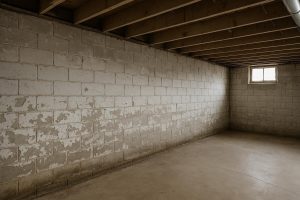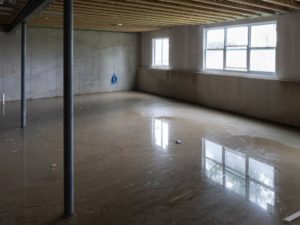
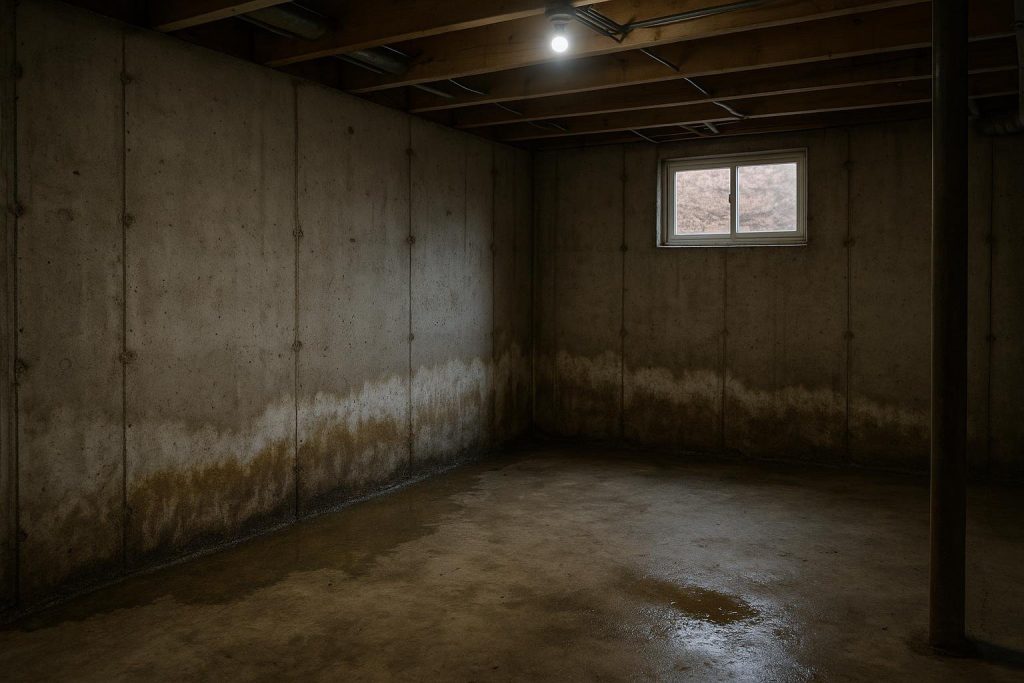
Basement flooding Richmond Hill homes experience most often traces back to two local realities: the heavy clay soil that blankets much of York Region, and original weeping tile systems that are now decades past their service life. When clay becomes saturated after a spring thaw or a summer downpour, it holds water against foundation walls for days, building hydrostatic pressure until water finds the path of least resistance through a crack, a cold joint, or a failed window well.
Key Takeaways
- Clay soil in Richmond Hill retains water far longer than sandy or loamy ground, making hydrostatic pressure the primary driver of wet basements in this area.
- Spring thaw and summer convective storms are the two peak failure windows for foundations across York Region.
- A single injected foundation crack typically costs $600 to $900; a full exterior waterproofing system on an average semi-detached runs roughly $6,000 to $9,000, depending on linear footage and excavation depth.
- Failed or silted-up original weeping tile is the most common root cause found during inspections in older Richmond Hill neighbourhoods.
- The correct fix depends on where water enters: a crack in the wall calls for a different solution than seepage across the entire floor perimeter.
Definitions and Scope
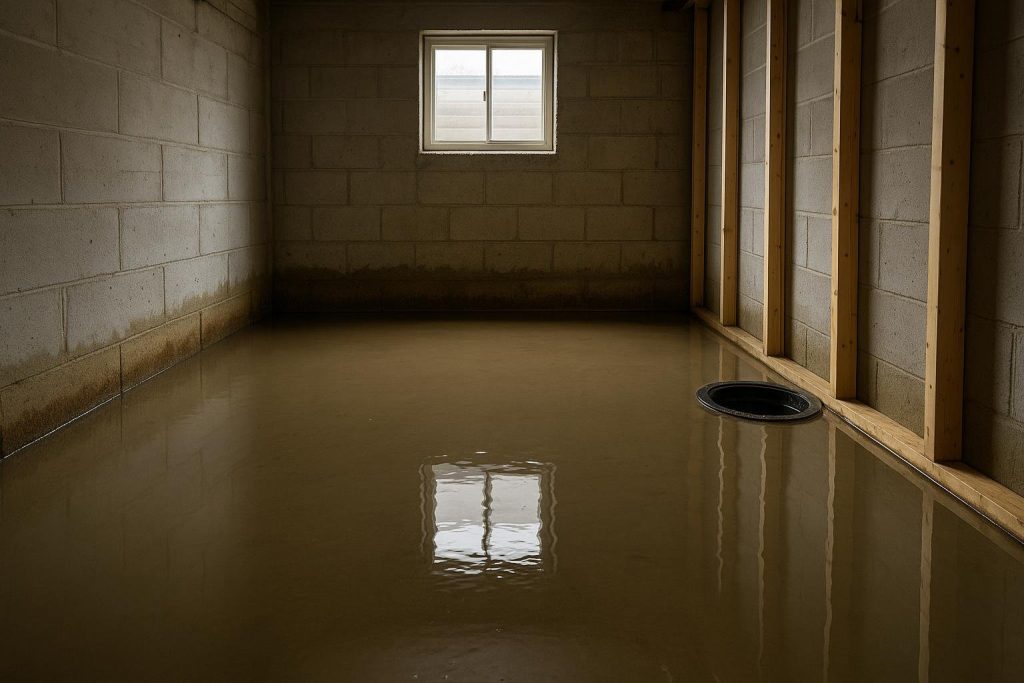
Basement flooding covers a spectrum from a thin film of moisture on the floor after heavy rain to several centimetres of standing water following a major storm event. For the purposes of this guide, flooding means any unwanted water entry that originates from the soil or drainage system around the foundation, not from a burst pipe or appliance leak inside the home.
The main entry points are: vertical or diagonal cracks in poured concrete walls, the cold joint where the wall meets the footing, window wells that overflow, floor drains that back up under surcharge, and floor cracks where hydrostatic pressure pushes water upward. Each entry point has a distinct cause and a distinct repair method. Treating the symptom without addressing the cause is the single most common reason Richmond Hill homeowners call for a second opinion.
This guide covers the full range of waterproofing options available to address basement flooding Richmond Hill properties face, how to choose between them, what drives the cost, and what the repair process actually looks like on the ground.
Why Basement Flooding Matters in Richmond Hill
Richmond Hill sits on a thick layer of Leda clay and glacial till deposited by Lake Iroquois. This clay expands when wet and contracts when dry, which means foundation walls in the area are under constant lateral and hydrostatic stress across the seasons. Unlike sandy soils that drain quickly after rain, clay can stay saturated for a week or more after a single storm, keeping pressure on the wall the entire time.
The town has also grown rapidly since the 1970s and 1980s, and a large share of its housing stock is now old enough that the original weeping tile, typically clay or early plastic pipe, has either collapsed, silted up completely, or been crushed by root intrusion. When the weeping tile fails, there is no longer a drainage path to relieve pressure at the footing, and water has nowhere to go except through the wall. Basement flooding Richmond Hill inspectors encounter most frequently in pre-1990 homes traces directly to this failure mode.
According to the Canada Mortgage and Housing Corporation (CMHC), moisture intrusion is the leading cause of premature foundation deterioration in Canadian homes. You can find their guidance on foundation moisture management at CMHC’s housing research portal. Left unaddressed, a wet basement in Richmond Hill does not stay a minor inconvenience. Repeated wetting and drying cycles accelerate concrete carbonation, promote mould growth within 24 to 48 hours of a flood event, and can compromise the structural integrity of the footing over time.
For a broader look at waterproofing options across the region, the Richmond Hill basement waterproofing and foundation crack repair service page covers the full scope of work available in this area.
Your Options for Stopping Basement Flooding in Richmond Hill
Polyurethane Crack Injection
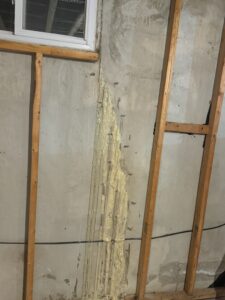
Low-pressure polyurethane injection is the correct first response when water is entering through a single vertical or diagonal crack in a poured concrete wall. A technician installs injection ports along the crack at regular intervals, seals the face with a surface paste, then injects expanding polyurethane foam under low pressure. The foam follows the crack through the full thickness of the wall and cures flexible, so it tolerates the seasonal movement that Richmond Hill’s clay soil imposes on foundations without re-cracking.
Epoxy injection is reserved for structural cracks where the wall needs to be re-bonded and rigidity restored. Polyurethane is the right choice for non-structural cracks that are simply leaking. A single crack injection typically costs $600 to $900 and can be completed in a few hours with no excavation. It is not appropriate when water is entering at multiple points or across the floor perimeter, because those symptoms indicate a system-level drainage failure rather than a discrete crack.
See the detailed breakdown of what affects pricing on the crack injection cost page.
Interior Weeping Tile System
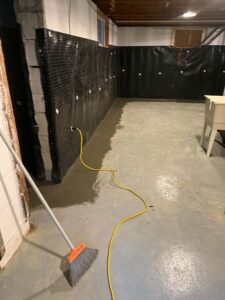
When hydrostatic pressure is pushing water through the floor-wall joint or across the floor slab, an interior drainage system is the most practical solution. The perimeter of the basement floor is jackhammered, a new weeping tile is installed and directed to a sump basin, a vapour barrier is run up the wall, and the concrete is re-poured. The sump pump then discharges collected water away from the foundation.
This approach does not stop water from entering the wall, but it intercepts water before it reaches the floor and removes it before damage occurs. It is well suited to finished basements where exterior excavation would be highly disruptive, and to situations where the exterior membrane has already failed and full excavation is not in the budget. The interior route is generally less expensive than full exterior work.
Exterior Waterproofing
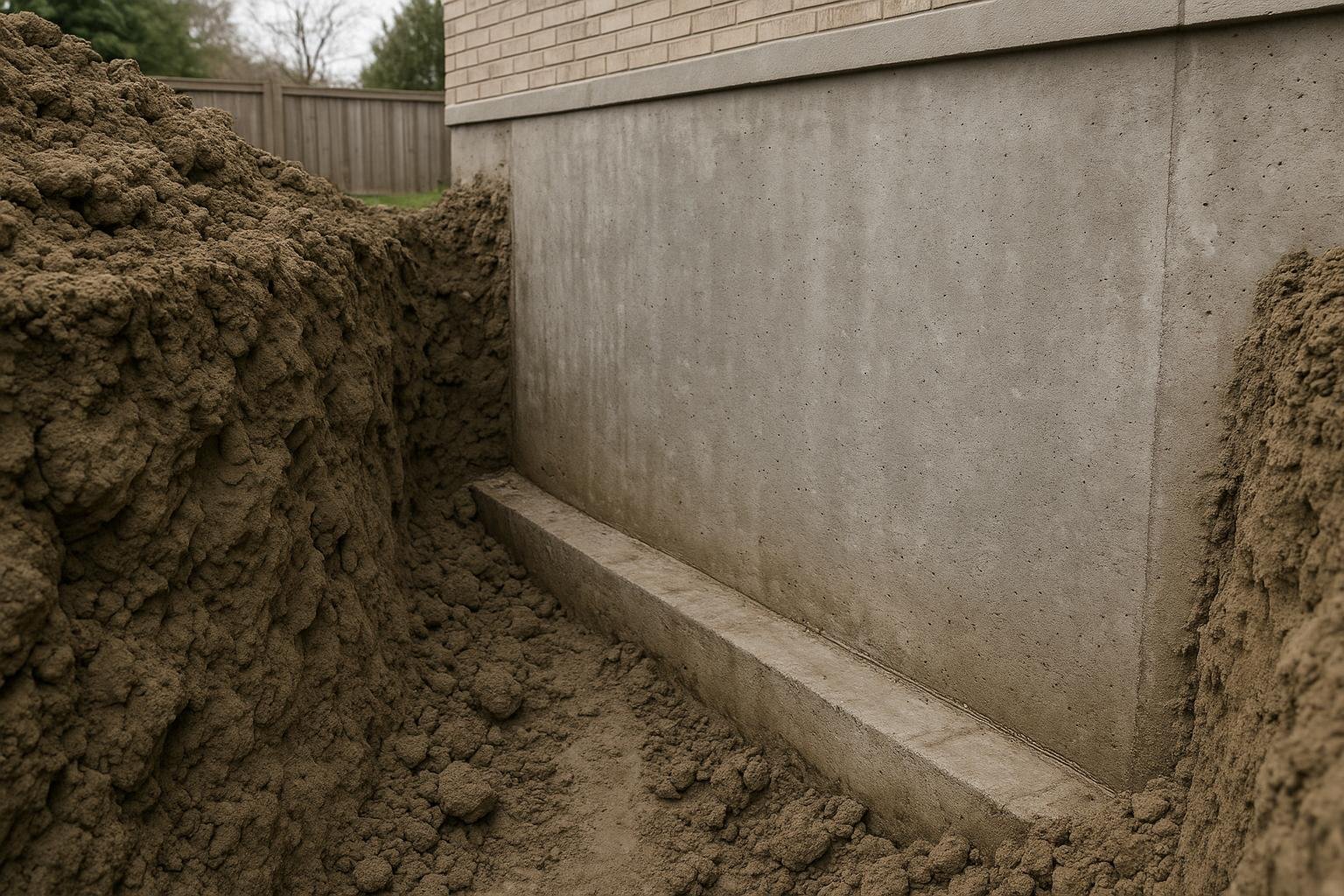
Exterior waterproofing is the most comprehensive solution and the only method that stops water at the source, outside the wall. The process involves excavating to the footing, applying hydraulic cement parging to any voids or honeycombing in the concrete, installing a rubberised waterproofing membrane over the full wall face, covering it with a dimpled drainage board to protect the membrane and channel water downward, laying new weeping tile in clear stone at the footing, and backfilling with corrected grade to direct surface water away.
On an average Richmond Hill semi-detached or detached home, this work typically runs $6,000 to $9,000 depending on linear footage, depth of excavation, and site access. Tight side yards, decks, or landscaping close to the wall increase the cost. This is the preferred solution for homes with chronic basement flooding Richmond Hill contractors identify as stemming from failed original weeping tile or walls that show significant parging deterioration.
Sump Pump Installation or Upgrade
A sump pump is a critical component of any interior drainage system, but it can also be installed as a standalone upgrade in homes that already have a weeping tile system that is still functional. A properly sized pump with a battery backup protects against flooding during power outages, which often coincide with the same storms that cause basement flooding. Richmond Hill’s storm events can knock out power for hours, making a backup unit essential rather than optional.
Sump pump installation is covered in detail on the sump pump installation services page.
Window Well Drainage
Below-grade window wells that lack adequate drainage are a common and often overlooked flood entry point in Richmond Hill homes. When a well fills with water faster than the soil can absorb it, water presses directly against the window frame and enters the basement. The fix involves installing a properly sized gravel bed at the base of the well, adding a drain connected to the weeping tile system, and fitting a clear polycarbonate cover to reduce the volume of rain and snowmelt entering the well.
Exterior Grade Correction and Downspout Extension
Negative grade, where the soil slopes toward the foundation rather than away from it, and downspouts that discharge within a metre of the wall are responsible for a meaningful share of wet basements that look like waterproofing failures but are actually surface drainage problems. Regrading the soil to achieve a positive slope away from the wall, and extending downspouts at least two metres from the foundation, can eliminate or significantly reduce water entry without any structural work. This is always assessed during a site inspection before more invasive repairs are recommended.
Options Compared
| Method | Best For | Typical Lifespan | Relative Cost | Disruption |
|---|---|---|---|---|
| Polyurethane crack injection | Single non-structural wall crack leaking water | Long-term when correctly applied; flexible cure tolerates seasonal movement | Lowest ($600 to $900 per crack) | Minimal, interior access only, no excavation |
| Interior weeping tile system | Floor-perimeter seepage, high water table, finished basements | 25 to 30 years with proper sump pump maintenance | Moderate | Moderate, jackhammer work inside, dust and noise |
| Exterior waterproofing | Chronic flooding, failed original weeping tile, wall membrane failure | Lifetime when membrane and drainage board are intact | Highest ($6,000 to $9,000 for average home) | High, full excavation to footing required |
| Sump pump installation | Homes with functional weeping tile needing discharge upgrade or backup | 7 to 10 years per pump unit; system is indefinite | Low to moderate | Low, pit excavation only |
| Window well drainage | Water entering specifically at below-grade windows | Gravel bed effective for many years; cover is long-lasting | Low | Minimal |
| Grade correction and downspout extension | Surface drainage contributing to wall saturation | Ongoing; may need re-grading after soil settlement | Very low | Minimal |
The table above makes clear that no single method fits every situation. Crack injection is the right tool for a discrete wall crack but does nothing for floor seepage. Exterior waterproofing addresses the root cause completely but requires access around the perimeter and a larger investment. Interior drainage manages water that has already entered the wall and is the practical choice when exterior access is restricted. In many Richmond Hill homes, the correct solution combines two methods, for example, crack injection on a specific wall crack plus a sump pump upgrade to handle residual hydrostatic pressure.
How to Choose the Right Fix
Choose polyurethane crack injection if water is entering at one or two identifiable vertical or diagonal cracks in a poured concrete wall, the cracks are non-structural, and the rest of the basement stays dry. This is the fastest and most cost-effective starting point.
Choose an interior weeping tile system if water appears along the full floor-wall joint, if the floor itself is damp or shows efflorescence across a wide area, or if the home has a finished basement where exterior excavation would require removing a deck, landscaping, or a driveway. Interior drainage also makes sense when the budget does not allow full exterior work but the flooding is recurring.
Choose exterior waterproofing if the original weeping tile is confirmed to be failed or silted up, if the wall shows widespread parging deterioration or multiple cracks, if water entry is occurring at or below the footing level, or if the home has experienced repeated basement flooding Richmond Hill contractors have been unable to resolve with interior repairs alone. This is the definitive solution for chronic cases.
Choose a sump pump upgrade if the existing drainage system is functional but the pump is more than seven years old, lacks a battery backup, or has no alarm. Richmond Hill’s summer storms can cause power outages lasting several hours, and a pump failure during a storm is the most common cause of a flooded basement in homes that otherwise have adequate waterproofing.
Always start with a site inspection. The entry point of water, the soil conditions visible at the base of the wall, and the condition of the existing weeping tile all determine which method will actually solve the problem.
Costs and Timelines
| Cost Driver | Why It Affects Price | Approximate Impact |
|---|---|---|
| Linear footage of wall to be treated | More wall means more membrane, drainage board, weeping tile and labour | Primary driver for exterior and interior systems |
| Excavation depth | Deeper footings require more digging time, shoring and backfill | Significant; older Richmond Hill homes often have deeper footings |
| Site access | Tight side yards, fences, decks, or mature landscaping slow excavation and may require hand-digging | Can add meaningfully to exterior work cost |
| Number of cracks to inject | Each crack is a discrete repair at $600 to $900 per crack | Scales directly with crack count |
| Condition of existing weeping tile | Fully collapsed tile requires complete replacement; partial blockage may allow cleaning | Replacement adds to exterior system cost |
| Sump pit and pump specification | Battery backup units and higher-capacity pumps cost more than basic units | Moderate; backup units are strongly recommended in Richmond Hill |
As a general reference, a single foundation crack injection runs $600 to $900. A full exterior waterproofing system on an average Richmond Hill semi-detached or detached home typically falls in the $6,000 to $9,000 range. Interior weeping tile systems generally come in below exterior work for the same linear footage. All figures depend on a site inspection, and the final scope is always provided in writing before any work begins. For a broader cost breakdown, the basement waterproofing cost guide covers the full range of variables across Southern Ontario.
A single foundation crack injection in Richmond Hill typically costs $600 to $900. Full exterior waterproofing on an average home runs $6,000 to $9,000. The final figure always depends on a site inspection.
Risks and Common Mistakes
| Symptom | Likely Cause | Correct Fix |
|---|---|---|
| Water along floor-wall joint after heavy rain | Failed or silted weeping tile, hydrostatic pressure at footing | Interior weeping tile system or exterior waterproofing |
| Water through a single vertical wall crack | Shrinkage or settlement crack in poured concrete | Polyurethane crack injection |
| Damp floor slab across a wide area | High water table or capillary rise through slab | Interior drainage system with sump pump |
| Water at window well | Inadequate well drainage, negative grade at window | Window well drain, gravel bed, polycarbonate cover |
| Flooding only during or immediately after rain | Surface drainage issue, downspout discharge too close to wall | Grade correction, downspout extension |
The most common mistake Richmond Hill homeowners make is applying hydraulic cement or a paint-on sealant to a leaking crack and assuming the problem is solved. These products can slow water entry temporarily, but they do not address hydrostatic pressure and they fail when the crack moves seasonally. The crack re-opens, often wider than before, and the next repair is more expensive.
A second frequent error is installing a sump pump without first confirming that the weeping tile is functional. A pump can only discharge water that reaches the sump pit. If the weeping tile is silted up, water bypasses the pit entirely and continues to enter through the wall. The pump runs dry while the basement floods.
Hydraulic cement and paint-on sealants are temporary measures. They do not relieve hydrostatic pressure and will fail when the foundation moves seasonally. A proper diagnosis before any repair is the most cost-effective step a Richmond Hill homeowner can take.
Skipping the site inspection is the third common mistake. Basement flooding Richmond Hill homes experience is rarely straightforward to diagnose. Clay soil behaviour, the depth and condition of the original weeping tile, and the specific construction era of the home all affect which repair will hold long-term. A written scope based on a physical inspection protects the homeowner and ensures the right method is applied.
How the Process Works
- Free on-site inspection and moisture assessment. A technician visits the property, traces water entry points, assesses the condition of the existing weeping tile and drainage, and identifies whether the issue is a discrete crack, a system failure, or a surface drainage problem.
- Written scope with linear-foot or per-crack pricing. A detailed written quote is provided before any work begins. For exterior work, this includes excavation depth, membrane specification, drainage board, and weeping tile replacement where required.
- Preparation and access. For exterior work, the area around the foundation is cleared and excavated to the footing. For interior work, the perimeter floor is jackhammered. For crack injection, ports are installed along the crack face.
- Core repair work. Exterior: hydraulic cement parging of voids, rubberised membrane application, dimpled drainage board installation, new weeping tile in clear stone, backfill and grade correction. Interior: weeping tile to sump basin, vapour barrier up the wall, concrete re-pour. Crack injection: low-pressure polyurethane injected through ports until the crack is fully saturated.
- Sump pump installation or verification. Where an interior system is installed, the sump pump is sized, installed, and tested. Battery backup units are connected and alarmed.
- Final inspection and cleanup. The completed work is inspected, the site is cleaned, and the homeowner is walked through what was done and why.
- Warranty documentation. A written warranty is issued. DryShield’s lifetime transferable warranty covers the waterproofing system and transfers to a new owner if the home is sold, which is a meaningful asset at resale.
DryShield’s waterproofing warranty is transferable to a new owner, which means a properly waterproofed Richmond Hill home carries a documented, warrantied foundation as part of its resale value.
Frequently Asked Questions
Why does my Richmond Hill basement flood even when it has not rained heavily?
Basement flooding in Richmond Hill can occur from snowmelt, rising groundwater, or a water table elevated by weeks of accumulated precipitation rather than a single storm. Clay soil holds moisture for extended periods, so hydrostatic pressure can build gradually and push water through the wall days after the last rain event. A site inspection will identify whether the source is surface water, groundwater, or a combination of both.
Is basement flooding covered by home insurance in Ontario?
Standard home insurance policies in Ontario typically cover sudden and accidental water damage from an internal source, such as a burst pipe, but exclude gradual seepage through foundation walls or floors. Some insurers offer overland water or sewer backup endorsements that may cover storm-related flooding. Reviewing your policy with your broker before a flood event is the only way to know your actual coverage. Waterproofing the foundation can also reduce your premium in some cases.
How long does exterior waterproofing take on a Richmond Hill home?
A full exterior waterproofing job on an average Richmond Hill semi-detached or detached home typically takes two to four days, depending on linear footage, excavation depth, and site access. Homes with tight side yards or significant landscaping close to the wall may take longer. The written scope provided before work begins will include a realistic timeline for your specific property.
Can I waterproof my basement from the inside instead of excavating?
Interior waterproofing is a legitimate and effective solution for many Richmond Hill homes, particularly where exterior access is restricted or the budget does not allow full excavation. An interior weeping tile system intercepts water before it reaches the floor and removes it via a sump pump. It does not stop water from entering the wall, but it prevents damage. For homes with failed exterior membranes and collapsed original weeping tile, exterior work remains the more complete solution.
What is the difference between polyurethane and epoxy crack injection?
Polyurethane injection cures flexible and is used for non-structural cracks that are leaking water. The flexible cure allows the repair to move with the foundation through seasonal freeze-thaw cycles without re-cracking. Epoxy injection cures rigid and is used for structural cracks where the wall needs to be re-bonded and its load-bearing capacity restored. Using epoxy on a non-structural crack in a moving foundation is a common error that leads to re-cracking adjacent to the repair.
How do I know if my original weeping tile has failed?
Signs of failed weeping tile include water entry along the full floor-wall joint rather than at a specific crack, efflorescence or mineral staining across a wide section of the wall base, and a basement that floods during moderate rain rather than only during extreme events. A camera inspection of the existing tile can confirm whether it is silted, crushed, or still functional. Many Richmond Hill homes built before 1990 have original clay tile that is at or past the end of its service life.
Will fixing my basement flooding increase my home’s resale value in Richmond Hill?
A documented, warrantied waterproofing system is a positive disclosure item in a Richmond Hill real estate transaction. Buyers and their inspectors look closely at foundation condition, and a wet basement is one of the most common reasons a sale falls through or a price is renegotiated downward. A properly waterproofed basement with a transferable warranty removes that risk from the transaction. The GTA waterproofing ROI guide covers the resale data in detail.
How soon should I act after noticing water in my basement?
Act within 24 to 48 hours if there is standing water, because mould can begin to establish on organic materials within that window. Even if the water has dried, the underlying cause will not resolve on its own and will worsen with each subsequent rain or thaw. Scheduling a free inspection as soon as the problem is noticed is the most cost-effective response, because early-stage cracks are less expensive to repair than cracks that have widened or shifted over multiple seasons.
If you are dealing with basement flooding Richmond Hill properties are prone to and want a clear diagnosis before committing to any repair, contact the DryShield team for a free on-site inspection. A written scope and honest recommendation, with no obligation, is the starting point for every job we do in York Region.