Basement flooding Kitchener homeowners deal with is most often caused by hydrostatic pressure building up in the clay-heavy soils that blanket much of Waterloo Region, not simply by heavy rain on its own. When that saturated soil presses against a foundation wall or footing, water finds every crack, cold joint and gap in aging weeping tile it can. Understanding the real source of the water is the first step toward a fix that actually holds.
Key Takeaways
- Clay soil across Kitchener holds water against foundation walls long after rain stops, making hydrostatic pressure the primary culprit in most flooded basements.
- Spring thaw and intense summer downpours are the two peak failure windows for Kitchener foundations.
- Older homes in neighbourhoods like Vanier, Centreville and downtown Kitchener commonly have original weeping tile that is fully silted up and no longer draining.
- A single foundation crack can be injected with polyurethane from the interior for roughly $600 to $900; full perimeter waterproofing is a larger investment with a wider range.
- The right fix depends on where water enters, how old the foundation is and whether the existing drainage system is still functional.
Definitions and Scope
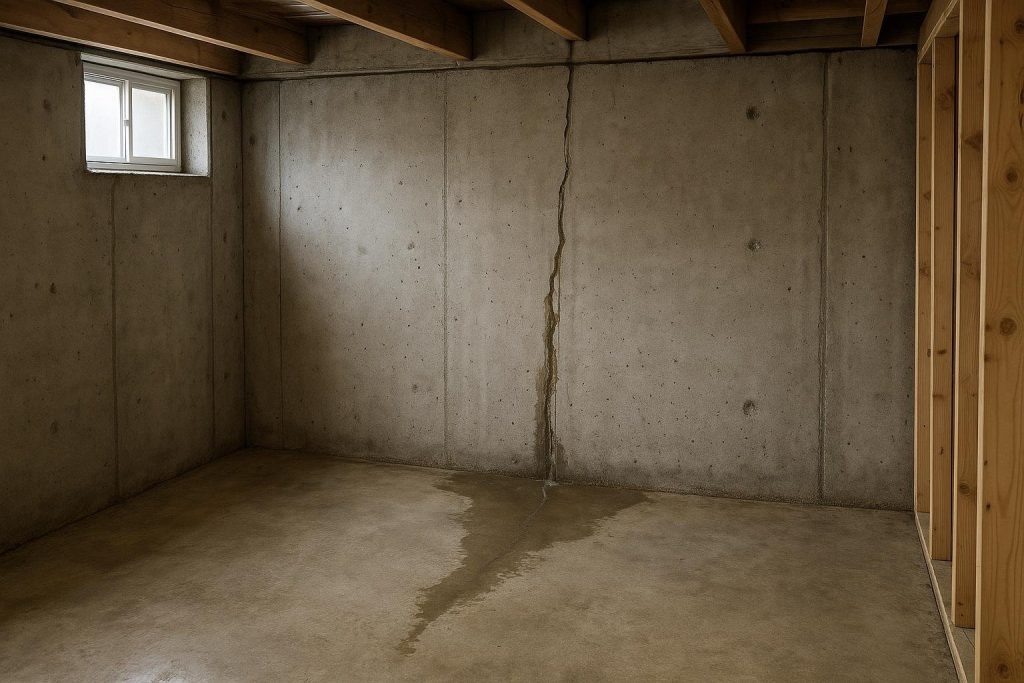
Basement flooding covers a spectrum from a thin film of moisture on the floor after heavy rain all the way to several centimetres of standing water following a spring thaw. In Kitchener, the term usually describes one of three scenarios: water seeping through a foundation wall crack, water rising through the floor slab due to a high water table, or surface water entering through window wells or the base of the wall where it meets the footing.
Hydrostatic pressure is the force that saturated soil exerts against a concrete or block foundation. Kitchener sits on a mix of glacial till and silty clay that drains slowly. After a significant rainfall or during snowmelt, that soil can hold water at foundation depth for days, pushing steadily inward. Weeping tile, the perforated pipe buried at the footing level, is supposed to intercept that water and carry it to a sump basin or municipal drain. When the tile silts up or collapses, the pressure has nowhere to go except through the wall.
This guide covers the full range of repair options available to Kitchener homeowners, what drives the cost of each, and how to decide which approach fits your specific situation. For a broader look at waterproofing services in the area, the Kitchener basement waterproofing and foundation crack repair page outlines the full scope of what is available locally.
Why Basement Flooding Kitchener Homes Experience Is So Common
Kitchener’s housing stock spans a wide age range. The older neighbourhoods close to downtown contain homes built in the 1940s through 1960s, many with original clay weeping tile that has long since collapsed or filled with silt. Homes built in the 1970s and 1980s often used corrugated plastic pipe that crimps over time. Even homes from the 1990s can have drainage systems that are approaching the end of their functional life.
The Region of Waterloo receives significant snowfall through winter, and the spring thaw typically arrives in March or April. When frozen ground thaws from the top down, meltwater cannot percolate and instead runs laterally toward the lowest point it can find, which is often a foundation wall. That same dynamic repeats in summer when intense convective storms drop large volumes of rain faster than the soil can absorb it.
Canada Mortgage and Housing Corporation notes that basement water entry is one of the most common and costly problems in Canadian housing. The CMHC’s guidance on moisture control, available at cmhc-schl.gc.ca, reinforces that addressing the drainage system rather than just the symptom is the only durable solution. Ignoring a wet basement in Kitchener’s climate allows mould to establish within 24 to 48 hours of a flood event, and repeated wetting and drying cycles accelerate concrete deterioration and can compromise the structural integrity of the footing over time.
Seasonal Risk: When Basement Flooding Kitchener Peaks
| Season / Period | Primary Risk Factor | Typical Entry Point | Risk Level |
|---|---|---|---|
| March to April (Spring Thaw) | Frozen ground blocks percolation; meltwater runs laterally to foundations | Wall base, cold joint, silted weeping tile | Very High |
| May to June (Late Spring Rain) | Saturated soil from snowmelt plus heavy rain; sump pumps under sustained load | Floor slab, perimeter joint, wall cracks | High |
| July to August (Summer Storms) | Intense convective storms exceed soil absorption rate; window wells fill rapidly | Window wells, negative-grade surface runoff | High |
| September to November (Fall) | Soil re-saturates after summer dry period; early freeze can trap water near footing | Wall cracks, cold joint | Moderate |
| December to February (Winter) | Freeze-thaw cycles widen existing cracks; ice damming can direct melt to foundation | Existing cracks, window frames | Low to Moderate |
The table above shows that basement flooding Kitchener homeowners face is not limited to a single season. Spring thaw carries the highest risk, but summer storms and late-spring rain create sustained pressure that can overwhelm drainage systems already weakened by winter freeze-thaw cycles. Planning repairs before March is the most effective way to reduce peak-season risk.
Kitchener Neighbourhood Foundation Age and Risk
| Neighbourhood / Area | Predominant Build Era | Common Foundation Type | Typical Drainage Risk |
|---|---|---|---|
| Downtown Kitchener, Vanier, Centreville | 1920s to 1960s | Stone rubble or early poured concrete | Very High: original clay tile fully silted or absent |
| Cherry Hill, Forest Hill, Westmount | 1960s to 1980s | Poured concrete or concrete block | High: corrugated plastic tile crimping or silted |
| Laurentian Hills, Country Hills | 1980s to 1990s | Poured concrete | Moderate: tile functional but aging; membrane may be failing |
| Doon, Huron Park, Trussler | 1990s to 2010s | Poured concrete | Lower: newer systems, but clay backfill still creates pressure |
| Williamsburg, Lackner Woods | 2000s to present | Poured concrete with modern membrane | Lowest: modern drainage, though clay soil risk remains |
Basement flooding Kitchener older neighbourhoods experience is disproportionately tied to drainage infrastructure that was never designed to last more than a few decades. Homes in Vanier or downtown Kitchener with original clay tile are the highest-priority candidates for weeping tile replacement, while newer subdivisions in Doon or Williamsburg are more likely to need only targeted crack repair or sump pump upgrades.
Your Options for Stopping Basement Flooding in Kitchener
Polyurethane Crack Injection
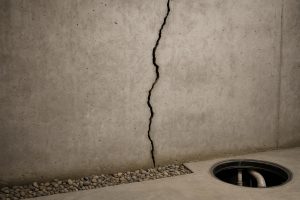
Low-pressure polyurethane injection seals an active crack from the interior without excavation. A technician drills ports along the crack at regular intervals, pastes surface ports in place, then injects expanding polyurethane foam under low pressure. The foam follows the crack through the full thickness of the wall and cures flexible, so it tolerates the seasonal movement that is normal in Kitchener’s freeze-thaw climate. This method works best for a single vertical or diagonal crack in a poured concrete wall where the surrounding concrete is otherwise sound. It is not appropriate for horizontal cracks, which signal lateral soil pressure and may indicate a structural concern.
Interior Weeping Tile System
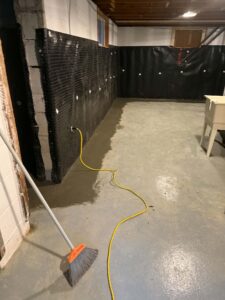
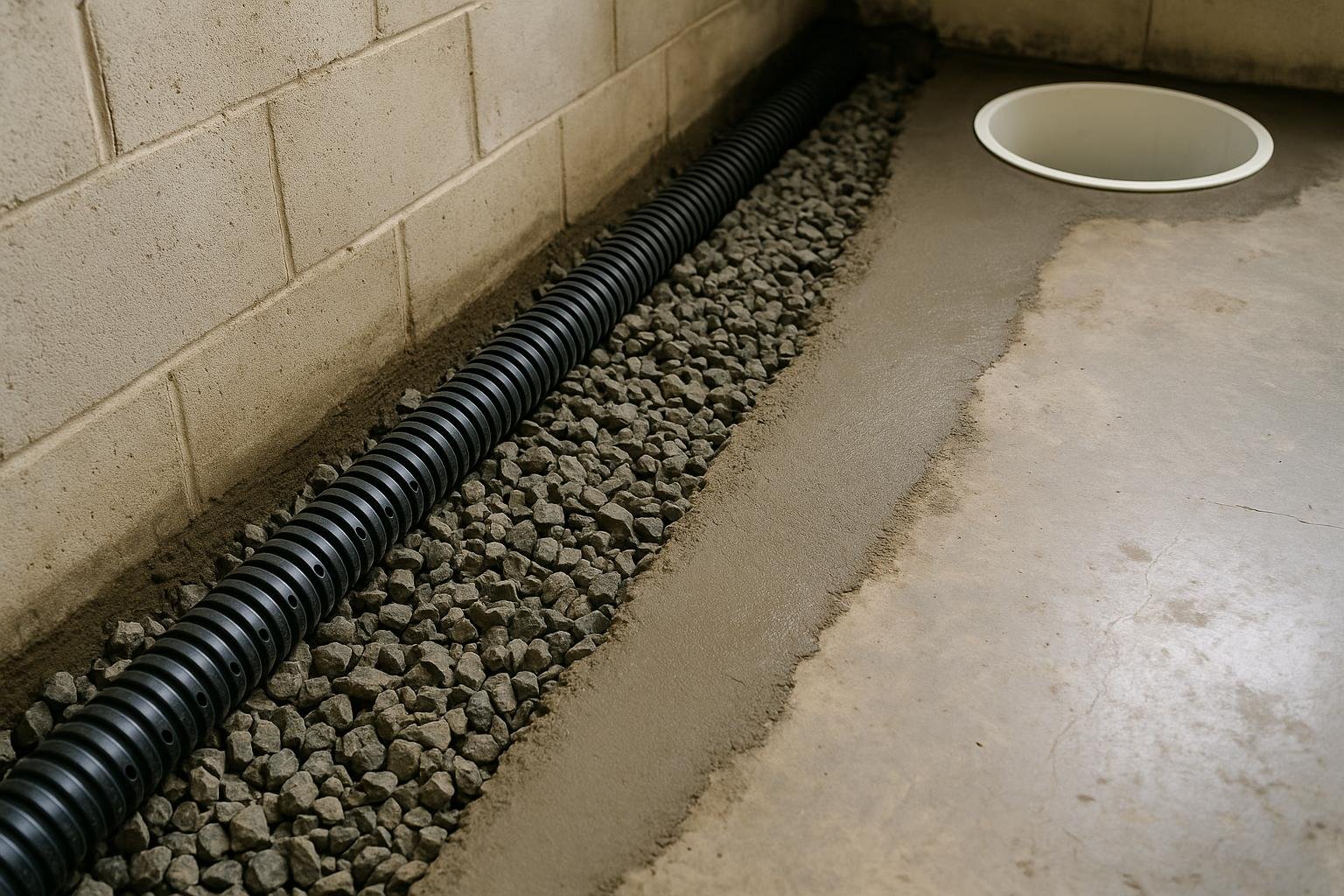
An interior perimeter drainage system involves breaking the concrete floor along the inside perimeter of the basement, installing a new perforated weeping tile in a bed of clear stone, and directing water to a sump basin where a pump ejects it away from the foundation. A vapour barrier is then run up the wall and sealed to prevent moisture from migrating inward. This approach does not stop water from entering the wall, but it intercepts and manages it before it reaches the floor. It is the preferred option when exterior excavation is not practical due to finished landscaping, decks or limited side-yard access.
Exterior Waterproofing with New Weeping Tile
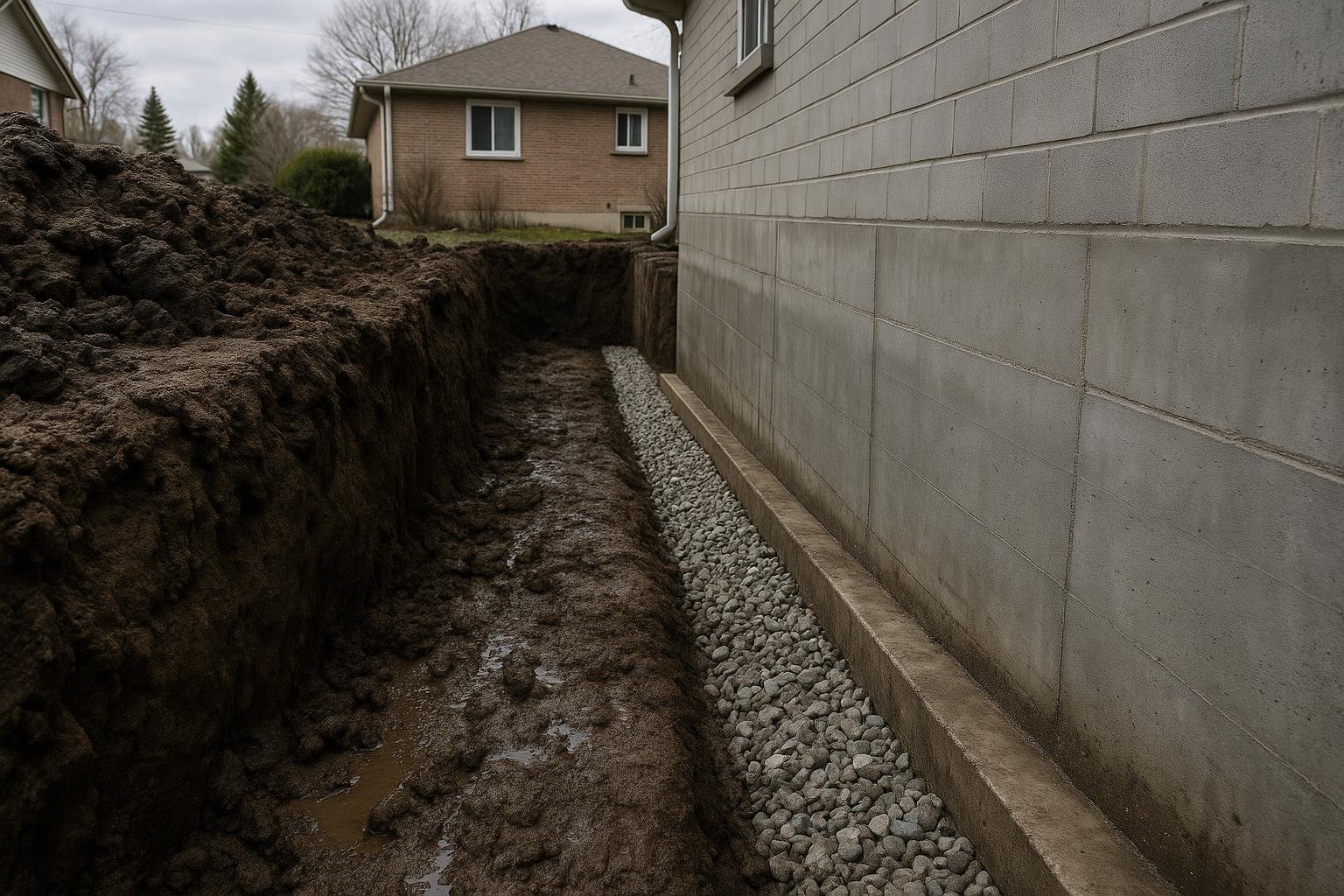
Full exterior waterproofing is the most comprehensive solution. The soil is excavated to the footing, voids in the foundation wall are filled with hydraulic cement parging, a rubberised waterproof membrane is applied to the exterior face of the wall, a dimpled drainage board protects the membrane, new weeping tile is bedded in clear stone at the footing, and the trench is backfilled with the grade corrected to slope away from the house. This stops water at the source rather than managing it inside. It is the right choice when the existing exterior membrane has failed, when the original weeping tile is completely non-functional, or when the homeowner wants the longest-lasting protection available.
Sump Pump Installation or Replacement
A sump pump is the active component of any drainage system. If a home already has a weeping tile system but no pump, or a pump that is undersized or aging, installing a properly sized unit with a battery backup is often the fastest way to reduce flood risk. A battery backup system keeps the pump running during power outages, which frequently coincide with the same storms that cause basement flooding Kitchener residents dread most. The sump pump installation service page covers sizing, placement and backup options in detail.
Epoxy Crack Injection
Epoxy injection is used specifically for structural cracks where the two sides of the wall must be re-bonded to restore load-bearing capacity. Unlike polyurethane, epoxy cures rigid and achieves compressive strength comparable to the original concrete. It is not appropriate for active leaks or for cracks that are still moving seasonally, because a rigid repair in a moving crack will simply re-crack at the bond line. A qualified inspector can determine whether a crack is structural or non-structural before recommending the appropriate injection material.
Exterior Grade Correction and Window Well Drainage
Sometimes the entry point is not through the wall at all. Negative grading, where the soil slopes toward the house rather than away from it, directs surface water straight to the foundation. Window wells without drains fill with water during heavy rain and allow it to enter through the window frame or the wall below. Correcting the grade and adding window well drains with covers is a lower-cost first step that can meaningfully reduce water entry in homes where the foundation itself is still in reasonable condition.
Options Compared
| Method | Best For | Typical Lifespan | Relative Cost | Disruption |
|---|---|---|---|---|
| Polyurethane crack injection | Single vertical crack in poured concrete | Long-term if crack is stable | Lowest ($600 to $900 per crack) | Minimal, interior only, no excavation |
| Interior weeping tile system | Perimeter seepage, failed original tile, limited exterior access | 20 to 30 years with pump maintenance | Moderate | Jackhammer work inside, 1 to 3 days |
| Exterior waterproofing with new weeping tile | Failed membrane, fully silted tile, comprehensive protection | 25 years or more | Highest ($6,000 to $9,000 for average semi/detached) | Full excavation, landscaping impact |
| Sump pump installation | Homes with existing drainage but no pump or aging pump | 7 to 10 years per pump unit | Low to moderate | Minimal, basin already present or small excavation |
| Epoxy crack injection | Structural cracks requiring re-bonding | Permanent if crack is stable | Low to moderate per crack | Minimal, interior only |
| Grade correction and window well drainage | Surface water entry, negative grading | Ongoing, depends on landscaping | Lowest | Exterior landscaping work only |
The table above shows that no single method fits every Kitchener basement. Crack injection is the right starting point when there is one identifiable entry point in an otherwise dry wall. Exterior waterproofing makes sense when the whole drainage system has failed and the homeowner wants a solution that addresses the root cause at the foundation exterior. Interior weeping tile sits in the middle: it cannot stop water from entering the wall, but it reliably manages it before damage occurs and is often the only practical option on a tight urban lot.
How to Choose the Right Fix for Basement Flooding in Kitchener
Choose polyurethane crack injection if water enters through a single, clearly visible vertical or diagonal crack in a poured concrete wall, the crack is not actively widening, and the rest of the basement stays dry. This is the fastest and least expensive resolution when the diagnosis is clear.
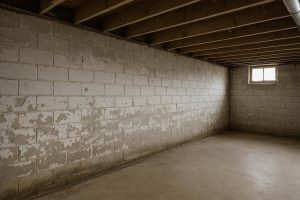
Choose an interior weeping tile system if water appears along the base of multiple walls or across the floor, if the home has a block foundation where injection is not practical, or if exterior excavation is blocked by a deck, patio, or narrow side yard. This system works regardless of what the exterior soil conditions are doing.
Choose exterior waterproofing if the original weeping tile is confirmed to be non-functional, if the exterior membrane has visibly failed, or if you want the most comprehensive protection available. Homes in older Kitchener neighbourhoods where the original clay tile has never been replaced are strong candidates. The exterior vs. interior perimeter waterproofing comparison guide walks through this decision in detail.
Choose grade correction and window well work first if water entry is clearly tied to surface runoff rather than groundwater pressure, and if the foundation wall itself shows no active cracks or seepage between rain events.
A free on-site inspection is the only reliable way to confirm which method applies to your specific foundation. Water entry points are not always where they appear to be, and the wrong fix wastes money without solving the problem.
Costs and Timelines for Basement Flooding Kitchener Repairs
| Cost Driver | Why It Affects Price | Approximate Impact |
|---|---|---|
| Linear footage of affected perimeter | More wall to treat means more membrane, weeping tile and labour | Primary driver for exterior and interior systems |
| Depth of excavation | Deeper footings require more digging time and shoring | Significant on older Kitchener homes with deep foundations |
| Site access | Narrow side yards, fences and decks slow excavation and raise labour cost | Can add meaningfully to exterior work |
| Number and type of cracks | Each crack injection is priced individually; structural cracks need epoxy | $600 to $900 per crack for polyurethane injection |
| Condition of existing drainage | Fully silted or collapsed tile requires complete replacement rather than supplementing | Increases scope of interior or exterior systems |
| Sump basin and pump | New basin, primary pump and battery backup add to interior system cost | Moderate addition, essential for system function |
As a general reference, a single polyurethane crack injection in Kitchener typically falls in the $600 to $900 range. Full exterior waterproofing of an average semi-detached or detached home runs roughly $6,000 to $9,000 depending on linear footage, excavation depth and access conditions. Interior weeping tile systems generally come in below the exterior figure. Every final number depends on a site inspection, because two homes on the same street can have meaningfully different foundation conditions. For a broader look at what drives waterproofing costs across Ontario, the foundation waterproofing cost guide provides useful context.
Timelines: crack injection is typically completed in a single visit. Interior weeping tile installation runs one to three days depending on perimeter length. Full exterior waterproofing on a standard Kitchener home usually takes two to four days, weather permitting.
Risks and Common Mistakes When Dealing with Basement Flooding in Kitchener
The most common mistake Kitchener homeowners make is treating the symptom rather than the cause. Applying hydraulic cement to the interior face of a crack stops visible water temporarily, but it does nothing to relieve the hydrostatic pressure behind the wall. The water simply finds the next weakest point, often the cold joint at the base of the wall where it meets the footing.
A second frequent error is installing a sump pump without functional weeping tile to feed it. A pump sitting in a dry basin does nothing. The drainage system must be in place and connected to the basin before the pump can do its job.
Ignoring horizontal cracks is a serious risk. A horizontal crack in a block or poured concrete wall indicates that lateral soil pressure is bending the wall inward. This is a structural concern that goes beyond waterproofing and requires an assessment of whether the wall needs reinforcement before any sealing work begins. The complete basement leak repair guide for Kitchener covers crack types and when to escalate to a structural assessment.
Delaying repairs also compounds cost. Basement flooding Kitchener homeowners postpone can escalate from a small crack injection under $900 to a much more extensive repair after one or two freeze-thaw cycles widen the opening and spall the surrounding concrete. Mould remediation after a flood event adds cost on top of the waterproofing work itself.
Never assume a dry summer means the problem has resolved. Hydrostatic pressure builds in spring and after heavy rain. A basement that appears dry in August may flood again by April.
How the Process Works
- Free on-site inspection and moisture assessment. A technician visits the property, inspects the foundation walls, floor slab, window wells and exterior grade, and uses moisture readings to identify active entry points. This step determines which repair method is appropriate.
- Written scope with linear-foot pricing. A detailed written quote is provided, broken down by method and scope. For exterior work, pricing reflects the linear footage of wall to be treated and the depth of excavation required.
- Preparation and protection. Interior contents near the work area are protected. For exterior work, landscaping, downspouts and any surface features near the excavation zone are noted and managed.
- Core repair work. For exterior waterproofing: excavation to the footing, hydraulic cement parging of voids, rubberised membrane application, dimpled drainage board installation, new weeping tile bedded in clear stone, backfill and grade correction. For interior systems: jackhammer along the perimeter, weeping tile to a sump basin, vapour barrier up the wall, concrete re-pour. For crack injection: port drilling, paste application, low-pressure polyurethane or epoxy injection.
- Sump pump connection and testing. Where a pump is part of the scope, it is connected to the drainage system, tested for correct operation and, where specified, a battery backup unit is installed and verified.
- Site cleanup and grade verification. Excavated areas are backfilled and graded to slope away from the foundation. Interior concrete is re-poured flush with the existing floor.
- Final walkthrough and warranty documentation. The completed work is reviewed with the homeowner, and warranty paperwork is provided.
Frequently Asked Questions
What is the most common cause of basement flooding in Kitchener?
Hydrostatic pressure from clay-heavy soil is the most common cause of basement flooding Kitchener homeowners report. Kitchener’s glacial till and silty clay holds water at foundation depth for extended periods after rain or snowmelt, pressing steadily against the wall. Silted-up original weeping tile is the second most frequent contributing factor, particularly in homes built before 1980.
How do I know if my weeping tile has failed?
Signs include water appearing along the base of the wall rather than through a visible crack, a sump pump that runs constantly during wet periods, and water that persists for days after rain stops. A camera inspection of the existing tile is the definitive test. Many Kitchener homes with original clay tile have systems that are fully collapsed or silted and no longer moving water at all.
Can I fix a flooded basement myself?
Surface-level steps like improving grading, adding window well covers and extending downspouts are reasonable DIY measures. Crack injection, weeping tile installation and membrane application require professional equipment and materials. An incorrect interior patch can mask a worsening problem and make a future professional repair more complicated and expensive.
How long does exterior waterproofing take on a Kitchener home?
Most exterior waterproofing jobs on a standard semi-detached or detached Kitchener home take two to four days from excavation to backfill, weather permitting. Homes with restricted access, deeper footings or larger perimeters take longer. Interior weeping tile installation typically runs one to three days.
Will my home insurance cover basement flooding in Kitchener?
Standard home insurance policies in Ontario typically exclude damage from groundwater seepage and hydrostatic pressure. Overland water coverage and sewer backup coverage are available as add-ons and may cover certain flood events. Reviewing your specific policy with your insurer before basement flooding Kitchener strikes is strongly recommended, as coverage terms vary significantly between providers.
Is polyurethane crack injection a permanent fix?
Polyurethane injection provides a long-lasting seal when the crack is stable and the surrounding concrete is sound. Because polyurethane cures flexible, it accommodates the minor seasonal movement that is normal in Ontario’s freeze-thaw climate. If the crack is still actively widening due to ongoing soil movement or a structural issue, injection alone will not be a permanent solution and the underlying cause must be addressed first.
What is the difference between interior and exterior waterproofing?
Exterior waterproofing stops water at the outside face of the foundation wall before it enters the structure. Interior systems intercept water that has already entered the wall and manage it to a sump pump. Exterior work is more disruptive and costs more upfront but addresses the root cause. Interior systems are often the practical choice on urban Kitchener lots where excavation access is limited.
How much does fixing basement flooding in Kitchener cost?
A single polyurethane crack injection typically runs $600 to $900. Full exterior waterproofing of an average semi-detached or detached home is roughly $6,000 to $9,000 depending on linear footage, excavation depth and site access. Interior weeping tile systems generally fall below the exterior range. Every quote depends on a site inspection because foundation conditions vary significantly even within the same neighbourhood.
Do I need a sump pump if I have weeping tile?
Yes. Weeping tile collects water and directs it to a sump basin, but the pump is what ejects that water away from the foundation. Without a functioning pump, the basin fills and water backs up into the drainage system. A battery backup pump is strongly recommended in Kitchener, where the storms most likely to cause basement flooding Kitchener residents face are also the ones most likely to knock out power.
When is the worst time of year for basement flooding in Kitchener?
Spring thaw, typically March through April, and intense summer thunderstorms are the two peak risk windows for basement flooding Kitchener homeowners should prepare for. During spring thaw, frozen ground prevents meltwater from percolating, so it runs laterally toward foundations. Summer convective storms can drop large volumes of rain faster than the soil can absorb, overwhelming drainage systems that are already marginal.
If your Kitchener basement has flooded or you are seeing early warning signs like efflorescence, damp patches or a musty smell, a free inspection is the right first step. Contact the DryShield Team to arrange an on-site assessment and get a written quote based on your actual foundation conditions.