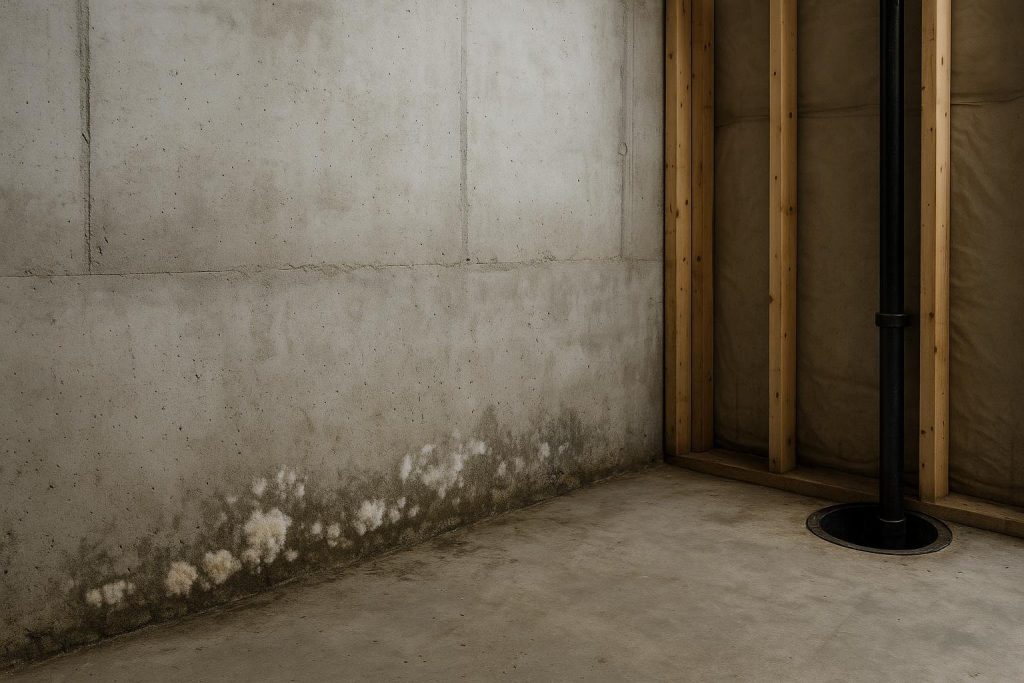
Mold in your basement is almost always a sign of sustained moisture, not a random occurrence. Before cleaning the surface, identify and stop the water source, because mold returns within days if the underlying dampness remains. The most likely explanations are a foundation crack letting in groundwater, a failed drainage system, condensation from high humidity, or a combination of all three. Locate where moisture is entering and assess how widespread the growth is before doing anything else. For mold specifically on Toronto-area walls, see the mold on basement walls Toronto page; this page covers the full diagnostic picture regardless of location.
- Surface mold is a symptom; the moisture source is the problem that must be fixed first.
- Mold on concrete can sometimes be cleaned, but mold on drywall, wood framing or insulation typically requires material removal.
- Condensation and water infiltration are different causes that require different fixes.
- Cleaning mold without addressing drainage or crack issues will result in regrowth.
- Health Canada classifies indoor mold as a potential health hazard; occupants with asthma or allergies face elevated risk.
Confirm it is actually this
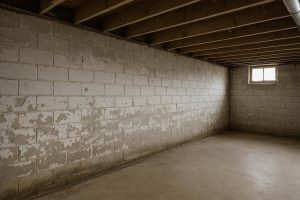
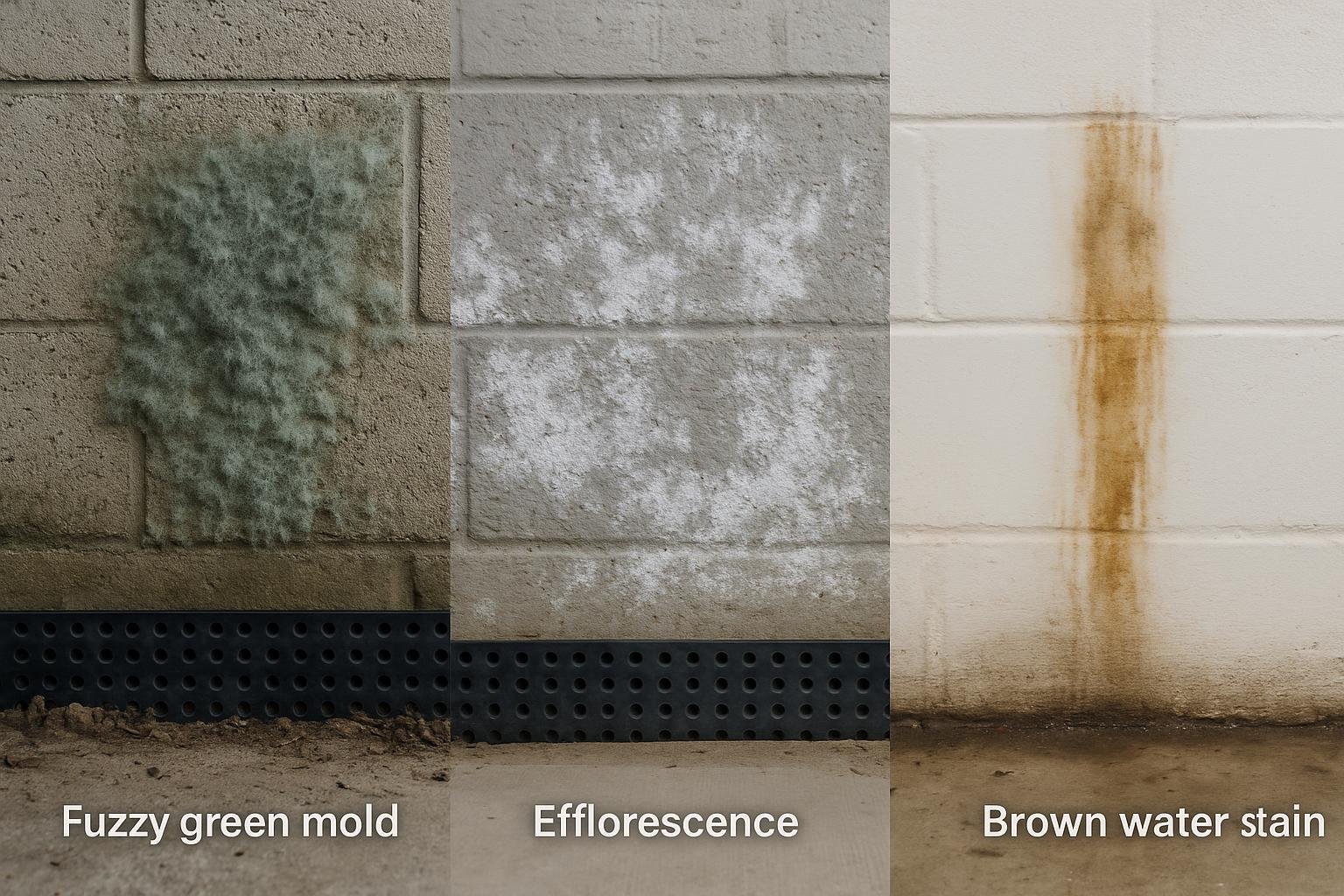
Basement mold appears as fuzzy or powdery patches ranging from white and grey to green, brown or black. It grows on any organic or porous surface: wood framing, drywall paper, carpet, cardboard and the paint or efflorescence layer on concrete. A persistent musty or earthy odour is often the first sign before visible growth appears.
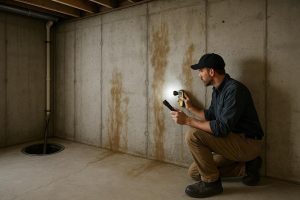
Run your hand along the wall near the growth. If the concrete feels damp or cool, or if you see a tide mark, rust staining or white mineral deposits nearby, water is moving through the wall. If the wall feels dry but the air is humid and mold is on stored items rather than the wall itself, condensation is the more likely driver. Both conditions can exist simultaneously.
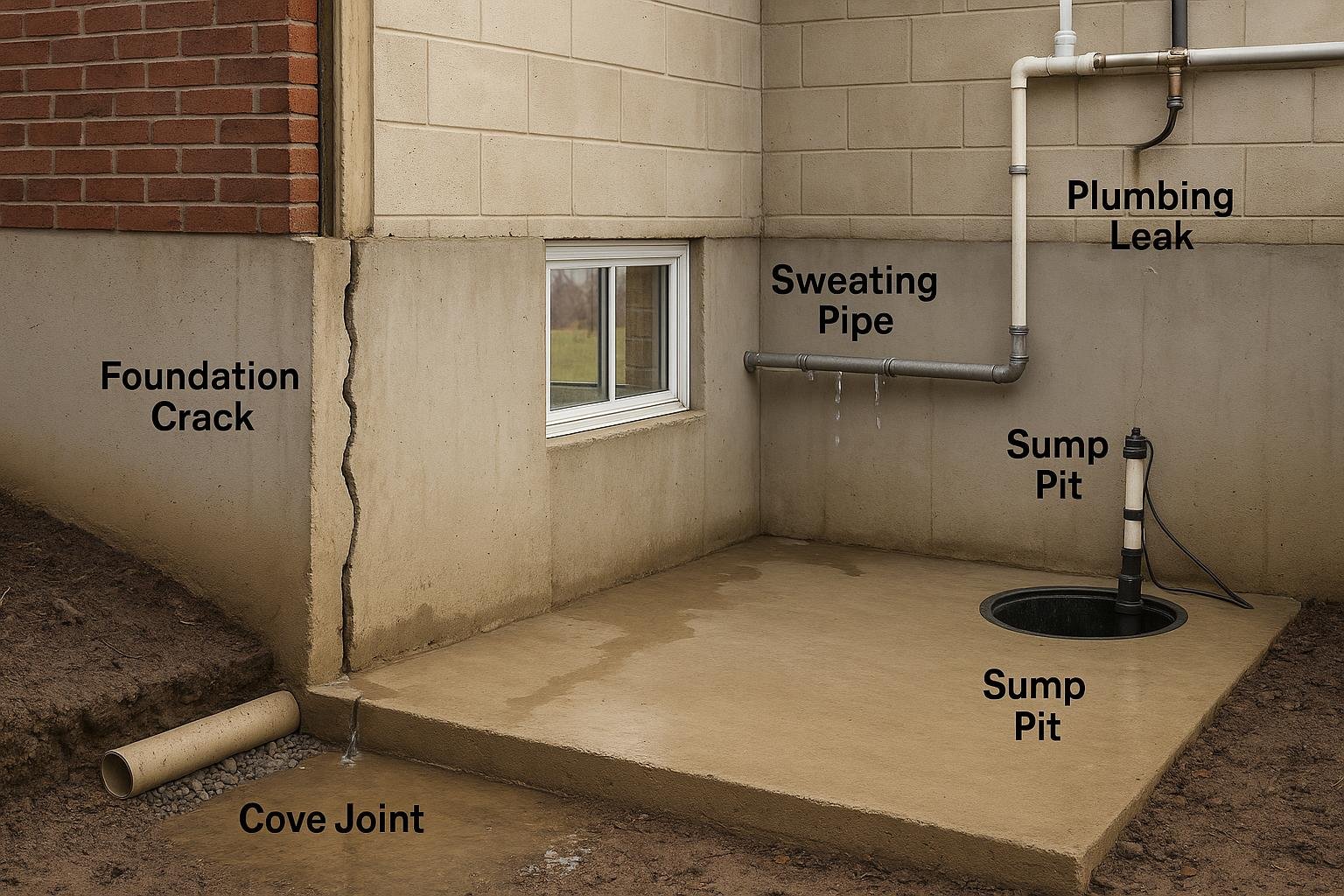
Check the floor-wall joint and any visible cracks. Active seepage at a crack or along the cove joint points to groundwater infiltration. Mold concentrated near windows or at the top of walls can indicate window well leaks or condensation on cold surfaces. Document the location, colour and approximate area before calling a professional.
Problems it gets confused with
Efflorescence: White, chalky or crystalline deposits on concrete are mineral salts left behind as water evaporates through the wall. Efflorescence is not mold, does not pose a direct health risk, and can be brushed off. It does confirm water is moving through the wall and mold may follow. See the efflorescence problem page for detail.
Dirt or soot: Dark smudges near air vents or pipe penetrations can look like mold but may be dust accumulation. Mold has a fuzzy or powdery texture; soot is flat and greasy. A bleach spot test will lighten mold within a minute or two but will not affect dirt or soot.
Water stains: Brown or grey tide marks indicate past moisture but are not themselves mold. Mold may be growing within or behind the stain, so probe the surface if in doubt.
Causes, ranked
1. Foundation cracks allowing groundwater infiltration
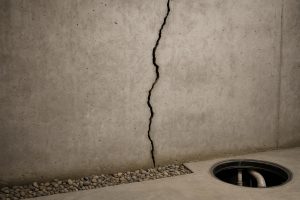
Poured concrete foundations develop shrinkage cracks as the concrete cures, and these widen under hydrostatic pressure from saturated soil. Water entering through a crack keeps the surrounding area persistently damp. The telltale sign is a visible crack with a tide mark, rust staining or active seepage at or below it. Mold typically concentrates near the crack and at the floor-wall joint. Polyurethane crack injection seals the crack from inside; exterior excavation addresses the source directly. See foundation crack monitoring guidance for context on crack progression.
2. Failed or absent weeping tile and drainage
Weeping tile collects groundwater around the footing and directs it to a sump pit or municipal drain. When it collapses or silts up, water accumulates at the footing and wicks up through the cove joint and lower wall. The telltale sign is a damp perimeter along the floor-wall joint with a white mineral line at the base and mold growing upward from the floor. Interior or exterior weeping tile replacement combined with a functioning sump pump is the appropriate long-term fix.
3. High indoor humidity and condensation
When warm, humid air contacts a cool basement wall or cold pipe, moisture condenses on the surface. This is especially common in summer. The telltale sign is mold on the cool side of the wall, on pipes and on stored items rather than at cracks or the floor-wall joint. A dehumidifier sized for the space and improved ventilation address condensation. See the basement dehumidification guide for sizing guidance.
4. Window well leaks
Below-grade window wells collect rainwater and snowmelt. If the well drain is blocked or absent, water pools against the window frame and seeps through the sill or surrounding masonry. The telltale sign is mold concentrated directly below or beside a basement window with visible staining on the frame. Clearing the well drain, adding a cover and sealing the window perimeter are first steps. See the window well leaking problem page for full detail.
5. Sump pump failure
A failed or undersized sump pump allows the pit to overflow, flooding the floor and saturating the lower wall area. Even a brief flood followed by incomplete drying creates conditions for rapid mold growth. The telltale sign is mold across a wide floor area and lower walls after a known flooding event. Restoring a working sump pump and drying the space within 24 to 48 hours limits mold establishment. See the sump pump not working page for diagnostic steps.
6. Pipe leaks and plumbing condensation
A slow leak from a supply pipe, drain line or water heater can drip onto framing for weeks unnoticed. Cold water supply pipes also sweat in summer. The telltale sign is mold localized directly around a pipe, often with soft drywall nearby. A plumber should confirm the pipe is sound before waterproofing work begins, as the two problems require different trades.
Cause and solution table
| Cause | Telltale sign | Appropriate fix | Urgency |
|---|---|---|---|
| Foundation crack | Mold at or below a visible crack; tide mark; rust staining | Polyurethane crack injection or exterior excavation and membrane | Act soon to Act now |
| Failed weeping tile | Damp perimeter at floor-wall joint; mold rising from floor | Interior or exterior weeping tile replacement; sump pump | Act soon |
| Condensation / high humidity | Mold on stored items and pipes; wall dry when cool | Dehumidifier; improved ventilation; vapour barrier if applicable | Monitor to Act soon |
| Window well leak | Mold below or beside window; stained frame | Clear well drain; add cover; seal window perimeter | Act soon |
| Sump pump failure | Wide floor-level mold after flooding event; waterline on items | Restore or replace sump pump; dry space within 48 hours | Act now |
| Pipe leak or condensation | Mold localized around a pipe; soft drywall nearby | Plumber to repair leak; pipe insulation for sweating pipes | Act soon |
Use this table as a starting point, not a final diagnosis. Multiple causes often overlap in the same basement. A professional inspection will identify whether water is entering from outside, condensing from inside air, or arriving through a plumbing fault, because the repair strategy differs significantly for each.
What you can safely check yourself
- Walk the perimeter walls and note every location where mold, staining, efflorescence or dampness appears. Photograph each spot with a reference object for scale.
- Check the floor-wall joint along all four walls for a white mineral line, soft mortar or visible moisture.
- Inspect visible cracks in the wall. Note their orientation (vertical, horizontal, diagonal), width, and whether they feel damp. Do not probe a crack with a tool.
- Look at window wells from outside. Check whether the drain at the bottom is clear and whether water has pooled and left a stain ring inside the well.
- Check the sump pit. Pour a bucket of water in slowly. The pump should activate before the water reaches the top of the pit. A pump that does not activate needs service.
- Measure relative humidity with an inexpensive hygrometer. Sustained readings above 60% relative humidity support mold growth even without active water infiltration.
- Check downspout extensions from outside. Downspouts should discharge at least 1.8 metres from the foundation; short or missing extensions direct roof runoff toward the wall.
What NOT to do
Do not paint over mold with waterproofing paint or encapsulant. The paint may hide the growth temporarily but mold continues to digest the substrate beneath and the paint will eventually blister or peel.
Do not use bleach on porous materials such as drywall, wood framing or insulation. Bleach kills surface cells but does not penetrate porous materials, and the moisture in the solution can feed regrowth. Non-porous surfaces such as concrete can be cleaned with appropriate products, but only after the moisture source is resolved.
Do not run a dehumidifier as the sole response to mold on walls. It manages indoor humidity but cannot stop groundwater entering through a crack or failed drainage system.
Do not disturb large areas of mold (generally over 1 square metre) without appropriate respiratory protection and containment. For significant growth, professional remediation with containment is the safer approach.
How a professional diagnoses it
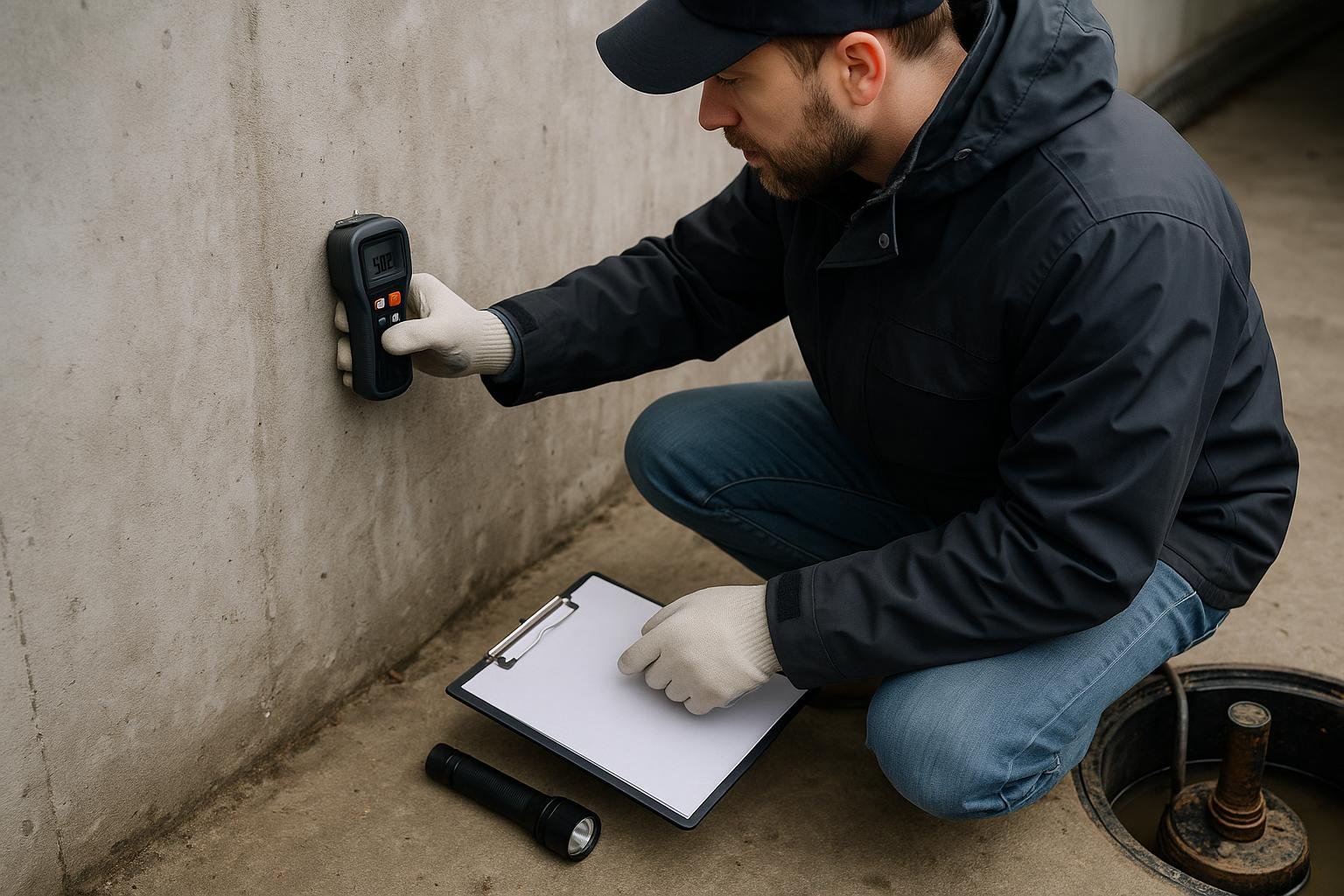
A waterproofing professional will begin with a visual inspection of the entire basement perimeter, looking for crack locations, staining patterns, efflorescence and the condition of the floor-wall cove joint. They will probe suspect areas to assess whether concrete has deteriorated from sustained wetting.
They will ask about the history of the space: when the mold first appeared, whether it follows rain events or is year-round, whether the sump pump has failed, and whether the basement has ever flooded. This history helps distinguish infiltration from condensation.
Where the moisture source is not immediately obvious, a professional may use a moisture meter to measure wall moisture content at multiple heights, or a thermal imaging camera to identify cold spots where water is moving through the wall. The inspector will also assess the drainage system: whether a sump pit is present, whether the pump is functional, and whether weeping tile is in place. DryShield offers a basement leak diagnostic tool as a starting point before an in-person visit.
Temporary vs permanent fixes
| Approach | What it does | Limitation | Appropriate when |
|---|---|---|---|
| Surface mold cleaning (non-porous surfaces) | Removes visible growth from concrete | Regrows if moisture source is not fixed | After the water source is confirmed resolved |
| Dehumidifier | Reduces ambient humidity; limits condensation mold | Does not stop groundwater infiltration | Condensation is the confirmed cause |
| Hydraulic cement at crack | Slows active seepage temporarily | Brittle; does not flex; often fails within a season | Emergency stop-gap only |
| Polyurethane crack injection | Fills and seals crack through the wall thickness | Does not address drainage if weeping tile has failed | Isolated crack is the confirmed entry point |
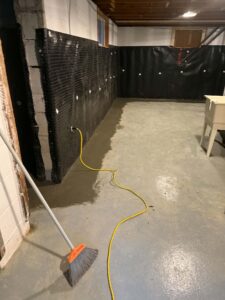
| Interior weeping tile and sump pump | Collects and removes groundwater before it reaches the floor | Does not stop water entering the wall; manages it | Failed perimeter drainage; high water table |
| Exterior waterproofing membrane and drainage board | Stops water at the wall exterior; most comprehensive | Requires excavation; higher cost and disruption | Persistent infiltration; multiple cracks; new construction |
No surface treatment is a permanent fix for mold driven by water infiltration. Permanent resolution requires stopping the moisture at its source. Mold remediation on porous materials should follow, not precede, the waterproofing repair.
Frequently asked questions
Is basement mold always caused by a foundation problem?
No. Mold can result from condensation alone if indoor humidity is consistently high, from a plumbing leak, or from inadequate ventilation. Foundation water infiltration is a common cause in Ontario homes because of clay soils and hydrostatic pressure, but a professional inspection is needed to confirm the actual source before committing to a repair method.
Can I clean basement mold myself?
Small patches on non-porous surfaces such as bare concrete can be cleaned by a careful homeowner using appropriate products and respiratory protection, but only after the moisture source is confirmed resolved. Mold on drywall, wood framing or insulation typically requires professional remediation because these materials must be removed. Health Canada guidance recommends professional help for growth exceeding 1 square metre.
Will a dehumidifier get rid of basement mold?
A dehumidifier reduces ambient humidity and can prevent condensation-driven mold from recurring, but it cannot stop mold caused by groundwater entering through a crack or failed drainage. If the wall is wet from infiltration, a dehumidifier will run continuously without resolving the problem. Identify the moisture source first, then use a dehumidifier as a complement to the repair.
How quickly does mold grow after a basement flood?
Under warm, humid conditions, mold can begin to establish on wet porous materials within 24 to 48 hours. Removing standing water, running fans and a dehumidifier, and removing saturated materials within that window significantly reduces the likelihood of mold becoming established. After 72 hours, remediation rather than drying is typically required for porous materials.
Does basement mold affect the rest of the house?
Mold spores are airborne and can migrate to upper floors through stairwells, HVAC ductwork and gaps in the floor assembly. Mold near a furnace or air handler is particularly concerning because the system can distribute spores throughout the home. Health Canada identifies indoor mold as a potential health hazard regardless of species.
What type of mold is most common in basements?
Common basement mold genera include Cladosporium, Penicillium, Aspergillus and, less frequently, Stachybotrys chartarum. Visual identification of mold species is not reliable; colour alone does not determine species or toxicity. If species identification matters for health or insurance purposes, a certified indoor air quality professional can take samples for laboratory analysis. DryShield does not provide mold testing or species identification.
Will waterproofing my basement prevent mold from coming back?
Waterproofing that successfully stops water infiltration removes the primary moisture source for infiltration-driven mold. Combined with remediation of affected materials and humidity management, it significantly reduces the likelihood of recurrence. If condensation is also a factor, ventilation and dehumidification must be addressed alongside the waterproofing repair.
Does home insurance cover mold from a basement leak?
Coverage depends on the policy and the cause of the leak. Sudden and accidental water damage is more commonly covered than gradual seepage or groundwater infiltration, which many standard policies exclude. Review your specific policy and speak with your insurer before assuming coverage. The Ontario home insurance and waterproofing guide provides additional context.
How do I know if the mold is behind my drywall?
Signs include a persistent musty odour that does not resolve after surface cleaning, soft or discoloured drywall paper, bubbling paint, and visible mold at the base of the wall. A moisture meter can detect elevated moisture content without cutting the wall open. If mold behind drywall is suspected, a professional assessment is the appropriate next step; cutting in without containment can release a large volume of spores.
What is the difference between mold and mildew in a basement?
Mildew is a surface fungus that grows flat and powdery, typically white or grey, on damp surfaces. It is easier to clean and generally considered less harmful than mold, which penetrates porous materials and can cause structural damage and health effects. Both indicate excess moisture, and the first step is the same: identify and stop the moisture source.
If you are seeing mold in your basement and are not certain of the moisture source, a professional assessment is the most reliable way to avoid spending money on the wrong repair. DryShield offers a free assessment for homeowners across Toronto, the GTA and Ontario cottage country. Use the basement leak diagnostic tool to describe what you are seeing, or contact the team directly to book a visit. Addressing the water source now prevents mold from becoming a recurring problem and protects both the structure and the air quality of your home. Related reading: wet basement walls, water stains on basement walls, and basement dehumidification.