When comparing french drain vs weeping tile, the short verdict is this: a french drain is the right choice for redirecting surface and shallow subsurface water away from a yard or foundation, while weeping tile is the right choice for relieving hydrostatic pressure at the footing level of a basement. Many Ontario homes need one or both, depending on where water is entering and how severe the pressure is. If your basement walls are wet and your footing drain is failed or absent, weeping tile is the primary fix. If water is pooling in your yard or running toward the house, a french drain addresses that source.
- French drains handle surface runoff and shallow groundwater; weeping tile handles deep footing-level hydrostatic pressure.
- Both use perforated pipe and gravel, but depth, placement and purpose differ significantly.
- Weeping tile replacement typically requires excavation to the footing; french drains are usually shallower and less disruptive.
- Cost drivers differ: weeping tile projects are generally more labour-intensive than surface french drains, though scope varies widely.
- In many wet-basement situations, both systems work together rather than competing.
How we compared
This comparison draws on the construction principles described in the Ontario Building Code for foundation drainage, published guidance from Natural Resources Canada on residential drainage, and the technical specifications DryShield applies when installing both systems across Toronto, the GTA and Ontario cottage country. We evaluated each system across six dimensions: purpose and mechanism, installation depth and disruption, typical cost drivers, longevity, maintenance requirements and suitability by problem type. No proprietary job-outcome dataset was available for this comparison; where verified cost figures are unavailable, we describe cost drivers rather than state price ranges.
French drain explained
A french drain is a gravel-filled trench containing a perforated pipe that intercepts water moving through the soil and redirects it to a safe discharge point such as a storm sewer, dry well or daylight outlet. The name has nothing to do with France; it derives from Henry French, a 19th-century Massachusetts farmer who popularized the technique.
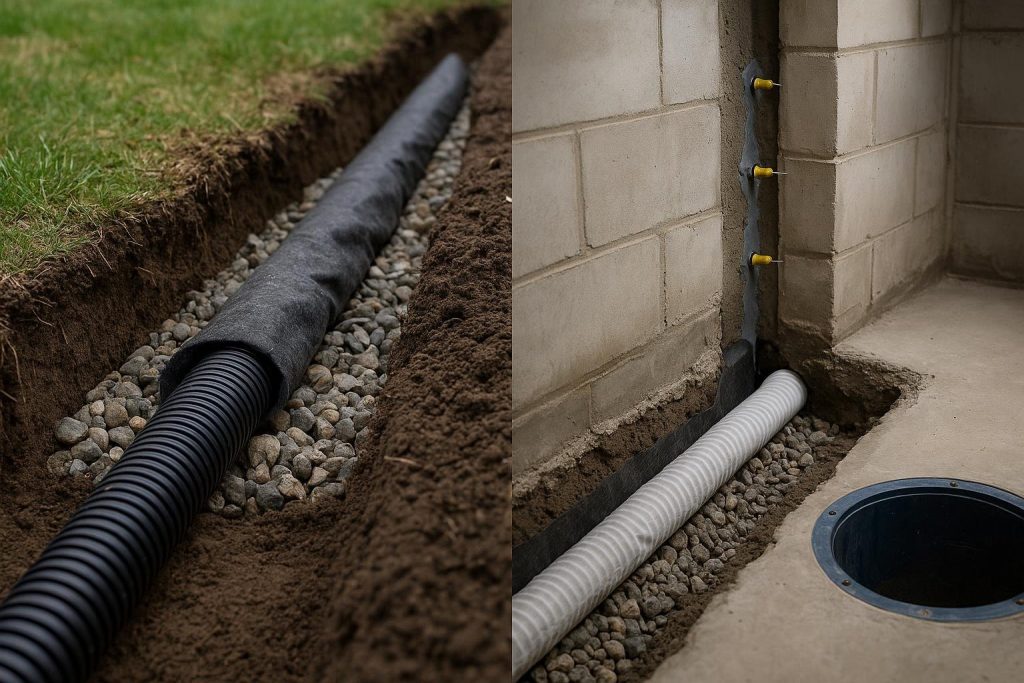
French drains are installed at varying depths depending on their purpose. A yard french drain designed to stop surface pooling may sit only 300 to 600 mm below grade. A curtain drain installed upslope of a house to intercept groundwater moving toward the foundation sits deeper, often 900 mm to 1.2 m. In both cases the trench is lined with filter fabric to prevent fine soil particles from clogging the gravel, and the perforated pipe sits at the bottom of the gravel bed with perforations facing down.
French drains excel at managing surface and near-surface water. They are commonly used to drain low-lying yards, redirect roof runoff that downspout extensions cannot handle, and create a curtain of interception upslope of a foundation. Because they operate above the footing level, they do not directly relieve the hydrostatic pressure that builds against basement walls from a saturated water table at depth. They can, however, reduce the volume of water reaching the foundation zone, which lowers the overall pressure load.
Installation disruption depends on length and depth. A short yard french drain can often be installed with minimal excavation. A full perimeter curtain drain around a house requires more extensive trenching. Discharge must be planned carefully to comply with local municipal bylaws, which generally prohibit directing drainage onto neighbouring properties or into sanitary sewers.
See also: French Drain System: Complete Homeowner’s Guide and French Drains: The Complete Homeowner’s Guide.
Weeping tile explained
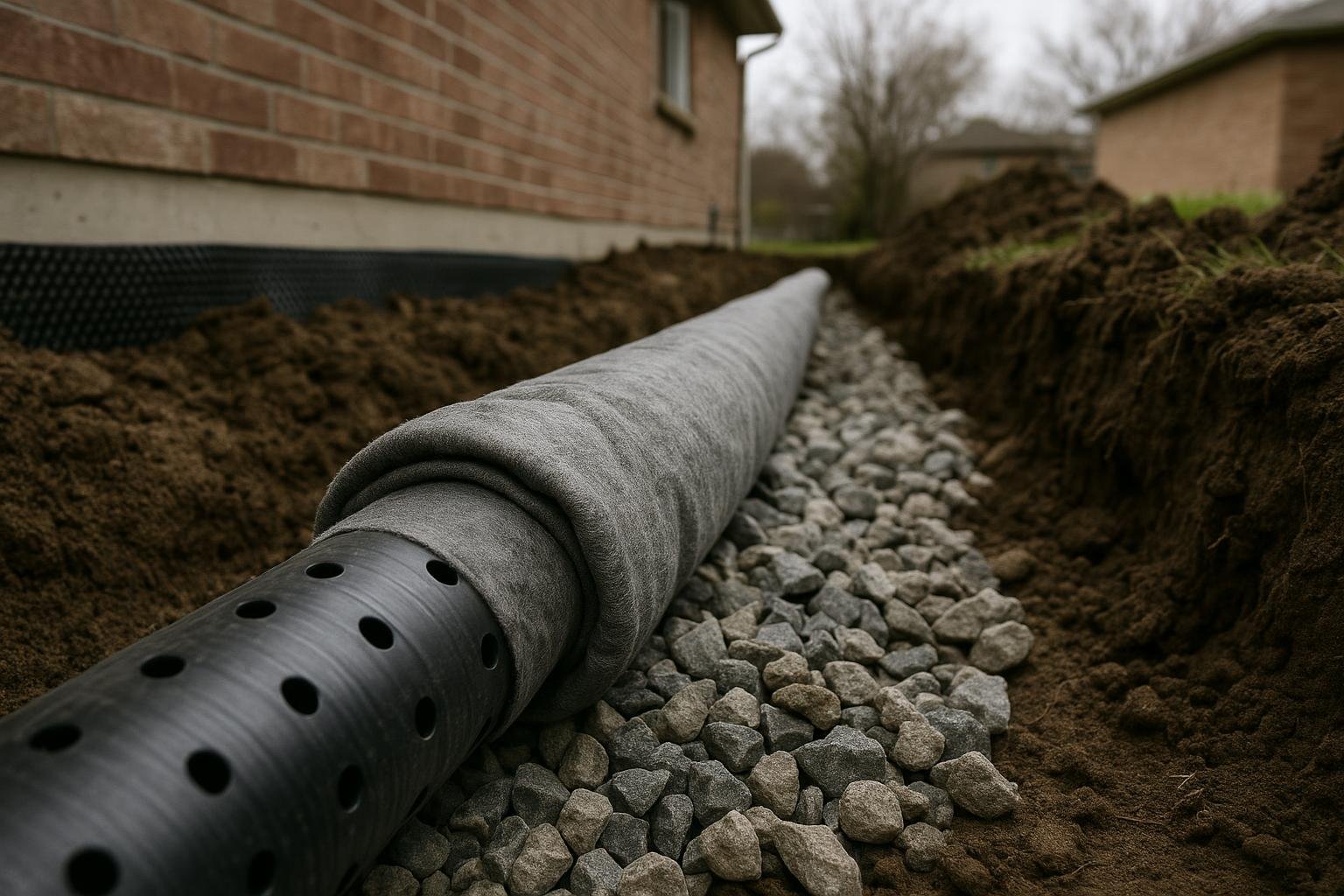
Weeping tile is a perforated drainage pipe installed at or near the base of a foundation footing, either on the exterior or interior perimeter of the basement wall. Despite the name, modern weeping tile is not clay tile at all; it is corrugated or rigid perforated plastic pipe wrapped in filter sock. The term persists from the era when short sections of clay pipe were laid end-to-end with gaps to allow water entry.
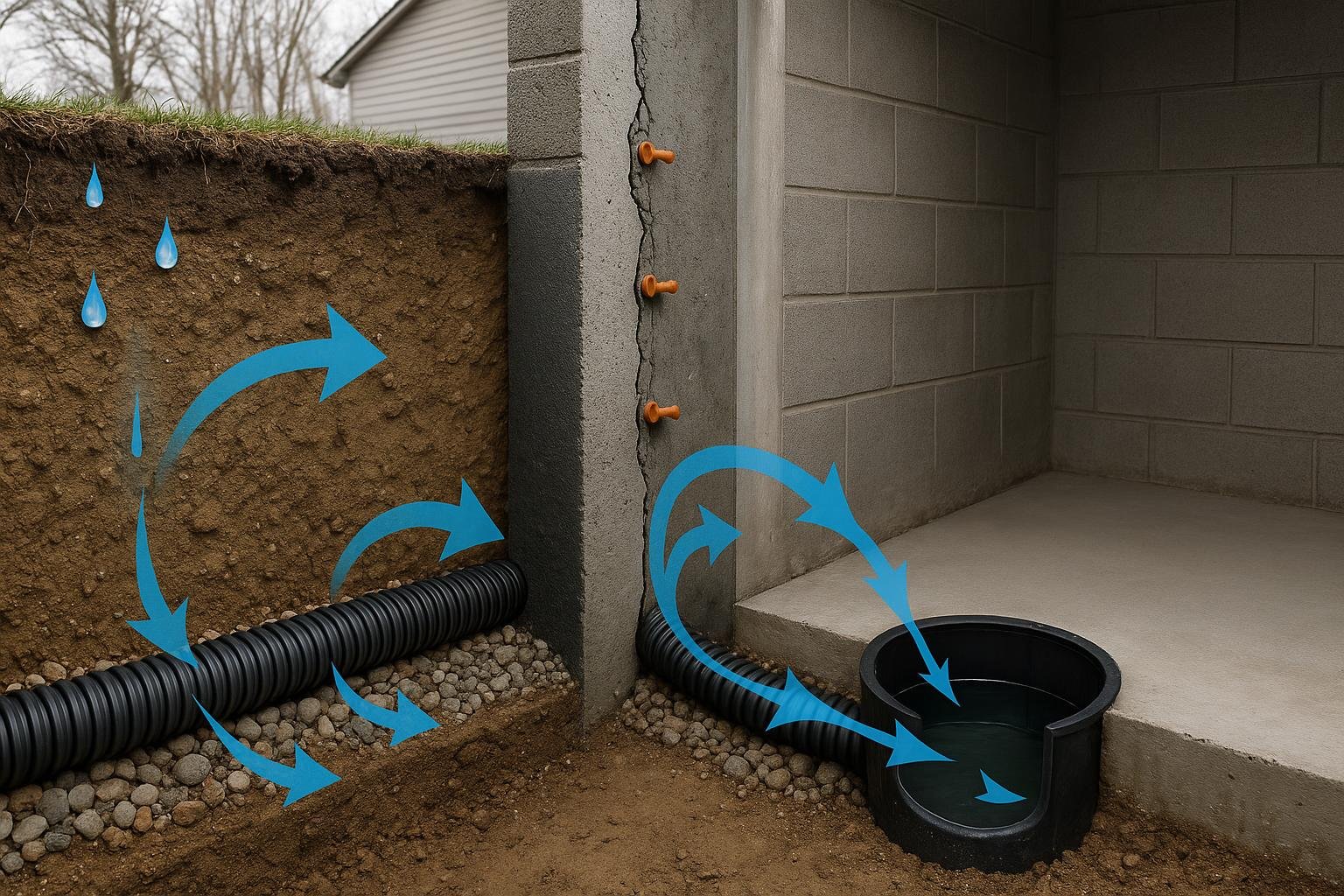
The primary function of weeping tile is to intercept groundwater before it builds hydrostatic pressure against the foundation wall and floor. Water enters the pipe through perforations, travels by gravity to a sump pit, and is pumped out by a sump pump. On the exterior, weeping tile is installed during new construction or during an excavation-based waterproofing project. On the interior, a channel is cut into the basement floor along the perimeter, the pipe is laid in gravel, and the floor is patched over it.
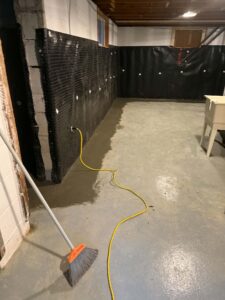
Exterior weeping tile replacement is the more comprehensive repair because it also allows the contractor to apply a waterproof membrane to the foundation wall, install a drainage board and address any wall cracks directly. Interior weeping tile does not stop water from entering the wall; it intercepts water that has already passed through and manages it before it reaches the floor. Both approaches require a functioning sump pump system.
Failed or absent weeping tile is one of the most common causes of chronic wet basements in older Ontario homes, particularly those built before the 1980s when clay tile systems were standard and have since collapsed or become blocked with roots and sediment. The Ontario Building Code requires footing drains on new construction, but many existing homes have systems that are decades past their service life.
See also: Weeping Tile Installation & Replacement Toronto and Weeping Tile Problems in Toronto: Causes, Signs and How to Fix Them.
Side by side
The table below compares the two systems across the dimensions most relevant to a homeowner deciding which solution fits their situation.
| Feature | French Drain | Weeping Tile |
|---|---|---|
| Primary purpose | Intercept and redirect surface and shallow subsurface water | Relieve hydrostatic pressure at the foundation footing |
| Typical installation depth | 300 mm to 1.2 m depending on application | At or below footing level, typically 1.5 m to 2.5 m+ |
| Location | Yard, upslope of house, or along foundation exterior at shallow depth | Exterior footing perimeter or interior basement floor perimeter |
| Requires sump pump | Not always; can discharge to daylight or dry well | Almost always; gravity discharge is rarely possible at footing depth |
| Excavation required | Shallow trenching in most cases | Deep exterior excavation or interior floor cutting |
| Addresses wall cracks directly | No | Exterior installation allows simultaneous crack repair |
| Disruption to landscaping | Moderate (trench across yard or along foundation) | High for exterior; low for interior (work stays inside) |
| Disruption to basement living space | None | High for interior (floor cutting, dust, curing time) |
| Maintenance | Periodic flushing; outlet inspection | Sump pump maintenance; periodic camera inspection of pipe |
| Typical lifespan of pipe | 20 to 30+ years with filter fabric | 25 to 50+ years for modern plastic pipe |
The table reveals that the two systems operate at different depths and solve different problems. A french drain genuinely wins on installation disruption for exterior work and on flexibility of discharge options. Weeping tile genuinely wins when the problem is hydrostatic pressure at the footing, because a shallow french drain simply cannot reach the water table at that depth. Neither system is universally superior; the right choice depends entirely on where the water is coming from.
Cost comparison
No verified current price dataset was available for this comparison. The table below describes the cost drivers for each system so you can understand what makes a project more or less expensive. For a project-specific estimate, use DryShield’s 2026 Waterproofing Cost Calculator or request a site assessment.
| Cost Driver | French Drain | Weeping Tile |
|---|---|---|
| Excavation depth and volume | Low to moderate; shallow trenching | High for exterior; moderate for interior floor cutting |
| Labour intensity | Lower; shorter dig, no footing exposure needed | Higher; footing must be fully exposed on exterior projects |
| Materials | Perforated pipe, gravel, filter fabric, outlet structure | Perforated pipe, gravel, filter sock, sump pit, sump pump |
| Sump pump and pit | Optional depending on discharge route | Required in most cases; adds pump and pit cost |
| Wall membrane and drainage board | Not included | Included in exterior waterproofing scope; adds cost but adds protection |
| Landscaping restoration | Moderate; sod, grading, garden beds | High for exterior; minimal for interior |
| Permit requirements | Varies by municipality; often not required for yard drains | May require permit for structural excavation; verify locally |
| Scope multiplier | Linear metres of trench; outlet distance | Linear metres of foundation perimeter; soil type; access constraints |
In general, a simple yard french drain is less expensive than a full exterior weeping tile replacement because the excavation is shallower and the scope is smaller. However, a long curtain drain installed deep around a full foundation perimeter can approach or exceed the cost of interior weeping tile, which avoids deep exterior excavation. Interior weeping tile is often chosen partly for its lower disruption and cost relative to full exterior excavation, though it does not address the wall itself. See Foundation Waterproofing Cost: What Ontario Homeowners Pay in 2026 for broader cost context.
Which is better for your situation
The right system depends on the source and location of your water problem. Use the guidance below as a starting point, not a substitute for a professional site assessment.
Choose a french drain if…
- Water pools in your yard after rain and does not drain within 24 to 48 hours.
- Runoff from a neighbouring property, a slope or a road is flowing toward your foundation.
- Your downspout extensions are insufficient and surface water is collecting against the house.
- You have a wet crawl space caused by surface water intrusion rather than a failed footing drain. See Wet Crawl Space: Causes, Urgency and How to Fix It.
- You want to reduce the volume of water reaching the foundation zone as a first or supplementary measure.
Choose weeping tile if…
- Your basement walls are wet along the base or water is seeping through the floor-wall joint.
- A camera inspection or excavation has confirmed the existing footing drain is collapsed, root-blocked or absent.
- You have chronic hydrostatic pressure causing efflorescence, wall bowing or persistent seepage despite surface grading corrections. See Bowing Basement Foundation Wall in Toronto: Causes, Urgency and Fixes.
- You are undertaking exterior waterproofing and want to address the footing drain as part of the same excavation.
- Your sump pump runs frequently or continuously during wet seasons, suggesting the existing drain system is overwhelmed.
Consider both if…
- You have both surface drainage problems in the yard and a failed footing drain system.
- You are doing a full exterior waterproofing project and want to intercept surface water before it reaches the new membrane.
- You live in an area with clay soils and a seasonally high water table, which is common across much of the GTA and southern Ontario, where surface and subsurface water management both contribute to basement moisture.
The trade-offs nobody mentions
French drain trade-offs
French drains can clog. Filter fabric slows sediment entry but does not eliminate it, and in clay-heavy soils fine particles eventually migrate into the gravel bed. A clogged french drain provides no drainage benefit and may be difficult to detect until water problems return. Outlet maintenance is often neglected; a blocked outlet turns the trench into a water reservoir against the foundation. French drains also require a compliant discharge point, and in dense urban areas finding one that satisfies municipal bylaws can be a constraint. Finally, a french drain does not address an existing failed footing drain; it can reduce the load on that system but cannot replace it.
Weeping tile trade-offs
Exterior weeping tile replacement is one of the most disruptive residential waterproofing projects. Landscaping, decks, walkways and sometimes driveways must be removed and restored. In tight urban lots with limited access, excavation equipment may not reach the foundation, raising hand-dig costs significantly. Interior weeping tile avoids that disruption but accepts a fundamental limitation: water still enters the wall before being managed. This means wall deterioration can continue over time if the wall is not also sealed or repaired. Interior systems also depend entirely on a functioning sump pump; a power outage during a major storm can result in flooding even with a properly installed interior system. A battery backup sump pump is strongly recommended. See Sump Pump Not Working in Toronto? Here Is What to Check First.
Frequently asked questions
Are french drains and weeping tile the same thing?
No. Both use perforated pipe in gravel, but they serve different purposes and are installed at different depths. Weeping tile is specifically a footing-level foundation drain designed to relieve hydrostatic pressure against a basement wall. A french drain is a broader term for any perforated-pipe trench drain used to intercept and redirect water, typically at shallower depths and for surface or near-surface drainage problems. The two terms are sometimes used interchangeably in casual conversation, which causes confusion when diagnosing basement water problems.
Can a french drain replace weeping tile?
Generally no. A french drain installed at shallow depth cannot intercept groundwater at the footing level, which is where hydrostatic pressure against a basement wall originates. A french drain can reduce the volume of surface water reaching the foundation zone, which may reduce pressure somewhat, but it is not a substitute for a properly functioning footing drain. If your existing weeping tile has failed, it needs to be replaced or supplemented with an interior system, not replaced by a shallow french drain.
How do I know if my weeping tile has failed?
Common signs include chronic seepage along the base of basement walls or through the floor-wall joint, efflorescence (white mineral deposits) at the base of the wall, a sump pump that runs continuously during wet weather, and water stains at footing level. A definitive diagnosis requires a camera inspection of the existing drain pipe, which can confirm collapse, root intrusion or complete blockage. See Weeping Tile Problems in Toronto: Causes, Signs and How to Fix Them for a detailed symptom guide.
Does a french drain need a sump pump?
Not always. A french drain can discharge by gravity to daylight (a slope, a ditch or a storm sewer inlet) if the outlet is lower than the pipe. When gravity discharge is not possible because the terrain is flat or the outlet is uphill, the water must be collected in a sump pit and pumped out. Weeping tile almost always requires a sump pump because the pipe sits at or below footing level, which is typically below any practical gravity outlet in Ontario’s relatively flat residential landscapes.
How long does each system last?
Modern perforated plastic pipe used in both systems is durable. With proper filter fabric installation and periodic maintenance, a french drain can function effectively for 20 to 30 or more years before clogging becomes a significant issue. Modern plastic weeping tile pipe has an expected service life of 25 to 50 or more years. The original clay tile systems installed in Ontario homes before the 1970s and 1980s have typically reached or exceeded their service life and are a common cause of chronic basement water problems in older housing stock.
Will a french drain stop my basement from leaking?
It depends on the source of the leak. If the leak is caused by surface water running against the foundation and entering through a crack or gap near grade, improving surface drainage with a french drain or regrading can reduce or eliminate the problem. If the leak is caused by hydrostatic pressure from a high water table acting against the foundation wall below grade, a surface french drain will have limited effect. A professional diagnosis is the most reliable way to determine the source before committing to a solution. Contact DryShield to arrange a site assessment.
Can both systems be installed at the same time?
Yes, and in many cases this is the most effective approach. When undertaking an exterior waterproofing project that involves excavating to the footing, it is practical to install or replace the weeping tile at the footing level and also install a french drain or curtain drain higher in the trench to intercept surface and near-surface water before it reaches the new membrane. Combining both systems in a single excavation avoids the cost and disruption of two separate projects. See Stop Foundation Leaks Permanently with Exterior Waterproofing for more on combined exterior approaches.
Does interior weeping tile work as well as exterior?
Interior weeping tile is effective at managing water that has already entered the wall and preventing it from flooding the floor. It does not stop water from entering the wall itself, so the wall continues to be exposed to moisture and hydrostatic pressure. Exterior weeping tile, combined with a waterproof membrane and drainage board, addresses the problem at its source and provides more comprehensive protection. Interior systems are often chosen when exterior excavation is impractical due to access constraints, cost or disruption. Both approaches are legitimate; the right choice depends on your specific situation, budget and tolerance for disruption. See Interior vs. Exterior Waterproofing: Which is Right for Your Toronto Home? for a full comparison.
If you are unsure which drainage system your home needs, DryShield has served Toronto, the GTA and Ontario cottage country for over 25 years. A site assessment is the most reliable way to identify the source of your water problem and recommend the right combination of solutions. Visit our French Drain Installation page or our Weeping Tile Installation & Replacement page to learn more, or contact us to arrange an assessment.