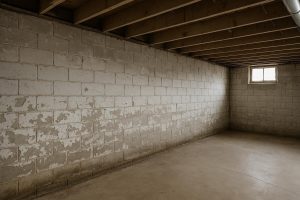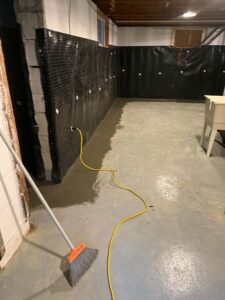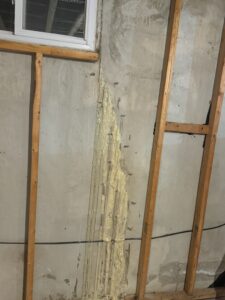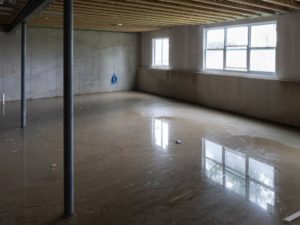
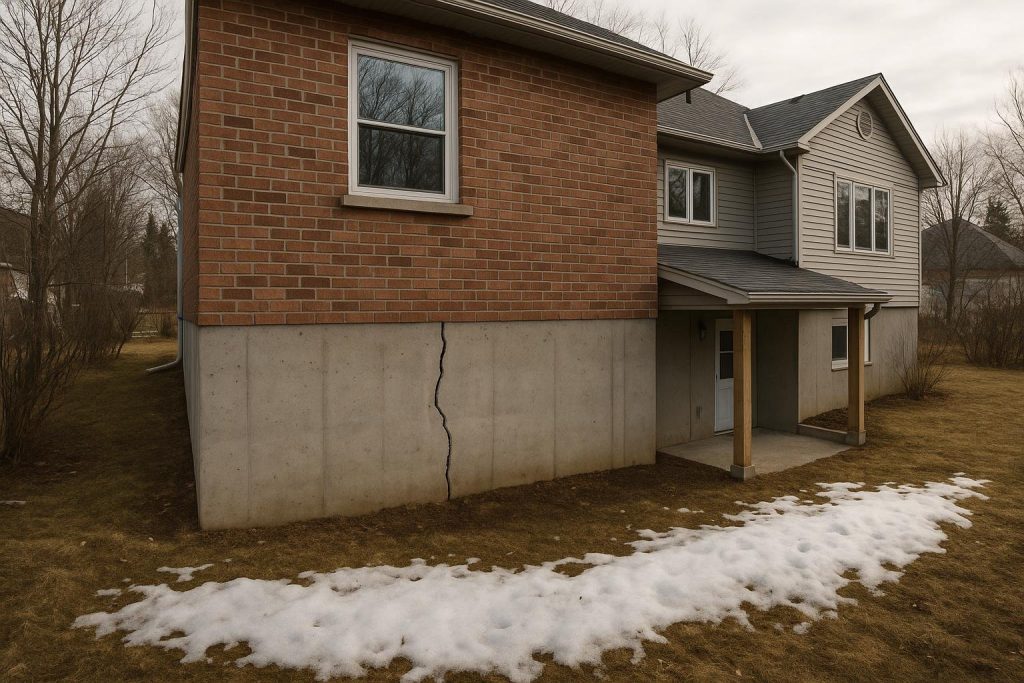
Foundation crack repair North Bay homeowners need most often comes down to one of three approaches: low-pressure polyurethane injection, interior perimeter waterproofing, or full exterior excavation. The right choice depends on the crack type, the soil conditions around your home, and how water is actually entering. North Bay sits on the Canadian Shield, which means bedrock is close to the surface in many neighbourhoods, but homes built on filled or disturbed soil still deal with hydrostatic pressure and freeze-thaw movement that opens cracks season after season.
Key Takeaways
- Most non-structural poured-concrete cracks in North Bay homes can be sealed from the interior using low-pressure polyurethane injection for roughly $750 to $1.000 per crack.
- Freeze-thaw cycling is the dominant cause of new cracks in this region. Spring thaw is the peak failure window, not summer rain.
- Horizontal cracks in block or poured walls signal lateral soil pressure and require a structural assessment before any injection work begins.
- Full exterior waterproofing, including excavation to the footing, rubberised membrane, dimpled drainage board and new weeping tile, runs approximately $6,000 to $9,000 for an average home, depending on linear footage and access.
- A free on-site inspection is the only reliable way to confirm which method is appropriate. Crack width alone does not determine severity.
Definitions and Scope
A foundation crack is any separation in a concrete or masonry wall that breaks the continuity of the material. Cracks are classified by orientation, width, depth, and whether they are active (still moving) or dormant. In North Bay, the most common types are vertical shrinkage cracks in poured concrete walls, diagonal cracks at window and door corners caused by differential settlement, and horizontal cracks in block walls caused by lateral earth pressure.
Foundation crack repair covers everything from a single interior injection port to a full exterior excavation and membrane system. The scope of work is determined by the crack’s cause, not just its appearance. A hairline crack that weeps water during spring thaw may need the same attention as a wider crack that stays dry all year.
This guide covers residential foundations in North Bay and the surrounding Nipissing District, where Canadian Shield bedrock, sandy glacial till, and pockets of clay-rich fill all influence how water behaves around a home’s footing.
Why This Matters for North Bay Homes
North Bay experiences some of the most dramatic freeze-thaw cycling in Ontario. Temperatures regularly drop below minus 20 Celsius in January and February, then climb above freezing repeatedly in March and April. Each freeze-thaw cycle expands water trapped in a crack by roughly nine percent in volume, widening the opening a fraction of a millimetre at a time. Over five to ten years, a hairline shrinkage crack can become a visible gap that admits water freely during spring snowmelt.
Unlike the GTA, where heavy clay soil holds water against foundation walls and hydrostatic pressure is the primary driver of leaks, North Bay foundations on sandy or gravelly glacial till drain more freely. However, homes built on disturbed fill, or those with failed or silted-up original weeping tile, still accumulate water at the footing. When that water has nowhere to go, it finds the path of least resistance: an existing crack.
The Canada Mortgage and Housing Corporation notes that freeze-thaw action is one of the leading causes of foundation deterioration in northern Ontario climates. Addressing a crack early, before it widens or admits water that can freeze inside the wall, is always less costly than waiting. For a broader look at what wet basement conditions mean for North Bay homes, the complete basement leak repair guide for North Bay covers the full range of causes and fixes.
Your Options for Foundation Crack Repair in North Bay
Low-Pressure Polyurethane Injection
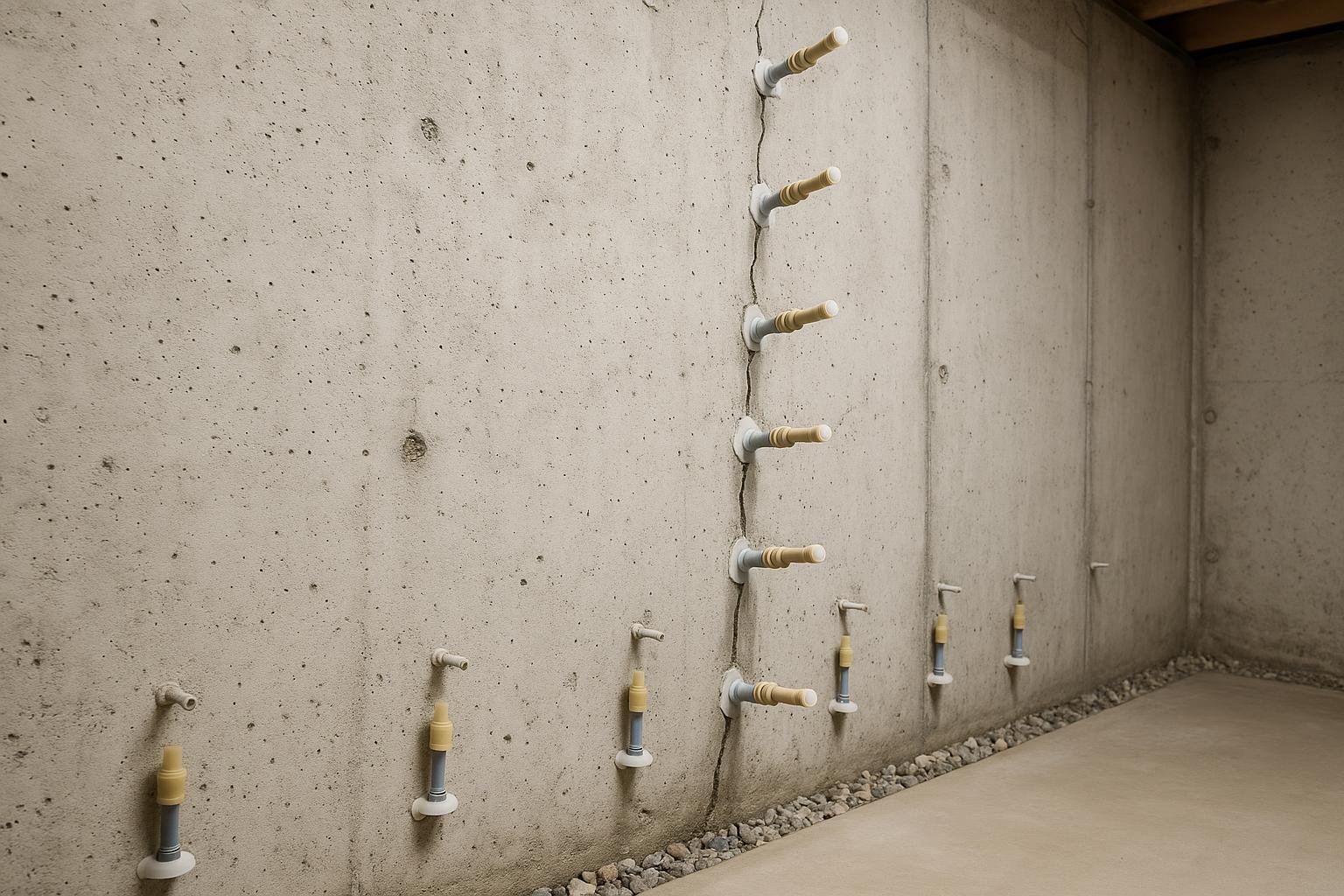
Polyurethane injection is the standard first-line repair for active, non-structural vertical and diagonal cracks in poured concrete walls. A technician drills or hammers injection ports into the crack at regular intervals, pastes them in place, and injects a two-part polyurethane resin under low pressure. The resin expands as it cures, filling the full depth of the crack from the interior face to the exterior face of the wall.
The cured material remains flexible, which is critical in North Bay’s climate. Because the foundation continues to move slightly with each freeze-thaw cycle, a rigid filler would re-crack at the same location. Polyurethane tolerates that seasonal movement without losing its seal. This method is best for single cracks that are leaking or at risk of leaking, where the wall itself is structurally sound. It is not appropriate for horizontal cracks or any crack showing signs of wall deflection.
Epoxy Crack Injection
Epoxy injection uses the same port-and-paste delivery method but injects a rigid, high-strength epoxy resin instead of flexible polyurethane. Epoxy bonds the two faces of the crack together and restores much of the wall’s original tensile strength. It is used specifically for structural cracks where the concrete must be re-bonded, not simply sealed against water.
In North Bay, epoxy is less commonly used than polyurethane because most residential cracks are non-structural shrinkage or freeze-thaw cracks. Epoxy is the correct choice when an engineer has confirmed the crack is structural and the wall needs to be re-bonded before any waterproofing membrane is applied. Using epoxy on an active, moving crack will cause the repair to fail, because the rigid material cannot flex.
Interior Perimeter Waterproofing with Weeping Tile
Where multiple cracks exist, or where water is entering along the footing joint as well as through wall cracks, an interior perimeter system addresses the problem at a larger scale. The perimeter concrete floor is jackhammered along the inside of the foundation walls, a new weeping tile is installed and connected to a sump basin, a vapour barrier is run up the wall face, and the concrete is re-poured.
This system does not stop water from entering the wall, but it intercepts water before it reaches the living space and routes it to the sump pump for discharge. It is best for homes where exterior excavation is impractical due to landscaping, decks, or close lot lines, and where the primary goal is keeping the basement dry rather than stopping water at the source.
Exterior Excavation and Membrane Waterproofing
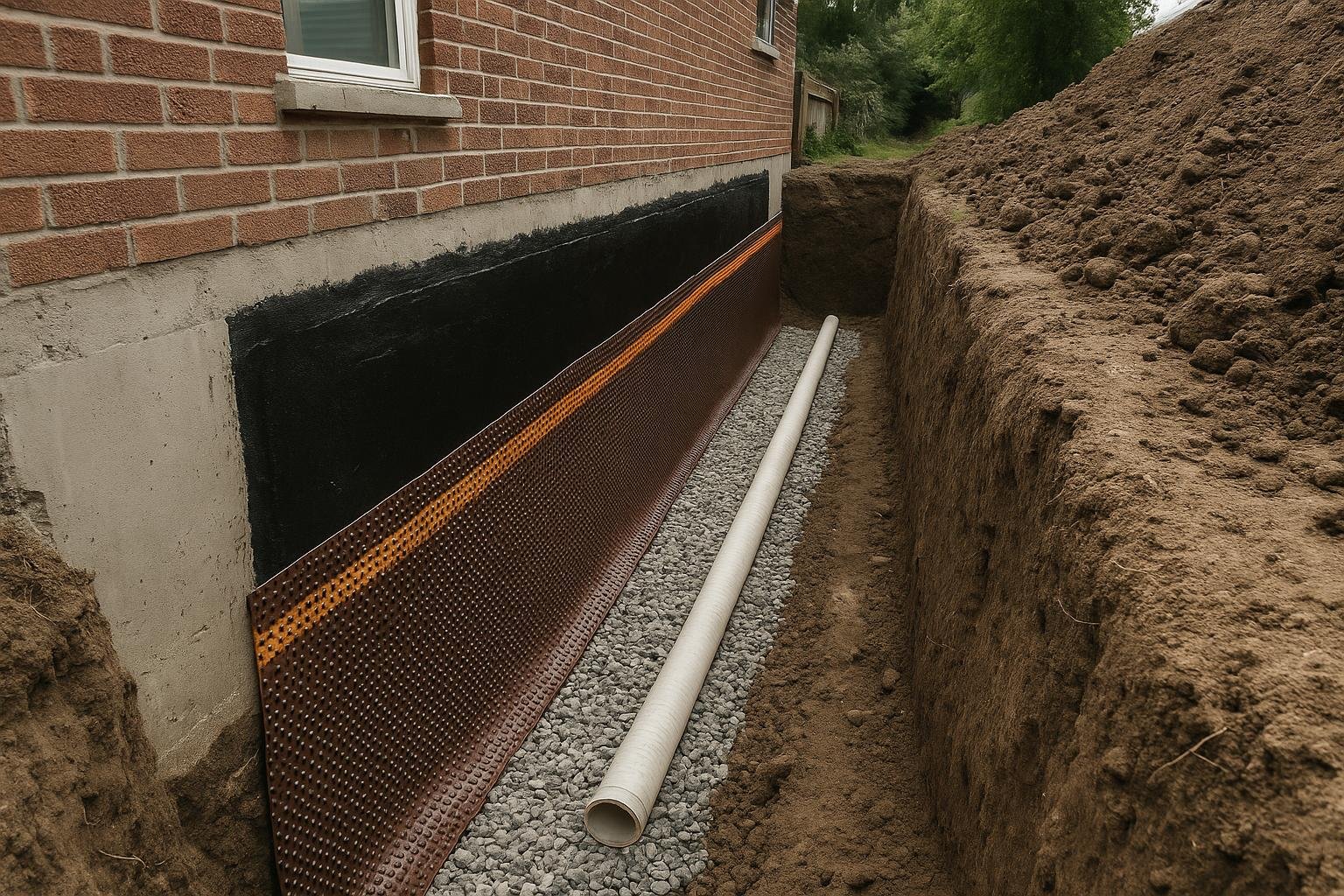
Full exterior waterproofing is the most comprehensive repair available. The soil is excavated to the footing, voids and cracks in the parging are filled with hydraulic cement, a rubberised waterproofing membrane is applied to the entire wall face, a dimpled drainage board is installed to protect the membrane and direct water downward, new weeping tile is bedded in clear stone at the footing, and the trench is backfilled with grade correction to direct surface water away from the wall.
This approach stops water at the exterior face of the wall before it can enter the structure. It is the most durable solution and is best for homes with severe or recurring leaks, failed original weeping tile, or where the foundation wall itself has deteriorated parging. The main limitation is cost and disruption: excavation requires access around the perimeter and typically takes two to three days per wall section.
Hydraulic Cement Spot Repair
Hydraulic cement is a fast-setting compound that can be packed into an active leak to stop water flow immediately. It is a temporary or supplementary measure, not a permanent repair. In North Bay, it is sometimes used to stop an urgent leak during spring thaw while a longer-term repair is planned. Hydraulic cement does not bond flexibly and will crack again with foundation movement, so it should always be followed by injection or a membrane system.
Options Compared
| Method | Best For | Typical Lifespan | Relative Cost | Disruption |
|---|---|---|---|---|
| Polyurethane injection | Single active non-structural crack, poured concrete | Long-term when crack is dormant; may need re-treatment if movement continues | Lowest ($750 to $1.000 per crack) | Minimal, interior only, no excavation |
| Epoxy injection | Structural crack requiring wall re-bonding | Permanent if crack is dormant | Low to moderate | Minimal, interior only |
| Interior weeping tile system | Multiple cracks, footing joint leaks, limited exterior access | 20 to 30 years with sump pump maintenance | Moderate | Moderate, jackhammer floor, interior work only |
| Exterior excavation and membrane | Severe or recurring leaks, failed weeping tile, deteriorated parging | 25 years or more with proper backfill and grade | Highest ($6,000 to $9,000 typical range) | High, excavation required, landscaping affected |
| Hydraulic cement spot repair | Emergency stop-gap during active leak | Short-term only | Very low | Minimal |
Polyurethane injection is the right starting point for most North Bay homeowners dealing with a single leaking crack in a poured concrete wall. Exterior excavation delivers the most complete protection but is reserved for situations where injection alone cannot address the volume or pattern of water entry. Interior weeping tile sits in the middle: it cannot stop water from entering the wall, but it reliably keeps the basement dry when exterior work is not feasible.
How to Choose the Right Repair
Choose polyurethane injection if you have one or two vertical or diagonal cracks in a poured concrete wall, the wall shows no signs of bowing or deflection, and the leaking is seasonal rather than constant. This is the most cost-effective starting point for foundation crack repair North Bay homeowners can book, and it can be completed in a single visit.
Choose epoxy injection if a structural engineer has assessed the crack and confirmed the wall needs to be re-bonded. Do not choose epoxy simply because the crack is wide. Width alone does not indicate structural failure.
Choose an interior weeping tile system if multiple cracks are present, water is entering along the floor-wall joint as well as through the wall, or exterior excavation is not possible due to a deck, addition, or close lot line. This system works well in combination with crack injection on the wall face.
Choose exterior excavation and membrane waterproofing if the original weeping tile has failed or silted up, the parging on the exterior wall face has deteriorated, or water entry is severe enough that interior management alone is not keeping the space dry. Homes in North Bay neighbourhoods built on fill or with older clay-tile drainage systems are strong candidates for this approach.
If you are unsure, use the foundation crack diagnosis tool to identify whether your crack pattern is vertical, horizontal, or diagonal before calling for an inspection.
A horizontal crack in a block or poured wall is never a candidate for injection alone. Horizontal cracking signals lateral earth pressure and requires a structural assessment before any repair work begins.
Costs and Timelines
| Cost Driver | Why It Affects Price | Approximate Impact |
|---|---|---|
| Number of cracks | Each crack requires its own ports, resin, and labour time | $750 to $1.000 per crack for injection |
| Crack depth and length | Longer or deeper cracks require more ports and more resin volume | Adds to per-crack cost |
| Excavation depth and linear footage | Deeper footings and longer wall runs require more labour and equipment time | Major driver of exterior system cost ($6,000 to $9,000 range) |
| Site access | Tight lots, decks, or landscaping increase excavation difficulty and time | Can add meaningfully to exterior work |
| Condition of existing weeping tile | Fully silted or collapsed tile must be replaced, not just supplemented | Adds to interior and exterior system cost |
| Sump pump installation | Interior systems require a sump basin and pump if none exists | Additional cost on top of weeping tile work |
A single polyurethane crack injection in North Bay typically falls in the $750 to $1.000 range. Full exterior waterproofing of an average home runs roughly $6,000 to $9,000 depending on linear footage, footing depth, and site access. Interior weeping tile systems generally fall below the exterior range. All figures are approximate and the final cost depends on a site inspection. For a broader breakdown of what drives waterproofing costs across Ontario, the foundation waterproofing cost guide provides detailed context.
Spring thaw is the peak failure window in North Bay. If you notice a new crack or a wet floor in March or April, book an inspection before summer, when water tables drop and the problem appears to resolve on its own. It rarely does.
Risks and Common Mistakes
| Symptom | Likely Cause | Correct Fix |
|---|---|---|
| Vertical crack weeping in spring only | Freeze-thaw movement opening a shrinkage crack | Polyurethane injection with flexible resin |
| Horizontal crack with wall bowing inward | Lateral soil pressure, possible structural failure | Structural engineer assessment before any repair |
| Water along floor-wall joint | Failed footing drain or hydrostatic pressure at base | Interior weeping tile to sump, or exterior excavation |
| White powder (efflorescence) on wall | Mineral deposits from water moving through concrete over time | Identify and seal the water source; efflorescence itself is not the problem |
| Crack re-opens after previous repair | Active foundation movement, or rigid filler used on a moving crack | Re-inject with flexible polyurethane; consider exterior membrane if recurring |
The most common mistake North Bay homeowners make is applying hydraulic cement or a surface sealant to a crack and assuming the job is done. Surface patching does not penetrate the full depth of the crack and fails within one or two freeze-thaw cycles. Water re-enters, often at a slightly different path, and the wall face becomes a patchwork of failed repairs that makes proper injection harder.
A second frequent error is choosing epoxy injection for a crack that is still moving. Epoxy is rigid. If the foundation shifts even slightly after the repair, the epoxy bond breaks and the crack re-opens. Polyurethane is the correct material for any crack in an active freeze-thaw environment unless structural re-bonding has been specifically recommended by an engineer.
Never ignore a crack that is widening. A crack that grows by more than a millimetre between inspections, or that shows stair-step cracking in a block wall, warrants a structural assessment before any injection work is attempted.
For guidance on distinguishing cosmetic cracks from genuinely dangerous ones, the guide on how to tell if a foundation crack is structural walks through the key indicators in plain language.
How the Process Works
- Free on-site inspection and moisture assessment. A technician visits the property, measures crack width and length, checks for wall deflection, and assesses moisture levels on both the interior and exterior. No repair scope is written without this step.
- Written scope with per-crack or linear-foot pricing. You receive a written quote that specifies the method, the materials, and the cost before any work begins. For injection work, pricing is per crack. For perimeter systems, pricing is per linear foot of wall treated.
- Surface preparation. For injection, the crack face is cleaned and ports are drilled or hammered in at intervals matched to the wall thickness. For exterior work, excavation begins and the wall face is cleaned of loose parging and debris.
- Repair execution. Polyurethane or epoxy resin is injected under low pressure until it appears at the next port, confirming the crack is filled to its full depth. For exterior systems, hydraulic cement fills voids, the rubberised membrane is applied, dimpled drainage board is installed, and new weeping tile is bedded in clear stone at the footing.
- Backfill and grade correction. Exterior work is completed with compacted backfill and grade correction to direct surface water away from the foundation wall. Interior work is completed with a re-poured concrete floor over the new weeping tile and vapour barrier.
- Final inspection and documentation. The completed repair is inspected, photographed, and documented. Warranty terms are confirmed in writing.
When evaluating foundation crack repair North Bay options, it helps to understand how crack patterns connect to broader basement moisture problems. The leaky basement guide for North Bay covers causes, fixes, and cost context in one place. For the North Bay service page covering all waterproofing and crack repair options available in this area, visit the North Bay basement waterproofing and foundation crack repair page.
Frequently Asked Questions
How much does foundation crack repair cost in North Bay?
A single polyurethane crack injection in North Bay typically costs between $750 to $1.000. Full exterior waterproofing, including excavation to the footing, membrane, drainage board, and new weeping tile, runs roughly $6,000 to $9,000 for an average home. The final figure depends on the number of cracks, wall length, footing depth, and site access. A free on-site inspection is required for an accurate quote.
Is polyurethane injection a permanent fix?
Polyurethane injection is a long-term repair when the crack is dormant or moving only within the tolerance of the flexible resin. In North Bay’s freeze-thaw climate, some cracks continue to move slightly each season. If the movement exceeds what the cured resin can absorb, the seal may eventually need to be re-treated. Re-treatment is straightforward when it is needed.
Can I inject a foundation crack myself?
DIY injection kits are available, but they typically deliver resin at higher pressure than professional low-pressure equipment, which can push water deeper into the crack rather than filling it. Professional port-and-paste injection controls pressure carefully to ensure the resin travels the full depth of the crack without bypassing voids. For a crack that is actively leaking or in a load-bearing wall, professional injection is strongly recommended.
What causes foundation cracks in North Bay specifically?
Freeze-thaw cycling is the dominant cause in this region. Water enters a hairline shrinkage crack, freezes and expands, then thaws and contracts, widening the crack incrementally over multiple seasons. Homes on sandy glacial till drain well but can still accumulate water at the footing if the original weeping tile has silted up. Homes on disturbed fill are more susceptible to differential settlement, which produces diagonal cracks at corners.
How do I know if my crack is structural?
Horizontal cracks, cracks accompanied by wall bowing or deflection, and stair-step cracks in block walls that are widening over time are the most reliable indicators of a structural problem. Vertical cracks that are stable in width and not accompanied by wall movement are almost always non-structural shrinkage or freeze-thaw cracks. When in doubt, a structural engineer’s assessment is the correct first step, not injection.
Does exterior waterproofing make sense in North Bay’s climate?
Yes, and in some cases it is the only method that fully addresses the problem. Homes with failed original weeping tile, deteriorated parging, or severe recurring leaks benefit most from exterior excavation and membrane application. The rubberised membrane and dimpled drainage board protect the wall face year-round, including during freeze-thaw cycles when hydrostatic pressure at the footing is highest. The CMHC recommends addressing drainage at the foundation level as the most effective long-term strategy for northern Ontario homes.
How long does crack injection take?
A single crack injection visit typically takes two to four hours, including port installation, injection, and cleanup. The polyurethane resin begins curing within minutes and reaches full cure within 24 to 48 hours. The basement can be used normally during the curing period. Exterior excavation work takes longer, typically two to three days per wall section depending on length and depth.
Will my home insurance cover foundation crack repair?
Most standard Ontario home insurance policies do not cover gradual water damage or foundation deterioration caused by freeze-thaw action or poor drainage. Sudden and accidental water damage may be covered under some policies, but the repair of the crack itself is generally considered a maintenance issue. Confirming coverage with your insurer before booking work is always worthwhile.
What happens if I ignore a foundation crack?
An untreated crack widens with each freeze-thaw cycle, admitting more water each spring. Over time, water that enters the wall can freeze inside it, accelerating spalling and deterioration of the concrete. Persistent moisture leads to mould growth, efflorescence, and eventual structural weakening if the crack is in a load-bearing section. A $750 to $1.000 injection repair today is consistently less costly than the remediation required after years of water infiltration.
Do you service North Bay and the surrounding Nipissing District?
Yes. DryShield provides foundation crack repair North Bay and the broader Nipissing District, including communities north and east of the city. Inspections are free and on-site. Work is scheduled based on current availability, with spring and early summer being the busiest periods following snowmelt season.
If you have noticed a crack in your foundation wall or water entering your basement, contact the DryShield Team for a free on-site inspection. A written scope and quote are provided before any work begins, with no obligation. Reach out through the contact page to book your assessment.