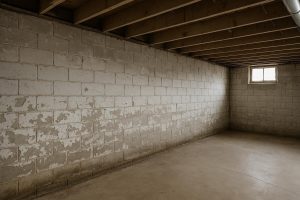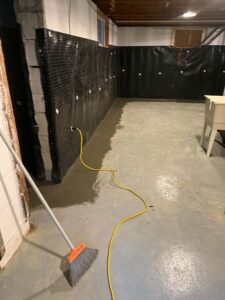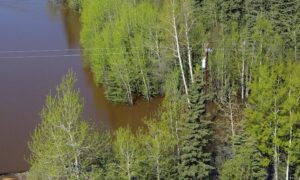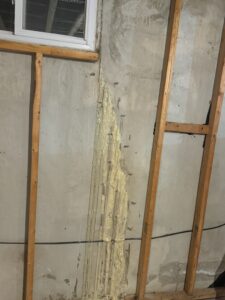
Sump pump installation North Bay homeowners need must account for the city’s granite-and-clay soil mix, heavy spring snowmelt from the Laurentian Highlands, and basements that face hydrostatic pressure from two directions at once. A correctly sized and properly installed sump system is the single most reliable way to keep a North Bay basement dry through the spring thaw and summer downpours that define the region’s two peak flood windows. For a full overview of waterproofing services available in the area, visit the North Bay foundation and waterproofing services page.
Key Takeaways
- North Bay’s spring snowmelt and shallow water table make sump pump installation a high-priority upgrade for most homes with finished or partially finished basements.
- The right pump type, basin size, and discharge route all depend on your foundation type, soil conditions, and whether you already have a weeping tile system in place.
- A battery backup unit is not optional in North Bay, where power outages during spring storms are common and a failed pump during a melt event can flood a basement in hours.
- Installation is almost always paired with interior weeping tile to collect water before it reaches the floor slab, giving the pump something to work with.
- Final cost depends on basin depth, linear footage of weeping tile, and access conditions. A site inspection is the only way to get an accurate figure.
Definitions and Scope
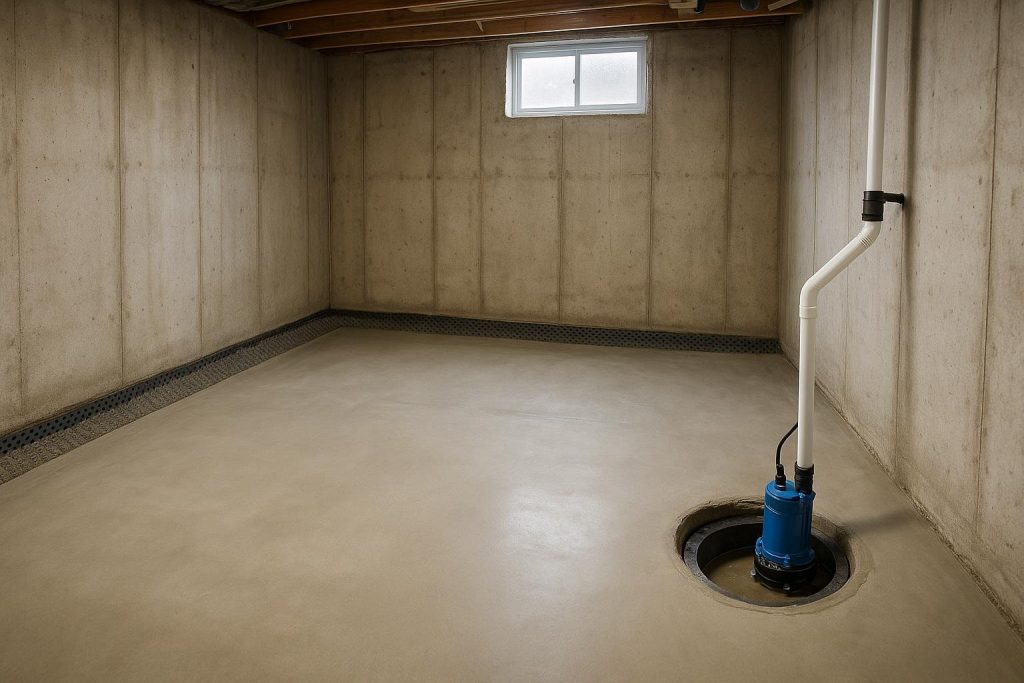
A sump pump is a submersible or pedestal pump seated inside a pit, called a sump basin, that is dug below the basement floor at the lowest point of the foundation. When groundwater rises, it enters the basin through perforations in the liner and through the connected weeping tile network. A float switch triggers the pump, which pushes water through a discharge pipe to daylight, typically to a splash pad at grade or to a storm drain where permitted by local bylaws.
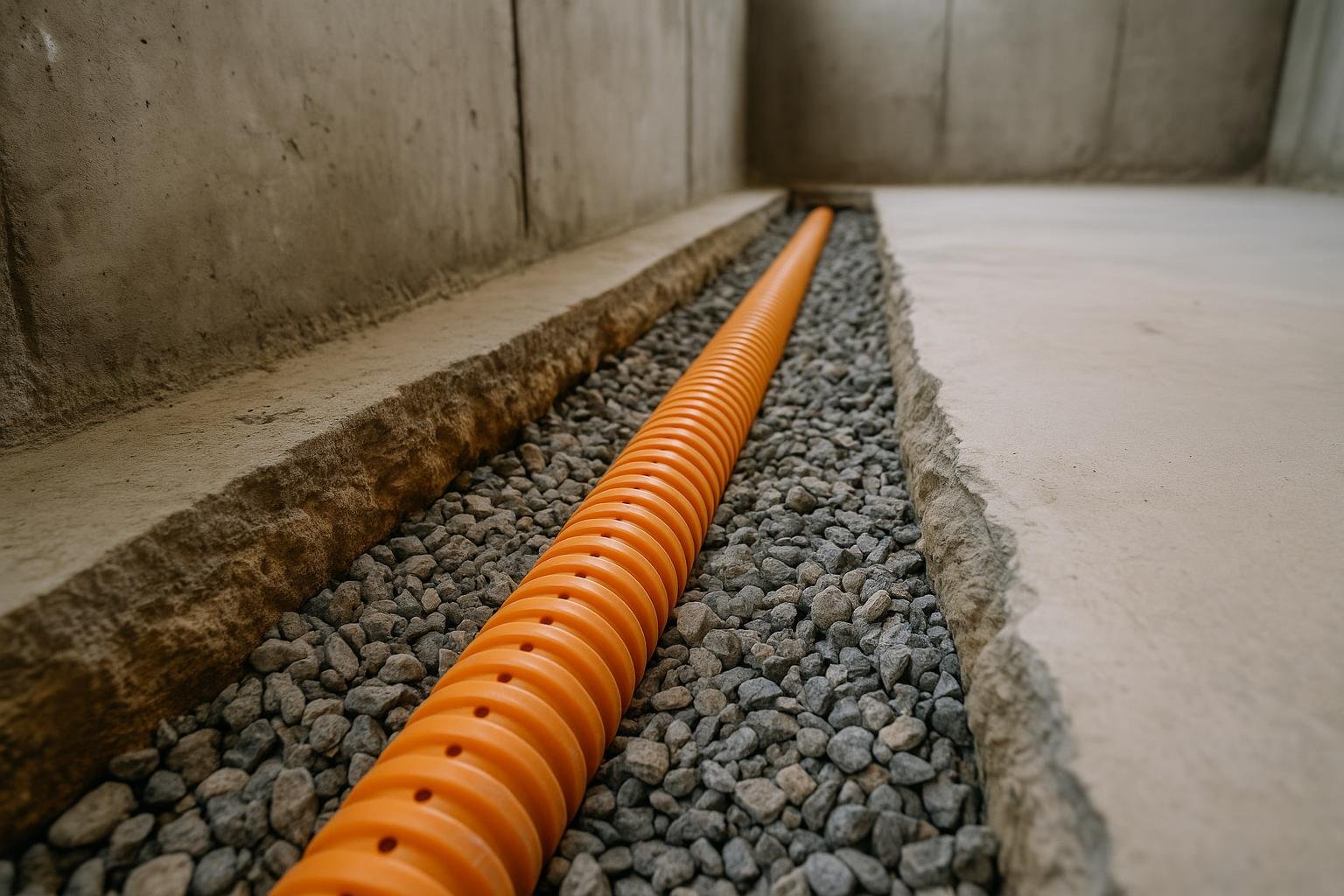
The scope of a full installation goes beyond the pump itself. It includes excavating the basin, bedding the liner in clear stone, connecting the perimeter weeping tile, running a discharge line with a check valve to prevent backflow, and re-pouring the concrete floor. In North Bay, where older homes often have original clay-pipe weeping tile that has silted up completely, the installation frequently includes replacing that tile at the same time.
The Ontario Building Code governs sump discharge routing and basin sizing. The Canada Mortgage and Housing Corporation (CMHC) publishes guidance on basement moisture control at cmhc-schl.gc.ca, which is a useful reference for understanding the moisture-management principles behind a properly designed system.
Why This Matters for North Bay Homes
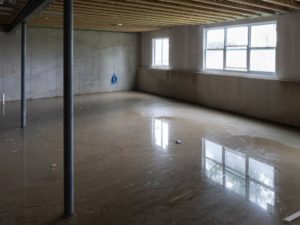
North Bay sits at the edge of the Canadian Shield, which means the soil profile shifts from shallow sandy loam over bedrock in some neighbourhoods to heavier clay deposits closer to Lake Nipissing. Clay holds water against foundation walls for weeks after a rain event, building hydrostatic pressure that pushes moisture through cracks, cold joints, and the wall-to-floor joint. Granite bedrock close to the surface in other areas creates a perched water table that has nowhere to drain naturally.
Spring thaw is the most dangerous window. The Laurentian Highlands receive significant snowpack, and when temperatures rise in March and April, meltwater saturates the ground faster than it can drain. Basements that stayed dry all winter can take on water within 48 hours of a warm front. Summer convective storms, which are common in the North Bay area, create a second peak. A sump pump that is correctly installed and paired with a battery backup handles both scenarios without requiring the homeowner to be present.
Homes built before the 1980s in North Bay are particularly vulnerable. Original weeping tile, where it exists at all, is typically a clay or concrete pipe that has collapsed or filled with silt over decades. Without a functioning collection system feeding a sump basin, groundwater has only one place to go: through the foundation wall or floor slab.
For a broader look at what wet basement conditions look like and what causes them, the wet basement repair North Bay service page covers the full range of symptoms specific to this area.
Your Options for Sump Pump Installation North Bay
Submersible Sump Pump with Interior Weeping Tile
This is the most common residential installation in North Bay. The pump sits fully submerged inside the basin, which keeps it quieter and cooler during operation. A perforated weeping tile is installed around the interior perimeter of the basement, bedded in clear stone, and pitched to drain into the basin. Water collected from the footing zone flows to the pump rather than seeping up through the floor slab.
Best for homes with finished or partially finished basements where exterior excavation is not practical, and for any home where the original weeping tile has failed. The submersible design handles high-volume inflow during spring melt without overheating. The main limitation is that the pump motor is not accessible without removing it from the basin, so annual testing is important.
Pedestal Sump Pump
A pedestal pump mounts the motor above the basin on a vertical shaft, with only the intake at the bottom of the pit. This design is easier to service because the motor is always accessible, and it tends to last longer in low-volume applications. It is louder during operation and takes up more vertical clearance, which can be a consideration in shallow basements.
Best for cottages or seasonal properties near North Bay where the pump runs infrequently and easy serviceability matters more than noise level. Not ideal for high-inflow situations during snowmelt.
Battery Backup Sump Pump
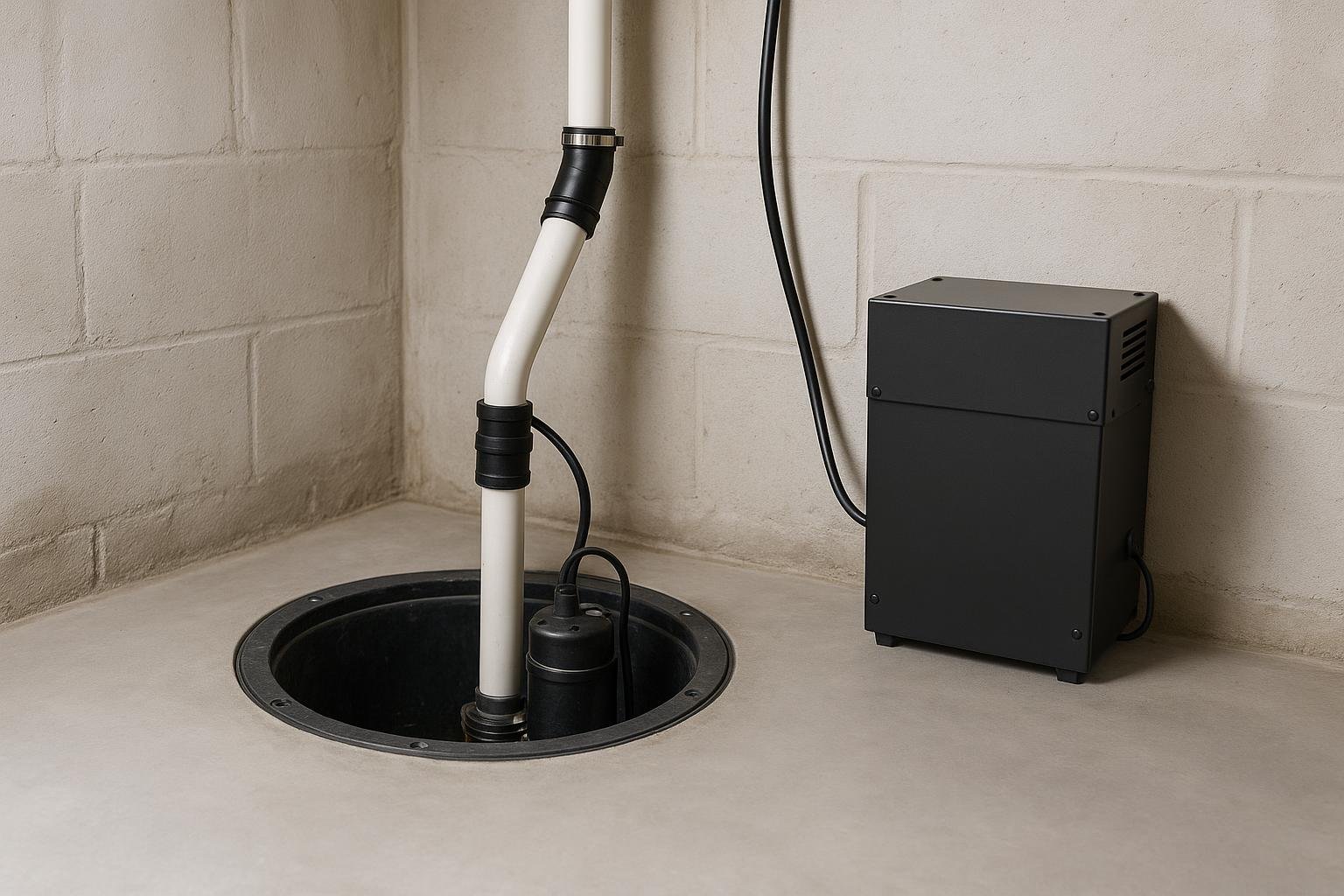
A battery backup unit is a secondary pump that activates when the primary pump fails or when a power outage cuts electricity. In North Bay, ice storms and spring wind events regularly knock out power for hours at a time, exactly when a sump pump is working hardest. The backup unit runs on a deep-cycle marine battery or a sealed AGM battery and can typically handle several hours of pumping before the battery depletes.
Best paired with any primary pump installation. It is not a standalone solution but an essential redundancy layer. Some systems include a water-powered backup that uses municipal water pressure instead of a battery, though this option requires adequate water pressure and produces wastewater.
Combination Primary and Backup System
A combination unit integrates the primary submersible pump and the battery backup into a single basin, with a shared controller that monitors both units and sends alerts to a smartphone app. This is the most complete residential solution and the one most appropriate for North Bay homeowners who are away from the property during spring thaw or who own a cottage in the surrounding Nipissing District.
Best for any home where an undetected failure would cause significant damage before the owner could respond. The monitoring component is particularly valuable for properties that are unoccupied for stretches of time.
Exterior Drainage with Sump Integration
Where the foundation wall is already being excavated for membrane application or weeping tile replacement, the sump basin can be integrated into an exterior drainage system. Exterior weeping tile at the footing drains to the basin rather than to a daylight outlet, giving the pump control over all collected groundwater. This is the most thorough approach but also the most disruptive and expensive.
Best for homes with active foundation wall leaks that need membrane treatment at the same time. The sump pump installation services page outlines how this integrates with a full waterproofing scope.
High-Water Alarm Only (Interim Measure)
A high-water alarm is a float-triggered alert device placed in an existing sump basin or in a low point of the basement floor. It does not pump water but alerts the homeowner before flooding reaches finished areas. This is not a waterproofing solution but a useful interim measure while a full installation is being planned, or as a monitoring layer in a basin that already has a functioning pump.
Options Compared
| System | Best For | Typical Lifespan | Relative Cost | Disruption |
|---|---|---|---|---|
| Submersible pump with interior weeping tile | Most North Bay homes, finished basements | 10 to 15 years (pump); weeping tile 25+ years | Moderate | Interior jackhammer work, 1 to 2 days |
| Pedestal pump | Seasonal cottages, low-inflow basements | 15 to 25 years | Lower | Minimal if basin exists |
| Battery backup unit | Add-on to any primary pump | Battery 3 to 5 years; pump 10+ years | Low to moderate (add-on) | Minimal, no excavation |
| Combination primary and backup system | Unoccupied or remote properties | 10 to 15 years | Moderate to higher | Interior work only |
| Exterior drainage with sump integration | Active wall leaks, full waterproofing scope | 25+ years with membrane | Higher | Exterior excavation, 3 to 5 days |
For most North Bay homeowners, the submersible pump paired with interior weeping tile and a battery backup gives the best balance of performance, cost, and disruption. The exterior integration option is worth the additional investment only when the foundation wall itself needs membrane treatment, because the excavation cost is shared across both scopes. Pedestal pumps suit seasonal properties where noise is not a concern and the pump runs only a few times per season.
How to Choose
Choose a submersible pump with interior weeping tile if your basement has a finished floor, if water is entering through the floor-to-wall joint or up through the slab, or if your original weeping tile has silted up. Sump pump installation North Bay homes built between 1950 and 1990 is the correct solution for the majority of properties in this era.
Choose a combination system with monitoring if you travel frequently during spring, if you own a cottage in the Nipissing District that sits unoccupied for weeks at a time, or if a previous pump failure caused significant damage. The monitoring cost is small relative to the cost of a flooded basement.
Choose exterior drainage with sump integration if a site inspection reveals active water infiltration through the foundation wall, visible efflorescence or mineral staining above the footing, or a failed exterior membrane on a home that has already had interior work done without lasting results.
Choose a pedestal pump if the basement is unfinished, the inflow volume is low, and serviceability without tools is a priority. This is a reasonable choice for a seasonal property where the pump is inspected at each opening.
Add a battery backup regardless of which primary pump you choose. In North Bay, this is not an optional upgrade. Power outages during the spring melt window are frequent enough that a primary-only installation carries meaningful risk.
A battery backup sump pump is the single most cost-effective upgrade a North Bay homeowner can add to an existing system. The battery costs a fraction of what one flooded basement costs to remediate.
Costs and Timelines
| Cost Driver | Why It Affects Price | Approximate Range (CAD) |
|---|---|---|
| Basin excavation and liner | Depth of dig, concrete thickness, access to lowest point | Included in system cost |
| Interior weeping tile (linear footage) | Perimeter length of basement determines jackhammer and tile footage | Priced per linear foot; full perimeter systems vary widely by home size |
| Pump unit and grade | Submersible vs. pedestal, horsepower rating, brand quality | Pump hardware alone: $300 to $800+ |
| Battery backup addition | Unit cost plus battery; AGM batteries cost more but last longer | $600 to $1,200 added to primary install |
| Discharge line routing | Distance to exterior, whether it must pass through finished walls or framing | Increases with complexity of routing |
| Concrete re-pour | Linear footage of trench opened for weeping tile | Included in interior system scope |
| Exterior excavation (if required) | Depth to footing, soil type, access for equipment | Full exterior waterproofing: $6,000 to $9,000 for average home |
Interior weeping tile systems with a submersible pump typically cost less than full exterior waterproofing. The $6,000 to $9,000 range cited above applies to exterior membrane work on an average Toronto-area semi-detached, and North Bay jobs with similar scope fall in a comparable band depending on excavation depth and access. A battery backup addition typically adds $600 to $1,200 to any installation. All figures are approximate and every final quote depends on a site inspection, because foundation depth, soil conditions, and existing drainage all affect the actual scope. For a broader view of what drives waterproofing costs across Ontario, the foundation waterproofing cost guide breaks down the key variables in detail.
Timelines for a standard interior weeping tile and sump installation run one to two days for most North Bay homes. Exterior excavation scopes take three to five days depending on depth and access.
Risks and Common Mistakes
| Symptom or Mistake | Likely Cause | Correct Fix |
|---|---|---|
| Pump runs constantly but basement stays wet | Weeping tile not connected to basin, or basin perforations blocked | Inspect and reconnect tile; clean or replace basin liner |
| Pump cycles on and off rapidly (short-cycling) | Basin too small for inflow volume, or float set too close to pump intake | Upsize basin or adjust float switch position |
| Discharge freezes in winter | Discharge pipe exits at grade without a freeze-proof termination | Install a freeze-resistant discharge outlet or re-route above frost line |
| Basement floods during power outage | No battery backup installed | Add battery backup unit to existing basin |
| Water enters above the weeping tile level | Wall crack or failed parging above the footing zone | Crack injection or exterior membrane; sump alone will not fix wall entry |
The most common mistake in sump pump installation North Bay projects is skipping the battery backup because the primary pump is new and the homeowner assumes it will not fail. Pump motors fail without warning, and the most likely failure moment is during a high-demand event when the motor is running continuously. A second common error is discharging the pump too close to the foundation, which allows the expelled water to re-enter the soil and return to the basin, creating a loop that accelerates pump wear. The discharge outlet should terminate at least two metres from the foundation wall and slope away from the building.
Installing a pump without replacing failed weeping tile is another frequent shortcut. If the tile cannot collect water and route it to the basin, the pump has nothing to move. The basin will stay dry while the basement floor stays wet.
A sump pump does not fix a leaking foundation wall. If water is entering through a crack above the footing, the crack needs injection or membrane treatment before the pump installation will produce a dry basement.
How the Process Works
- Free on-site inspection and moisture assessment. A technician visits the property, checks for active moisture, identifies the water entry points, and assesses whether existing weeping tile is functional. In North Bay, this step also looks at soil type and proximity to the water table near Lake Nipissing.
- Written scope with linear-foot pricing. You receive a written quote that breaks down the basin location, weeping tile footage, pump specification, discharge routing, and any crack injection or parging work required before the pump installation begins.
- Jackhammer and excavation. The perimeter trench is opened with a jackhammer, and the sump pit is dug to the required depth below the footing. Concrete and soil are removed and hauled out.
- Weeping tile installation and basin setting. Perforated weeping tile is bedded in clear stone around the perimeter and pitched to drain into the basin liner. The liner is set, levelled, and connected to the tile network.
- Pump installation and discharge routing. The submersible pump is placed in the basin, the float switch is set, and the discharge pipe is run through the rim joist or foundation wall to the exterior termination point. A check valve is installed to prevent backflow.
- Vapour barrier and concrete re-pour. A vapour barrier is run up the wall and over the stone bed before the trench is re-poured with concrete, restoring the floor surface.
- Test and handover. The pump is tested by filling the basin manually, the float switch trigger point is confirmed, and the battery backup (if included) is verified. The homeowner receives guidance on annual testing and battery replacement intervals.
Frequently Asked Questions
Do I need a sump pump if my North Bay basement has never flooded?
A basement that has never flooded may still have elevated moisture levels that cause mould, efflorescence, and structural deterioration over time. North Bay’s spring melt creates conditions that can overwhelm a previously dry basement in a single season, particularly as the water table rises. A sump system is a preventive measure, not just a response to an existing flood problem.
How long does sump pump installation North Bay take?
A standard interior installation, including weeping tile and basin, takes one to two days for most residential basements. Larger homes or those requiring exterior excavation take three to five days. The concrete re-pour needs 24 to 48 hours to cure before the area is fully usable.
Can I install a sump pump myself?
The pump unit itself can be dropped into an existing basin by a capable DIYer, but cutting the basin, running weeping tile, and routing the discharge correctly requires experience with concrete work and an understanding of drainage grades. Incorrect discharge routing is the leading cause of pump failure and re-flooding. A professional installation also ensures the work meets the Ontario Building Code requirements for sump discharge.
How often should I replace the sump pump?
Submersible pumps in active use typically last 10 to 15 years. In North Bay, where the pump may run heavily during spring melt for several weeks each year, the lower end of that range is more realistic. The battery in a backup unit should be replaced every three to five years regardless of apparent condition, because battery capacity degrades before failure is obvious.
What happens if the power goes out during a spring flood?
Without a battery backup, the primary pump stops working and the basin fills. Depending on inflow rate, a basement can flood within two to four hours during a high-melt event. A properly sized battery backup extends operation for several hours, which is usually enough time for power to be restored or for the homeowner to take action. For properties that are unoccupied, a monitoring system that sends alerts to a smartphone is an important companion to the backup unit.
Will a sump pump fix a leaking foundation crack?
No. A sump pump manages groundwater that enters the drainage system below the floor. Water entering through a crack in the foundation wall above the footing zone bypasses the weeping tile entirely and will continue to enter regardless of how well the pump works. Cracks need polyurethane or epoxy injection, or exterior membrane treatment, depending on their nature. The North Bay foundation and waterproofing services page covers the full range of repair options for this area.
Does the discharge pipe freeze in a North Bay winter?
It can, if the pipe exits at grade without a freeze-resistant termination fitting or if the pipe diameter is too small. Standard practice is to use a minimum 38 mm discharge pipe, terminate it with a freeze-proof outlet, and ensure the exterior end is not buried under snow accumulation. In North Bay, where temperatures regularly drop below minus 20 Celsius, this detail is not optional.
Is a sump pump covered by home insurance in Ontario?
The pump hardware itself is not typically covered under a standard home insurance policy. However, many Ontario insurers offer a sewer backup and overland water endorsement that covers damage caused by a pump failure. Premiums for this endorsement are often lower when a functioning sump system with a battery backup is in place, because the insurer’s risk is reduced. Check your specific policy wording and speak with your broker.
What size sump pump do I need for a North Bay home?
Most residential applications use a 1/3 to 1/2 horsepower submersible pump. Homes on low-lying lots near Lake Nipissing, or those with a high water table confirmed during inspection, may need a 3/4 horsepower unit to handle peak inflow during spring melt. The correct sizing depends on the basin diameter, the vertical lift to the discharge outlet, and the expected inflow volume, all of which are assessed during the site inspection.
Can sump pump installation North Bay be added to a basement that has never had one?
Yes. The basin is cut into the existing concrete floor at the lowest point of the basement, and weeping tile is installed in a perimeter trench. This is a standard retrofit scope and does not require the basement to have been designed for a sump originally. Older North Bay homes that were built without any drainage system are the most common candidates for this type of installation.
If you are ready to protect your North Bay basement before the next spring thaw, contact the DryShield Team for a free on-site inspection. We will assess your foundation, identify the right system for your soil conditions and inflow volume, and provide a written quote with no obligation. Reach out through the contact page to schedule your visit.