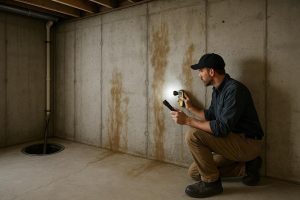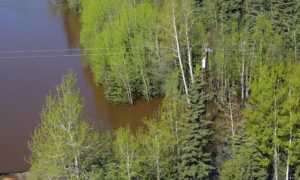
A leaky basement Oakville homeowners encounter most often traces back to one root cause: hydrostatic pressure from water-saturated clay soil pressing against the foundation wall. Oakville sits on a band of heavy Halton clay that drains slowly, holds moisture for weeks after a rainstorm, and pushes steadily against poured-concrete and block foundations alike. Understanding that pressure is the starting point for choosing the right fix.
Key Takeaways
- Halton clay soil is the dominant driver of wet basements in Oakville, not rainfall volume alone.
- Spring thaw and summer convective storms are the two peak failure windows for local foundations.
- A single injected crack typically costs $600 to $900; full exterior waterproofing runs roughly $6,000 to $9,000 depending on linear footage and excavation depth.
- Interior weeping-tile systems manage water that has already entered; exterior membranes stop it at the wall.
- Failed or silted-up original weeping tile is common in Oakville homes built before the 1990s and is a frequent hidden cause of chronic dampness.
Definitions and Scope
“Leaky basement” covers a wide range of problems: a hairline crack weeping a few drops after heavy rain, a perimeter floor-wall joint seeping during spring thaw, or a wall that is visibly damp even in dry weather. Each symptom points to a different failure mode and calls for a different repair.
The main entities involved are the foundation wall (poured concrete or concrete block), the footing at its base, the original weeping tile buried beside that footing, the soil and its drainage behaviour, and the hydrostatic pressure that builds when drainage fails. In Oakville, the clay content of Halton soils means water does not percolate away quickly. It pools at the footing level and forces its way through any gap, crack, or porous section of the wall.
Repairs fall into two broad categories: exterior systems that intercept water before it reaches the wall, and interior systems that collect and redirect water that has already passed through. Crack injection is a third, targeted approach for isolated cracks that have not yet compromised the drainage system. The right category depends on where the water is entering, how much of it there is, and the age and condition of the existing drainage infrastructure.
Why This Matters for Oakville Homeowners
Oakville’s housing stock spans several eras. Older neighbourhoods like Bronte, Old Oakville, and parts of Kerr Village contain homes built in the 1950s through 1970s with clay-tile or concrete-pipe weeping tile that is now 50 to 70 years old. That original drainage infrastructure silts up, collapses, or simply stops functioning. When it does, water that was once carried away from the footing has nowhere to go except through the wall, and a leaky basement Oakville residents thought was minor can become a chronic problem.
Newer subdivisions in North Oakville, built on land that was farmfield until the 2000s, sit on equally heavy clay but with modern drainage. Even so, the grading around newer homes can settle over time, directing surface water toward the foundation rather than away from it. Both scenarios produce the same result: a wet or damp basement.
The Canada Mortgage and Housing Corporation (CMHC) notes that moisture intrusion is the leading cause of basement air-quality problems in Canadian homes, and that early intervention consistently costs less than remediation after mould has established. Oakville’s two peak failure windows are the spring thaw, when frozen ground sheds snowmelt faster than the soil can absorb it, and summer convective storms that drop 30 to 50 mm of rain in under an hour. Both events spike hydrostatic pressure rapidly.
Leaving a leaky basement Oakville property unaddressed also carries a financial cost. A disclosed water problem depresses resale value and can complicate mortgage financing. Fixing the source, rather than masking it with paint or a dehumidifier, is the only approach that holds up to a home inspection.
Your Options for Fixing a Leaky Basement in Oakville
Polyurethane Crack Injection
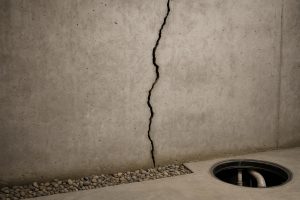
Crack injection is the right first response when a single vertical or diagonal crack in a poured-concrete wall is the only entry point. A technician drills ports along the crack at regular intervals, pastes surface ports over them, and injects low-pressure polyurethane foam that expands to fill the crack from face to footing. Polyurethane cures flexible, which matters in Oakville because seasonal freeze-thaw cycles cause minor foundation movement every year. A rigid filler would re-crack; a flexible one moves with the wall. For a full breakdown of injection pricing, see the crack injection cost guide.
Epoxy injection is reserved for structural cracks where the wall needs to be re-bonded and rigidity is the goal. Most residential cracks in Oakville are non-structural shrinkage or settlement cracks, so polyurethane is the standard choice. The repair is done from the interior, with no excavation, and typically takes two to four hours per crack. It is not appropriate when the weeping tile has failed or when water is entering at the floor-wall joint rather than through the wall itself.
Interior Weeping Tile System
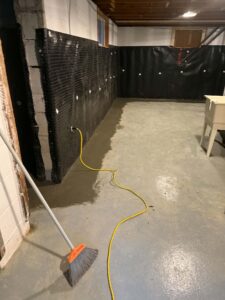
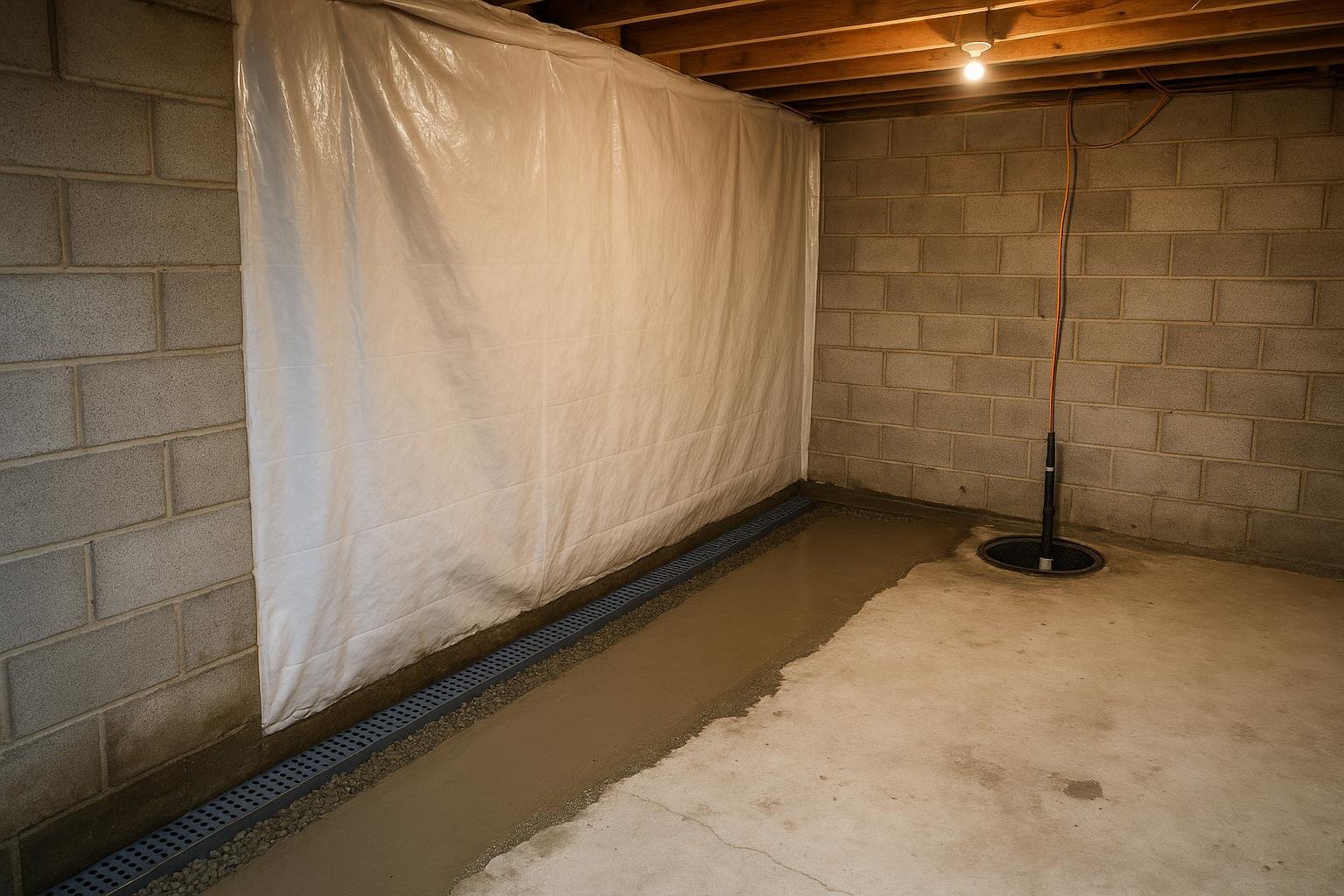
An interior system addresses water that is already passing through the wall or rising through the floor-wall joint. The perimeter concrete is jackhammered, a new perforated weeping-tile channel is installed at footing level, and the water is directed to a sump basin where a pump discharges it away from the house. A vapour barrier is run up the wall to direct any wall seepage into the channel rather than onto the floor. The concrete is then re-poured. For a side-by-side comparison of interior and exterior approaches, the exterior vs. interior perimeter waterproofing guide covers the key trade-offs.
This approach is less disruptive than exterior excavation and works well in Oakville homes where access around the foundation is limited by decks, driveways, or neighbouring properties. It manages water rather than stopping it at the source, so the wall itself continues to experience hydrostatic pressure. For homes with active structural concerns, exterior work is the stronger choice.
Exterior Waterproofing
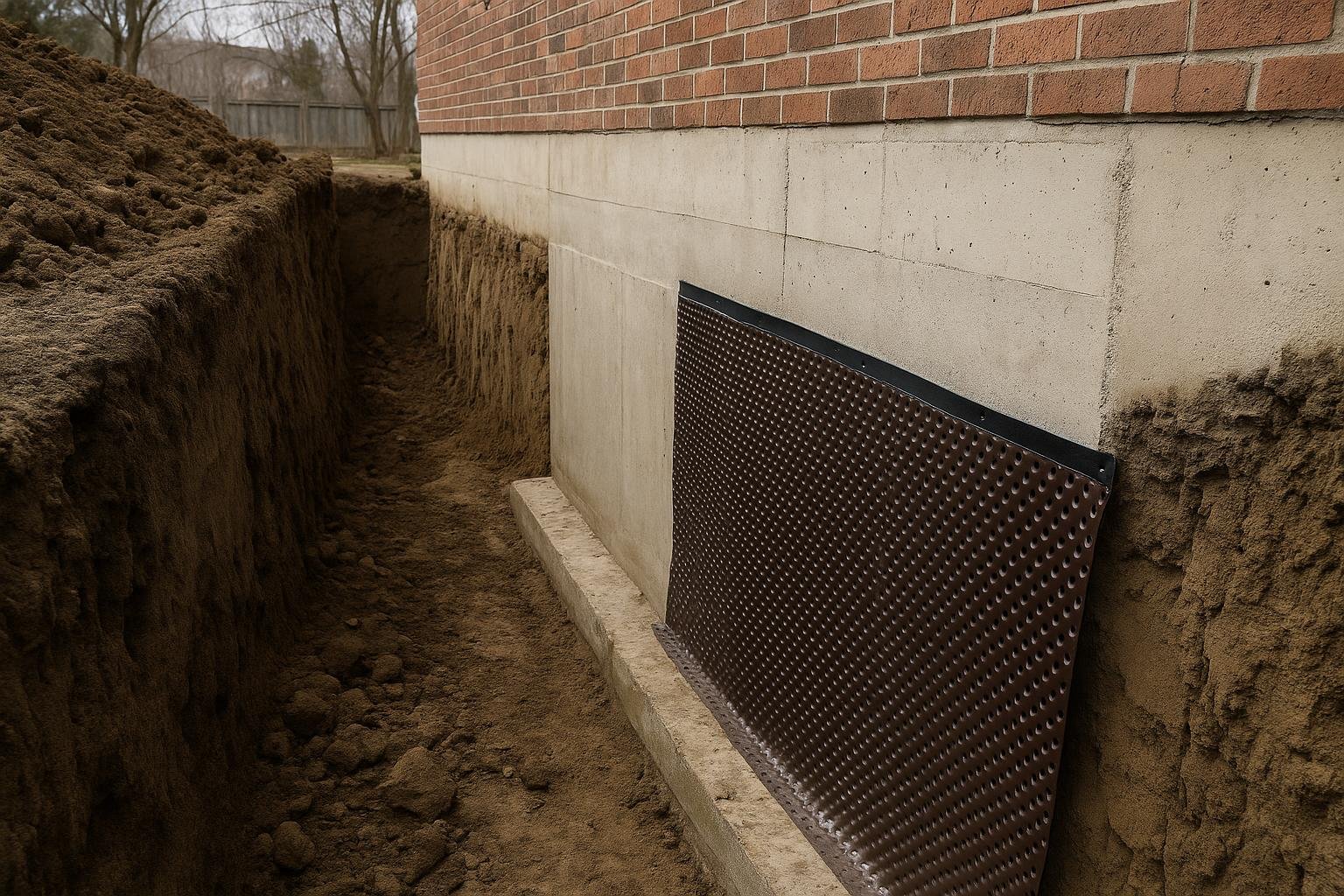
Exterior waterproofing is the most comprehensive solution for a leaky basement Oakville home can have. The soil is excavated down to the footing, the wall is cleaned, any voids are filled with hydraulic cement parging, and a rubberised membrane is applied to the full wall face. A dimpled drainage board goes over the membrane to protect it and create a drainage plane. New weeping tile is bedded in clear stone at the footing and connected to the drainage system. The trench is then backfilled and the grade is corrected to slope away from the house.
This is the method that stops water at the wall rather than managing it inside. It is the right choice when the original weeping tile has failed, when the wall shows signs of deterioration from long-term moisture exposure, or when a permanent solution is the priority. Excavation in Oakville’s clay soil is straightforward but requires equipment access around the perimeter.
Sump Pump Installation or Replacement
A sump pump is often part of an interior system but can also be added as a standalone upgrade when an existing pump is undersized, aging, or lacks a battery backup. Oakville’s spring thaw and summer storms can knock out power at the exact moment the pump is working hardest. A battery-backup or water-powered backup unit is a practical safeguard for any Oakville home that relies on a sump for basement dryness. See the sump pump installation page for specifications and options.
Exterior Grade Correction and Window-Well Drainage
Sometimes the entry point is not the wall at all but a window well that has filled with debris and is directing water straight at the foundation, or a grade that has settled to slope toward the house. Correcting the grade and installing a proper window-well drain can stop minor seepage without any structural work. This is a low-cost first step worth checking before committing to a larger repair, but it will not solve problems caused by failed weeping tile or wall cracks.
Options Compared
| Method | Best For | Typical Lifespan | Relative Cost | Disruption |
|---|---|---|---|---|
| Polyurethane crack injection | Single non-structural wall crack | Long-term if crack is stable | Lowest ($600-$900 per crack) | Minimal, interior only, no excavation |
| Interior weeping tile system | Perimeter seepage, failed original tile, limited exterior access | 20-25 years with pump maintenance | Moderate | Interior jackhammering, 2-4 days |
| Exterior waterproofing | Failed weeping tile, wall deterioration, permanent fix | 25+ years | Highest ($6,000-$9,000 typical range) | Excavation required, 3-5 days |
| Sump pump upgrade | Existing system lacking backup, undersized pump | 7-12 years per unit | Low to moderate | Minimal, pit work only |
| Grade correction / window-well drain | Surface water entry, minor seepage | Ongoing with maintenance | Lowest | Minimal, exterior landscaping |
The table shows that crack injection and grade correction are the right starting points when the problem is isolated and recent. Interior weeping tile suits homes where exterior access is restricted or where the budget does not allow full excavation right now. Exterior waterproofing costs more upfront but addresses the root cause at the wall and replaces failed drainage infrastructure at the same time. Sump pump upgrades are almost always worth doing alongside any other repair in Oakville, given the frequency of heavy rain events.
How to Choose the Right Fix
Choose crack injection if you have found a single vertical crack in a poured-concrete wall, the crack appeared after a specific heavy-rain event, and there is no evidence of perimeter dampness or floor-wall joint seepage. This is a targeted, cost-effective repair when the drainage system is still functioning.
Choose an interior weeping tile system if water is entering at the floor-wall joint along multiple walls, the basement has a history of dampness rather than a single acute event, or excavation is not practical because of a deck, driveway, or close neighbouring structure. Interior systems are also a sensible choice when the home is occupied and minimising outdoor disruption is a priority.
Choose exterior waterproofing if the original weeping tile is known to have failed or has never been replaced, if the wall shows parging that is cracking or spalling from long-term moisture exposure, or if you want a solution that stops water at the source and carries a long-term warranty. Homes in older Oakville neighbourhoods with 50-year-old drainage infrastructure are strong candidates for this approach when a leaky basement Oakville inspection confirms failed tile.
Choose a sump pump upgrade alongside whichever primary repair you select if the existing pump is more than seven years old, lacks a battery backup, or has no alarm. In Oakville, where summer storms can cut power for hours, a backup unit is not optional for any home that depends on a sump.
In Oakville’s heavy clay soil, hydrostatic pressure builds quickly after rain. A sump pump without battery backup can fail at the worst possible moment. Pair any waterproofing repair with a backup unit.
Costs and Timelines
| Cost Driver | Why It Affects Price | Approximate Impact |
|---|---|---|
| Linear footage of wall treated | More wall means more membrane, weeping tile, and labour | Primary driver for exterior and interior systems |
| Excavation depth | Deeper footings require more soil removal and shoring time | Significant for exterior work on older homes |
| Access around the foundation | Decks, driveways, and fences increase hand-digging time | Can add meaningfully to exterior job cost |
| Number and width of cracks | Each crack is a separate injection job | $600-$900 per crack, site-inspection dependent |
| Condition of existing weeping tile | Fully silted or collapsed tile requires complete replacement | Adds to both interior and exterior system cost |
| Sump basin and pump specification | Larger basins, dual pumps, and battery backups increase cost | Moderate, but worthwhile in Oakville’s storm climate |
As a general guide, a single injected crack runs $600 to $900. A full exterior waterproofing job on a typical Oakville semi-detached or detached home falls in the $6,000 to $9,000 range, depending on the factors above. Interior weeping-tile systems generally come in below the exterior range. Every figure here is approximate. The final number depends on a site inspection, because no two foundations in Oakville are in the same condition. For a detailed breakdown of what drives waterproofing costs across Ontario, the foundation waterproofing cost guide covers the full picture.
All price ranges on this page are approximate and based on typical completed jobs. Your actual cost depends on a free on-site estimate. Linear footage, excavation depth, and access conditions are the three biggest variables.
Risks and Common Mistakes
The most common mistake Oakville homeowners make is treating the symptom rather than the cause. Applying hydraulic cement or waterproofing paint to a damp wall stops the visible moisture temporarily but does nothing about the hydrostatic pressure behind it. Within one or two seasons, water finds a new path through a different section of the wall or the floor-wall joint.
A second frequent error is injecting a crack without first confirming that the weeping tile is still functional. If the drainage system has failed, the crack is just one of several entry points the water will eventually find. Injection on its own is appropriate only when the drainage infrastructure is confirmed to be working.
Skipping a battery-backup sump pump is a risk specific to Oakville’s weather pattern. The summer storms that produce the highest hydrostatic pressure are also the ones most likely to knock out power. A primary pump that cannot run during a power outage provides no protection at the moment it is needed most.
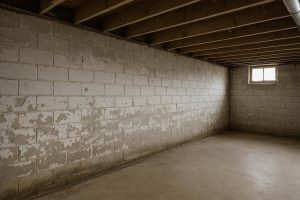
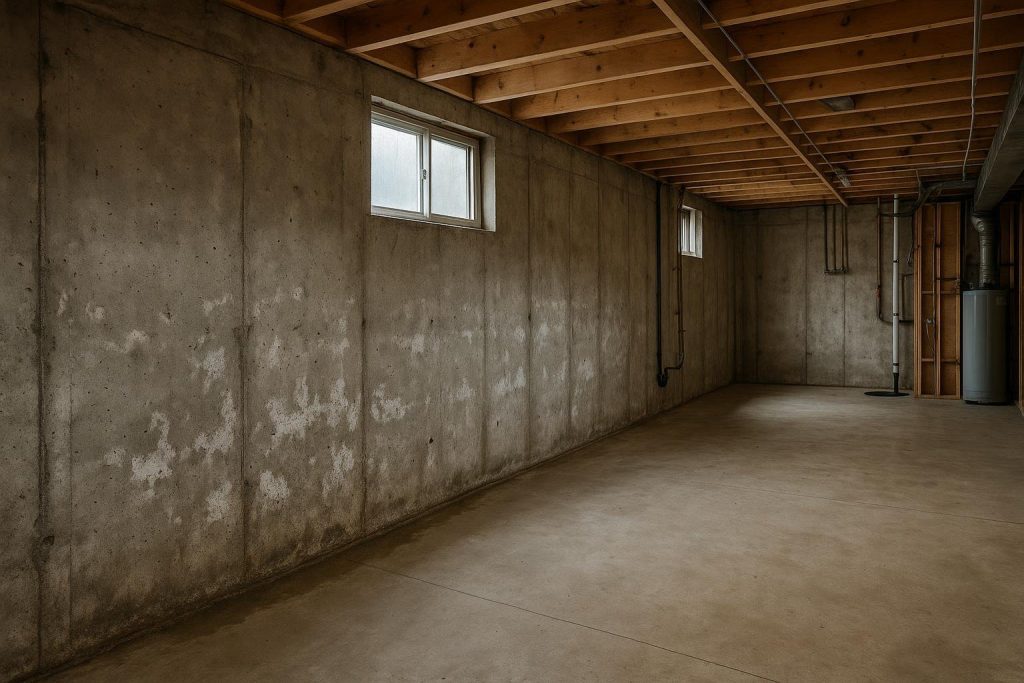
Ignoring efflorescence, the white chalky mineral deposit that appears on basement walls, is another missed signal. Efflorescence is evidence that water has been moving through the concrete wall and depositing dissolved minerals on the surface. It is not a cosmetic issue. It indicates active moisture migration that will eventually deteriorate the concrete if left unaddressed. Any leaky basement Oakville homeowner notices should be assessed before efflorescence advances to spalling.
Finally, choosing a contractor based on price alone without verifying their process is a common regret. A proper exterior job requires excavation to the footing, membrane application, drainage board, new weeping tile in clear stone, and correct backfill and grading. Shortcuts at any of these stages produce a repair that fails within a few years.
| Symptom | Likely Cause | Correct Fix |
|---|---|---|
| Single crack weeping after rain | Shrinkage or settlement crack in poured wall | Polyurethane crack injection |
| Damp perimeter at floor-wall joint | Failed weeping tile, hydrostatic pressure at footing | Interior or exterior weeping tile replacement |
| White chalky deposits on wall | Active moisture migration through concrete | Identify and seal entry point; address drainage |
| Water after every heavy rain, dry otherwise | Surface water entry via grade or window well | Grade correction, window-well drain |
| Chronic dampness regardless of weather | Fully failed weeping tile, saturated clay holding pressure | Exterior waterproofing with full weeping tile replacement |
This symptom-to-cause table is a starting point for diagnosis, not a substitute for a professional inspection. Several symptoms can overlap, and the correct fix sometimes combines two approaches, for example crack injection plus an interior sump upgrade when the weeping tile is partially functional but the wall has an isolated crack.
How the Process Works
- Free on-site estimate and moisture assessment. A technician visits the property, checks the interior walls and floor for moisture patterns, probes the exterior grade, and assesses whether the existing weeping tile shows any signs of function. This step determines which repair category applies.
- Written scope with linear-foot pricing. You receive a written proposal that specifies exactly what will be done, which walls are included, what materials will be used, and the total cost. No surprises on the day of work.
- Preparation and access. For exterior work, the area around the foundation is cleared and equipment is positioned. For interior work, furniture and flooring near the perimeter are protected or removed.
- Core repair work. Exterior: excavation to the footing, hydraulic cement parging of voids, rubberised membrane application, dimpled drainage board, new weeping tile in clear stone, backfill and grade correction. Interior: jackhammer perimeter, install weeping tile to sump basin, vapour barrier up the wall, re-pour concrete. Crack injection: port-and-paste method, low-pressure polyurethane fill, port removal and surface finishing.
- Sump and drainage connection. New weeping tile is connected to the sump basin or to the municipal storm drain where permitted. The pump is tested under load.
- Final inspection and cleanup. The completed work is reviewed with the homeowner, the grade is confirmed to slope away from the house, and the site is left clean.
- Warranty documentation. The repair is covered by a written warranty. For full exterior systems, this is a lifetime transferable warranty, which is relevant if you plan to sell the home.
A proper exterior waterproofing job in Oakville typically takes three to five days from excavation to backfill. Interior weeping-tile systems usually run two to four days. Crack injection is often completed in a single visit.
Frequently Asked Questions
What is the most common cause of a leaky basement in Oakville?
Hydrostatic pressure from Halton clay soil is the most common cause. The clay holds water against the foundation for days after rain, building pressure that forces moisture through cracks, the floor-wall joint, or porous sections of the wall. Failed original weeping tile, which can no longer carry that water away from the footing, is the underlying infrastructure failure that allows the pressure to build.
Can I fix a leaky basement in Oakville myself?
Minor surface patching with hydraulic cement can slow a small crack temporarily, but it does not address hydrostatic pressure or failed drainage. DIY repairs on Oakville foundations typically last one to two seasons before water finds a new path. Injection, weeping tile replacement, and exterior membrane work require professional equipment and experience to be effective long-term.
How much does it cost to fix a leaky basement Oakville homeowners ask about most?
A single injected crack runs approximately $600 to $900. A full exterior waterproofing job on a typical Oakville home falls in the $6,000 to $9,000 range, depending on linear footage, excavation depth, and access. Interior weeping-tile systems generally cost less than exterior work. Every estimate depends on a site inspection. You can also review the crack injection cost guide for a detailed breakdown of injection pricing across southern Ontario.
How do I know if my Oakville home needs exterior or interior waterproofing?
If the original weeping tile has failed, if the wall shows deterioration from long-term moisture exposure, or if you want water stopped at the wall rather than managed inside, exterior waterproofing is the stronger choice. If exterior access is limited by a deck or driveway, or if the problem is perimeter seepage with a functional drainage system, an interior system is a practical alternative. A site inspection is the only reliable way to confirm which applies to your home.
Does a leaky basement affect home value in Oakville?
Yes. A disclosed water problem in Oakville’s real-estate market reduces buyer confidence and can complicate mortgage financing. A professionally repaired and warranted basement, by contrast, is a positive disclosure. A lifetime transferable warranty on an exterior system can be transferred to the new owner, which is a meaningful selling point in a competitive market.
How long does basement waterproofing last in Oakville?
Exterior systems with a full membrane, drainage board, and new weeping tile typically last 25 years or more when the grade is maintained. Interior weeping-tile systems last 20 to 25 years with regular sump pump maintenance. Polyurethane crack injection is long-lasting for stable cracks, but a crack that continues to move due to ongoing settlement may need re-treatment over time.
Is spring the worst time for basement leaks in Oakville?
Spring thaw is one of the two peak failure windows, because frozen ground sheds snowmelt faster than clay soil can absorb it, spiking hydrostatic pressure rapidly. Summer convective storms that drop 30 to 50 mm in under an hour are equally problematic. Both seasons are worth monitoring closely, particularly in homes with aging weeping tile or a sump pump that lacks a battery backup.
What is the difference between polyurethane and epoxy crack injection?
Polyurethane cures flexible and is the standard choice for residential foundation cracks in Oakville, because it tolerates the seasonal movement that freeze-thaw cycles cause. Epoxy cures rigid and is used only when the crack is structural and the wall needs to be re-bonded for load-bearing reasons. Most hairline and shrinkage cracks in Oakville homes are non-structural and call for polyurethane.
Do I need a permit to waterproof my basement in Oakville?
Interior waterproofing and crack injection generally do not require a building permit in Oakville. Exterior excavation that involves significant structural work may require one depending on scope. The Ontario Building Code sets the baseline requirements for foundation drainage and damp-proofing. Your contractor should confirm permit requirements as part of the written scope before work begins.
If your Oakville home has a leaky basement Oakville residents should not ignore, the DryShield Team is ready to help. We offer free on-site estimates with no obligation, and every quote comes with a written scope and linear-foot pricing so you know exactly what you are getting. Visit our Oakville basement waterproofing and foundation crack repair page to request your inspection, or contact us directly to book a time that works for you.