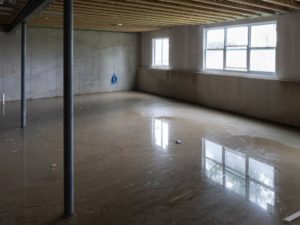
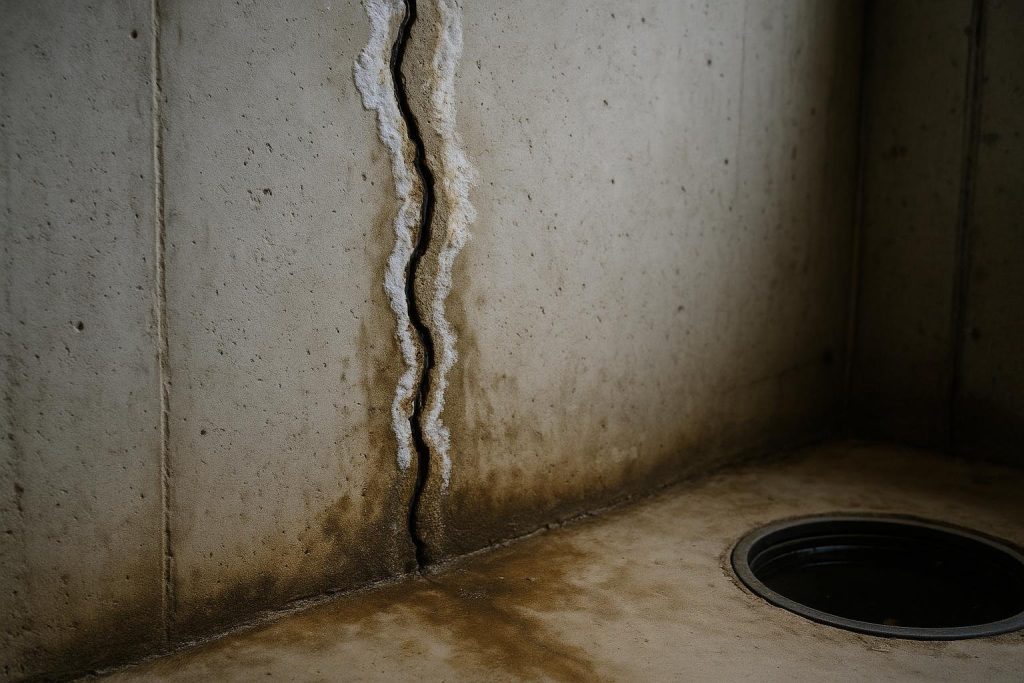
Foundation crack repair in Hamilton is one of the most common waterproofing needs in the city, driven by clay-heavy soils, seasonal freeze-thaw cycles, and the hydrostatic pressure that builds against basement walls after heavy rain or snowmelt. Most non-structural cracks in poured concrete walls can be sealed from the interior using polyurethane or epoxy injection, stopping active leaks without excavation. The right repair method depends on crack type, location, width, and whether water is actively entering. This guide explains every option, how to compare them, and what drives cost.
- Hairline to moderate-width vertical and diagonal cracks in poured concrete walls are typically candidates for crack injection from the interior.
- Horizontal cracks and step cracks in block foundations may indicate lateral soil pressure and require a structural assessment before waterproofing.
- Hamilton’s Escarpment soils and clay-rich lowland areas create above-average hydrostatic pressure, making prompt repair important.
- A Lifetime Transferable Warranty is available on qualifying crack injection work, which can benefit resale value.
- Cost is driven by crack length, access, method, and whether drainage upgrades are needed alongside the crack repair.
Definitions & scope
A foundation crack is any fracture in a basement wall, floor slab, or footing. Cracks are broadly classified as non-structural (the wall retains its load-bearing capacity but allows water ingress) or structural (the wall’s integrity is compromised). This guide focuses on non-structural crack repair and waterproofing methods. Structural concerns, underpinning, and backwater valve installation are outside scope; a licensed structural engineer should assess any crack showing horizontal displacement, significant width change, or active bowing.
Common crack types in Hamilton homes include:
- Vertical cracks – typically caused by concrete shrinkage during curing or differential settlement; usually non-structural.
- Diagonal cracks – often caused by differential settlement or corner stress; may be non-structural if narrow and stable.
- Horizontal cracks – caused by lateral soil pressure; require structural evaluation.
- Step cracks – follow mortar joints in block foundations; can indicate settlement or lateral pressure.
- Floor cracks – caused by slab settlement or hydrostatic pressure from below.
The scope of foundation crack repair services at DryShield covers injection-based sealing, interior and exterior waterproofing membranes, and drainage solutions that address the source of water pressure.
Why this matters
Hamilton sits at the base of the Niagara Escarpment, with clay-rich lowland soils in the lower city and shallower till on the Mountain. Clay soils absorb and retain water, expanding when wet and contracting when dry. This repeated movement exerts pressure on foundation walls and widens existing cracks over time. Seasonal freeze-thaw cycling compounds the problem: water that enters a hairline crack freezes, expands, and forces the crack wider each winter. Research on freeze-thaw deterioration of concrete confirms that repeated ice-crystal formation within a crack exerts internal pressures that progressively widen the fracture plane; see the Environment and Climate Change Canada climate data portal for Hamilton’s recorded freeze-thaw cycle frequency.
Older Hamilton neighbourhoods, including many homes in the North End, Kirkendall, Durand, and Stinson, contain houses built in the early to mid-twentieth century with poured concrete or concrete block foundations that have had decades of exposure to these conditions. Newer subdivisions on the Mountain and in Ancaster, Binbrook, and Waterdown are built on re-graded clay and can experience settlement cracking in the first several years after construction.
For Hamilton-area homes, see how DryShield handles foundation crack repair, from settlement cracks in newer builds to older poured walls.
Leaving a foundation crack unrepaired allows water infiltration that can lead to mold growth, efflorescence, deterioration of the concrete itself, and damage to finished basement spaces. Early repair is generally less disruptive and less costly than waiting until drainage systems or exterior excavation become necessary. For context on what active leaks look like, see the leaky basement Hamilton guide and the basement leak repair Hamilton guide.
Ontario Building Code requirements govern foundation drainage and waterproofing for new construction and significant renovations. The Ontario Building Code basement waterproofing compliance guide summarises permit obligations; confirm requirements with the City of Hamilton Building Division before exterior work begins.
Your options
Polyurethane crack injection
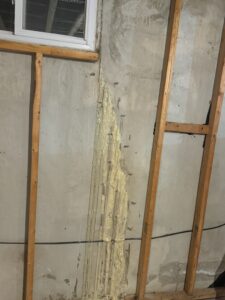
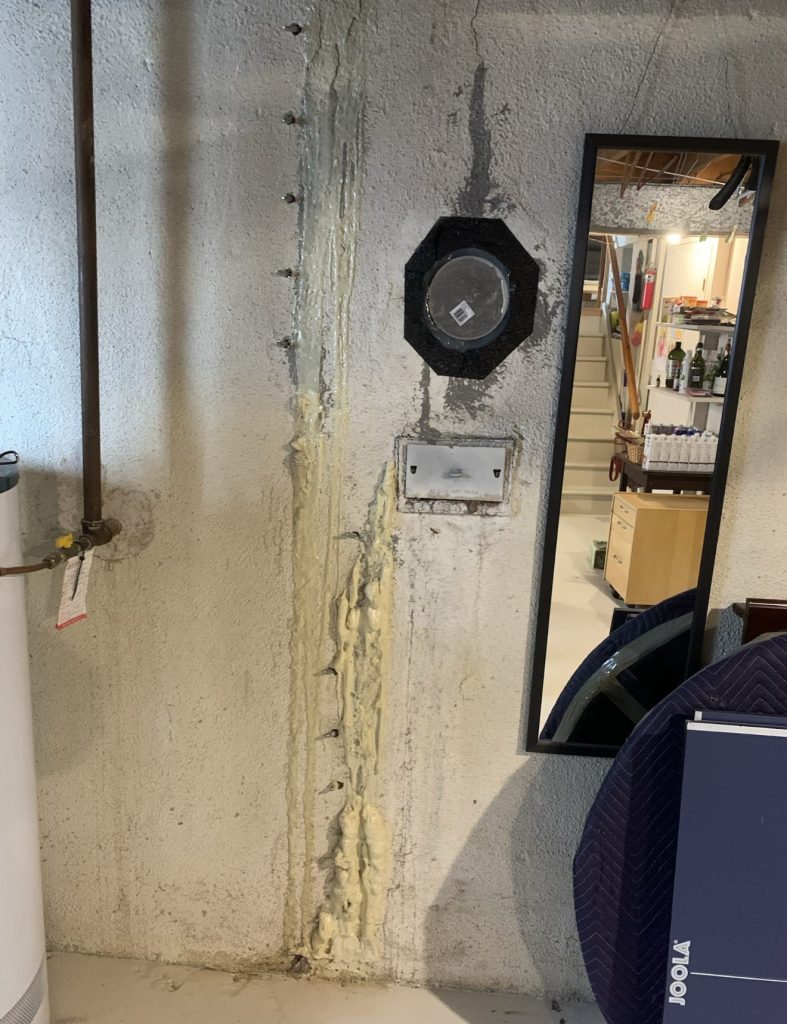
Polyurethane injection is the most widely used method for sealing active or previously wet vertical and diagonal cracks in poured concrete walls. A low-viscosity polyurethane foam is injected under controlled pressure through ports drilled or surface-mounted along the crack. The foam expands to fill the full depth of the crack, bonding to the concrete and creating a flexible, waterproof seal that can accommodate minor future movement.
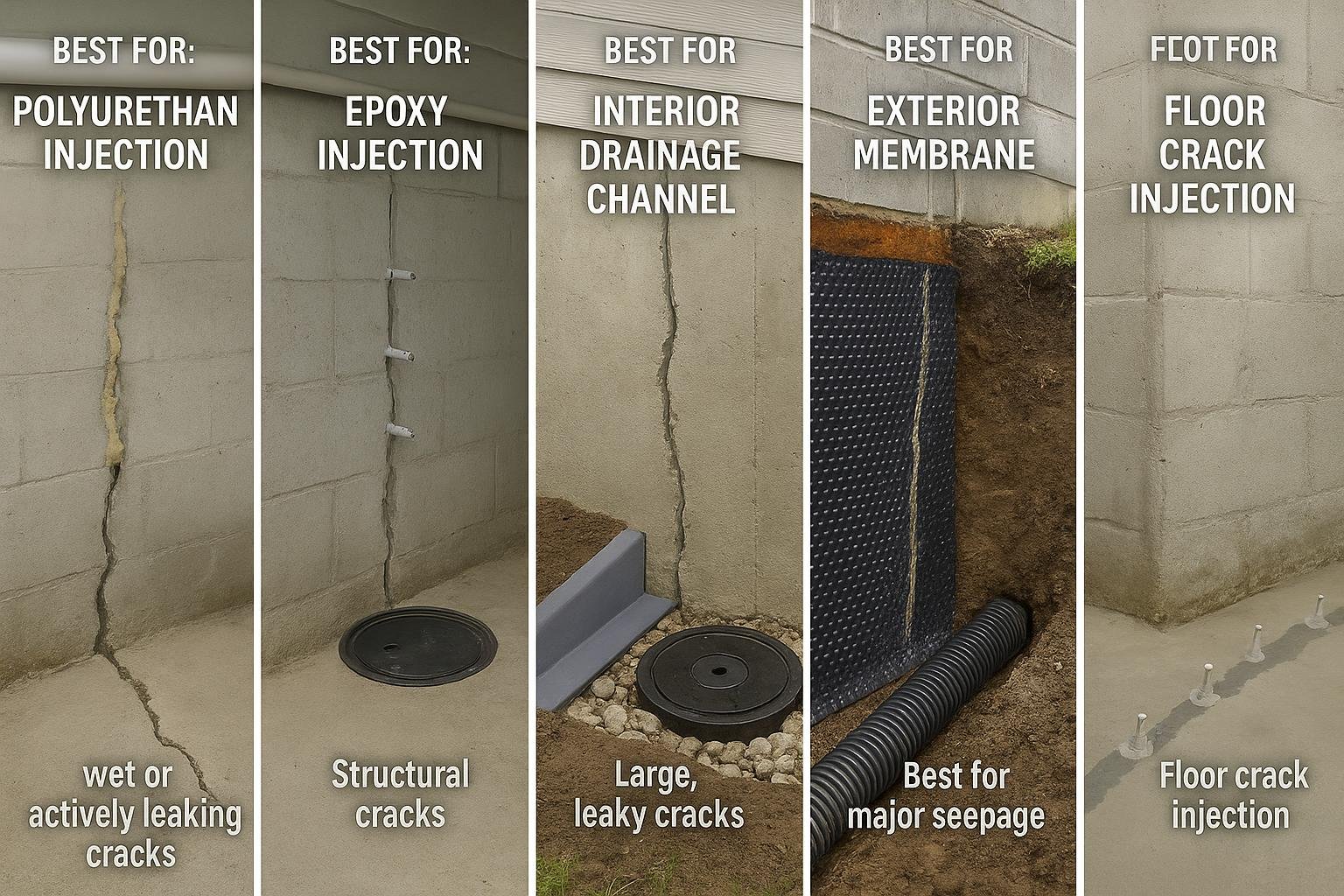
Best for: Active or previously wet hairline to moderate-width cracks in poured concrete walls; situations where excavation is not practical.
Limitations: Not suitable for cracks wider than approximately 12 mm without additional preparation; does not address the external source of water pressure; not appropriate for structural cracks or block foundations without additional assessment.
DryShield’s crack injection service uses polyurethane as the primary material for wet or damp cracks. The Lifetime Transferable Warranty applies to qualifying injection repairs.
Epoxy crack injection
Epoxy injection fills cracks with a rigid, high-strength adhesive that bonds the two faces of the crack together. It is used when structural restoration of the concrete section is the goal, such as restoring load transfer across a crack in a structural wall or slab.
Best for: Dry, stable cracks where restoring tensile strength across the crack plane is the primary objective.
Limitations: Epoxy is rigid and does not accommodate future movement; if the underlying cause of cracking is not resolved, a new crack may form adjacent to the repair. Not suitable for actively wet cracks, as moisture inhibits adhesion. See the epoxy crack injection service page for more detail.
Interior waterproofing membrane and drainage
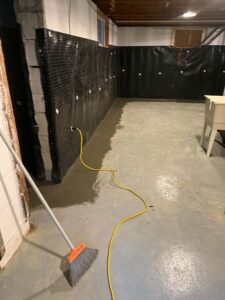
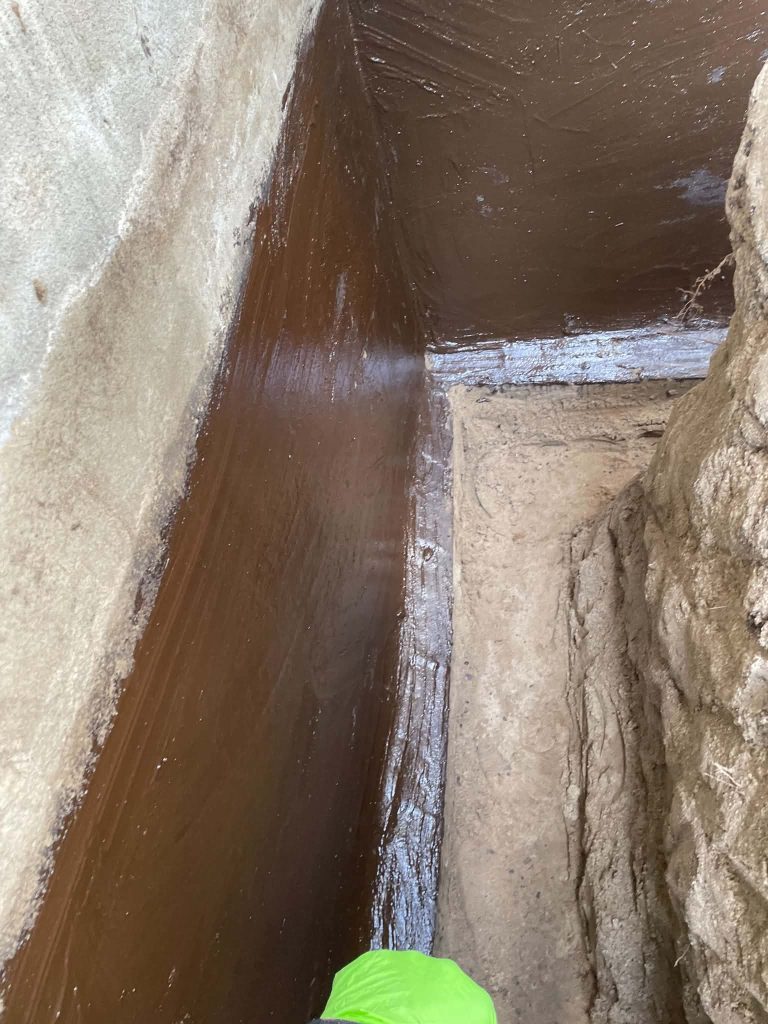
Where multiple cracks exist, where the wall face is deteriorated, or where water is entering at the wall-floor joint, an interior waterproofing system may be more appropriate than crack-by-crack injection. This typically involves installing a drainage channel at the perimeter of the basement floor, directing water to a sump pit, and applying a membrane or drainage board to the interior wall face.
Best for: Basements with multiple entry points, high water table conditions, or where injection alone has not resolved the problem.
Limitations: Manages water rather than stopping it at the source; requires a functioning sump pump; more disruptive to finished basement spaces than injection alone. See interior waterproofing for service details.
Exterior waterproofing and membrane application
Exterior waterproofing involves excavating the soil around the foundation to expose the wall, cleaning the surface, applying a waterproofing membrane, installing a drainage board, and replacing or upgrading the weeping tile before backfilling.
Best for: Situations where the exterior membrane has failed, where multiple cracks are present on a single wall, or where interior methods have been exhausted. Addresses the source of water pressure directly.
Limitations: Significant excavation cost and disruption; landscaping, driveways, or structures near the foundation may complicate access; not always practical for attached homes or tight lots. See exterior waterproofing services and the exterior vs interior perimeter waterproofing comparison guide.
Weeping tile repair or replacement
Weeping tile (perimeter drain tile) collects groundwater at the footing level and directs it away from the foundation. Failed, crushed, or root-infiltrated weeping tile is a common cause of persistent basement moisture in older Hamilton homes. Repair or replacement can be done from the interior or from the exterior during full excavation.
Best for: Homes with chronically wet basements where the drainage system is confirmed to be failed or absent.
Limitations: Interior weeping tile replacement is less disruptive but requires a sump pump; exterior replacement is more comprehensive but more costly. See weeping tile installation and replacement for service information.
Floor crack injection and slab sealing
Cracks in the basement floor slab allow water to enter under hydrostatic pressure from below. Floor cracks can be injected with polyurethane or sealed with a surface-applied product, depending on whether active water flow is present.
Best for: Isolated floor cracks with active seepage or dampness; situations where the slab is otherwise sound.
Limitations: If the water table is persistently high, floor crack sealing alone may not be sufficient without a drainage system to relieve pressure. See floor crack injections for more detail.
Options compared
| Method | Best for | Typical considerations | Durability / limitations |
|---|---|---|---|
| Polyurethane injection | Active or damp vertical / diagonal cracks in poured concrete | Interior access only; minimal disruption; no excavation | Flexible seal; Lifetime Transferable Warranty on qualifying work; not for structural cracks |
| Epoxy injection | Dry, stable cracks needing structural restoration | Interior access; crack must be dry; rigid bond | High strength; rigid; new crack may form if cause unresolved |
| Interior drainage system | Multiple entry points; high water table; wall-floor joint leaks | Requires sump pump; disrupts floor perimeter; manages water | Long-term management; does not stop water at source |
| Exterior waterproofing | Failed exterior membrane; multiple wall cracks; source-level fix | Excavation required; landscaping disruption; higher cost | Most comprehensive; addresses source; long membrane service life |
| Weeping tile repair / replacement | Failed or absent perimeter drainage | Interior or exterior approach; sump pump required for interior | Resolves drainage failure; cost varies by approach and linear footage |
| Floor crack injection | Isolated slab cracks with seepage | Interior; minimal disruption; may need drainage if pressure is high | Effective for isolated cracks; not a substitute for drainage if water table is high |
For most Hamilton homeowners with one or two active vertical cracks in a poured concrete wall, polyurethane injection is the logical starting point: it is the least disruptive, least costly, and carries a transferable warranty on qualifying repairs. Exterior waterproofing becomes the stronger choice when the exterior membrane has failed or when multiple cracks are present on the same wall. Interior drainage systems suit chronic high-water-table situations where stopping every entry point individually is not practical. Epoxy injection is a specialist tool for dry structural restoration, not a general waterproofing solution.
How to choose
Use the following framework to narrow down the right approach before requesting a professional assessment.
Choose polyurethane crack injection if: you have one or two identifiable vertical or diagonal cracks in a poured concrete wall; the crack is actively wet or shows staining and efflorescence; you want minimal disruption and a warranty-backed repair; excavation is not practical due to landscaping, a deck, or a driveway above the crack location.
Choose epoxy injection if: the crack is dry and stable; a structural engineer or inspector has confirmed the crack is non-structural but recommends restoring tensile continuity across the section; the wall is not experiencing ongoing movement.
Choose interior drainage if: water is entering at multiple points along the wall-floor joint or through several cracks; the water table in your area is persistently high; you have already had individual cracks injected and moisture continues to appear elsewhere.
Choose exterior waterproofing if: the home is older and the original exterior membrane is known or suspected to have failed; you are already excavating for another reason; multiple cracks are present on the same wall face; you want the most comprehensive long-term solution and budget allows.
Choose weeping tile repair or replacement if: a camera inspection or professional assessment has confirmed the perimeter drain is crushed, blocked, or absent; water consistently appears at the wall-floor joint across a wide section of the basement.
Choose floor crack injection if: seepage is isolated to one or two floor cracks; the water table is not persistently elevated; the slab is otherwise in good condition.
If you are uncertain which category your situation falls into, the foundation crack diagnosis tool and the basement leak diagnostic tool can help clarify the crack type before you book an assessment. The guide to identifying structural cracks is also a useful reference.
Costs & timelines
No verified Hamilton-specific price data has been supplied to this page. The following cost drivers are listed in approximate order of impact. For indicative Ontario price ranges, refer to the crack injection cost guide and the foundation crack sealing cost guide.
| Cost driver | Why it matters | Direction of impact |
|---|---|---|
| Repair method | Injection is the least costly; exterior excavation is the most costly | Injection lowest; exterior highest |
| Number and length of cracks | Each crack requires individual preparation and injection ports | More cracks = higher cost |
| Crack width and depth | Wider or deeper cracks require more material and preparation | Wider / deeper = higher cost |
| Access and obstructions | Finished walls, insulation, or stored items must be cleared; tight lots increase excavation cost | Poor access = higher cost |
| Drainage upgrades required | If weeping tile or a sump pump must be added alongside crack repair, total cost rises significantly | Drainage addition = significant increase |
| Foundation material | Block foundations may require different preparation than poured concrete | Block typically more complex |
Crack injection is typically a single-day job for one to three cracks. Interior drainage system installation usually takes one to two days depending on basement perimeter length. Exterior waterproofing timelines depend on excavation length and backfill conditions; a single-wall exterior job commonly takes two to three days, weather permitting. Timelines can extend in Hamilton’s winter months when frozen ground limits excavation.
 Risks & common mistakes
Treating the symptom, not the cause. Painting over a crack with hydraulic cement or a surface sealant may stop visible moisture temporarily but does not address the water pressure behind the wall. The underlying crack remains open and water will find another path or force the patch off.
Ignoring horizontal cracks. Horizontal cracks in poured concrete or block walls are a warning sign of lateral soil pressure. Attempting to inject or patch a horizontal crack without a structural assessment can mask a worsening condition. Always have horizontal cracks evaluated by a qualified professional before any repair work. The National Research Council of Canada’s construction technical advisory resources provide background on lateral earth pressure and foundation wall design.
Choosing the wrong injection material. Using epoxy in a wet or damp crack prevents proper adhesion and leads to repair failure. Polyurethane is the correct choice for active moisture; epoxy is for dry structural restoration. The epoxy vs polyurethane comparison explains the distinction in detail.
Delaying repair on an active crack. Hamilton’s freeze-thaw cycles mean a crack that is 1 mm wide in autumn can be significantly wider by spring. Water that enters freezes, expands, and mechanically widens the crack. Early repair is almost always less expensive than repair after several winters of cycling.
Not addressing grading and drainage first. If the soil around your foundation slopes toward the house, or if downspout extensions discharge water against the wall, no crack repair will perform optimally. Correcting surface drainage before or alongside crack repair improves long-term outcomes.
Assuming one injection fixes all moisture. A single injected crack does not waterproof the entire basement. If water is entering at the wall-floor joint, through the floor, or through other cracks, those entry points need separate assessment and repair.
Skipping the warranty review. Confirm what is and is not covered before work begins. DryShield’s Lifetime Transferable Warranty applies to qualifying crack injection repairs; understanding the terms protects you at resale.
How the process works
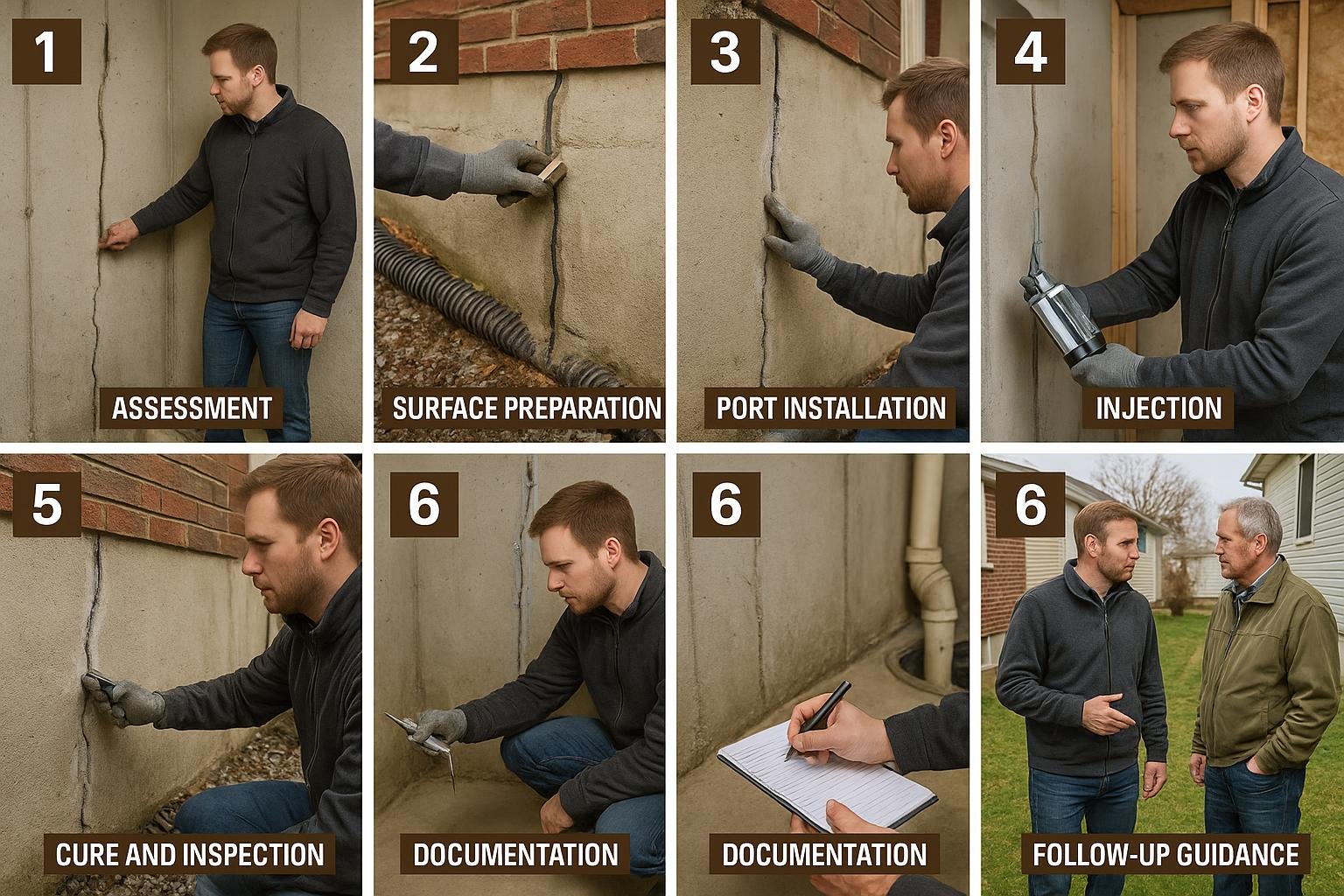
- Assessment and diagnosis. A technician inspects the crack, measures its width and length, checks for horizontal displacement or bowing, and identifies whether water is actively present. The foundation material and crack pattern are documented to confirm the appropriate repair method.
- Surface preparation. The crack face is cleaned of loose concrete, efflorescence, and any previous patch material. For injection work, ports are positioned along the crack at intervals determined by wall thickness and crack width.
- Injection. Polyurethane or epoxy is injected under controlled pressure, starting at the lowest port and working upward. The technician monitors for material emerging at adjacent ports to confirm full-depth penetration.
- Cure and inspection. The injected material is allowed to cure. The technician inspects the repair for complete fill and addresses any voids or missed sections.
- Surface finish and cleanup. Port caps and excess material are removed. For exterior work, drainage board and membrane are inspected before backfilling begins.
- Documentation and warranty issuance. The repair is documented and, where the work qualifies, warranty paperwork is issued. The transferable nature of the warranty is confirmed in writing.
- Follow-up guidance. The homeowner receives recommendations on grading, downspout management, and any additional drainage measures that would support the repair’s long-term performance.
Frequently asked questions
How do I know if a crack in my Hamilton basement wall is serious?
Width, orientation, and displacement are the key indicators. Vertical and diagonal cracks up to a few millimetres wide that are stable and show no horizontal displacement are typically non-structural and can be addressed with injection. Horizontal cracks, cracks with one side displaced inward or outward, or cracks that have grown noticeably wider over a short period warrant a structural assessment before any repair. The guide to identifying structural cracks provides a detailed visual reference.
Can polyurethane injection be done in winter in Hamilton?
Interior crack injection can generally be performed year-round because the work takes place inside a conditioned or semi-conditioned space. Exterior excavation work is more weather-dependent and may be limited during periods of deep frost or frozen ground. If you have an active leak in winter, interior injection is typically the most practical immediate option. See the winter waterproofing guide for broader context.
What does foundation crack repair typically cost in Hamilton?
No verified Hamilton-specific price data is available on this page. Cost is driven primarily by repair method, number and length of cracks, access conditions, and whether drainage upgrades are needed alongside the crack repair. The crack injection cost guide provides indicative Ontario price ranges. A site assessment is the most reliable way to obtain an accurate estimate for your specific situation.
Will my home insurance cover foundation crack repair in Hamilton?
Standard Ontario home insurance policies typically exclude gradual water damage and maintenance-related issues such as foundation cracking from soil pressure or normal settlement. Sudden and accidental water damage may be covered depending on your policy. The Ontario home insurance and foundation cracks guide explains what is typically covered and what is not; review your specific policy with your insurer before assuming coverage.
How long does a polyurethane crack injection repair last?
A properly executed polyurethane injection into a stable, non-structural crack creates a flexible, permanent seal. DryShield offers a Lifetime Transferable Warranty on qualifying crack injection repairs, meaning the warranty transfers to a new owner if the home is sold. The repair’s longevity depends on the crack remaining stable; if the underlying cause of movement continues, a new crack may form adjacent to the sealed one, which would be assessed separately.
Do I need a permit for foundation crack repair in Hamilton?
Interior crack injection typically does not require a building permit. Exterior excavation work, particularly if it involves altering drainage systems or is adjacent to a property line, may require a permit from the City of Hamilton. Confirm requirements with the City of Hamilton Building Division before exterior work begins. DryShield can advise on what is typically required based on the scope of work proposed.
What signs indicate my Hamilton basement needs professional attention soon?
Active water entry through a wall crack, white chalky deposits (efflorescence) on the wall face, a musty or damp odour, visible mold growth near the base of the wall, or a crack that has visibly widened are all signs that prompt professional assessment is warranted. Hamilton’s spring snowmelt and autumn rain seasons are the periods when existing cracks are most likely to become active. The leaky basement Hamilton guide covers warning signs in more detail.
Is the DryShield warranty transferable if I sell my Hamilton home?
Yes. The Lifetime Transferable Warranty on qualifying crack injection repairs transfers to subsequent owners of the property. This can be a meaningful point of disclosure during a real estate transaction, as it demonstrates that a known crack was professionally repaired and warranted. Confirm the specific terms and qualifying conditions with DryShield at the time of repair.
If you have noticed a crack in your Hamilton basement wall or floor, or if moisture is appearing without an obvious source, DryShield’s team is available to assess the situation and recommend the most appropriate repair approach. Visit the Hamilton service page to learn more or to request an assessment, or use the contact page to get in touch directly.