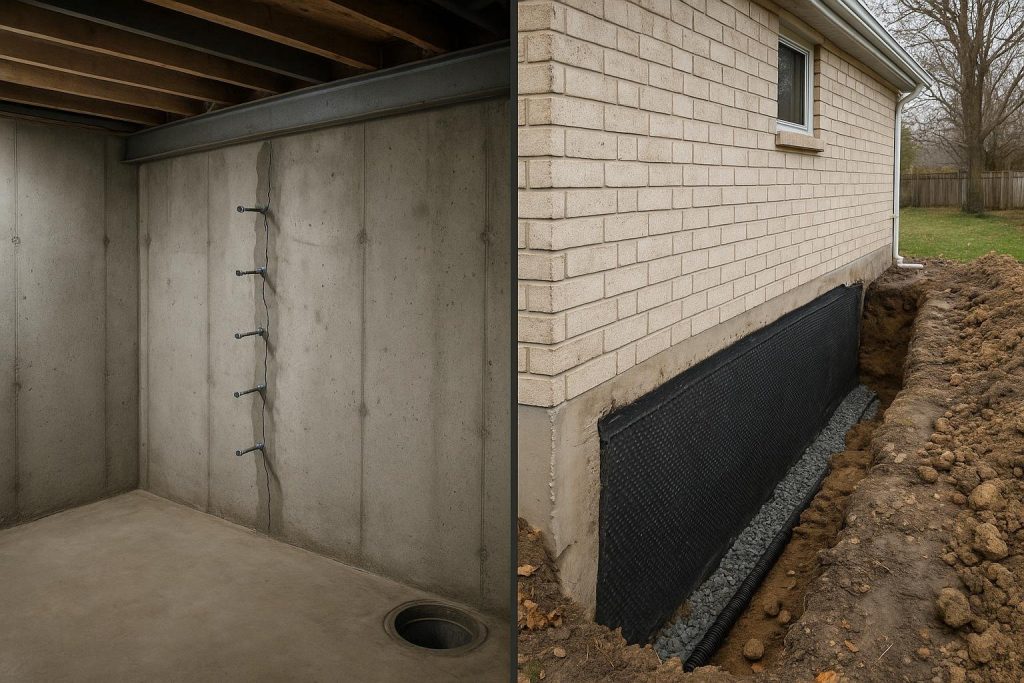
Interior crack injection vs exterior foundation crack repair: injection is the right starting point for most active poured-concrete wall cracks that are isolated, non-structural and accessible from inside, because it seals the crack from within with minimal disruption and cost. Exterior excavation is the better choice when the crack is wide, structural, accompanied by a failed waterproofing membrane, or when multiple failure points exist along the same wall. Both methods can stop water; the deciding factors are crack severity, site access, budget and long-term goals.
Key takeaways
- Interior polyurethane injection fills a crack through its full depth and cures flexible, making it well-suited to hairline-to-moderate non-structural cracks in poured concrete.
- Exterior repair addresses the crack at its source, replaces or supplements the original waterproofing membrane, and is the only option that physically restores the outside face of the wall.
- Exterior excavation costs significantly more and takes longer, but it is the only approach that lets a contractor inspect and repair the membrane, drainage layer and weeping tile in the same operation.
- Neither method is universally superior: crack type, wall construction, soil conditions and access all influence which is appropriate.
- A professional assessment is necessary before committing to either approach, particularly when horizontal cracking or wall deflection is present.
How we compared
This comparison draws on the technical characteristics of each method as described in manufacturer application guidelines and Ontario Building Code requirements for foundation drainage, alongside DryShield’s 25-plus years of field experience waterproofing homes across Toronto, the GTA and Ontario cottage country. We evaluated both options across seven dimensions: mechanism of action, suitable crack types, disruption to the property, typical cost drivers, durability, limitations and best-fit scenarios. No proprietary job-outcome dataset was used; where verified performance figures are unavailable, we describe the mechanism and note the limitation rather than substitute an invented number. The goal is an honest, balanced comparison that helps homeowners ask better questions before booking a contractor.
 Interior crack injection explained
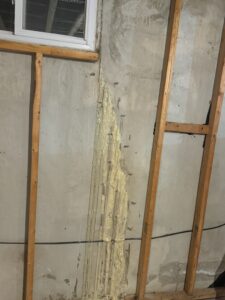
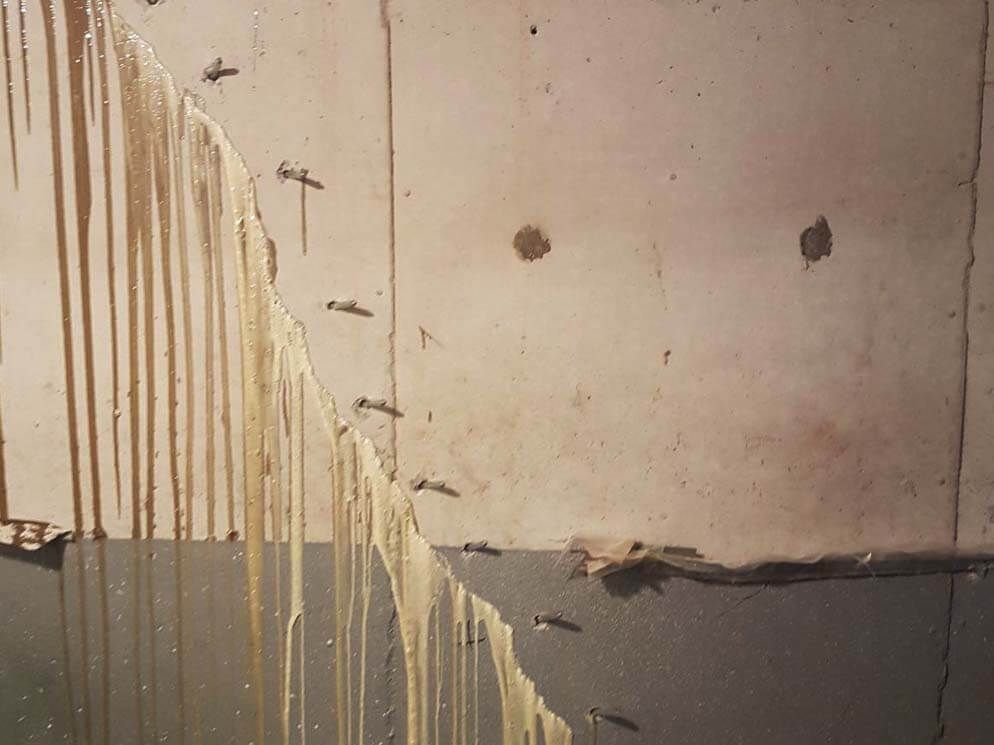
Interior crack injection seals a foundation wall crack by injecting a liquid resin through a series of ports drilled or surface-mounted along the crack from inside the basement. The most common resin used in residential work is polyurethane foam, which expands on contact with moisture, fills voids through the full thickness of the wall and cures to a flexible, waterproof seal. Epoxy injection is an alternative that cures rigid and is used when structural bond strength is the primary goal rather than flexibility.
The process is relatively quick. A technician cleans the crack, installs injection ports at intervals, injects resin under low pressure until it migrates through the wall, then caps the ports and smooths the surface. No excavation is required, landscaping is undisturbed and the work is typically completed in a few hours for a single crack.
Polyurethane injection is particularly effective on active leaks because the resin reacts with water already present in the crack, expanding to fill irregular voids that a rigid material would miss. For more detail on the resin chemistry and application process, see the Polyurethane Injection: Expert Crack Repair Guide and the Polyurethane Crack Injection service page.
The method has real limits. It does not replace a deteriorated exterior membrane, does not address drainage failures, and cannot be used on block or stone foundations where cracks are diffuse rather than discrete. If the crack is actively moving due to ongoing settlement or lateral soil pressure, the seal may re-open over time. Interior injection also leaves the exterior face of the wall unaddressed, which matters when the original dampproofing coat has failed along the same section of wall.
For a broader look at when injection is the right tool versus a full waterproofing system, see Foundation crack injection vs waterproofing: When injection works.
Exterior foundation crack repair explained
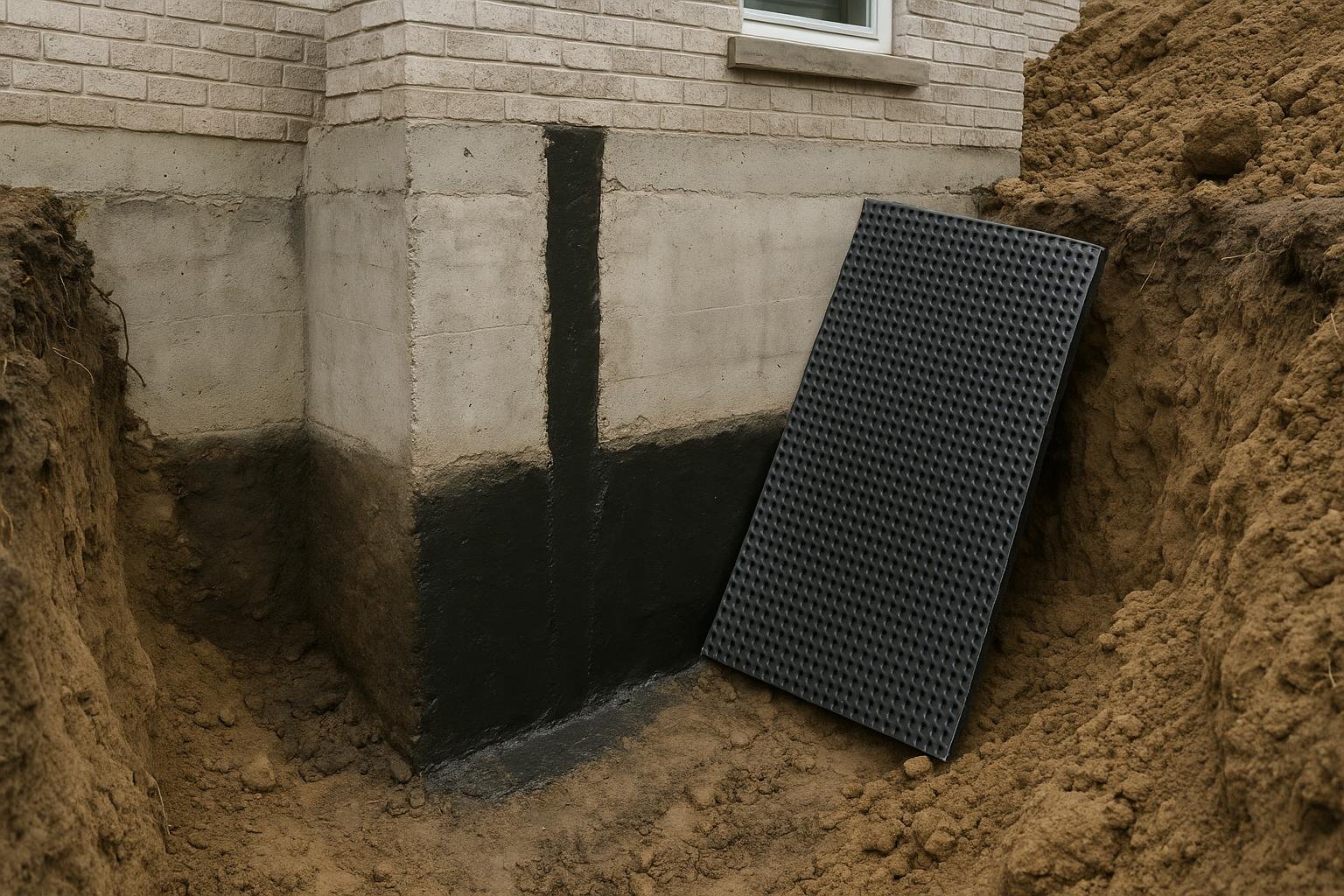
Exterior foundation crack repair requires excavating the soil beside the foundation wall down to the footing, exposing the full height of the crack on the outside face. The contractor cleans the crack, applies hydraulic cement or a compatible filler, then applies or replaces the waterproofing membrane over the repaired area. Drainage board, filter fabric and properly graded backfill are reinstated before the trench is closed.
Because the work happens at the source of water entry, exterior repair is considered the most comprehensive single-crack solution available. It also gives the contractor a direct view of the wall’s condition: membrane adhesion, previous repairs, efflorescence patterns and the state of the weeping tile at the footing can all be assessed and addressed in the same mobilization.
The trade-off is significant disruption. Excavating beside a foundation typically means removing landscaping, garden beds, decking, walkways or driveways depending on where the crack is located. Equipment access can be difficult in urban lots with tight side yards or rear additions. The work takes longer, requires backfill compaction and surface restoration, and the total cost is substantially higher than injection for a single crack.
Exterior repair is the preferred approach when the crack is wide, when there is evidence of wall movement, when the original membrane has visibly failed, or when the homeowner is already planning exterior work such as weeping tile replacement. The Exterior Basement Waterproofing Services page and the guide Waterproofing Outside: The Complete Guide to Exterior Foundation Protection cover the full exterior system in detail.
For homes with multiple cracks or a history of recurring leaks, exterior work combined with new weeping tile and a sump pump is often more cost-effective over a longer horizon than repeated interior repairs, even though the upfront cost is higher.
Side by side
| Feature | Interior Crack Injection | Exterior Foundation Crack Repair |
|---|---|---|
| Point of intervention | Inside face of wall; resin migrates through crack | Outside face of wall, at the source of water entry |
| Suitable wall types | Poured concrete (primary); not suitable for block or stone | Poured concrete, block, stone (with appropriate filler) |
| Crack width range | Hairline to moderate (typically up to a few mm) | Any width, including wide or displaced cracks |
| Structural cracks | Not appropriate without engineer sign-off; epoxy can restore bond | Can be combined with structural repair; engineer review still required |
| Membrane restoration | No | Yes, membrane replaced or supplemented |
| Weeping tile inspection | No | Yes, accessible during excavation |
| Landscaping disruption | None | Significant; depends on site conditions |
| Typical project duration | Hours (single crack) | One to several days depending on depth and access |
| Active leak suitability | Good; polyurethane reacts with moisture | Good, but water management during excavation required |
| Interior finishing removal | Minimal to none if crack is accessible | None on interior; exterior surface restoration needed |
The table shows that neither method dominates across all categories. Interior injection wins clearly on speed, cost and disruption for a single accessible crack. Exterior repair wins on comprehensiveness: it is the only method that restores the membrane, allows weeping tile inspection and addresses the crack on the side where water first contacts the wall. The right choice depends on which of these factors matters most for a given situation. A crack that has been injected successfully and holds for years is a better outcome than an excavation that was unnecessary; equally, an injection that fails on a crack that needed exterior membrane work is money spent twice.
Cost comparison
No verified current price quotes for Ontario are supplied to this page. The following table describes the cost drivers for each method so homeowners can understand why quotes vary. For current indicative ranges, see the Crack Injection Cost in Southern Ontario page and the Foundation Crack Sealing Cost in Ontario guide.
| Cost Driver | Interior Crack Injection | Exterior Foundation Crack Repair |
|---|---|---|
| Labour | Low; typically one technician, a few hours | High; excavation crew, equipment, backfill and compaction |
| Equipment | Injection pump and ports; no heavy machinery | Excavator or hand-dig depending on access; shoring if deep |
| Materials | Polyurethane or epoxy resin, ports, surface cap | Hydraulic cement, membrane, drainage board, filter fabric, backfill |
| Site restoration | Minimal; interior surface patch only | Landscaping, paving or deck reinstatement; variable cost |
| Crack length and depth | Moderate influence; longer cracks need more ports and resin | Strong influence; deeper foundations require more excavation |
| Access difficulty | Low influence if basement is accessible | High influence; tight side yards, decks or driveways add cost |
| Concurrent work | Can add epoxy or surface coating; modest incremental cost | Weeping tile, sump pump, full membrane replacement can be bundled; significant but efficient |
As a general principle, interior injection is the lower-cost option for a single non-structural crack in a poured concrete wall. Exterior repair costs more per crack but becomes relatively more efficient when multiple issues along the same wall can be addressed in one excavation. Homeowners planning to sell or finish the basement should also factor in the home value and ROI implications of each approach. Insurance coverage for either method depends on the cause of the leak; see the home insurance guide for Ontario-specific context.
Which is better for your situation
Choose interior crack injection if:
- The crack is in a poured concrete wall, is hairline to moderate in width, and shows no signs of lateral displacement or wall bowing.
- The leak is active and you need a fast, low-disruption repair without excavating landscaping, a driveway or a deck.
- A structural engineer or experienced contractor has confirmed the crack is non-structural.
- Budget is a primary constraint and the crack is isolated, with no evidence of membrane failure or drainage problems elsewhere on the wall.
- You are preparing to finish the basement and need the crack sealed before framing, but exterior access is not feasible at this stage. See the guide on basement crack repair before finishing for sequencing advice.
Choose exterior foundation crack repair if:
- The crack is wide, displaced, or accompanied by horizontal cracking or wall deflection that suggests structural movement. Review how to tell if a foundation crack is structural before deciding.
- The original exterior membrane has visibly failed, is absent (common on older homes with only dampproofing), or has been breached in multiple locations along the same wall.
- The weeping tile at the footing is suspected to be blocked, collapsed or absent, and you want to inspect and replace it in the same operation.
- Previous interior injection on the same crack has failed or the crack has re-opened, suggesting ongoing movement or exterior drainage pressure.
- You are already planning exterior work such as landscaping, a new driveway or an addition, making excavation cost-efficient to bundle.
When in doubt, a diagnostic assessment before committing to either method is the most cost-effective first step. Use the Basement Leak Diagnostic Tool or contact DryShield directly for an on-site evaluation.
The trade-offs nobody mentions
Interior injection trade-offs: The most significant limitation that is rarely stated upfront is that injection does not tell you what is happening on the outside of the wall. A crack that injects cleanly and holds for several years can mask a deteriorating membrane that is allowing water to migrate laterally to other entry points. If the original dampproofing was thin or applied poorly, injection on one crack may simply redirect water to the next weakest point. There is also a skill dependency: under-injection leaves voids; over-injection can cause resin to bypass the crack and emerge in unintended locations. The quality of the outcome depends heavily on the technician’s experience with pressure and resin viscosity.
Exterior repair trade-offs: Excavation is genuinely disruptive and the disruption is often underestimated at the quoting stage. Mature trees, root systems, gas lines, electrical conduit and irrigation systems can all complicate or increase the cost of a dig. Backfill settlement is a real phenomenon: even well-compacted backfill can settle over the first winter, creating a depression beside the foundation that directs surface water toward the wall rather than away from it. Homeowners should confirm that grading will be restored to a positive slope away from the foundation after backfill. Exterior repair also does not prevent future cracks from forming in other locations; it addresses the current failure point only.
Both methods share one honest limitation: neither is a substitute for addressing the root cause if that cause is hydrostatic pressure from a high water table, failed grading or a blocked weeping tile system. In those cases, crack repair of either type is a component of the solution, not the whole solution.
Frequently asked questions
Can interior crack injection permanently fix a leaking foundation crack?
Polyurethane injection can provide a long-lasting seal on a stable, non-structural crack in poured concrete. The seal is durable when the crack is not actively moving and when the resin fully penetrates the crack’s depth. If the crack is caused by ongoing settlement, lateral soil pressure or freeze-thaw cycling that continues to stress the wall, the seal may re-open over time. A warranty from a reputable contractor is a useful indicator of confidence in the repair, but it does not change the underlying physics: a moving crack is harder to seal permanently than a stable one.
Is exterior crack repair always better than injection?
No. Exterior repair is more comprehensive but also more expensive and disruptive. For a single, stable, non-structural crack in a poured concrete wall, interior injection is a well-established and effective repair that avoids excavation entirely. Exterior repair becomes the better choice when the crack is structural, when the membrane has failed, or when drainage issues need to be addressed at the same time. The balance here is genuine: injection wins on cost and disruption for the right crack type.
What type of crack cannot be injected from the interior?
Horizontal cracks in poured concrete or block walls are a red flag because they often indicate lateral soil pressure and potential structural movement. These require a structural engineer’s assessment before any repair method is chosen, and injection alone is not an appropriate response. Very wide or displaced cracks where the two faces of the wall have shifted relative to each other are also poor candidates for injection. Block, stone and rubble foundations do not have discrete cracks suitable for port injection; they typically require exterior membrane work or interior drainage systems instead. See Foundation Crack Diagnosis: Vertical vs. Horizontal for guidance on crack types.
How long does each repair method take?
Interior crack injection on a single crack is typically completed in a few hours by one technician. The resin cures quickly and the basement can usually be used normally the same day. Exterior foundation crack repair requires excavation, crack treatment, membrane application, drainage board installation, backfill and compaction, followed by surface restoration. Depending on depth, access and site conditions, this typically takes one to several days. Surface restoration such as replacing sod, paving or decking may add additional time.
Will my home insurance cover either repair?
Coverage depends on the cause of the leak and the specific policy. Sudden and accidental water damage may be covered; gradual seepage through a foundation crack is frequently excluded. Neither repair method is automatically covered or excluded; the cause of the damage is the determining factor. The Ontario home insurance guide for foundation cracks explains the key policy distinctions. Always review your policy and speak with your insurer before assuming coverage.
Can I inject a crack myself with a DIY kit?
DIY polyurethane injection kits are available at building supply retailers. They can be effective on very small, stable, hairline cracks when the instructions are followed carefully. The main risks are incomplete penetration (leaving voids that allow water to bypass the repair), incorrect port spacing, and using the wrong resin type for the crack condition. For any crack that is actively leaking, wider than a hairline, or located in a wall showing other signs of movement, professional assessment and injection is the more reliable approach. An incomplete DIY repair can also make subsequent professional injection more difficult.
What happens if a crack is injected but the exterior membrane has also failed?
The injection may seal the specific crack successfully, but water can continue to enter through the deteriorated membrane at adjacent locations. In this scenario, the homeowner may notice the original crack is dry but new damp patches appear nearby. This is one reason why a thorough inspection of the full wall condition, not just the visible crack, is important before choosing a repair method. If membrane failure is suspected, exterior repair or a full interior drainage system may be the more durable long-term solution.
Does DryShield offer a warranty on crack injection?
DryShield offers a lifetime transferable warranty on qualifying work. Details of what is covered and any conditions are set out on the Lifetime Transferable Warranty page. Warranty terms vary by repair type and site conditions; confirm the specific coverage that applies to your repair at the time of quoting.
If you are unsure which repair method is right for your foundation crack, DryShield’s team serves Toronto, the GTA and Ontario cottage country and can assess your situation on-site. Visit the Crack Injection service page to learn more, use the Basement Leak Diagnostic Tool to identify your problem, or contact us to arrange an assessment.