Sump Pump Installation in Hamilton: A Complete Homeowner's Guide
Sump pump installation in Hamilton usually pairs a pump with interior weeping tile so groundwater has somewhere to go during spring thaw and heavy rain. Lower-city clay and Mountain escarpment lots need different pit depth, pump capacity, and discharge routing. Book a free estimate with DryShield's Hamilton office at (289) 408-5057 to size the system for your home.
Book a free estimate or call (289) 408-5057.

Rated 4.9 Starson Google (300+ reviews)
25+ years of experience
Sump pump installation in Hamilton most often pairs with an interior weeping tile system to manage the hydrostatic pressure that builds against foundation walls during spring thaw and summer downpours. Without a working sump, collected groundwater has nowhere to go, and even a well-waterproofed basement can eventually show moisture. This guide covers system types, what drives the cost, and how installation typically unfolds from the first free estimate to the final concrete pour.
- Hamilton sits on a mix of clay-heavy soils and Niagara Escarpment bedrock, which create distinct drainage challenges and affect which sump system you need.
- A sump pump is the discharge point for an interior weeping tile system, not a standalone fix. The two components work together.
- Battery backup is often recommended in Hamilton, where summer thunderstorms can cause power outages at the same time water volume is highest.
- Final cost depends on pit depth, discharge distance, soil conditions, and whether new weeping tile is being installed at the same time.
- A free estimate is the reliable way to size the pump and confirm the correct pit location before any work begins.

What Our Customers Say
DryShield has a 4.9-star rating from 300+ Google reviews across the GTA and Ontario.


How the process works
- Free estimate and moisture assessment
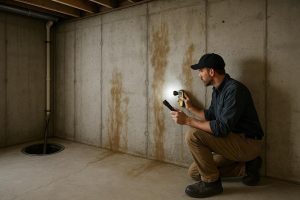
A technician visits the basement, identifies water entry points, checks the existing weeping tile condition using a probe or camera where accessible, confirms the lowest floor elevation, and assesses discharge routing options. Work is quoted after this visit. - Written scope
The visit produces a written scope covering pit location, pump specification, weeping tile linear footage if replacement is needed, discharge routing, and a backup recommendation. Pricing is confirmed before any work begins. - Perimeter work and pit excavation
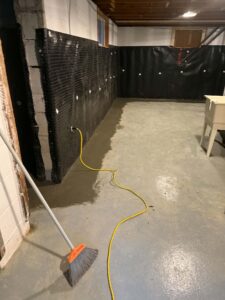
Where interior weeping tile is part of the scope, a channel is opened around the basement perimeter and the sump pit is excavated to the correct depth. Spoil is bagged and removed. - Weeping tile installation and pit liner placement
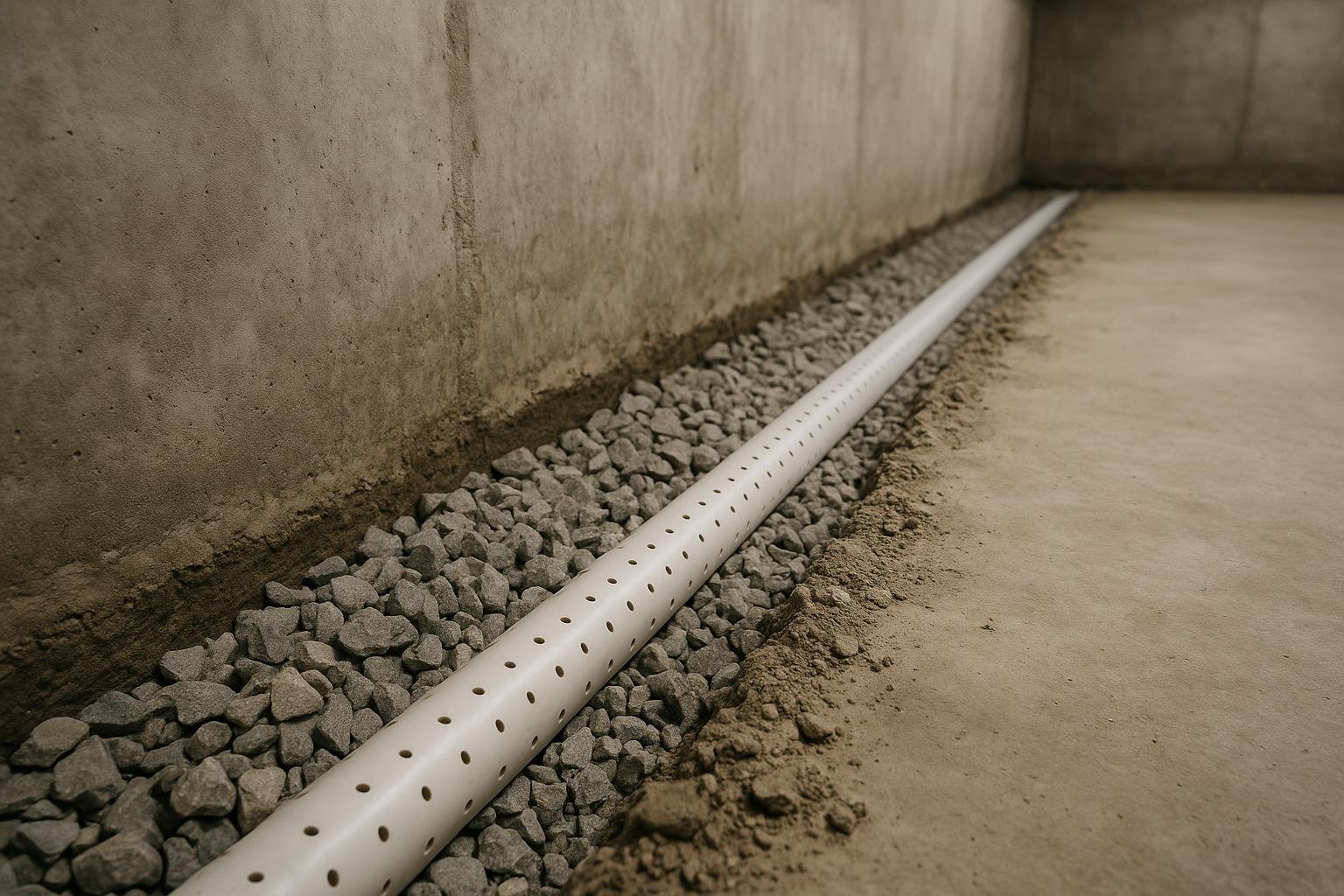
Perforated pipe is laid in a bed of clear stone along the perimeter channel, sloped to drain toward the pit. The sump basin liner is set and levelled. Joints are confirmed before stone cover is placed. - Pump installation, discharge routing, and check valve
The submersible pump is set in the basin, the discharge line is run through the foundation wall or up through the floor to the exterior outlet, and a check valve is fitted on the outlet side of the pump. If a battery backup is in the scope, it is wired and tested. - Concrete re-pour and floor restoration
The perimeter channel is filled with concrete to match the existing floor level. The pit is covered with a sealed lid. The basement is left clean and accessible. - Final test and homeowner walkthrough
The technician fills the pit with water to confirm the float triggers at the correct level, the pump evacuates the pit, the check valve holds, and the backup activates on a simulated power loss when one is installed. The homeowner is shown how to test the system and when to replace a battery.
Definitions and scope
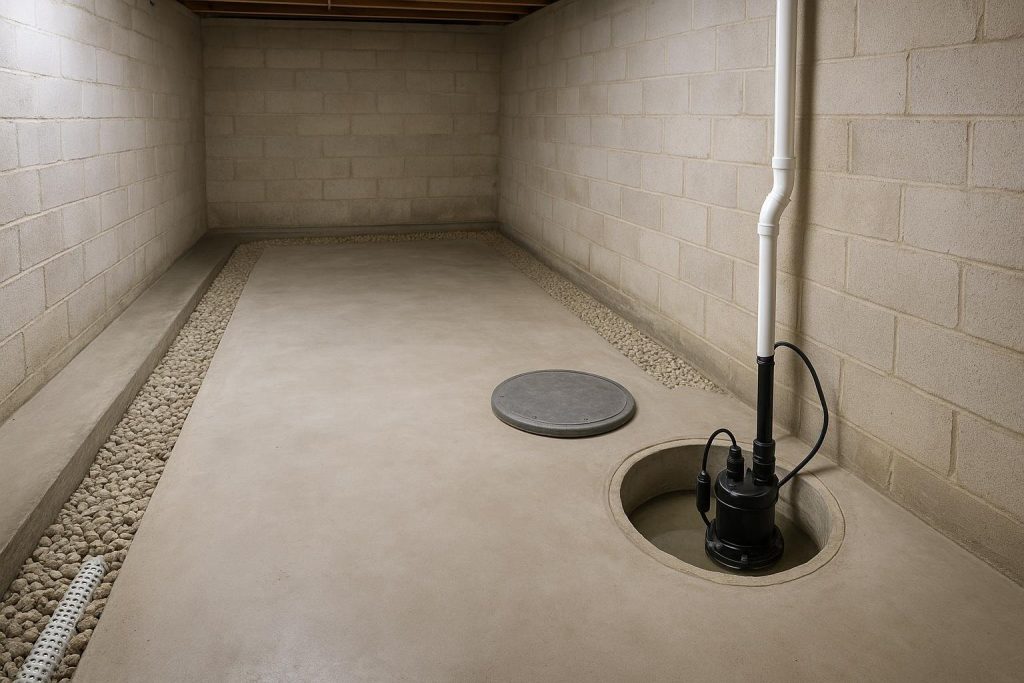
A sump pump is a submersible or pedestal pump installed in a pit excavated below the basement floor. Its job is to collect groundwater that drains toward the pit through a perimeter weeping tile system, then discharge that water away from the foundation through a rigid PVC pipe routed to daylight, a storm drain, or a dry well.
The sump pit itself is typically a cylindrical basin, often about 18 to 24 inches in diameter, set into the lowest point of the basement floor. A float switch triggers the pump when water reaches a set level. The pump runs, empties the pit, and shuts off automatically. In a properly designed system, the pump cycles only as often as the water table and rainfall demand.
Scope matters here. A sump pump alone does not waterproof a basement. It manages water that has already been intercepted by a drainage system. For Hamilton homes where water enters through wall cracks or through the floor-wall joint, the correct scope includes both the drainage layer and the pump. You can learn more about the full range of waterproofing approaches on the Hamilton basement waterproofing and foundation crack repair page.
Why this matters for Hamilton homes
Hamilton’s geography creates two distinct waterproofing environments. Homes in the lower city, particularly in older neighbourhoods near the harbour, sit on heavy clay soil that absorbs water slowly and holds it against foundation walls for weeks after a rain event. That sustained pressure, called hydrostatic pressure, is the primary cause of wet basements in these areas, not a single storm event.
Homes on the Mountain, by contrast, are closer to the Niagara Escarpment’s limestone bedrock. Drainage there can be faster, but surface water moves quickly and can pool at foundation walls where grading has settled. Both environments benefit from a properly sized sump system, but the pit depth, pump capacity, and discharge routing differ.
Spring thaw is the highest-risk window. When frozen ground thaws from the top down, meltwater cannot percolate and instead runs laterally toward the lowest point it can find, which is often the foundation wall. A sump pump that is undersized, has a failed float switch, or lacks a backup can be overwhelmed precisely when it is needed most. CMHC guidance on residential drainage and foundation moisture notes that proper sump and weeping tile systems are among the effective defences against basement flooding in Canadian clay-soil conditions.
Many Hamilton homes built before 1980 have original clay-tile or concrete-pipe weeping tile that has fully silted up. When that happens, the drainage system stops functioning and the sump pit stops receiving water, not because conditions are dry, but because the pathway to the pit is blocked. Replacing the weeping tile and installing a new sump together is often the correct fix in those cases, because the two components depend on each other.
Your options
Submersible sump pump with interior weeping tile
This is the most common system for Hamilton homes. The submersible pump sits inside the pit, fully below the water line, which keeps it quieter and cooler during operation. Interior weeping tile is installed by opening a channel around the basement perimeter, laying perforated pipe in clear stone, and directing all collected water to the sump basin. The floor is then re-poured with concrete. Best for homes where exterior excavation is impractical or where the weeping tile has failed. Limitation: it manages water after it enters the drainage plane rather than stopping it at the wall face.
Pedestal sump pump
The motor sits on a column above the pit, keeping it out of the water. Pedestal pumps are easier to service because the motor is accessible without removing the pump from the pit. They are louder than submersible units and are generally suited to pits with a smaller diameter. Best for retrofit situations where pit diameter is constrained. Limitation: the exposed motor can be a hazard in a finished basement, and the noise level is higher.
Battery backup sump system
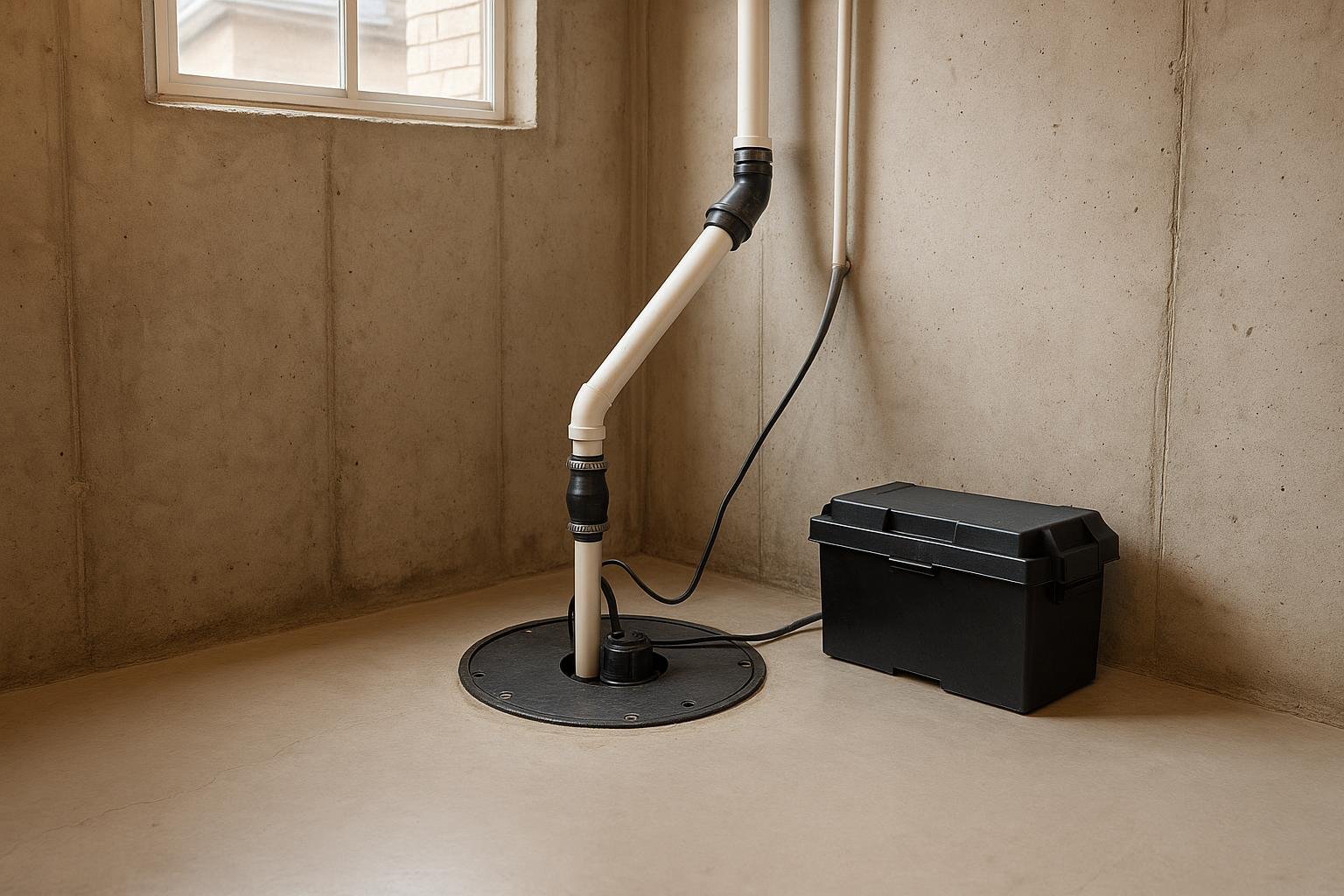
A battery backup unit is a secondary pump that activates when the primary pump fails or when a power outage occurs. It runs on a deep-cycle or maintenance-free battery. In Hamilton, where summer thunderstorms can knock out power for several hours, a backup system is often recommended for any home with a history of water entry. Limitation: the battery requires annual testing and typical replacement every few years.
Water-powered backup pump
This option uses municipal water pressure to drive a venturi pump that lifts water from the pit. No battery is required, so it never loses charge. Best for homes with reliable municipal water pressure and where battery maintenance is a concern. Limitation: it uses municipal water while it runs, and it is not permitted in every situation. Confirm with the City of Hamilton before choosing this option. This guide describes the option for comparison; DryShield has not listed water-powered backup installation as a confirmed service on this page.
Combination primary and backup unit
A single housing contains both the primary submersible pump and a battery backup unit, with a shared controller that monitors both. It is simpler to install than two separate units and takes up less pit space. Best for new installations where the pit is being excavated fresh. Limitation: if the controller fails, both pumps may be affected at the same time.
Exterior sump and French drain
On some Hamilton properties, particularly on the Mountain where grade allows, water can be intercepted at the exterior footing and directed to a daylight outlet or a buried collection pit without routing it through the basement. This approach pairs with an exterior waterproofing membrane and dimpled drainage board. Best for homes undergoing full exterior waterproofing. Limitation: excavation to the footing is required, which increases cost and disruption. See the sump pump installation services page for a broader overview of configurations.
Options compared
| System | Best for | Relative cost | Disruption |
|---|---|---|---|
| Submersible with interior weeping tile | Most Hamilton homes, failed original tile | Moderate to high | High (floor opened) |
| Pedestal pump only | Small pit, accessible service | Lower | Low (pit only) |
| Battery backup addition | Homes in storm-prone areas | Add-on | Minimal |
| Water-powered backup | Homes with strong municipal pressure | Moderate add-on | Minimal |
| Combination primary and backup unit | New pit installations | Moderate | Low to moderate |
| Exterior sump and French drain | Full exterior waterproofing projects | High | Very high (excavation) |
For many Hamilton homeowners dealing with a wet basement, the submersible pump paired with new interior weeping tile is a complete interior approach. An exterior French drain can be a strong option when it is already part of a full exterior waterproofing project, because it requires excavation to the footing and is often combined with membrane and drainage board work. A battery backup is a relatively small add-on that can prevent a flood the first time the power goes out during a storm.
How to choose
Start with an interior submersible system with new weeping tile if the basement shows water entry along the floor-wall joint, if the original weeping tile is clay or concrete pipe installed before 1980, or if exterior excavation is blocked by a deck, driveway, or neighbouring structure.
Choose an exterior sump and French drain if you are already planning full exterior waterproofing, if the grade on your property allows a gravity daylight outlet, or if your foundation wall has active cracks that need membrane coverage at the exterior face.
Choose a pedestal pump if you are replacing a failed pump in an existing pit and the pit diameter is too small for a submersible unit. This is a repair scenario, not a full system installation.
Plan for battery backup if your neighbourhood loses power during summer storms, if the basement contains finished living space or mechanical equipment, or if you travel and the home may be unoccupied during storm season.
A sump pump sized too small for the drainage area it serves will run continuously during peak events and can burn out early. Correct sizing requires knowing the linear footage of weeping tile draining to the pit and the expected inflow during a heavy rain. That is confirmed at the free estimate.
Costs and timelines
DryShield prices sump work from a free estimate at the home, not from a phone guess. The table below explains what usually drives the quote. For context on a complete interior waterproofing system, try the basement waterproofing cost calculator. Foundation crack injection, when it is also needed, is from $750 per crack.
| Cost driver | Why it affects price |
|---|---|
| Interior weeping tile (linear footage) | More perimeter means more floor opening, pipe, clear stone, and concrete re-pour |
| Pit excavation depth | Deeper pits in clay require more labour and spoil removal |
| Pump type and capacity | Higher-capacity submersible units and combination systems cost more than a basic pedestal pump |
| Battery backup addition | A separate unit, battery, and controller add labour and materials |
| Discharge routing distance | Longer PVC runs through walls or under slabs increase material and labour |
| Existing weeping tile condition | Full replacement versus a pump-only swap changes the scope significantly |
A pump-only replacement in an existing pit is the most limited scope. A full interior weeping tile system with a new sump basin, submersible pump, and battery backup is a larger project, and the final figure depends on the basement perimeter, soil conditions, and discharge routing confirmed on site. Timeline depends on that same scope and is confirmed in the written quote.
Risks and common mistakes
| Mistake | Likely consequence | Correct approach |
|---|---|---|
| Installing a pump without replacing silted weeping tile | Pit receives no water; basement stays wet | Inspect and replace tile before or during pump installation |
| Undersizing the pump for the drainage area | Continuous cycling and early motor failure | Size the pump to inflow calculated from linear footage and soil type |
| Discharging to the sanitary sewer | Possible bylaw violation | Confirm the outlet with the City of Hamilton; many municipalities require storm, daylight, or an approved dry well |
| No backup in a storm-prone area | Flooding during a power outage | Discuss battery backup (or another backup) during the free estimate |
| Pit located at the wrong low point | Water bypasses the pit and pools elsewhere | Confirm the lowest floor elevation before excavating |
| Skipping the check valve on the discharge line | Water can flow back into the pit when the pump stops, causing rapid cycling | Install a check valve on the pump outlet, typically close to the pump |
A common mistake in Hamilton is replacing a failed pump without investigating why the original system failed. If the weeping tile is silted, the new pump can sit in a dry pit while the basement stays wet. A proper diagnosis before any hardware purchase can save a second visit. The guide to testing sump pump sensors covers how to confirm the float and controller are functioning after installation.
Confirm discharge rules with the City of Hamilton before work begins. Many Ontario municipalities, including Hamilton, do not allow sump pump discharge to the sanitary sewer. Discharge is typically routed to the storm sewer, a daylight outlet at grade, or an approved infiltration area.
Get Your Free Sump Pump Estimate in Hamilton
Reviewed by Jason Carrillo, DryShield · 25+ years of experience · Call (289) 408-5057
Frequently asked questions
Does sump pump installation in Hamilton require a building permit?
Permit rules vary with the scope of work. Confirm with the City of Hamilton’s building department before work begins, particularly if the discharge line will connect to a municipal storm lateral.
How long does a sump pump last in a Hamilton home?
Service life varies with how often the pump cycles, water quality, and maintenance. A quality submersible pump in a well-designed system often lasts for several years; pumps that run almost constantly because they are undersized or sit in a high water table can wear out sooner. Test a battery backup at least once a year and plan to replace the battery on the manufacturer’s schedule, often every few years.
Can I install a sump pump without replacing the weeping tile?
Yes, if the existing weeping tile is functional and draining to the pit location. If the tile is silted or collapsed, installing a new pump without replacing the tile will not resolve a wet basement. A camera inspection or probe test of the existing tile during your free estimate confirms whether replacement is needed before any pump work begins.
What size sump pump do I need for a Hamilton basement?
Pump sizing depends on the drainage area, the soil’s water-holding capacity, and the vertical lift from the pit to the discharge outlet. Correct sizing is confirmed during a free estimate at the home, not guessed over the phone.
Where should the sump pit be located?
The pit should be at the lowest point of the basement floor, positioned so that all perimeter weeping tile drains toward it by gravity. In a Hamilton home with an uneven floor, this is confirmed with a level during the free estimate. Placing the pit at the wrong elevation means water can bypass it and pool elsewhere on the slab.
Is a battery backup sump pump worth considering in Hamilton?
Often yes. Hamilton summer thunderstorms can knock out power at the same time water inflow is highest. A battery backup unit activates automatically and can cover many outage windows, depending on battery size and how often the pump cycles. The cost of a backup unit is typically far lower than the cost of a flooded basement.
How do I know if my existing sump pump has failed?
Signs include water in the pit that is not being discharged, the pump running continuously without emptying the pit, unusual grinding or rattling during operation, or a float stuck in the up or down position. A simple test is to pour a bucket of water into the pit and confirm the pump activates and empties the pit.
Can a sump pump handle water coming through foundation wall cracks?
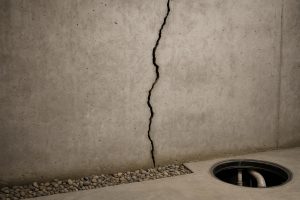
A sump and interior weeping tile system intercepts water at the floor-wall joint and below the slab, which relieves hydrostatic pressure and helps keep the floor dry. Active wall cracks that allow water to run down the wall face may also need polyurethane crack injection to seal the entry point directly. Foundation crack injection is from $750 per crack. The two repairs are complementary, not competing. See the basement crack repair page and foundation crack injection for methods.
Does DryShield service Hamilton and the surrounding area?
Yes. DryShield serves Hamilton, Burlington, Oakville, and the broader GTA, from the Hamilton office at 21 King Street West Unit 508. The team scopes each job based on the conditions found during a free estimate. Call (289) 408-5057.
What maintenance does a sump pump system require?
Test the float switch every few months by pouring water into the pit. Clean the inlet screen on the pump annually to remove sediment. Test the battery backup at least once a year by unplugging the primary pump and confirming the backup activates. Replace the battery on schedule. Inspect the discharge outlet at grade each spring to confirm it is clear of ice, debris, or soil settlement that could block flow. See the sump pump maintenance guide and the guide to testing sump pump sensors.
If you are ready to protect your Hamilton basement, DryShield offers a free estimate from the office at 21 King Street West Unit 508. The visit covers the full drainage picture and produces a written scope before any work begins. Call (289) 408-5057 or use the form on this page. You can also start on the Hamilton waterproofing page or the sump pump installation service page.
By Jason Carrillo, DryShield. Reviewed November 21, 2026. 25+ years of experience.