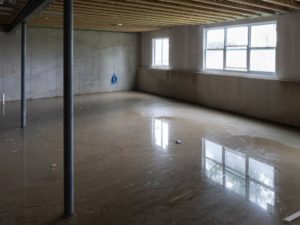
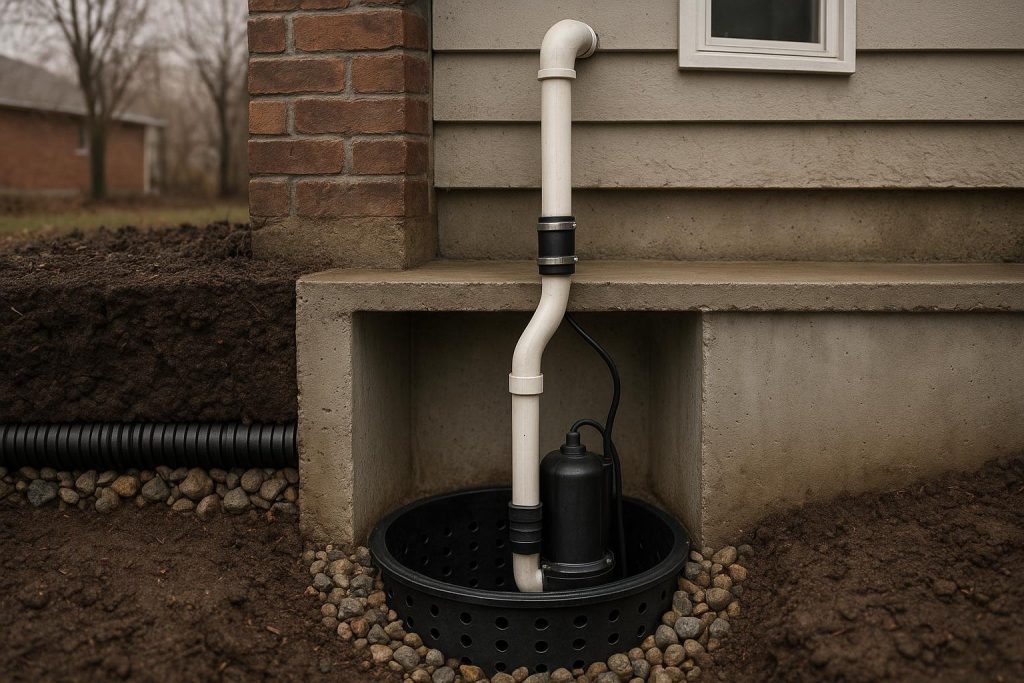
Putting in a sump pump is one of the most reliable ways to protect a basement from groundwater intrusion and flooding. A sump pump sits in a pit excavated at the lowest point of your basement floor, collects water that accumulates through the surrounding soil or drainage system, and discharges it safely away from the foundation. This guide covers every decision a homeowner needs to make, from choosing the right pump type to understanding what drives installation cost.
- A sump pump works as part of a drainage system, not as a standalone waterproofing solution; it must be paired with proper water management to be effective.
- Submersible pumps are the most common residential choice; pedestal pumps suit narrow pits but are noisier and less durable under heavy use.
- A battery backup or water-powered backup pump is essential for Ontario homes where power outages often coincide with the heaviest rain events.
- Pit size, discharge routing, electrical requirements, and whether a weeping tile system is already in place are the main cost drivers.
- Professional installation is strongly recommended because improper pit depth, discharge slope, or electrical work can render the system ineffective or create code violations.
Definitions & scope
A sump pump system has four core components: the sump pit (also called a sump basin or crock), the pump itself, a discharge pipe that carries water out of the home, and a check valve that prevents discharged water from flowing back into the pit. The pit is typically 45 to 60 cm in diameter and 60 to 90 cm deep, though dimensions vary by manufacturer specification and local soil conditions.
The term “putting in a sump pump” can refer to a simple pump swap in an existing pit, or to a full installation that includes excavating a new pit, connecting interior weeping tile, running a dedicated electrical circuit, and routing a discharge line to daylight or a storm drain. This guide addresses the full installation scenario because that is the situation most homeowners face when their basement has no existing system.
Sump pumps are rated by horsepower (commonly 1/3 HP or 1/2 HP for residential use) and by flow rate, expressed in litres per minute or gallons per hour at a given head height. Matching pump capacity to the expected inflow volume is a key engineering decision. The Ontario Building Code governs basement drainage and sump installations; consult the current edition or a licensed contractor for code-specific requirements in your municipality.
Why this matters
Ontario’s climate creates conditions that make basement water management a genuine structural concern, not merely a comfort issue. Spring snowmelt and heavy summer rainfall events can saturate soil rapidly, raising the water table against foundation walls and floors. Clay-rich soils common across the GTA, Simcoe County, and much of southern Ontario drain slowly, prolonging the period of hydrostatic pressure on foundations.
Without a functioning drainage outlet, water that enters through wall cracks, floor joints, or a failed weeping tile system has nowhere to go. Standing water accelerates concrete deterioration, promotes mold growth, and can undermine the structural integrity of footings over time. A properly installed sump pump provides a controlled exit point for that water before it causes damage.
Power outages are a compounding risk. Major storm events that produce the heaviest inflow are also the events most likely to knock out grid power. A pump that cannot run during the worst conditions offers limited protection. This is why backup systems are considered a standard part of a complete installation rather than an optional upgrade.
For homeowners in cottage country or those with seasonally unoccupied properties, the stakes are higher still. A pump failure during a spring thaw with no one present can result in significant water damage before it is discovered. Remote monitoring and battery backup systems address this specific risk. See our guide on sump pumps for seasonal and unoccupied cottages for details specific to that scenario.
Your options
Submersible sump pump
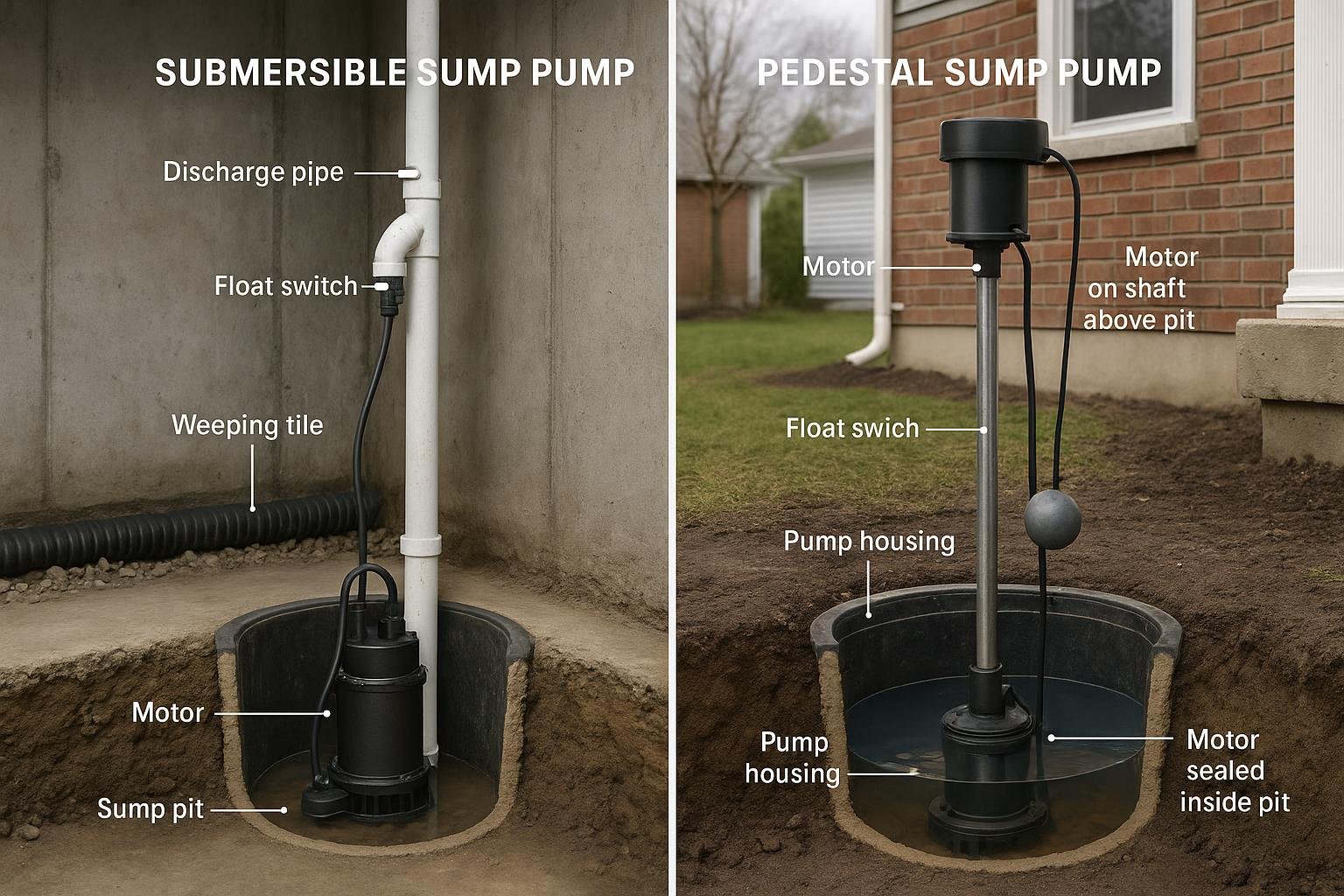
A submersible pump sits entirely inside the sump pit, submerged in water when operating. The motor is sealed in a waterproof housing. Most residential submersible pumps are activated by a float switch that rises with the water level and triggers the pump automatically.
How it works: Water enters the pit through perforations in the basin or through connected weeping tile. When the float reaches a set height, the pump activates, draws water through an intake screen, and forces it up the discharge pipe and out of the home.
Best for: Most residential basements with adequate pit diameter. Quieter than pedestal models because the water and pit walls muffle motor noise.
Limitations: Motor is harder to access for inspection or repair without removing the pump from the pit. Sealed motors can fail if the pump runs dry repeatedly.
Pedestal sump pump
A pedestal pump has its motor mounted on a vertical shaft above the pit, keeping the motor out of the water. Only the impeller and intake are submerged.
How it works: The float switch is attached to the shaft. When water rises, the float triggers the motor, which spins the impeller to draw water up through the shaft and into the discharge pipe.
Best for: Narrow pits where a submersible unit will not fit. The motor is accessible for inspection without removing the pump.
Limitations: Noisier during operation. The exposed motor is more vulnerable to humidity and debris. Generally considered less durable under high-volume or frequent-cycling conditions.
Battery backup sump pump
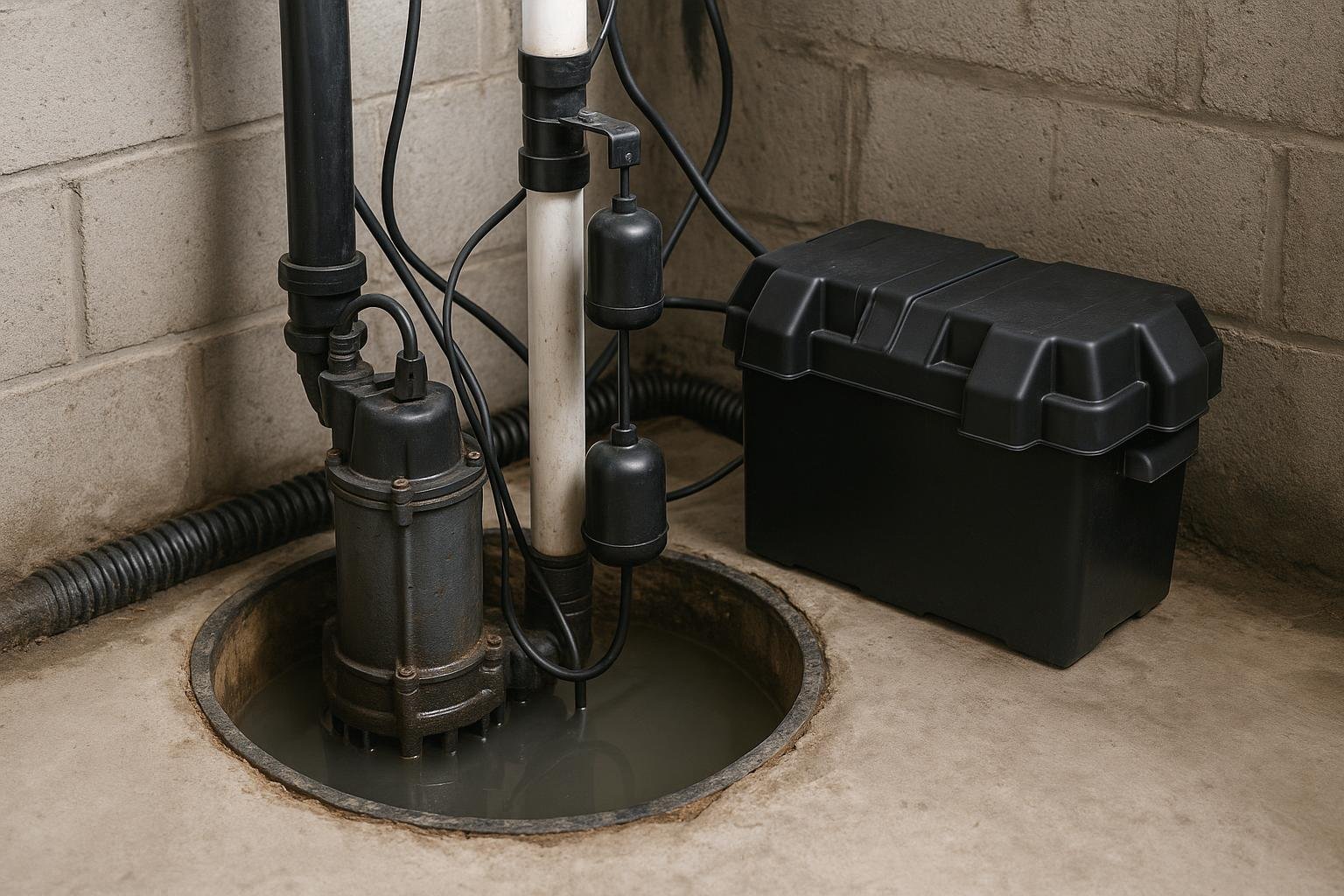
A battery backup system is a secondary pump, typically a smaller submersible unit, powered by a 12-volt deep-cycle battery. It activates automatically when the primary pump fails or when power is lost.
How it works: A separate float switch set slightly higher than the primary pump’s switch triggers the backup unit. A battery charger keeps the battery topped up during normal operation.
Best for: Any home where power outages are a realistic risk during storm events, which describes most of Ontario. Also provides redundancy if the primary pump fails mechanically.
Limitations: Battery capacity is finite; extended outages or very high inflow volumes can exhaust the battery. Batteries require periodic testing and replacement, typically every three to five years depending on the manufacturer’s specification.
Water-powered backup sump pump
A water-powered backup uses municipal water pressure to create suction through a venturi effect, drawing sump water up and out without any electrical power.
How it works: When activated, pressurized municipal water flows through a venturi nozzle, creating a vacuum that lifts sump water and carries it out through the discharge line. For every litre of municipal water used, approximately two litres of sump water are removed, though ratios vary by product.
Best for: Homes on municipal water supply where battery maintenance is a concern. Unlimited runtime as long as municipal pressure is maintained.
Limitations: Not suitable for homes on well water. Consumes municipal water during operation, which may be a concern during drought conditions or where water rates are high. Check with your municipality regarding any restrictions on this type of device.
Combination primary and backup system
Many manufacturers and contractors offer integrated units that house a primary submersible pump and a battery backup in a single basin, with a shared controller that monitors both systems and sends alerts.
How it works: The controller monitors float levels, battery charge, and pump operation. It can send alerts via Wi-Fi or cellular connection when the primary pump activates, when the backup activates, or when the battery charge drops below a threshold.
Best for: Homeowners who want a single installation with built-in redundancy and remote monitoring. Particularly valuable for cottage or investment properties.
Limitations: Higher upfront cost than a primary-only installation. The controller adds a component that can itself require maintenance or replacement.
Exterior sump (exterior drainage integration)
In some installations, particularly those involving full exterior waterproofing, a sump pit is connected to an exterior weeping tile system. Water collected around the footing drains to the pit and is pumped out.
How it works: Perforated pipe installed at footing level around the exterior of the foundation directs groundwater to a collection point, which drains to the interior sump pit or to a separate exterior sump.
Best for: Homes undergoing full exterior waterproofing where the excavation is already open. Provides the most comprehensive drainage solution.
Limitations: Requires significant excavation. Cost is substantially higher than interior-only installation. See our exterior vs interior perimeter waterproofing comparison for a full analysis.
Options compared
| Option | Best for | Typical considerations | Durability / limitations |
|---|---|---|---|
| Submersible pump | Most residential basements | Requires adequate pit diameter; dedicated circuit recommended | Generally 7-15 years depending on cycling frequency and water quality; motor sealed from humidity |
| Pedestal pump | Narrow pits; easy motor access | Noisier; motor exposed to basement air | Motor accessible but more vulnerable to humidity; less suited to high-volume use |
| Battery backup | Storm redundancy; power outage protection | Battery requires periodic replacement; finite runtime | Battery life typically 3-5 years; pump itself similar to primary submersible |
| Water-powered backup | Municipal water supply; unlimited runtime | Not for well water; consumes municipal water | No battery to replace; venturi nozzle may require periodic cleaning |
| Combination system | Single install with redundancy and monitoring | Higher upfront cost; controller adds complexity | Integrated monitoring extends system life through early fault detection |
| Exterior drainage integration | Full exterior waterproofing projects | Requires excavation; highest cost | Most comprehensive; addresses source rather than symptom |
The table above shows that no single option is universally superior. A submersible primary pump paired with a battery backup covers the needs of most Ontario homeowners at a reasonable cost and complexity level. Homes with a history of extended power outages or those that are seasonally unoccupied benefit most from adding remote monitoring. Exterior drainage integration is the right choice when the home is already undergoing excavation for waterproofing, because the marginal cost of adding the drainage connection at that point is lower than doing it as a standalone project later.
How to choose
Use the following decision framework to identify the right configuration for your situation.
Choose a submersible primary pump if your basement has an existing pit of adequate diameter, you have a standard residential water table that rises seasonally but does not produce extreme inflow volumes, and you are comfortable with annual maintenance checks.
Choose a pedestal pump if your existing pit is too narrow to accommodate a submersible unit and excavating a larger pit is not feasible. Also consider it if you want the motor to be easily accessible for inspection without removing the pump.
Add a battery backup if your area experiences power outages during storms, your basement has flooded before during an outage, or you simply want redundancy. This applies to the majority of Ontario homeowners and should be considered standard practice rather than a premium option.
Choose a water-powered backup instead of battery if you are on municipal water, you want unlimited backup runtime without battery maintenance, and your municipality permits this type of device. Confirm local regulations before specifying this option.
Choose a combination system with monitoring if the property is seasonally unoccupied, you manage a rental property, or you want real-time alerts without installing separate sensors. The additional upfront cost is offset by the early warning capability.
Choose exterior drainage integration if you are already planning exterior waterproofing, your interior drainage alone has proven insufficient, or a waterproofing professional has assessed that the primary water entry point is at the footing level rather than through wall cracks. Review our foundation waterproofing guide to understand when exterior work is warranted.
Do not rely on a sump pump alone if your basement walls have active cracks. A pump manages water that has already entered the drainage plane; it does not seal wall cracks. Crack injection or exterior waterproofing should address wall penetrations separately. See our crack injection vs waterproofing guide for guidance on that decision.
Costs & timelines
No verified price dataset has been supplied to this page. The following describes cost drivers in ranked order; actual quotes will vary by contractor, region, site conditions, and material costs at the time of your project. Use these drivers to evaluate and compare quotes, not as price guarantees.
| Cost driver | Why it matters | Relative impact |
|---|---|---|
| New pit excavation vs. existing pit | Cutting concrete, excavating soil, and disposing of material is the single largest labour component when no pit exists | High |
| Weeping tile connection | Connecting the pit to an interior or exterior weeping tile system requires additional trenching and pipe work | High |
| Discharge line routing | Longer runs, routing through finished walls, or connecting to a storm sewer add labour and materials | Medium |
| Electrical work | A dedicated GFCI-protected circuit is required by code in most jurisdictions; panel upgrades add cost | Medium |
| Pump capacity and brand | Higher-horsepower or premium-brand pumps cost more; combination systems with monitoring are priced higher than basic units | Medium |
| Backup system type | Battery backup adds cost for the secondary pump and battery; combination systems add controller cost | Low to medium |
| Concrete patching | After pit excavation, the surrounding floor must be patched and cured | Low |
Timeline for a straightforward installation in an unfinished basement with no existing pit is typically one to two days for the pit excavation, pump installation, discharge routing, and concrete patching. Installations that require weeping tile trenching along the perimeter take longer. Finished basements add time for careful material removal and restoration. Use our waterproofing cost calculator for a preliminary estimate based on your specific situation.
Risks & common mistakes
Undersized pump. Selecting a pump based on price rather than required flow rate is one of the most common errors. A pump that cannot keep up with peak inflow will allow the pit to overflow. A waterproofing professional can assess expected inflow based on soil type, drainage area, and historical water table behaviour.
No check valve. Without a check valve on the discharge line, water drains back into the pit when the pump stops, causing the pump to cycle repeatedly and wear out prematurely. A check valve is a low-cost component that should always be included.
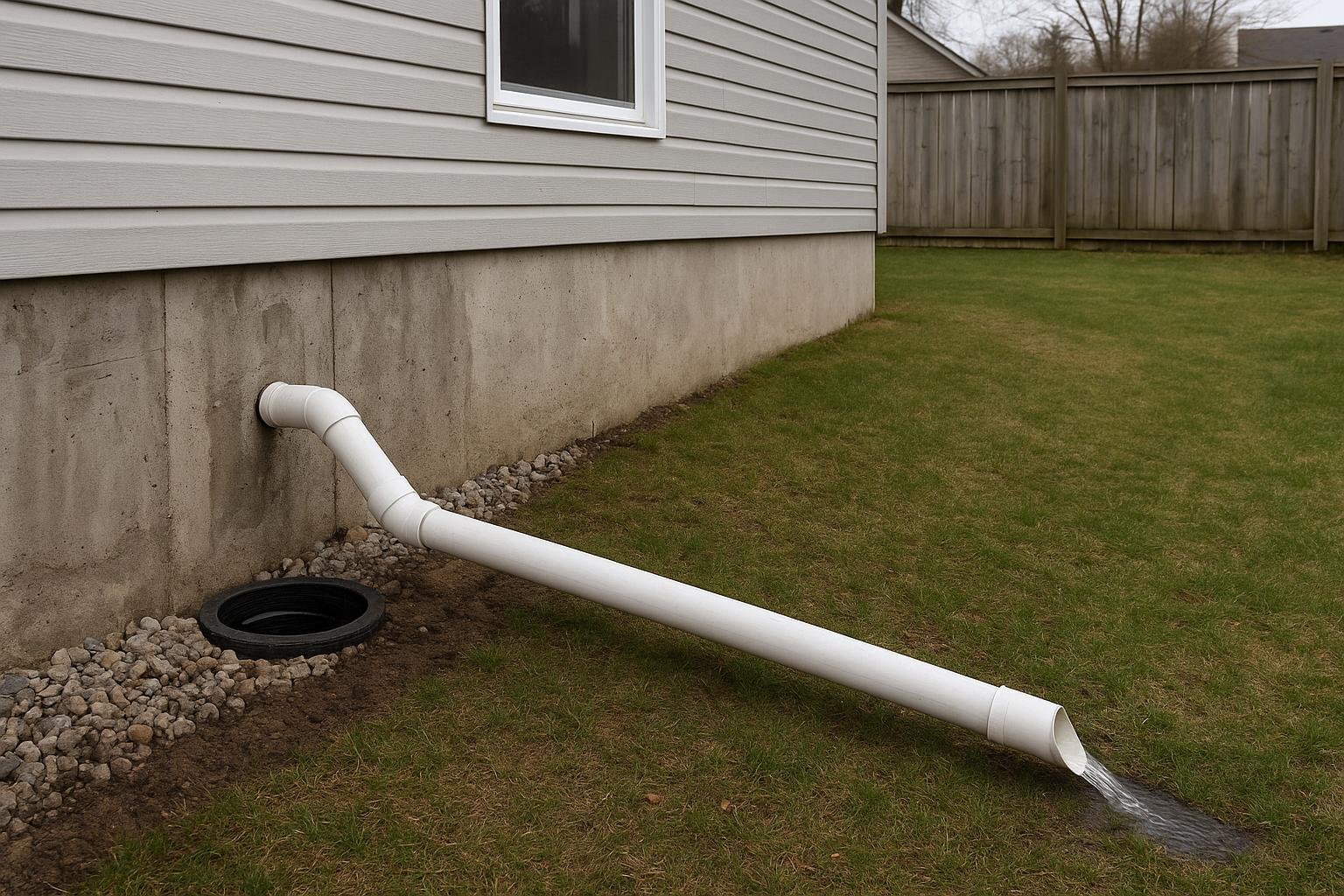
Improper discharge location. Discharging water too close to the foundation simply returns it to the soil around the house. The discharge outlet should terminate well away from the foundation and slope away from the building. Some municipalities require connection to a storm sewer rather than surface discharge; verify local requirements before routing the pipe.
No backup system. Installing only a primary pump without any backup leaves the home unprotected during the power outages that most commonly accompany heavy storm events. This is a significant and avoidable risk in Ontario.
Incorrect pit depth. A pit that is too shallow will not collect water from the weeping tile system effectively. A pit that is too deep in certain soil conditions can create structural concerns around the footing. Pit dimensions should follow manufacturer specifications and local code requirements.
Skipping the electrical permit. Sump pump installations typically require a dedicated electrical circuit. In most Ontario municipalities, this work requires an electrical permit and inspection. Unpermitted work can create issues with home insurance claims and property sales.
Treating the pump as the only solution. A sump pump manages water that reaches the drainage plane. If wall cracks are allowing water to enter above the footing, the pump will run constantly but the walls will still be wet. Address the entry points and the drainage together. Our wet basement master guide explains how to diagnose the actual source of water entry before specifying a solution.
How the process works
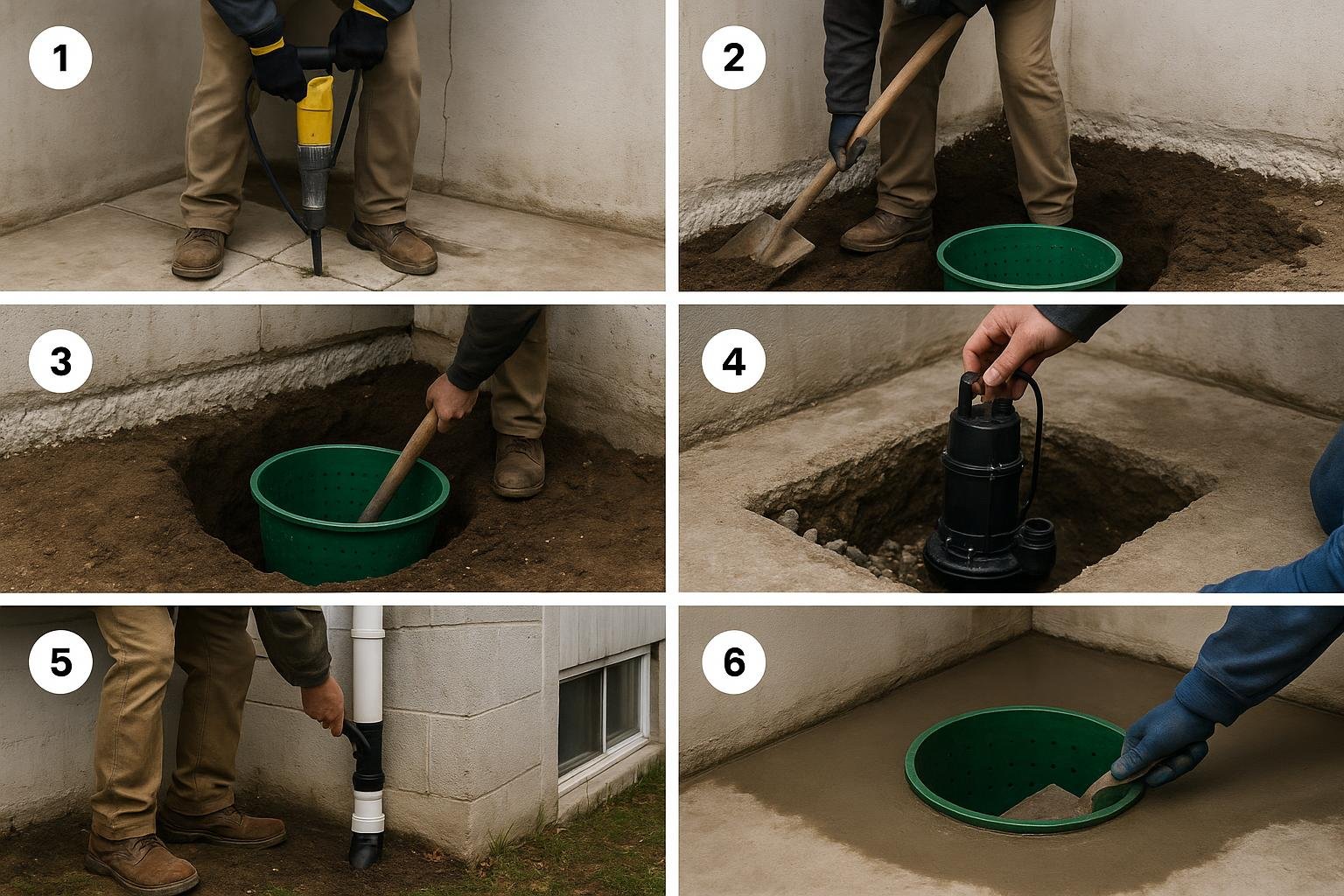
- Site assessment and planning. A waterproofing professional inspects the basement to identify the lowest point, assess existing drainage, locate the water entry source, and determine discharge routing options. Electrical panel capacity is also reviewed at this stage.
- Concrete cutting and pit excavation. The floor is saw-cut around the pit location. Soil is excavated to the required depth, typically below the footing level, and removed from the site. If weeping tile trenching is included, the trench is cut along the perimeter at this stage.
- Basin installation and drainage connection. The perforated sump basin is set in the excavation and levelled. Weeping tile or drainage pipe is connected to the basin. Gravel is placed around the basin to allow water to enter freely.
- Pump and discharge installation. The pump is placed in the basin and the discharge pipe is run to the exterior, including a check valve and any required fittings. The discharge outlet is positioned to direct water away from the foundation.
- Electrical connection. A licensed electrician connects the pump to a dedicated GFCI-protected circuit. If a battery backup or combination system is installed, the controller and charger are wired at this stage.
- Concrete patching and cleanup. The floor around the pit and along any trenches is patched with concrete and allowed to cure. The work area is cleaned and the system is tested by filling the pit with water to verify float activation, pump operation, check valve function, and backup activation.
- Homeowner walkthrough. The contractor explains the system operation, maintenance schedule, alarm indicators, and what to do if the backup activates. Documentation of the installation, including any permits, is provided.
Frequently asked questions
Do I need a permit to put in a sump pump in Ontario?
Requirements vary by municipality. The electrical work for a dedicated circuit typically requires an electrical permit and inspection in most Ontario jurisdictions. The plumbing or drainage work may also require a permit depending on whether the discharge connects to a storm sewer. Contact your local building department before starting work. A licensed contractor familiar with your municipality can confirm what permits apply to your specific installation.
Can I install a sump pump myself?
A homeowner with construction experience can physically install the basin and pump, but the electrical connection to a dedicated circuit must be done by a licensed electrician in Ontario. Concrete cutting and pit excavation also require appropriate tools and knowledge of footing clearances. Errors in pit depth, discharge slope, or electrical wiring can render the system ineffective or create code violations. Professional installation is strongly recommended for a full new installation.
Where should the sump pump discharge to?
The discharge pipe should terminate at least 1.5 to 3 metres from the foundation, directed away from the building and toward a natural drainage slope. Some municipalities require connection to a storm sewer rather than surface discharge. Discharging to a sanitary sewer is prohibited in most Ontario municipalities. Verify your local requirements before routing the discharge line, as non-compliant discharge can result in fines or required remediation.
How often does a sump pump need to be replaced?
Submersible pumps in residential use typically last between 7 and 15 years, depending on cycling frequency, water quality, and whether the pump has run dry. Pumps in high-water-table areas that cycle frequently will wear out faster than those that activate only during heavy rain events. Annual testing and inspection can identify wear before failure occurs. Battery backup batteries generally require replacement every 3 to 5 years per manufacturer guidance.
What size sump pump do I need?
Pump sizing depends on the expected inflow volume, which is influenced by the drainage area, soil permeability, and local water table. A 1/3 HP submersible pump is adequate for many residential applications with moderate inflow. Homes with high water tables, large drainage areas, or a history of significant inflow may require a 1/2 HP or larger unit. A waterproofing professional can assess your site conditions and recommend an appropriate capacity rather than relying on a generic rule of thumb.
Will a sump pump stop my basement from leaking through wall cracks?
No. A sump pump collects and removes water that reaches the drainage plane at or below the floor level. It does not seal wall cracks or prevent water from entering through them. If water is entering through cracks in poured concrete or block walls, those cracks should be addressed with polyurethane injection or exterior waterproofing. A sump pump is most effective when combined with a complete drainage and waterproofing system. See our sump pump installation services page for how DryShield integrates pump installation with broader waterproofing work.
Do I need a battery backup sump pump?
For most Ontario homeowners, yes. The storm events that produce the highest inflow volumes are also the events most likely to cause power outages. A primary pump that cannot run during a power failure provides no protection at the moment it is most needed. A battery backup or water-powered backup is a standard component of a complete system, not a luxury upgrade. Homeowners with seasonally unoccupied properties should also consider remote monitoring to receive alerts if the backup activates.
How deep should a sump pit be?
Residential sump pits are typically 60 to 90 cm deep, with the bottom of the pit positioned below the level of the weeping tile or drainage pipe that feeds it. The pit must be deep enough to allow the float switch to activate before water reaches the floor level, and to provide sufficient volume to prevent the pump from short-cycling. Manufacturer specifications for the basin and pump should be followed, and local code requirements may specify minimum dimensions. A contractor can determine the appropriate depth based on your footing depth and drainage configuration.
Can a sump pump freeze in winter?
The pump itself, located inside the basement, will not freeze under normal conditions. The discharge pipe, however, can freeze where it exits the foundation and runs along the exterior, particularly in sections that hold standing water after the pump stops. A freeze in the discharge line can block the outlet and cause the pit to overflow. Sloping the discharge line so it drains completely after each pump cycle, and insulating exposed exterior sections, reduces this risk. In cottage country, winterizing procedures for unoccupied properties should include addressing the discharge line. Our seasonal cottage foundation protection guide covers winterization in more detail.
Is a sump pump covered by home insurance in Ontario?
Standard home insurance policies in Ontario typically do not cover sump pump failure or the resulting water damage under the base policy. Sewer backup and overland water endorsements are available from most insurers and may cover damage caused by pump failure, depending on the policy wording. Confirm the specific terms of your policy with your insurer. Some municipalities offer subsidy programs for sump pump installation as part of basement flooding protection initiatives; the City of Toronto has operated such a program, though subsidy availability and terms change over time and should be verified directly with the municipality. See our Toronto basement flooding subsidy page for current information on that program.
If you are weighing your options for putting in a sump pump or need a professional assessment of your basement drainage situation, the DryShield team serves Toronto, the GTA, and Ontario cottage country. Contact DryShield to arrange an inspection, or use the cost calculator for a preliminary estimate before you call.