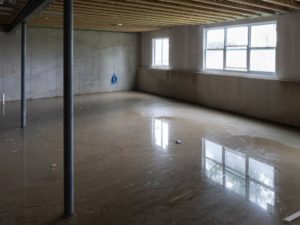
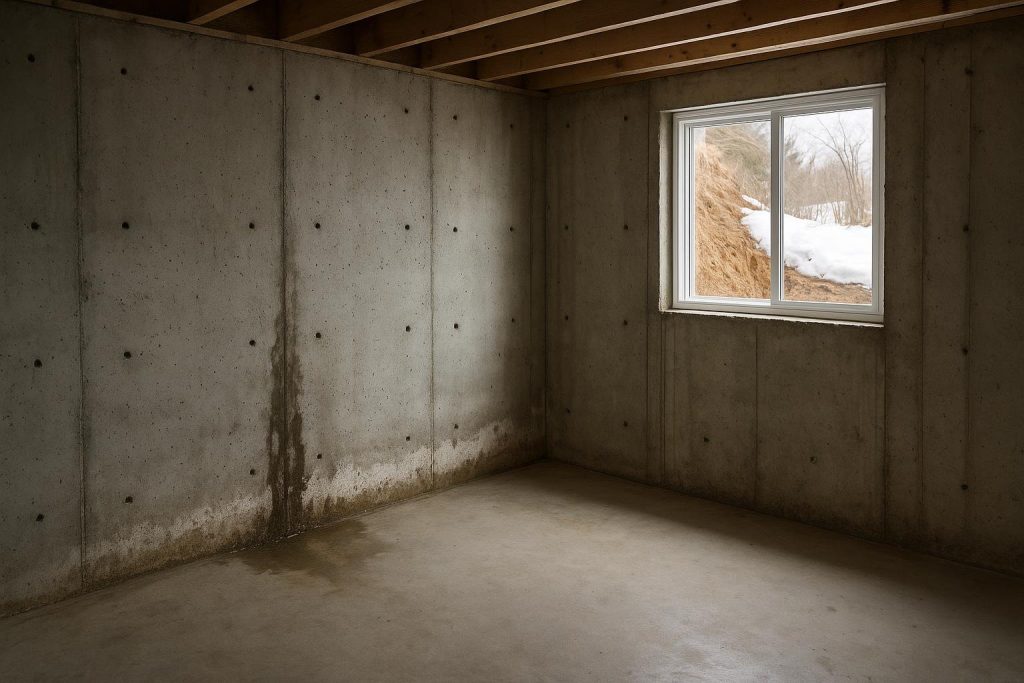
A leaky basement Oro-Medonte homeowners discover is rarely a simple plumbing problem. The township sits on a mix of sandy glacial soils, exposed Canadian Shield bedrock, and pockets of heavier clay, and each soil type creates a different water pathway into your foundation. Understanding which pathway is active in your home is the first step toward a fix that actually lasts.
Key Takeaways
- Oro-Medonte’s varied soils, from sandy lake-plain deposits near Lake Simcoe to Shield bedrock on the ridge, mean the right repair depends on your specific lot, not a one-size-fits-all solution.
- Spring snowmelt is the single highest-risk window: the township receives heavy snowpack and the ground thaws unevenly, sending large volumes of water against foundation walls in a short period.
- A single injected crack typically costs $600 to $900; a full interior weeping-tile system runs less than a full exterior excavation, which averages $6,000 to $9,000 for a typical home.
- Older homes in communities like Hawkestone, Moonstone, and Warminster often have original clay-tile weeping tile that has fully silted up and no longer drains.
- Every repair should start with a free on-site inspection to confirm the water source before any work begins.
Definitions and Scope
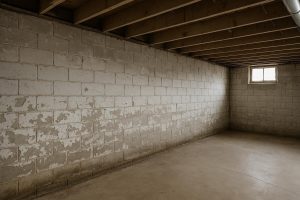
A wet or leaking basement is any condition where liquid water, water vapour, or both enter the below-grade living space. In Oro-Medonte the problem takes three common forms: active seepage through a foundation wall crack, water wicking up through the floor slab, and bulk water entering at the cove joint where the wall meets the footing.
The root cause in almost every case is hydrostatic pressure. When saturated soil presses against a concrete or block wall, water finds the path of least resistance, which is usually a shrinkage crack, a cold joint, or a deteriorated parging coat. Oro-Medonte’s freeze-thaw cycle, which can run 60 to 80 cycles per winter on the ridge, widens those openings every season.
This guide covers the full range of repair options available to Oro-Medonte homeowners, from low-cost crack injection to full exterior waterproofing, with honest cost ranges drawn from DryShield’s own completed work in Simcoe County and the surrounding region.
Why This Matters for Oro-Medonte Homes
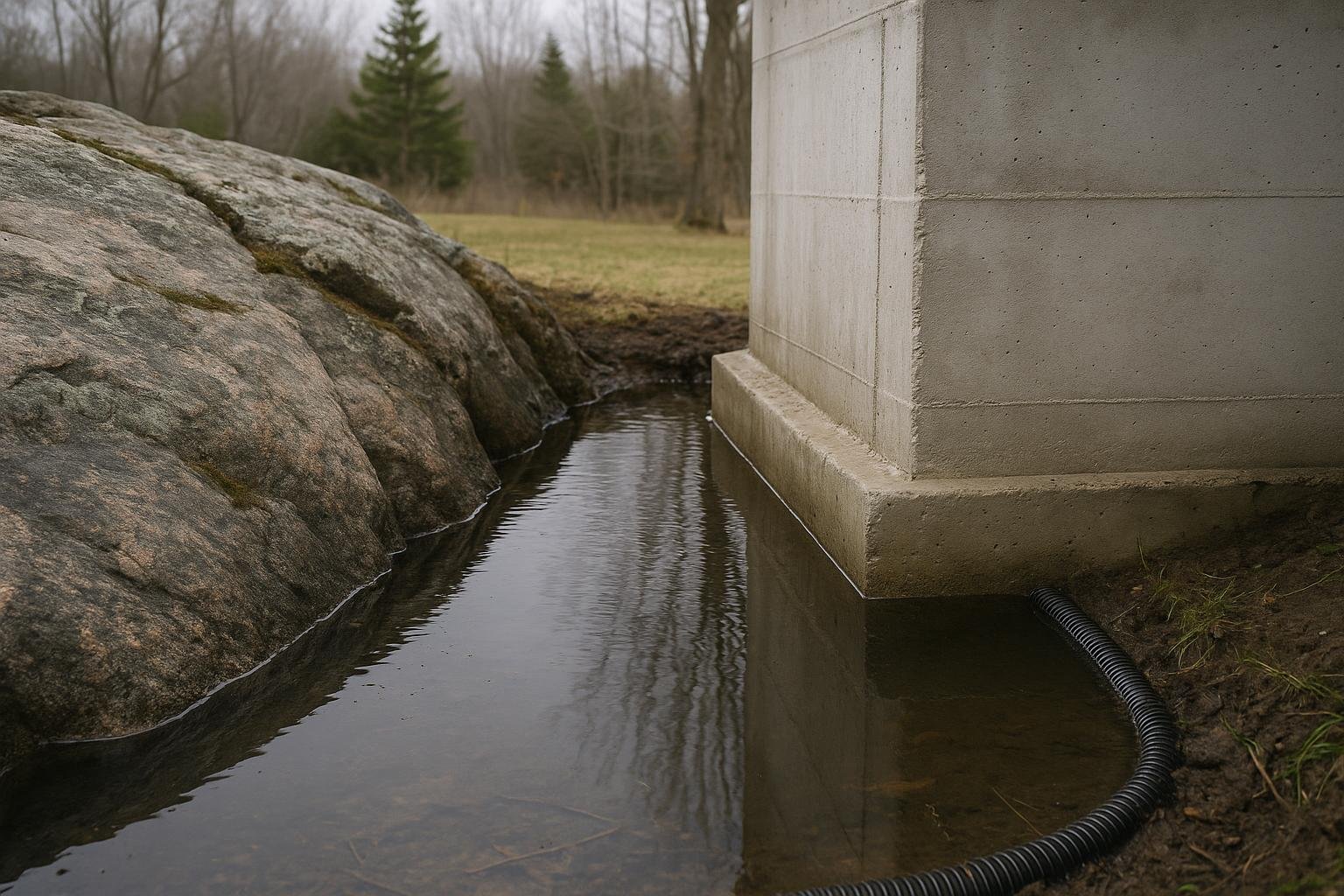
Oro-Medonte is not a uniform landscape. The southern portion of the township, near the Lake Simcoe shoreline and communities like Hawkestone, sits on sandy, well-drained soils where surface water moves quickly but can still pond against a foundation if grading is poor. The central ridge, including areas around Moonstone and Horseshoe Valley, sits on or very close to Canadian Shield granite, which means water cannot percolate downward and instead runs laterally along the rock surface directly toward any foundation in its path.
That lateral flow is the most misunderstood water source in cottage-country and rural Simcoe County repairs. A leaky basement Oro-Medonte homeowners attribute to a single crack is often driven by lateral groundwater pressure that the crack merely reveals. Sealing the crack without managing the water table around the footing produces a temporary fix at best.
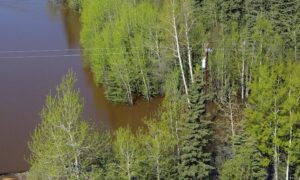
Spring thaw is the peak failure window. Oro-Medonte sits in a snowbelt corridor that regularly accumulates 200 centimetres or more of snow over winter. When temperatures rise in March and April, that snowpack melts faster than frozen ground can absorb it. The result is a sudden, sustained surge of water against every foundation wall in the township. CMHC’s guidance on residential moisture control, available at cmhc-schl.gc.ca, confirms that uncontrolled groundwater is the leading cause of basement moisture problems in Canadian homes.
Homes that were built as seasonal cottages and later converted to year-round use carry additional risk. Original foundations were often shallow, lightly waterproofed, and designed for a structure that sat empty through the wettest months. Year-round occupancy changes the thermal envelope and can accelerate freeze-thaw cracking at the footing level. For a broader look at how these issues play out across the county, the Simcoe County basement waterproofing guide covers the regional picture in detail.
Your Options for Fixing a Leaky Basement in Oro-Medonte
Polyurethane Crack Injection
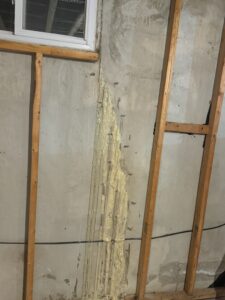
Polyurethane injection is the correct first response to a single, non-structural vertical or diagonal crack in a poured concrete wall. A technician drills ports along the crack at 20 to 30 centimetre intervals, pastes surface ports in place, and injects low-pressure expanding polyurethane foam that fills the crack from the footing to the surface. The cured foam remains flexible, so it tolerates the seasonal movement that is common in Oro-Medonte’s freeze-thaw environment without re-cracking.
Epoxy injection is reserved for structural cracks where the wall must be re-bonded and rigidity is required. Polyurethane is the right choice for the vast majority of residential water-entry cracks. This method works best when the crack is the only entry point and the surrounding drainage is adequate. It is not appropriate for block foundations, cove-joint seepage, or situations where the entire weeping tile system has failed.
Interior Weeping Tile System
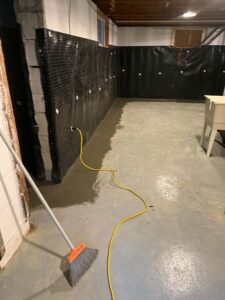
An interior weeping tile system manages water that has already entered the wall assembly by capturing it at the footing and routing it to a sump basin. The process involves jackhammering a perimeter channel in the basement floor, laying perforated drain pipe bedded in clear stone, installing a vapour barrier up the lower section of the wall, and re-pouring the concrete. A sump pump then discharges the collected water away from the foundation.
This is the most common solution for a leaky basement Oro-Medonte properties develop when excavation is impractical, when the original weeping tile has silted up, or when the water source is diffuse rather than a single crack. It does not stop water from entering the wall, but it prevents that water from reaching the floor and living space. Disruption is limited to the interior perimeter strip.
Exterior Waterproofing
Full exterior waterproofing addresses the problem at its source by excavating to the footing, applying hydraulic cement to any voids in the wall, coating the exterior face with a rubberised membrane, installing a dimpled drainage board to protect the membrane and channel water downward, laying new weeping tile in clear stone at the footing, and backfilling with corrected grading. This is the most comprehensive solution and carries the longest service life.
For Oro-Medonte properties on the Shield ridge, where lateral groundwater flow is the primary driver, exterior work that intercepts water before it reaches the wall is often the only permanent answer. Access can be a challenge on properties with mature landscaping, decks, or tight lot lines.
Sump Pump Installation or Replacement
A sump pump is a component, not a standalone waterproofing system, but it is a critical one. Many Oro-Medonte homes, particularly those built before 1990, have no sump at all, or have an original pump that has never been replaced. A properly sized sump with a battery backup is essential for any home that experiences seasonal high water tables. Battery backup is especially important for rural properties where power outages during spring storms are common.
Exterior Drainage Correction and Grading
Poor grading, blocked eavestroughs, and downspouts that discharge within two metres of the foundation are responsible for a significant share of wet basements in Oro-Medonte’s newer subdivisions. Correcting the grade so that the ground slopes away from the foundation at a minimum of five percent over the first 1.5 metres, and extending downspouts to discharge well clear of the wall, can eliminate or substantially reduce seepage without any structural work. This is always the first corrective step to take before investing in more intensive repairs.
Parging Repair and Wall Coating
Parging is the mortar coat applied to the exterior of a block or stone foundation. When it deteriorates, it exposes the masonry to direct water contact. Re-parging a deteriorated wall and applying a waterproof coating to the interior face can slow seepage in mild cases, but it does not address hydrostatic pressure and should not be treated as a substitute for proper drainage. It is most useful as a supplementary step after the drainage issue has been resolved.
Options Compared
| Method | Best For | Typical Lifespan | Relative Cost | Disruption |
|---|---|---|---|---|
| Polyurethane crack injection | Single vertical crack in poured concrete | Long-term if drainage is adequate | Lowest | Minimal, interior only, 1 day |
| Interior weeping tile system | Failed original tile, diffuse seepage, slab entry | 25 or more years with pump maintenance | Moderate | Interior perimeter jackhammer, 2 to 4 days |
| Exterior waterproofing | Severe hydrostatic pressure, lateral Shield flow | Lifetime with membrane intact | Highest | Full excavation, landscaping impact, 3 to 5 days |
| Sump pump installation | High seasonal water table, no existing sump | 7 to 10 years per pump unit | Low to moderate | Minimal, basin excavation only |
| Grading and drainage correction | Surface water, downspout discharge near wall | Ongoing with maintenance | Lowest | Exterior landscaping only |
| Parging repair and wall coating | Mild block wall seepage, supplementary step | 5 to 10 years | Low | Minimal |
The table shows that no single method is universally best for a leaky basement Oro-Medonte homeowners are dealing with. Crack injection is the right starting point for a single entry point, but it will not solve a failed weeping tile system. Exterior waterproofing is the most durable solution but also the most disruptive and costly. Most Oro-Medonte homes end up with a combination: injection for any active cracks, an interior system or exterior membrane for the perimeter, and a sump pump to manage seasonal water table peaks.
How to Choose the Right Fix
Choose crack injection if you have a single, clearly visible vertical or diagonal crack in a poured concrete wall, the rest of the basement is dry, and a moisture assessment confirms the crack is the only entry point. This is also the right first step if you are on a tight budget and the crack appeared recently after a particularly wet spring.
Choose an interior weeping tile system if water is entering along the cove joint, the floor slab, or multiple points along the wall, if your original weeping tile is silted up, or if excavation is not practical due to a deck, patio, or close lot line. Interior systems are also the preferred solution for a leaky basement Oro-Medonte homes carry when the basement is finished or partially finished, since the work is contained to the perimeter strip.
Choose exterior waterproofing if you are on the Shield ridge and lateral groundwater flow is the confirmed source, if the foundation wall itself is deteriorating, or if you want the most permanent solution available. Properties near Horseshoe Valley or on elevated lots where water runs toward the foundation from uphill are strong candidates.
Choose grading correction first, before anything else, if your downspouts discharge near the wall or if the grade slopes toward the foundation. This costs the least and sometimes eliminates the need for more invasive work entirely.
For a detailed breakdown of what each approach costs across Ontario, the basement leaking repair cost guide provides current investment ranges by method.
Costs and Timelines
| Cost Driver | Why It Affects Price | Approximate Range |
|---|---|---|
| Number of cracks to inject | Each crack is a separate port-and-paste operation | $600 to $900 per crack |
| Linear footage of interior weeping tile | More perimeter means more jackhammering, pipe, and stone | Priced per linear foot; full perimeter varies by home size |
| Excavation depth and access | Deeper footings and tight access increase equipment and labour time | Full exterior job typically $6,000 to $9,000 |
| Soil type | Sandy soil excavates faster than clay or Shield rock; rock may require breaking | Can add 10 to 25 percent to exterior job cost |
| Sump basin and pump | Required whenever an interior system is installed; battery backup adds cost | Included in interior system quote or standalone installation |
| Grading and backfill correction | Always included in exterior work; may be a separate line item on interior jobs | Varies by volume of material required |
All ranges above are approximate and drawn from DryShield’s completed work in Simcoe County and the broader Ontario region. The final figure for any leaky basement Oro-Medonte property depends on a site inspection, because soil conditions, foundation depth, and access vary significantly even within the same neighbourhood. A single crack injection is the lowest-cost entry point. A full exterior waterproofing job on a larger home with difficult access will sit at the higher end of the $6,000 to $9,000 range or above. Request a written scope with linear-foot pricing before committing to any contractor.
A single foundation crack injected with polyurethane typically costs $600 to $900. A full exterior waterproofing job in Simcoe County averages $6,000 to $9,000 depending on excavation depth and access. Always get a written scope before work begins.
Risks and Common Mistakes
| Symptom | Likely Cause | Correct Fix |
|---|---|---|
| Water at cove joint after heavy rain | Failed or silted weeping tile, hydrostatic pressure at footing | Interior weeping tile system with sump |
| Single vertical crack weeping in spring | Shrinkage crack widened by freeze-thaw, hydrostatic pressure | Polyurethane crack injection |
| Damp floor slab, no visible crack | Capillary rise through slab, high water table | Interior drainage system, vapour barrier, sump |
| Water after every rain, near downspout | Downspout discharge too close to wall, poor grading | Extend downspouts, regrade, then reassess |
| Efflorescence on block wall | Long-term mineral-laden water moving through masonry | Identify and stop water source; parging after drainage corrected |
The most common mistake Oro-Medonte homeowners make is treating the visible symptom rather than the water source. Painting a damp wall with hydraulic cement or a waterproof coating traps moisture in the wall assembly and accelerates deterioration of the masonry. The coating fails within a few seasons and the underlying problem is unchanged.
A second frequent error is skipping the sump pump battery backup. Rural Oro-Medonte properties lose power during the same spring storms that generate the highest water table. A primary pump with no backup will fail at the worst possible moment. A battery backup unit that can run the pump for 8 to 12 hours is a minimal investment relative to the cost of a flooded basement.
Never paint over a damp foundation wall as a permanent fix. Hydraulic cement coatings cannot withstand sustained hydrostatic pressure and will fail, often making the underlying wall harder to repair correctly later.
How the Process Works
- Free on-site inspection and moisture assessment. A technician visits the property, identifies all active and historic water entry points, checks the condition of the existing weeping tile if accessible, and assesses soil and grading conditions around the foundation. For a leaky basement Oro-Medonte homeowners report, this step confirms the exact water source before any scope is written.
- Written scope with linear-foot pricing. You receive a clear written proposal specifying exactly what work will be done, which materials will be used, and how the price is calculated. No verbal estimates.
- Crack injection (if applicable). Ports are drilled and pasted along each active crack. Low-pressure polyurethane is injected until it fills the crack fully and begins to appear at the surface. Ports are removed and the surface is finished.
- Excavation and exterior membrane (if exterior work is specified). The crew excavates to the footing, applies hydraulic cement parging to any voids, coats the wall with a rubberised membrane, installs dimpled drainage board, lays new weeping tile in clear stone, and backfills with grading corrected away from the wall.
- Interior system installation (if interior route is chosen). The perimeter concrete is jackhammered, weeping tile is laid to a new or existing sump basin, a vapour barrier is installed up the lower wall, and the concrete is re-poured.
- Sump pump commissioning. The pump is tested, the float switch is set, and battery backup is connected and verified. Discharge routing is confirmed to direct water well away from the foundation.
- Final walkthrough and documentation. The completed work is reviewed with the homeowner, warranty documentation is provided, and any grading or downspout recommendations are confirmed in writing.
Every DryShield job starts with a free on-site inspection. No scope is written and no work is scheduled until the water source is confirmed. This protects you from paying for a repair that does not match the actual problem.
Frequently Asked Questions
What makes Oro-Medonte basements more prone to leaking than homes in Barrie or the GTA?
The combination of Shield bedrock on the ridge and sandy lake-plain soils near Lake Simcoe creates conditions where lateral groundwater flow is common. Water cannot percolate through granite, so it travels horizontally along the rock surface toward any foundation in its path. GTA homes deal primarily with clay-driven hydrostatic pressure, which is a different mechanism requiring a different approach. Oro-Medonte’s seasonal snowpack also generates a larger and faster spring melt than most GTA locations.
Can I inject a crack myself using a hardware store kit?
DIY injection kits use cartridge-based foam that does not penetrate the full depth of the crack and cures rigid rather than flexible. In Oro-Medonte’s freeze-thaw environment, a rigid fill will re-crack within one or two seasons. Professional low-pressure polyurethane injection fills the crack from the interior face to the exterior face and cures with the flexibility needed to tolerate seasonal foundation movement. The cost difference between a DIY attempt and a professional injection is small relative to the cost of a second repair.
My basement only leaks in spring. Does that mean I need a full system or just crack injection?
Seasonal leaking that tracks closely with snowmelt points to a water table that rises above the footing level for a few weeks each year. If the entry point is a single crack, injection may be sufficient. If water is entering at the cove joint or through the slab, the water table is the driver and an interior weeping tile system with a sump is the appropriate solution. A moisture assessment during or just after a wet spring will confirm which is the case.
How long does a polyurethane crack injection last in a cottage-country climate?
When the surrounding drainage is adequate and the crack is not under ongoing structural stress, a properly injected polyurethane repair is long-lasting. The flexible cure means it accommodates the seasonal movement that is common in Oro-Medonte without re-opening. If the crack is widening due to ongoing settlement or structural loading, injection alone will not hold and a structural assessment is needed first.
Is exterior waterproofing always better than an interior system?
Exterior waterproofing stops water at the wall and is the most complete solution, but it is not always the right choice. On properties with mature trees, decks, or tight lot lines, excavation is disruptive and costly. Interior systems manage water effectively for decades when properly installed and maintained. The right choice depends on the water source, the site conditions, and the budget, which is why a site inspection comes before any recommendation.
My home was originally a seasonal cottage. Does that change what repair I need?
Yes, in several ways. Cottage-origin foundations are often shallower than those built to current Ontario Building Code standards, which means the footing sits closer to the frost line and is more vulnerable to freeze-thaw heave. Original waterproofing, if any was applied, was typically a thin tar coat that has long since deteriorated. Year-round occupancy also means the basement is heated, which changes condensation patterns. A leaky basement Oro-Medonte cottage-conversion owners discover often needs a combination of crack injection, interior drainage, and grading correction rather than a single repair. The guide to freeze-thaw foundation cracks in cottage country covers these seasonal-home specifics in detail.
What is the weeping tile around my foundation and how do I know if it has failed?
Weeping tile is a perforated pipe installed at the base of the foundation footing to collect groundwater and direct it away from the wall. In Oro-Medonte homes built before the 1980s, the original tile is often clay or concrete sections that have cracked, collapsed, or filled with silt and root intrusion. Signs of failure include water at the cove joint, a sump that never runs despite wet conditions, and persistent dampness along the base of the wall. A camera inspection of the drain can confirm the condition, but in many older homes the tile is simply assumed to have failed based on age and symptoms.
Will fixing my basement leak increase my home’s resale value?
A dry, documented foundation is a material selling point in Oro-Medonte’s real estate market, where buyers are often purchasing a property as a primary residence or a year-round recreational home. A transferable warranty on the waterproofing work provides additional reassurance to buyers. Conversely, an active leaky basement Oro-Medonte buyers discover during inspection is a common reason for price reductions or failed home inspections. Addressing the problem before listing removes a negotiating liability. The waterproofing ROI guide covers the resale data in more detail.
Do I need a permit to waterproof my basement in Oro-Medonte?
Interior crack injection and interior drainage systems generally do not require a building permit in Oro-Medonte. Full exterior excavation that alters the grade or drainage pattern may require notification to the Township of Oro-Medonte, and any work near a shoreline or wetland must comply with Nottawasaga Valley Conservation Authority or Lake Simcoe Region Conservation Authority requirements. Your contractor should confirm permit requirements as part of the scoping process.
How do I find a reliable waterproofing contractor for my Oro-Medonte property?
Look for a contractor who offers a free on-site inspection before quoting, provides a written scope with per-linear-foot pricing, and carries a transferable warranty. Avoid any company that quotes over the phone without visiting the site, or that recommends the same solution for every home without diagnosing the water source first. The contractor hiring checklist outlines the key questions to ask before signing anything.
DryShield serves Oro-Medonte and the broader Simcoe County region, including Barrie, Innisfil, Midland, Wasaga Beach, and Collingwood. If your basement is showing signs of water entry, contact the DryShield team to schedule a free on-site inspection and receive a written scope with no obligation.