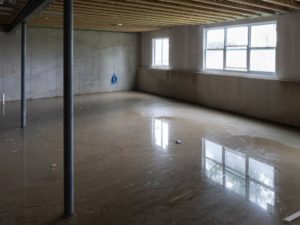
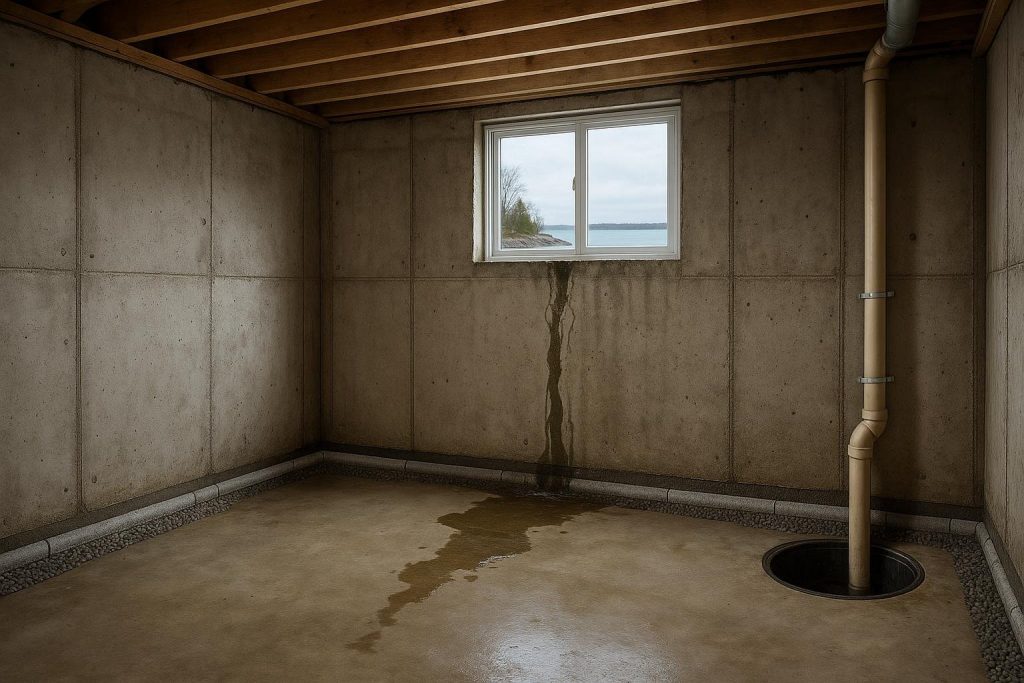
Basement leak repair in Penetanguishene addresses water entry caused by a combination of Georgian Bay shoreline moisture, seasonal freeze-thaw cycling, and the clay-rich glacial till that underlies much of southern Simcoe County. Identifying the precise entry point and soil condition is the essential first step before choosing any repair method. This guide explains the main options available to homeowners in Penetanguishene, how each works, what drives cost, and how to avoid the most common mistakes.
- Penetanguishene sits on glacial till and clay soils that hold moisture and generate hydrostatic pressure against foundation walls after rain and snowmelt.
- Proximity to Georgian Bay means elevated ambient humidity and a water table that can rise quickly in spring.
- Freeze-thaw cycles through the Simcoe County winter open and widen existing foundation cracks each year.
- Repair options range from minimally invasive crack injection to full exterior excavation and membrane systems, depending on severity.
- Choosing the wrong method for the soil and foundation type is the most common and costly mistake local homeowners make.
Definitions & scope
Basement leak repair covers any professional intervention that stops water from entering a below-grade living or storage space through foundation walls, floor slabs, wall-floor joints, or window wells. In Penetanguishene and the broader Simcoe County area, the term encompasses several distinct disciplines: polyurethane or epoxy crack injection, interior drainage systems with weeping tile and sump pumps, exterior excavation and membrane waterproofing, and surface-level grading or window-well corrections.
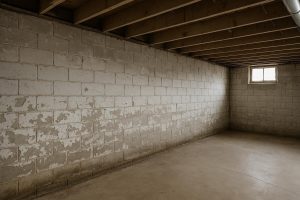
Not every wet basement requires the same scope of work. A single hairline crack in a poured-concrete wall is a fundamentally different problem from chronic seepage through a deteriorated block foundation or a failed perimeter weeping tile system. The scope of repair must match the source of water entry, the foundation material, the soil type, and the seasonal pressure patterns specific to this part of Georgian Bay country. Repairs that address symptoms without resolving the underlying cause tend to fail within a few seasons in this climate.
Why this matters
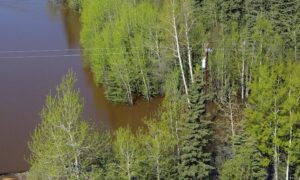
Penetanguishene occupies a peninsula on the eastern shore of Georgian Bay’s Severn Sound. The town’s soils are predominantly glacial till with significant clay content in low-lying areas, and the water table responds quickly to the heavy snowpack that accumulates through a typical Simcoe County winter. When that snowpack melts in March and April, the ground becomes saturated and hydrostatic pressure against basement walls can reach its annual peak within days.
The town’s older housing stock, including many homes built before modern waterproofing membranes were standard practice, relies on aging tar-and-felt dampproofing that degrades over decades. Seasonal cottages near the bay face additional stress: foundations left unheated through winter experience deeper frost penetration, which forces water into cracks and expands them. Each freeze-thaw cycle widens those openings slightly, so a crack that was cosmetic five years ago may be actively leaking today.
Unaddressed basement leaks in this environment carry real consequences beyond a damp smell. Persistent moisture promotes mold growth on framing and insulation, degrades structural wood, and can undermine the bearing capacity of footings if water erosion continues beneath the slab. For homeowners considering resale, a wet basement is a significant disclosure liability. Addressing the problem with a documented, warranted repair protects both the structure and the property’s market value. See our guide on whether basement waterproofing increases home value for broader context.
Your options
Polyurethane crack injection
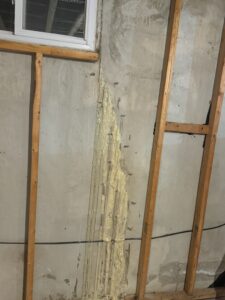
Polyurethane crack injection is a minimally invasive repair method suited to active or dormant cracks in poured-concrete foundation walls. A technician drills ports along the crack at measured intervals, then injects a two-part polyurethane resin under low pressure. The resin expands as it cures, filling the crack from the inside face to the exterior face and bonding to the concrete. Because polyurethane remains slightly flexible after curing, it can accommodate minor ongoing movement without re-opening.
Best for: Single or multiple discrete cracks in poured-concrete walls where the surrounding wall is otherwise sound and the exterior soil has not been severely eroded.
Limitations: Not suitable for block or stone foundations, cracks wider than approximately 6 mm without supplemental preparation, or situations where the wall itself has structural compromise. Does not address a failed drainage system or perimeter seepage.
Interior drainage system with weeping tile and sump pump
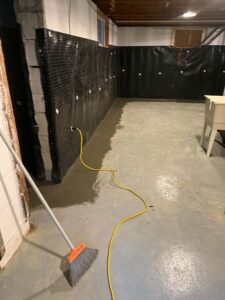
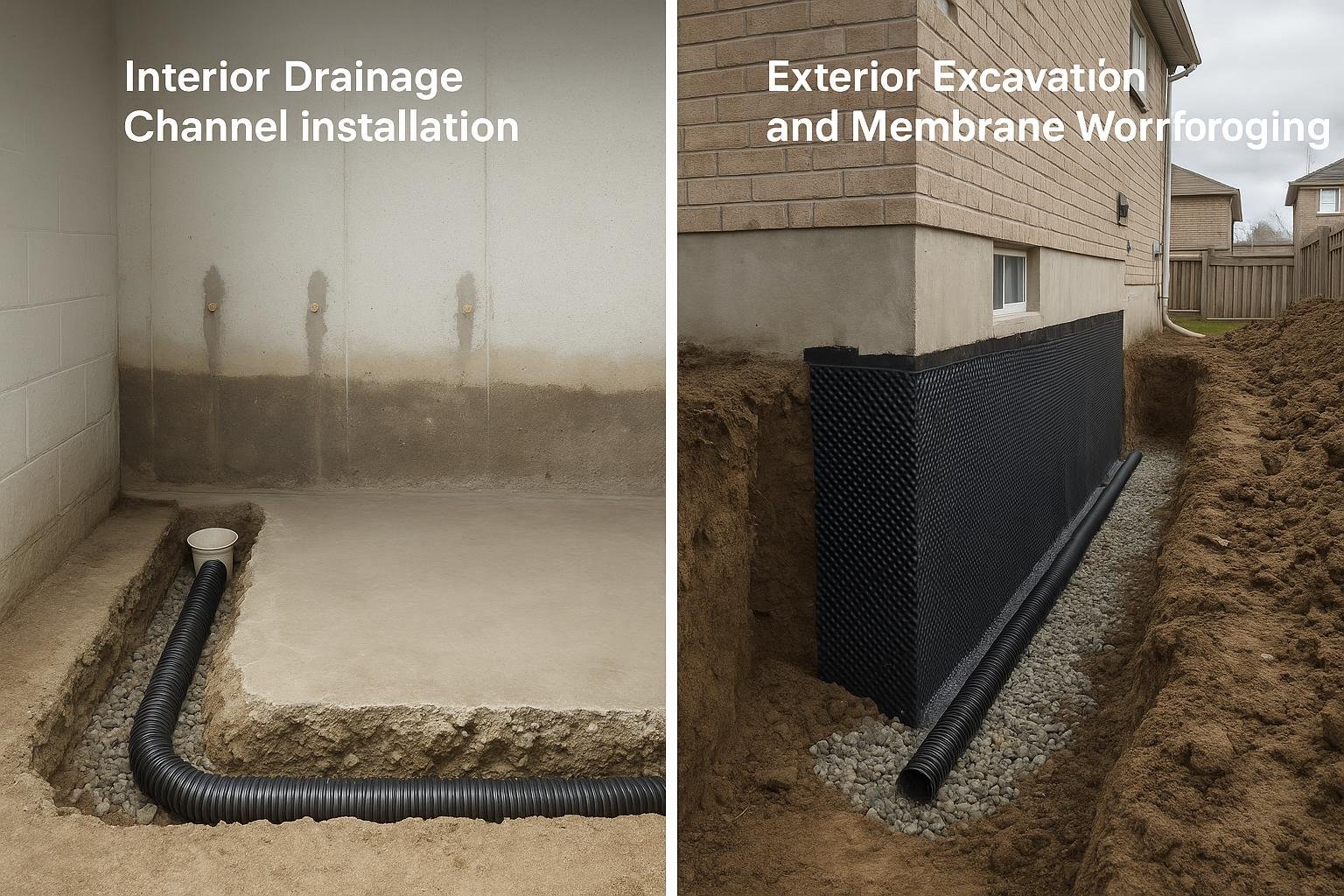
An interior drainage system involves cutting a channel around the perimeter of the basement floor, installing a perforated drain pipe (weeping tile) in a gravel bed, and directing collected water to a sump pit where a pump discharges it away from the foundation. This approach manages water that has already entered the wall-floor joint or seeps through the lower wall, rather than stopping it at the exterior.
Best for: Chronic perimeter seepage, failed or collapsed original weeping tile, situations where exterior excavation is impractical due to landscaping, driveways, or lot lines, and homes where the water source is diffuse rather than a single crack.
Limitations: Does not stop water from contacting the exterior of the foundation wall. Requires ongoing sump pump maintenance and a reliable power source; battery backup is strongly recommended in areas with frequent outages.
Exterior excavation and membrane waterproofing
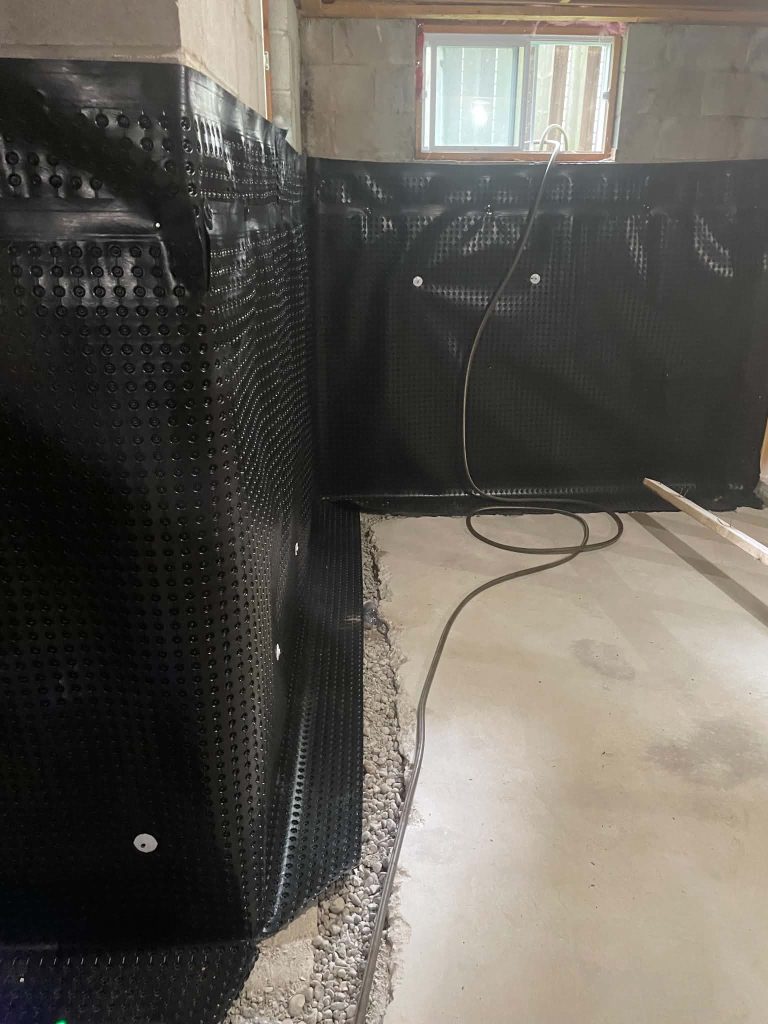
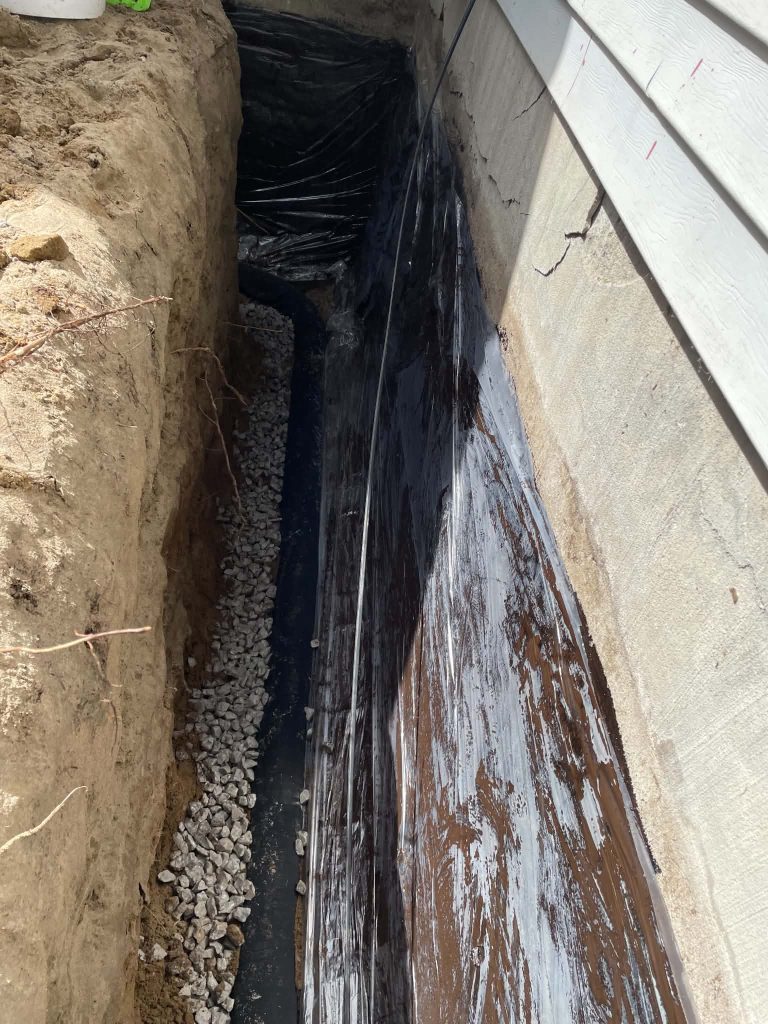
Exterior waterproofing involves excavating the soil around the foundation down to the footing, cleaning and repairing the wall surface, applying a waterproofing membrane (typically a rubberized asphalt or polymer-modified product), installing a drainage board, and replacing or installing new weeping tile at the footing before backfilling. This is the most comprehensive approach because it addresses the source of water entry at the exterior face of the wall.
Best for: Severely deteriorated original dampproofing, multiple or large cracks, foundations with significant water infiltration across broad wall sections, and situations where a long-term solution with minimal interior disruption is the priority.
Limitations: Highest cost and disruption of all options. Requires excavation equipment and adequate site access. Landscaping, decks, walkways, and utility lines near the foundation must be managed. Not always practical for attached or semi-detached homes with shared walls.
Epoxy crack injection
Epoxy injection uses a rigid, high-strength adhesive resin injected into structural cracks to restore tensile strength to the concrete. Unlike polyurethane, cured epoxy is rigid and bonds the crack faces together, making it appropriate when structural integrity is the primary concern.
Best for: Cracks where structural reinforcement is needed in addition to waterproofing, such as cracks showing signs of wall deflection or load-related stress.
Limitations: Epoxy does not flex; if the crack continues to move after injection, the repair can re-open. Not appropriate for active water infiltration at the time of injection, as moisture inhibits adhesion. Requires a dry crack face for proper bonding.
Sump pump installation or replacement
A sump pump is a submersible or pedestal pump installed in a pit at the lowest point of the basement floor. It activates automatically when water reaches a set level and discharges through a pipe to a safe distance from the foundation. In Penetanguishene, where spring melt can saturate the ground rapidly, a properly sized sump pump is often a critical component of any waterproofing system.
Best for: Homes with existing interior drainage systems that lack a pump, basements that flood during heavy rain or snowmelt events, and as a component of a new interior drainage installation.
Limitations: A sump pump is a mechanical device that requires periodic testing and eventual replacement. Power outages during storms, which are the same events that drive the highest water volumes, are the most common failure scenario. Battery backup or water-powered backup systems are advisable.
Grading, window-well and surface drainage corrections
Sometimes water enters a basement not through a structural failure but because surface water is directed toward the foundation by negative grading, blocked window wells, or downspouts discharging too close to the wall. Correcting these conditions is the least invasive and least expensive intervention and should always be evaluated before more extensive work is undertaken.
Best for: Basements where water entry correlates directly with rainfall events and is concentrated near windows, corners, or downspout locations; situations where grading has settled toward the foundation over time.
Limitations: Surface corrections alone will not resolve leaks caused by hydrostatic pressure from a high water table, failed weeping tile, or existing cracks in the foundation wall.
 Options compared
| Method | Best for | Typical considerations | Durability / limitations |
|---|---|---|---|
| Polyurethane crack injection | Discrete cracks in poured concrete | Minimal disruption; interior access only needed | Long-lasting when crack is stable; may need re-treatment if movement continues |
| Epoxy crack injection | Structural cracks needing strength restoration | Requires dry crack; rigid bond | Durable in stable cracks; can re-open if movement persists |
| Interior drainage + sump pump | Chronic perimeter seepage; failed weeping tile | Moderate interior disruption; ongoing pump maintenance | Effective long-term with maintenance; pump requires power |
| Exterior excavation + membrane | Broad wall deterioration; comprehensive fix | Highest disruption and cost; site access required | Most durable when properly installed; addresses source directly |
| Sump pump only | Managing water already entering; supplement to drainage | Low disruption if pit exists; mechanical maintenance required | Dependent on power; does not stop water at source |
| Grading / surface drainage | Surface-water-driven entry near windows or downspouts | Least invasive and least costly | Ineffective against hydrostatic pressure or structural cracks |
The table above illustrates that no single method is universally superior. Crack injection is highly effective for its specific application but is irrelevant if the leak source is perimeter seepage from a failed drainage system. Exterior waterproofing is the most thorough solution but carries the highest cost and site disruption, which may not be justified for a single isolated crack. In practice, many Penetanguishene homes require a combination of methods: for example, crack injection to seal an active wall crack alongside a sump pump upgrade to manage seasonal groundwater. A proper diagnosis of the entry point and water source is the prerequisite for any sound repair plan.
How to choose
The decision framework below is organized around the most common diagnostic findings. Use it as a starting point, not a substitute for a professional assessment of your specific foundation and soil conditions.
Choose polyurethane crack injection if you have one or more identifiable cracks in a poured-concrete wall, the surrounding wall is structurally sound, and water entry is clearly associated with those cracks rather than diffuse seepage along the floor or wall-floor joint. This is also the appropriate first response for a crack that has been widening gradually due to freeze-thaw cycling, provided the movement has stabilized.
Choose an interior drainage system with a sump pump if water enters along the perimeter of the floor, through the wall-floor joint, or through multiple low-wall locations that do not correspond to discrete cracks. This is also the right choice when exterior excavation is not feasible due to site constraints, or when the original weeping tile system has collapsed or become blocked with silt and clay fines, which is common in older Penetanguishene homes.
Choose exterior excavation and membrane waterproofing if the foundation wall shows widespread deterioration of the original dampproofing, multiple large or structural cracks, or if previous interior repairs have failed repeatedly. This is also the preferred approach when the home is being substantially renovated and site access is already available.
Choose epoxy injection over polyurethane if a structural engineer or waterproofing professional has identified that the crack requires strength restoration in addition to sealing, and the crack is dry at the time of repair.
Start with grading and surface drainage corrections if water entry is clearly correlated with rainfall events and concentrated near windows, corners, or downspout discharge points, and there is no evidence of structural cracking or perimeter seepage. Correcting surface drainage is low cost and should always be evaluated first.
For a broader comparison of interior and exterior approaches, see our guide on exterior vs interior perimeter waterproofing.
Costs & timelines
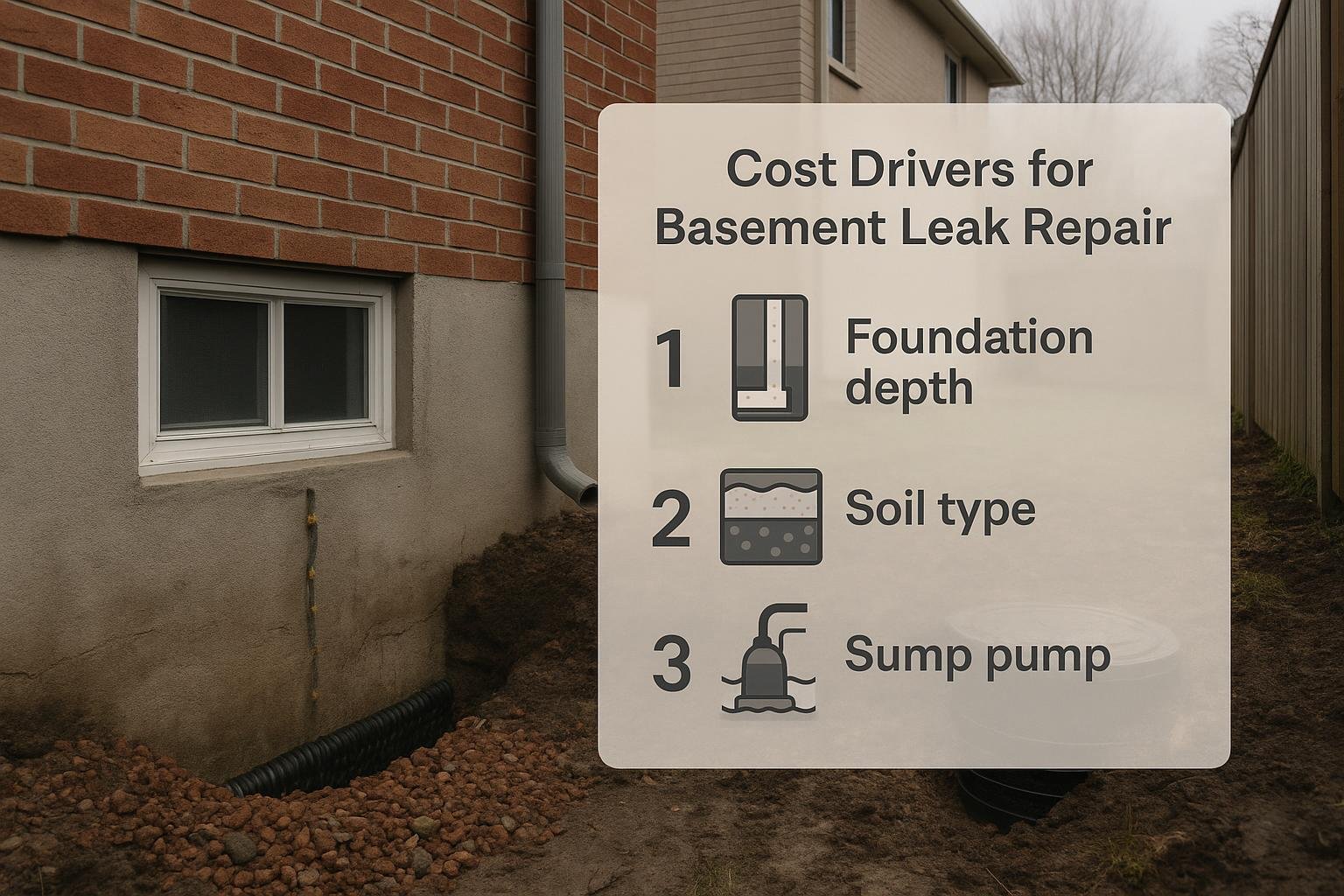
No verified current price data specific to Penetanguishene has been supplied to this guide. The following describes the cost drivers that professionals use to estimate any basement leak repair project. Actual quotes will vary by contractor, site conditions, and material costs at the time of work.
| Cost driver | Why it matters | Direction of influence |
|---|---|---|
| Repair method selected | Crack injection is the least material-intensive; exterior excavation the most | Crack injection lowest; exterior excavation highest |
| Linear footage of wall or crack affected | More wall treated means more material and labour | Increases with scope |
| Foundation depth | Deeper excavation requires more equipment time and backfill | Increases with depth |
| Site access | Tight lots, decks, or landscaping increase excavation complexity | Increases cost when access is restricted |
| Soil type | Dense clay requires more effort to excavate and backfill properly | Increases in heavy clay conditions |
| Sump pump specification | Pump capacity, battery backup, and alarm systems add to base cost | Increases with feature level |
| Permit requirements | Structural foundation work may require a building permit under the Ontario Building Code | Adds permit fee and inspection timeline |
Timeline varies similarly. Crack injection on a single wall crack can typically be completed in a few hours. Interior drainage installation for a full perimeter is generally a multi-day project. Exterior excavation of a full foundation perimeter is typically a week or more depending on wall length, depth, and backfill conditions. Homeowners should request itemized written estimates and confirm whether permit applications are included in the contractor’s scope. For a broader overview of cost factors across Ontario, see our basement leaking repair costs guide.
Risks & common mistakes
The most consequential mistake Penetanguishene homeowners make is treating a symptom rather than the source. Applying hydraulic cement or a crystalline coating to a leaking wall crack may slow visible seepage temporarily, but if the underlying crack extends through the full wall thickness and the exterior soil is saturated, water will find another path. The repair appears to have worked until the next heavy rain or spring melt reveals a new entry point nearby.
A second common error is selecting an interior drainage system when the actual problem is a structural crack that should be injected. Interior drainage manages water after it has entered the wall assembly; it does not stop moisture from contacting the concrete, which can continue to degrade the wall over time. Conversely, injecting a crack when the real problem is a failed perimeter weeping tile system will not prevent the chronic seepage that originates at the wall-floor joint.
Delaying repair is a significant risk in this climate. Freeze-thaw cycling through a Simcoe County winter actively enlarges existing cracks. A crack that is injectable this fall may require more extensive intervention by spring if water has entered, frozen, and expanded the opening repeatedly. Early action is almost always less expensive than deferred action.
Hiring a contractor without a written warranty is another avoidable risk. Reputable waterproofing companies offer documented warranties on their work. A verbal assurance is not enforceable. Confirm the warranty terms in writing before work begins, and verify whether the warranty is transferable to a future buyer, which can be a meaningful asset at resale. DryShield offers a lifetime transferable warranty on qualifying work.
Finally, neglecting the sump pump in a system that depends on one is a recurring failure point. A pump that has not been tested before the spring melt season is an unreliable one. Test the float switch manually at least once per year and confirm the discharge line is clear of ice or debris before snowmelt begins.
How the process works
- Inspection and diagnosis: A waterproofing professional examines the foundation interior and, where accessible, the exterior grade. The technician identifies entry points, assesses crack type and width, evaluates the drainage system condition, and determines the water source (surface, groundwater, or both).
- Repair plan and written estimate: Based on the diagnosis, the contractor prepares a written scope of work with method, materials, timeline, and warranty terms. For structural cracks or exterior excavation, a building permit application may be required under the Ontario Building Code.
- Site preparation: Interior work requires clearing the affected wall area and protecting belongings. Exterior work requires marking utilities, arranging equipment access, and protecting adjacent landscaping or structures.
- Repair execution: The selected method is applied: ports drilled and resin injected for crack injection; perimeter channel cut, drain pipe installed, and pit constructed for interior drainage; or excavation, membrane application, drainage board, and new weeping tile for exterior work.
- Drainage and backfill: For exterior work, the drainage board and weeping tile are inspected before backfilling. For interior work, the floor channel is filled with concrete after the drain pipe is set. Sump pump operation is tested before the technician leaves.
- Final inspection and documentation: The completed work is reviewed with the homeowner. Warranty documentation is provided in writing. Maintenance recommendations, including sump pump testing schedule and signs of re-entry to monitor, are communicated clearly.
- Follow-up: The homeowner monitors the repaired area through the first significant rain and the first spring melt season. Any warranty claim is submitted directly to the contractor with documentation of the re-entry location and conditions.
 Frequently asked questions
What causes most basement leaks in Penetanguishene?
The most common causes in this area are hydrostatic pressure from clay-rich glacial till soils that retain moisture after rain and snowmelt, freeze-thaw cycling that opens and widens foundation cracks each winter, and aging or collapsed original weeping tile systems that no longer drain groundwater away from the footing. Proximity to Georgian Bay also means elevated ambient humidity, which can contribute to condensation on cold walls in summer, sometimes mistaken for a structural leak.
Can I repair a foundation crack myself?
DIY hydraulic cement or surface-applied sealants can slow visible seepage temporarily but rarely address the full depth of a crack or the hydrostatic pressure driving water through it. Polyurethane injection kits are available at hardware stores, but proper port spacing, injection pressure, and resin selection require training and experience to execute correctly. An improperly injected crack can trap water behind the repair, worsening the condition. Professional injection with a written warranty is the more reliable long-term choice for most homeowners.
How do I know if my weeping tile has failed?
Signs of failed weeping tile include chronic seepage along the base of the foundation wall or at the wall-floor joint, water entry that persists even during moderate rain rather than only during heavy events, and efflorescence (white mineral deposits) along the lower wall. A contractor can use a camera inspection of the drain pipe to confirm whether the tile is blocked, crushed, or has lost its slope. See our overview of weeping tile problems for more detail on the signs.
Is exterior waterproofing always better than interior?
Exterior waterproofing addresses the source of water entry at the outside face of the wall, which is the most thorough approach when the wall itself is deteriorated or the original dampproofing has failed. However, it is not always the most appropriate choice. For a single crack in an otherwise sound wall, crack injection is more targeted and far less disruptive. For chronic perimeter seepage where excavation is impractical, an interior drainage system is a proven and effective alternative. The best method depends on the specific diagnosis, not a general preference. Our guide on exterior vs interior perimeter waterproofing covers this comparison in detail.
Do I need a building permit for basement waterproofing in Penetanguishene?
The Town of Penetanguishene falls under the Ontario Building Code for structural foundation work and excavation. Permit requirements depend on the scope: crack injection is generally exempt, while exterior excavation to the footing or structural crack repair may require a permit. Homeowners should confirm requirements with the Town of Penetanguishene’s building department before work begins. A reputable contractor will advise on permit obligations as part of the written estimate. Note that permit requirements and fees can change; always verify with the local authority having jurisdiction.
How long does basement leak repair take?
Timeline depends on the method. Polyurethane crack injection on a single crack is typically completed in a few hours on the same day. Interior drainage installation for a full basement perimeter generally takes two to four days. Exterior excavation and membrane waterproofing for a full foundation perimeter is typically one to two weeks, depending on wall length, foundation depth, and site conditions. Permit processing time, if required, adds to the overall schedule and should be factored into planning before the spring melt season.
What maintenance does a sump pump require?
A sump pump should be tested manually at least once per year, ideally before the spring melt season begins. Testing involves pouring water into the pit to confirm the float switch activates the pump and that the discharge line is clear. The pit should be inspected for debris that could clog the intake screen. Battery backup units require battery replacement on the manufacturer’s recommended schedule, typically every three to five years. A pump that runs continuously or fails to activate is a sign of mechanical failure requiring prompt attention. See our guide on sump pump battery backup and monitoring for seasonal cottage considerations.
Will basement waterproofing affect my home insurance?
Home insurance policies in Ontario vary significantly in how they treat basement water damage. Some policies exclude gradual seepage or groundwater infiltration while covering sudden events. A documented, warranted waterproofing repair may support a conversation with your insurer about coverage terms, but no specific outcome can be guaranteed without reviewing your individual policy. Our guide on home insurance and basement waterproofing in Ontario provides a broader overview of how policies typically treat these repairs.
Can seasonal cottages near Penetanguishene be waterproofed in the off-season?
Exterior waterproofing and interior drainage work can generally be performed in shoulder seasons when ground temperatures are above freezing. Polyurethane crack injection requires temperatures above approximately 5 degrees Celsius for proper resin cure. Work performed in late summer or early fall, before the ground freezes, allows repairs to cure fully before winter freeze-thaw cycling begins. Scheduling repairs before the spring melt is also effective. Confirm seasonal scheduling constraints with your contractor at the time of estimate. Our guide on freeze-thaw foundation cracks in cottage country covers the seasonal timing of crack development in more detail.
How do I find a qualified waterproofing contractor in Penetanguishene?
Look for a contractor with documented experience in foundation waterproofing, a written warranty on completed work, and clear communication about permit requirements. Request a written, itemized estimate before agreeing to any work. Verify that the contractor carries liability insurance and workers’ compensation coverage. Avoid contractors who pressure for immediate decisions or who propose a single solution without first inspecting the foundation. Our checklist for hiring a waterproofing contractor provides a structured set of questions to ask before signing any agreement.
DryShield has served Penetanguishene and the broader Simcoe County area as part of its Ontario cottage country service region. If you are dealing with a wet basement, an active crack, or a drainage system that has not been inspected in several years, a professional assessment is the right starting point. Visit our Simcoe County basement waterproofing guide for regional context, or contact DryShield to arrange an inspection of your Penetanguishene home or cottage.