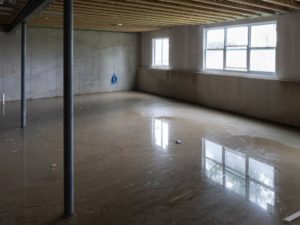
Basement flooding in Penetanguishene is a recurring challenge for homeowners in this Georgian Bay community, where a combination of marine clay soils, a high seasonal water table, and heavy spring snowmelt creates persistent hydrostatic pressure against foundations. This guide explains the specific causes at work in Penetanguishene, the repair and waterproofing methods available, how to choose between them, what drives costs, and the mistakes that make water problems worse.
- Penetanguishene sits on glaciolacustrine clay deposits left by post-glacial Lake Algonquin, which hold water and transmit hydrostatic pressure efficiently to basement walls.
- Spring snowmelt from the southern Georgian Bay snowbelt is a primary flooding trigger; freeze-thaw cycling also opens foundation cracks throughout winter.
- Interior and exterior waterproofing, weeping tile replacement, sump pump installation, and polyurethane crack injection are the main repair options, each suited to different conditions.
- Choosing the wrong method or delaying repair allows water infiltration to progress to mould growth and structural deterioration.
- A professional inspection to identify the exact water entry point is the essential first step before any repair.
Definitions & scope
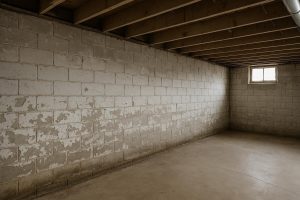
Basement flooding refers to any unwanted water entry into a below-grade living or storage space, ranging from a damp floor after rain to several centimetres of standing water after snowmelt. In Penetanguishene, the term covers three distinct phenomena that are often confused: hydrostatic seepage through poured-concrete or block walls, surface water intrusion through window wells or door thresholds, and sewer backup through floor drains. Each has a different cause and a different fix.
Foundation waterproofing is the broader discipline of managing water around and through a foundation system. It includes drainage management (weeping tile, sump pumps, grading), membrane or coating application to foundation walls, and crack sealing. This guide focuses on the residential basement, covering homes built on full foundations in Penetanguishene and the immediately surrounding area of Simcoe County. Cottages and seasonal properties on the Georgian Bay shoreline face related but distinct challenges covered in the Simcoe County basement waterproofing guide.
Hydrostatic pressure is the force exerted by water-saturated soil against a foundation wall. Clay soils, which dominate Penetanguishene’s geology, are particularly effective at retaining water and transmitting this pressure because they drain slowly after rain or snowmelt events.
Why this matters
Penetanguishene occupies a narrow peninsula between Penetang Harbour and Hog Bay on the southeastern shore of Georgian Bay. The town’s soils are predominantly glaciolacustrine clays deposited when the area was submerged under post-glacial Lake Algonquin. These clays are dense, poorly draining, and expand slightly when saturated, all of which intensify hydrostatic pressure on basement walls.
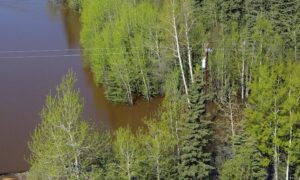
The southern Georgian Bay region is part of Ontario’s snowbelt. Prevailing westerly winds pick up moisture over Georgian Bay and deposit heavy snowfall on communities including Penetanguishene, Midland, and nearby Elmvale. When that snowpack melts rapidly in March and April, large volumes of water enter the ground faster than clay soils can drain it. The result is a sharp, seasonal spike in the water table that can push water through any existing crack, joint, or porous section of a foundation wall.
Freeze-thaw cycling compounds the problem. Penetanguishene experiences many freeze-thaw transitions each winter. Water that enters a hairline crack freezes, expands by approximately nine percent in volume, and widens the crack. Each subsequent cycle enlarges the opening further. By spring, cracks that were cosmetic in autumn may be actively leaking.
Older housing stock in Penetanguishene’s downtown and harbour-adjacent neighbourhoods often relies on clay tile or deteriorated weeping tile systems installed decades ago. These systems lose function over time as tiles crack, root intrusion occurs, or sediment accumulates, leaving foundations without effective perimeter drainage precisely when hydrostatic pressure is highest.
Unaddressed basement flooding leads to mould growth, deterioration of insulation and framing, reduced indoor air quality, and, in severe cases, lateral cracking of foundation walls from sustained soil pressure. Early intervention is consistently less costly than remediation after structural damage has occurred.
Your options
Polyurethane crack injection
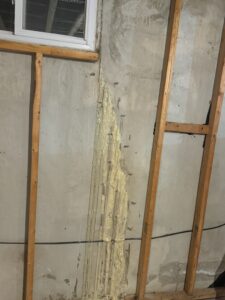
Polyurethane crack injection is a minimally invasive method for sealing active cracks in poured-concrete foundation walls. A technician drills a series of ports along the crack, injects a two-part polyurethane resin under low pressure, and the resin expands to fill the crack from face to face. The cured foam remains flexible, accommodating minor seasonal movement without re-cracking.
How it works: The expanding resin displaces any water present in the crack and bonds to the concrete on both sides, creating a waterproof seal within the crack itself rather than on the surface.
Best for: Single, non-structural vertical or diagonal cracks in poured-concrete walls where the surrounding wall is otherwise sound. Common in Penetanguishene homes that have developed one or two shrinkage or settlement cracks.
Limitations: Does not address the source of hydrostatic pressure. If drainage around the foundation is inadequate, water will find or create a new path. Not suitable for block foundations, horizontal cracks indicating lateral pressure, or walls with multiple widespread cracks. See the polyurethane crack injection guide for technical detail.
Interior waterproofing with drainage channel and sump pump
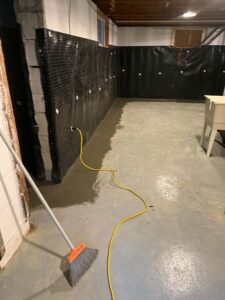
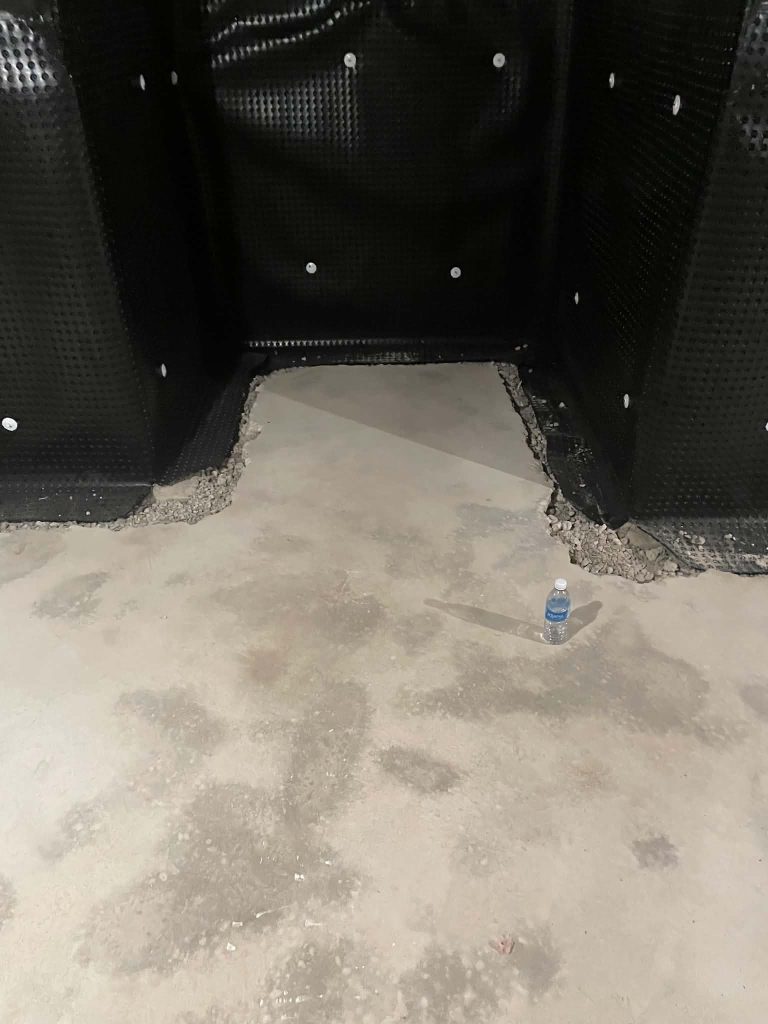
Interior waterproofing intercepts water that has already entered the foundation system and redirects it to a sump pit before it reaches the floor. A contractor installs a drainage channel along the interior perimeter of the basement floor, connects it to a sump pit, and installs a sump pump to discharge water away from the building.
How it works: The channel sits below the floor slab at the wall-floor joint, the most common entry point for hydrostatic seepage. Water is collected and removed rather than blocked at the wall.
Best for: Homes where exterior excavation is impractical or cost-prohibitive, where multiple wall sections are seeping, or where the weeping tile system has failed and full exterior replacement is not yet feasible. Widely applicable across Penetanguishene’s older housing stock.
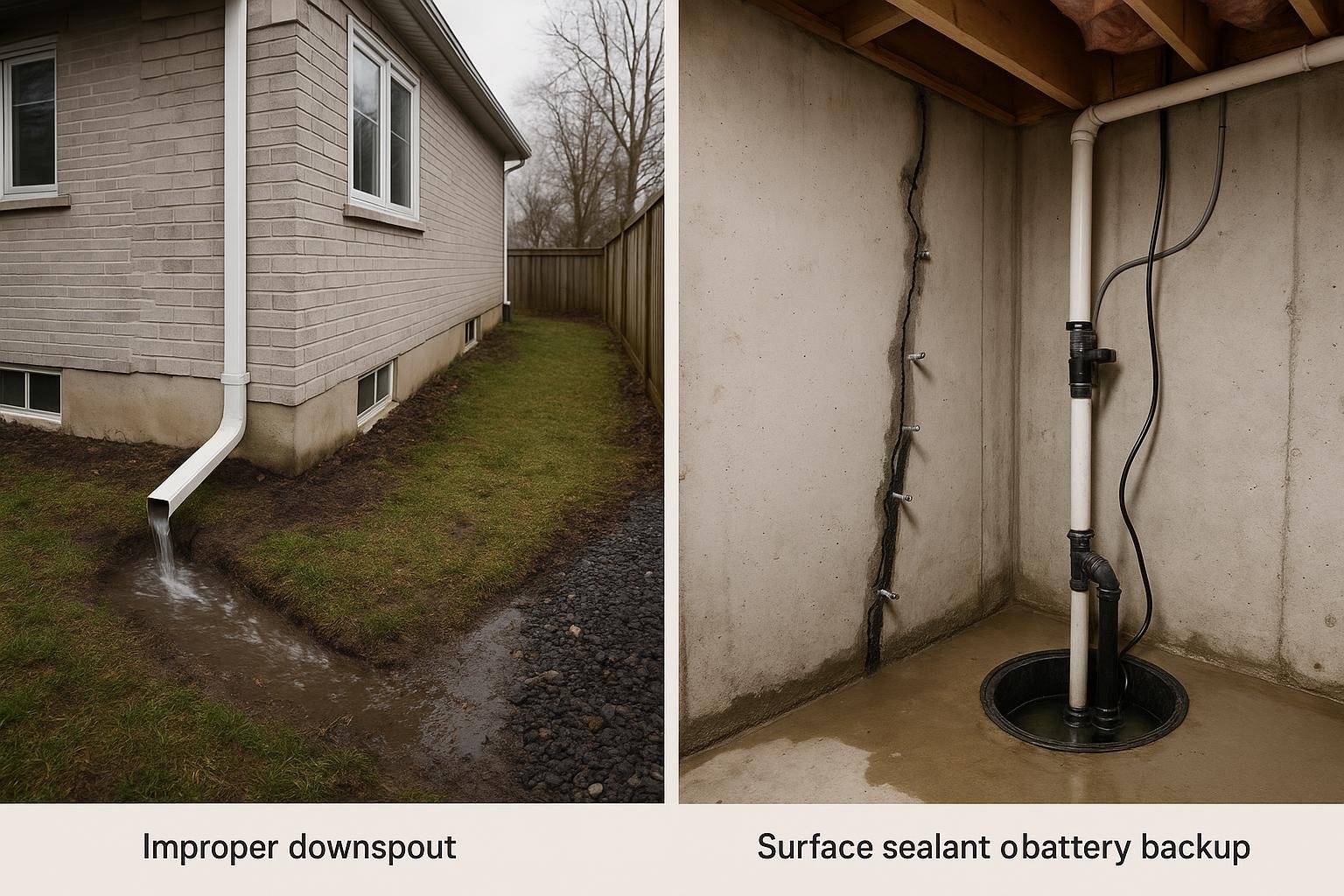
Limitations: Does not stop water from entering the wall; it manages water after entry. The sump pump requires power and maintenance. A battery backup is strongly recommended given the risk of power outages during the spring storms that coincide with peak snowmelt. Learn more at interior and internal basement waterproofing.
Exterior waterproofing with membrane
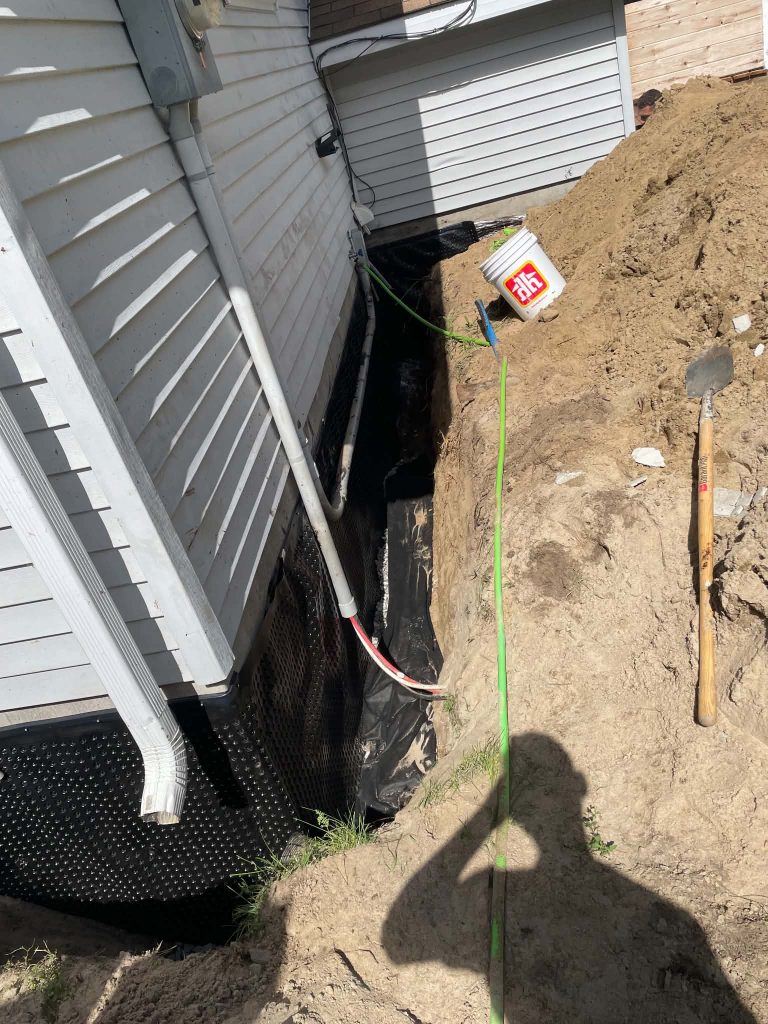
Exterior waterproofing addresses the problem at its source by excavating around the foundation, applying a waterproof membrane to the exterior face of the wall, installing a drainage board, and replacing or upgrading the weeping tile before backfilling.
How it works: The membrane prevents water from contacting the foundation wall. The drainage board and weeping tile direct groundwater away from the footing before it can build pressure against the wall.
Best for: Homes with severely deteriorated exterior dampproofing, failed weeping tile, or walls showing widespread seepage across multiple sections. Provides the most comprehensive long-term protection.
Limitations: Requires excavation to footing depth, which is disruptive to landscaping, driveways, and decks. Higher upfront cost and longer project duration than interior methods. Access may be restricted on narrow lots common in Penetanguishene’s older neighbourhoods. See the exterior basement waterproofing services page and the exterior foundation protection guide.
Weeping tile replacement
Weeping tile (also called a French drain or perimeter drain) is a perforated pipe installed at footing level to collect and redirect groundwater before it accumulates against the foundation wall. Original clay tile systems in older Penetanguishene homes are frequently cracked, crushed, or blocked.
How it works: New perforated pipe, typically wrapped in filter fabric, is installed in a gravel bed at or below footing level. Water enters the pipe through perforations and is carried to a sump pit or daylight outlet.
Best for: Homes where the primary cause of flooding is a failed perimeter drainage system rather than a cracked wall. Often combined with exterior waterproofing as part of a comprehensive exterior repair.
Limitations: Requires excavation. Interior weeping tile can be installed without exterior excavation but addresses drainage at the floor level rather than at the footing. See weeping tile installation and replacement and the French drain system guide.
Sump pump installation or upgrade
A sump pump is a submersible or pedestal pump installed in a pit at the lowest point of the basement. It activates automatically when water in the pit reaches a set level and discharges it through a pipe to a safe distance from the foundation.
How it works: A float switch triggers the pump motor. Water is expelled through a discharge line that must terminate well away from the foundation and above grade to prevent re-infiltration.
Best for: Any home in a high-water-table area as a standalone protective measure or as a component of an interior or exterior waterproofing system. Particularly important in Penetanguishene given the seasonal water table spikes during snowmelt.
Limitations: Dependent on electrical power. A battery backup or water-powered backup is essential for spring storm events. Requires annual testing and periodic maintenance. Does not seal cracks or address the source of water entry. See sump pump installation services.
Grading and surface drainage correction
Improper grading directs surface water toward the foundation rather than away from it. Correcting the slope of soil, adding window well covers, extending downspout discharge pipes, and ensuring paved surfaces drain away from the building are surface-level interventions that reduce the volume of water reaching the foundation.
How it works: Soil is regraded to slope away from the foundation at a minimum of five percent over the first 1.5 to 2 metres, per general building practice. Downspouts are extended or connected to underground discharge pipes.
Best for: Homes where surface water is a significant contributor to basement flooding, often identifiable when flooding correlates strongly with rainfall rather than groundwater rise. Useful as a low-cost first step or complement to other methods.
Limitations: Does not address hydrostatic pressure from a high water table, failed weeping tile, or existing wall cracks. Insufficient as a standalone solution when the water table is the primary driver, which is common in Penetanguishene’s clay soils.
 Options compared
| Method | Best for | Typical considerations | Durability / limitations |
|---|---|---|---|
| Polyurethane crack injection | Single poured-concrete wall crack | Minimally invasive; interior access only needed | Long-lasting seal; does not address drainage |
| Interior waterproofing + sump pump | Multiple seepage points; failed weeping tile | No exterior excavation; pump requires power | Manages water entry; ongoing pump maintenance |
| Exterior waterproofing + membrane | Widespread wall seepage; new membrane needed | Excavation required; disrupts landscaping | Most comprehensive; addresses source directly |
| Weeping tile replacement | Failed perimeter drainage system | Usually combined with exterior waterproofing | Restores perimeter drainage; excavation required |
| Sump pump installation | High water table; complement to other methods | Low disruption; needs battery backup | Effective while operational; power-dependent |
| Grading correction | Surface water contribution | Low cost; no excavation | Limited to surface water; not a standalone fix |
No single method suits every Penetanguishene home. Crack injection is the right starting point for a single isolated crack in an otherwise sound poured-concrete wall. Interior waterproofing with a sump pump is the most practical solution when excavation is not feasible or when multiple wall sections are seeping. Exterior waterproofing provides the most durable protection but at higher cost and disruption. Weeping tile replacement is often necessary when the original drainage system has failed, and it is most efficiently done in combination with exterior waterproofing. Grading correction should be evaluated for every property but rarely resolves flooding driven by clay-soil hydrostatic pressure on its own.
 How to choose
The right method depends on where water is entering, what is driving it, and what constraints apply to your property.
Choose polyurethane crack injection if you have one or two clearly defined vertical or diagonal cracks in a poured-concrete wall, the surrounding wall is structurally sound, and there is no evidence of widespread seepage or a failed drainage system. This is often the appropriate first repair for a newer home that has developed a shrinkage crack. Review the guide on crack injection versus waterproofing to confirm suitability.
Choose interior waterproofing with a sump pump if water is entering at the wall-floor joint along multiple sections, exterior excavation is not practical due to lot constraints or cost, or you need a solution that can be implemented quickly before the next snowmelt season. This is a common and effective approach for Penetanguishene’s older housing stock.
Choose exterior waterproofing if the exterior dampproofing membrane has failed, the weeping tile system is confirmed as non-functional, or the wall shows widespread seepage across its full height. If you are already excavating for another reason, adding an exterior membrane at the same time is cost-effective.
Choose weeping tile replacement if a camera inspection or excavation reveals that the existing perimeter drain is crushed, blocked, or absent. This is frequently the underlying cause of chronic flooding in homes built before the 1980s.
Choose sump pump installation or upgrade if you do not yet have a sump pump, your existing pump is more than ten years old, or you are implementing any other waterproofing method that will direct collected water to a pit. Add a battery backup without exception given Penetanguishene’s spring storm exposure.
Start with grading correction if you observe water pooling against the foundation after rain events and the lot has settled toward the house. Combine with other methods as needed after a professional assessment confirms the primary entry mechanism. Use the basement leak diagnostic tool as a starting point.
Costs & timelines
DryShield does not publish fixed price lists because waterproofing costs vary significantly based on the factors below. No verified current price data specific to Penetanguishene has been supplied to this guide, and inventing price ranges would be misleading. The following cost drivers are ranked by their typical influence on total project cost.
| Cost driver | Why it matters | Typical direction of influence |
|---|---|---|
| Method selected | Exterior excavation is substantially more labour-intensive than interior work | Exterior > interior > crack injection |
| Linear metres of wall affected | Drainage channel, membrane and weeping tile are priced per metre | Longer perimeter = higher cost |
| Excavation depth and access | Deep footings and restricted lot access increase machine time and hand-digging | Deeper or tighter = higher cost |
| Foundation type | Block foundations require different crack treatment than poured concrete | Block typically more complex |
| Existing drainage condition | Completely failed weeping tile requires full replacement rather than supplementation | Failed system = higher cost |
| Sump pump specification | Battery backup, alarm systems and higher-capacity pumps add to base cost | More features = higher cost |
For general cost context applicable to Ontario, the basement waterproofing cost guide and the crack injection cost page provide ranges based on method type. Timeline for crack injection is typically one day. Interior waterproofing systems typically take two to four days depending on basement perimeter length. Exterior waterproofing projects vary from two days for a single wall to a week or more for a full perimeter, subject to excavation conditions.
Risks & common mistakes
Treating symptoms rather than causes. Applying hydraulic cement or surface sealant to a leaking crack without addressing the hydrostatic pressure behind it is the most common mistake. Surface patches are displaced by water pressure and fail, sometimes within one season. The underlying crack or drainage failure must be resolved.
Skipping the sump pump battery backup. Penetanguishene’s peak flooding risk coincides with spring storms that can cause power outages. A sump pump without a battery backup is unreliable precisely when it is most needed. This is a straightforward and relatively low-cost addition that significantly reduces risk.
Incorrect downspout discharge. Downspouts that terminate within one metre of the foundation, or that discharge into a blocked underground pipe, add large volumes of roof runoff to the soil immediately adjacent to the wall. Extending discharge pipes is one of the simplest preventive measures available.
Ignoring horizontal cracks. Horizontal cracks in a basement wall indicate lateral soil pressure and are a structural concern distinct from shrinkage or settlement cracks. They require engineering assessment and should not be treated with crack injection alone. See the guide on identifying structural foundation cracks.
Delaying repair after first signs of water. Efflorescence (white mineral deposits) and damp patches are early indicators of water movement through a wall. Waiting until active flooding occurs allows water to saturate insulation, promote mould growth, and widen cracks through freeze-thaw cycling. Early intervention is less disruptive and less costly. See efflorescence identification and removal.
Choosing a method based on cost alone. Interior waterproofing is less expensive than exterior waterproofing, but if the exterior membrane has failed and the weeping tile is non-functional, an interior system manages water that should not be reaching the wall at all. A professional assessment of the actual failure mechanism prevents mismatched repairs.
Neglecting maintenance after installation. Sump pumps should be tested annually, discharge lines checked for blockage, and window well drains cleared of debris before each spring. A waterproofing system that is not maintained will eventually fail.
How the process works
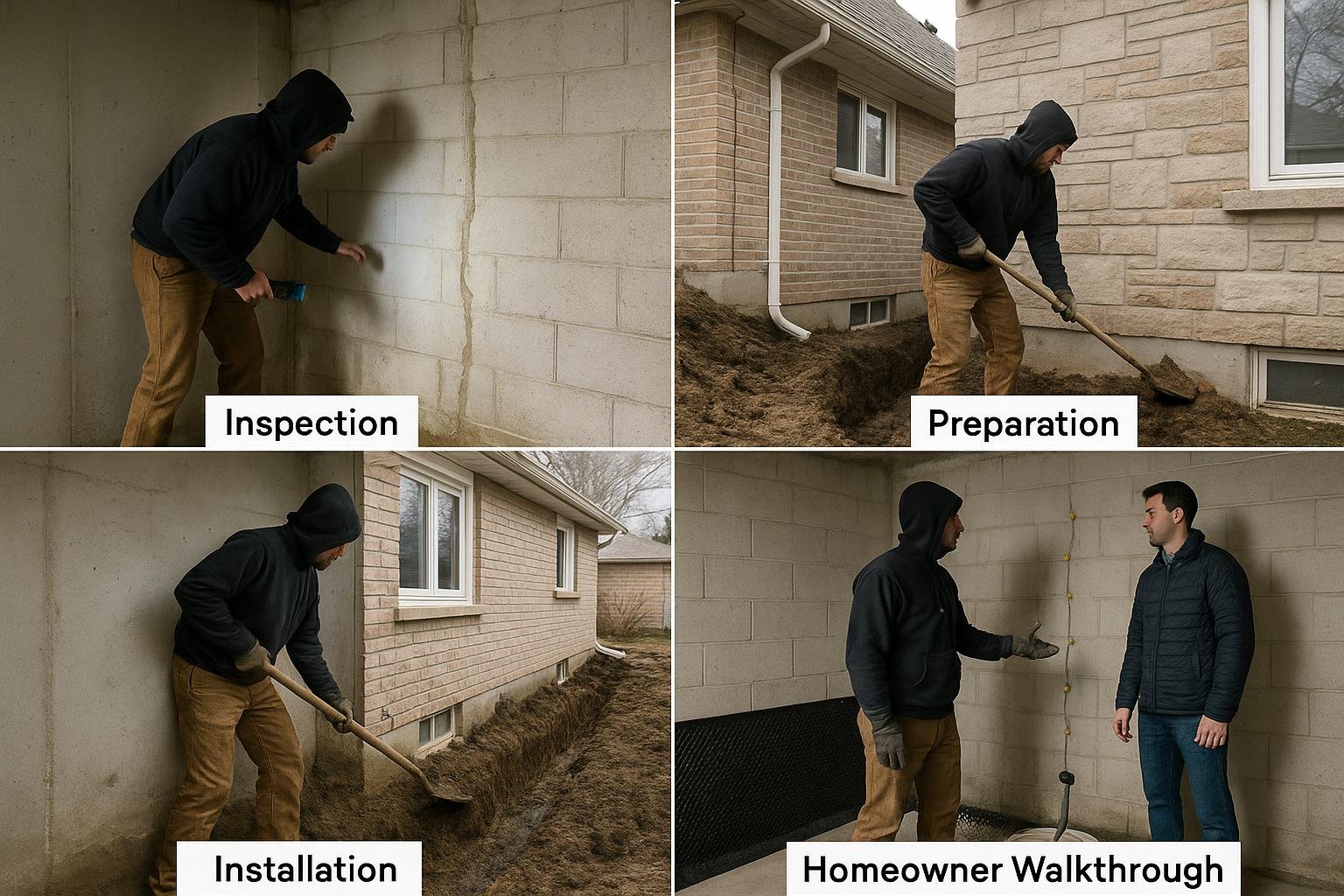
- Inspection and diagnosis. A waterproofing technician inspects the basement interior, examines wall cracks, checks for efflorescence and staining patterns, assesses the sump pit and pump if present, and reviews exterior grading and downspout discharge. The goal is to identify the primary water entry mechanism before recommending a method.
- Scope definition and proposal. Based on the inspection, a written scope of work is prepared. For crack injection, this identifies each crack to be treated. For drainage or waterproofing systems, it specifies the linear metres of wall or perimeter to be addressed, the drainage system design, and the sump pump specification.
- Site preparation. Interior work requires clearing the basement perimeter. Exterior work requires marking utilities, obtaining any required permits under the Ontario Building Code, and setting up excavation equipment. Homeowners should confirm permit requirements with the Town of Penetanguishene for structural foundation work.
- Core repair work. Depending on method: crack ports are drilled and resin injected; drainage channel is cut into the floor slab and installed; exterior wall is excavated, cleaned, membrane applied, drainage board installed, and weeping tile laid in gravel; or sump pit is dug and pump installed.
- Backfill, restoration and cleanup. Exterior excavations are backfilled with granular material to promote drainage, and the surface is restored. Interior floor cuts are patched with concrete. The site is cleaned and the system is tested before the crew leaves.
- Homeowner walkthrough. The technician explains what was done, demonstrates sump pump operation and testing, and reviews maintenance requirements. Any warranty documentation is provided at this stage. DryShield offers a lifetime transferable warranty on qualifying work.
- Post-installation monitoring. Homeowners are advised to monitor the basement through the first spring snowmelt after repair, test the sump pump before the melt season, and contact the contractor if any new seepage appears.
Frequently asked questions
Why does my Penetanguishene basement flood every spring but stay dry the rest of the year?
The seasonal pattern points to snowmelt as the primary driver. Penetanguishene’s clay soils drain slowly, so the large volume of water released when the snowpack melts in March and April saturates the ground faster than it can disperse. This creates a temporary but sharp spike in the water table and hydrostatic pressure that overwhelms aging drainage systems or pushes through existing cracks. The fix depends on whether the entry point is a crack, a failed weeping tile, or inadequate drainage capacity.
Is polyurethane crack injection a permanent fix?
Polyurethane injection creates a durable, flexible seal within the crack that is designed to last the life of the structure when the crack is properly prepared and injected from face to face. However, it does not address the hydrostatic pressure that caused the crack. If drainage around the foundation is inadequate, water pressure may cause new cracks to form elsewhere. Injection is most effective when combined with a review of overall drainage conditions. See the polyurethane injection guide for detail.
Can I waterproof my basement from the inside only, or do I need exterior excavation?
Interior waterproofing is a legitimate and widely used solution that manages water after it enters the foundation system, rather than blocking it at the exterior wall. It is appropriate when exterior excavation is impractical or when the primary need is drainage management rather than membrane replacement. Exterior waterproofing is necessary when the exterior membrane has failed or when the weeping tile must be replaced. Many Penetanguishene homes are successfully protected with interior systems. A professional inspection determines which approach addresses the actual failure mechanism.
How do I know if my weeping tile has failed?
Signs of failed weeping tile include chronic basement seepage along the wall-floor joint, water entry that does not correlate with specific wall cracks, and a sump pit that fills rapidly during snowmelt or rain. A definitive assessment requires a camera inspection of the existing pipe or excavation to expose the tile. Homes built before the 1980s in Penetanguishene are more likely to have original clay tile that has cracked or collapsed over time. The weeping tile problems guide describes the signs in detail.
Do I need a permit for basement waterproofing work in Penetanguishene?
Permit requirements depend on the scope of work. The Ontario Building Code requires permits for structural foundation repair and for excavation that affects the structural integrity of the foundation. Crack injection and interior drainage systems typically do not require a permit, but exterior excavation and structural repairs generally do. Homeowners should confirm current requirements with the Town of Penetanguishene’s building department before work begins. The Ontario Building Code waterproofing guide provides general context.
What is the difference between dampproofing and waterproofing?
Dampproofing is a basic coating, typically asphalt-based, applied to the exterior of a foundation wall during original construction to resist soil moisture under normal conditions. It is not designed to withstand sustained hydrostatic pressure. Waterproofing uses a fully bonded membrane system rated to resist water under pressure. Most homes built before the 1990s in Ontario were dampproofed rather than waterproofed, which is why exterior membrane replacement is sometimes necessary when hydrostatic conditions have intensified. The basement wet repair guide explains the distinction further.
How long does a sump pump last, and when should I replace it?
Most residential sump pumps have a service life of seven to twelve years under normal operating conditions, though pumps in high-water-table areas like Penetanguishene may cycle more frequently and wear sooner. Signs that replacement is needed include unusual noise, slow discharge, failure to activate, or a pump that runs continuously. Annual testing before the spring melt season is the minimum recommended maintenance. A battery backup unit should be tested at the same time. See how to test sump pump sensors for a step-by-step process.
Will basement waterproofing affect my home’s resale value?
A dry, protected basement is generally viewed positively by buyers and home inspectors. A documented waterproofing system with a transferable warranty can be a selling point, as it reduces buyer concern about water risk. The basement waterproofing ROI guide discusses the relationship between waterproofing and resale value in the Ontario market. No specific Penetanguishene resale data has been supplied to this guide.
Does home insurance cover basement flooding in Penetanguishene?
Standard home insurance policies in Ontario typically exclude damage caused by groundwater seepage or hydrostatic pressure, which are the primary flooding mechanisms in Penetanguishene. Overland flood coverage and sewer backup coverage are available as optional endorsements from most insurers and are worth reviewing given the local risk profile. Waterproofing repairs themselves are generally not covered by insurance. The home insurance and waterproofing guide explains coverage categories in detail. Verify current policy terms directly with your insurer.
If your Penetanguishene basement has shown signs of water entry, whether a damp patch after snowmelt, a visible crack, or standing water after a spring storm, the DryShield team is available to assess the situation and recommend the repair method that matches the actual cause. Contact us through the DryShield contact page or use the basement leak diagnostic tool to begin identifying your problem. Nearby communities including Midland and Wasaga Beach face similar Georgian Bay clay conditions and are within our service area.