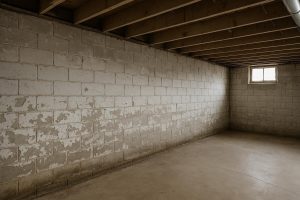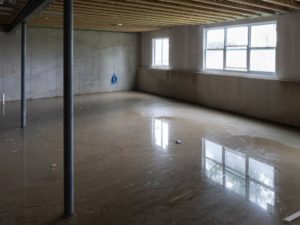
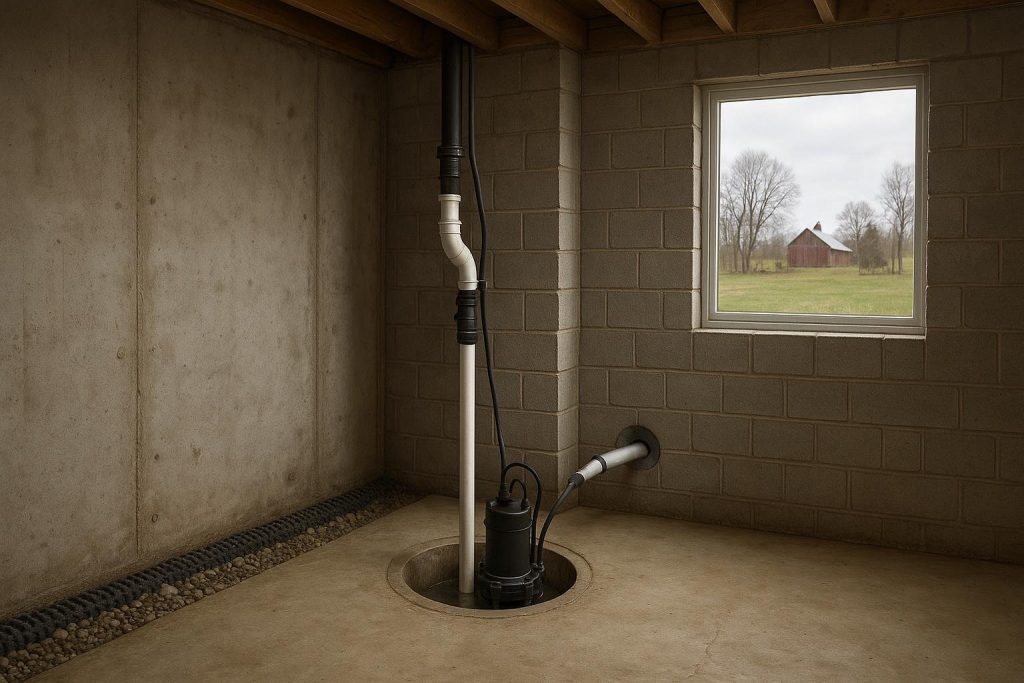
Sump pump installation in Clearview Township is one of the most effective ways to protect a basement from water intrusion driven by the area’s clay-heavy soils, seasonal snowmelt from the Niagara Escarpment, and a water table that rises sharply each spring. A correctly sized and properly installed sump system collects groundwater before it can enter the living space and discharges it safely away from the foundation. This guide covers every option available to Clearview homeowners, how to compare them, what drives cost, and the steps a professional installation follows.
- Clearview’s mix of clay till, sandy loam pockets, and proximity to the Escarpment creates variable but often high seasonal water tables.
- A sump pump is rarely a stand-alone fix; it works best paired with a drainage system such as a weeping tile or interior perimeter drain.
- Battery backup and water-level alarms are especially important for rural Clearview properties where power outages during storms are common.
- Permit requirements for excavation and drainage alterations follow the Ontario Building Code; confirm with Clearview Township before work begins.
- Cost is driven by pit depth, pump type, discharge distance, and whether new drainage tile must be installed alongside the pump.
Definitions & scope
A sump pump is a submersible or pedestal electric pump installed in a pit (the sump basin) dug into the lowest point of a basement floor. When groundwater rises and enters the pit through perforations or through connected drainage tile, the pump activates and moves water through a discharge pipe to daylight, a storm drain, or a dry well located well away from the foundation.
The scope of a sump pump installation can range from a simple pump swap in an existing pit to a full system that includes breaking the concrete floor, excavating a new pit, installing a perforated basin liner, connecting interior weeping tile around the perimeter, and restoring the concrete. In Clearview Township, where many homes sit on rural lots with no municipal storm sewer, the discharge route and dry-well sizing are as important as the pump itself. The Ontario Building Code governs drainage alterations and excavation near foundations; homeowners should verify local permit requirements with Clearview Township’s building department before any structural work begins.
Why this matters
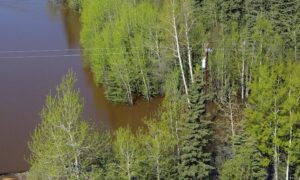
Clearview Township spans a broad area of Simcoe County that includes the communities of Stayner, Creemore, Nottawa, New Lowell, and Sunnidale Corners. The landscape transitions from the sandy soils of the Minesing Wetlands corridor in the east to the clay-rich till that blankets much of the Escarpment foothills. Homes in lower-lying areas near the Mad River and its tributaries can experience groundwater that rises within centimetres of the basement slab during spring freshet.
The Niagara Escarpment acts as a natural water collector. Snowpack accumulates heavily on its slopes through winter, and rapid thaw events in March and April send large volumes of meltwater downslope into the clay soils below. Clay drains slowly, so hydrostatic pressure builds against foundation walls and slabs for weeks after a thaw event. Older homes in Creemore and Stayner with clay-tile weeping tile that has collapsed or silted over have little drainage relief, making an active sump pump the primary line of defence.
Power outages during spring storms are a documented reality in rural Simcoe County. A pump that loses power at the worst moment provides no protection. This is why battery backup systems and cellular water alarms are not optional extras in Clearview; they are core components of a reliable installation. For more on protecting seasonal and rural properties, see the DryShield guide on sump pumps for seasonal and unoccupied cottages: battery backup, alarms and winter protection.
Your options
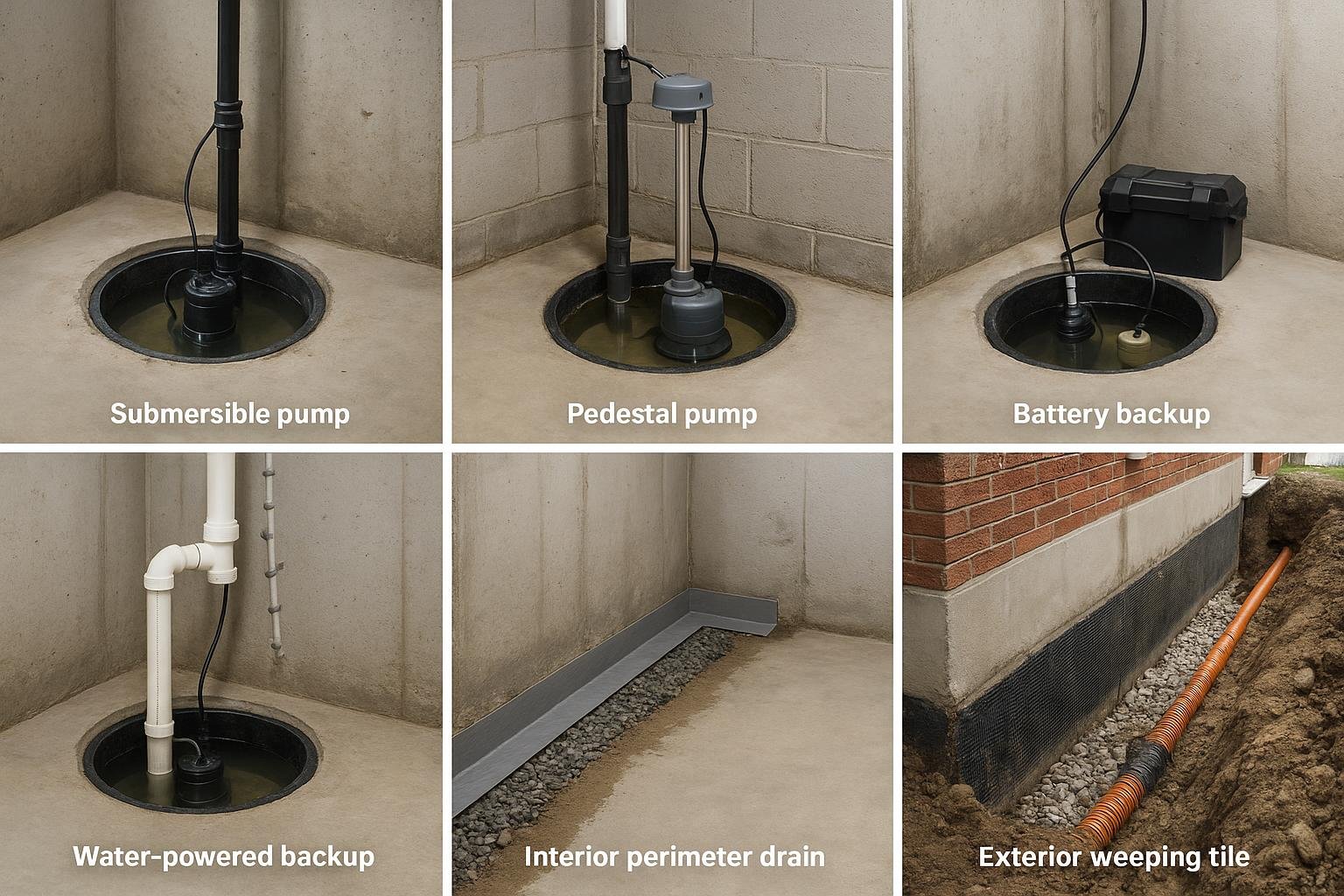
Submersible sump pump (standard)
A submersible pump sits inside the sump basin below the water line. The motor is sealed and cooled by the surrounding water. Most residential submersible pumps are rated between 1/3 and 3/4 horsepower and can move several thousand gallons per hour depending on the head pressure (the vertical height water must be lifted plus friction losses in the discharge pipe).
How it works: A float switch or pressure sensor detects rising water in the pit and activates the pump automatically. Water exits through a discharge pipe, typically 1.5 inches in diameter, routed through the rim joist or foundation wall to daylight.
Best for: Most Clearview homes with an existing pit or a new pit being installed as part of a drainage system upgrade.
Limitations: Requires a dedicated electrical circuit. Motor lifespan is typically 7 to 10 years under normal use, shorter if the pump runs frequently due to high groundwater. Loses function during power outages without a backup system.
Pedestal sump pump
A pedestal pump mounts the motor above the pit on a vertical shaft, keeping it out of the water. The impeller at the bottom of the shaft draws water up and into the discharge line.
How it works: Similar float-switch activation to a submersible. Because the motor is above water, it is easier to service without removing the pump from the pit.
Best for: Narrow pits where a submersible unit will not fit, or situations where easy motor access is a priority.
Limitations: Noisier than a submersible. The exposed motor is more vulnerable to moisture in a damp basement environment. Generally considered less durable than a quality submersible for high-volume applications.
Battery backup sump pump
A battery backup system pairs a secondary pump (powered by a 12-volt or 24-volt deep-cycle battery) with the primary pump. The backup activates automatically when the primary pump fails or when power is lost.
How it works: A trickle charger keeps the battery topped up during normal operation. When the primary pump’s circuit loses power or the primary pump is overwhelmed, the backup pump engages. Some systems use a combination unit that integrates both pumps in one basin.
Best for: All Clearview Township installations, given the frequency of rural power outages during the spring thaw and summer storm season. Particularly important for homes near the Mad River floodplain or in low-lying areas of Stayner and New Lowell.
Limitations: Battery capacity is finite; a standard 12-volt battery may run the backup pump for 5 to 12 hours depending on cycling frequency. Batteries require replacement every 3 to 5 years. Does not replace a properly sized primary pump.
Water-powered backup sump pump
A water-powered backup uses municipal water pressure to create a venturi effect that draws sump water up and out through the discharge line. No electricity or battery is required.
How it works: When the primary pump fails, a float valve opens a municipal water supply line. Incoming water flows through a venturi nozzle, creating suction that lifts sump water. For every gallon of municipal water used, approximately one gallon of sump water is removed.
Best for: Homes on municipal water supply in Stayner or Nottawa where a battery backup is not preferred and water consumption during emergencies is acceptable.
Limitations: Not suitable for homes on well water, as it depletes the well and may not maintain adequate pressure. Consumes municipal water during operation. Not permitted in all municipalities; verify with Clearview Township’s building department. Pumping rate is lower than a battery backup system.
Interior perimeter drainage system with sump pump
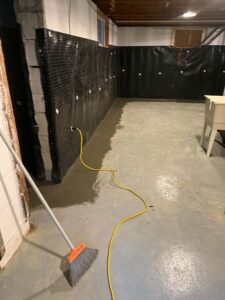
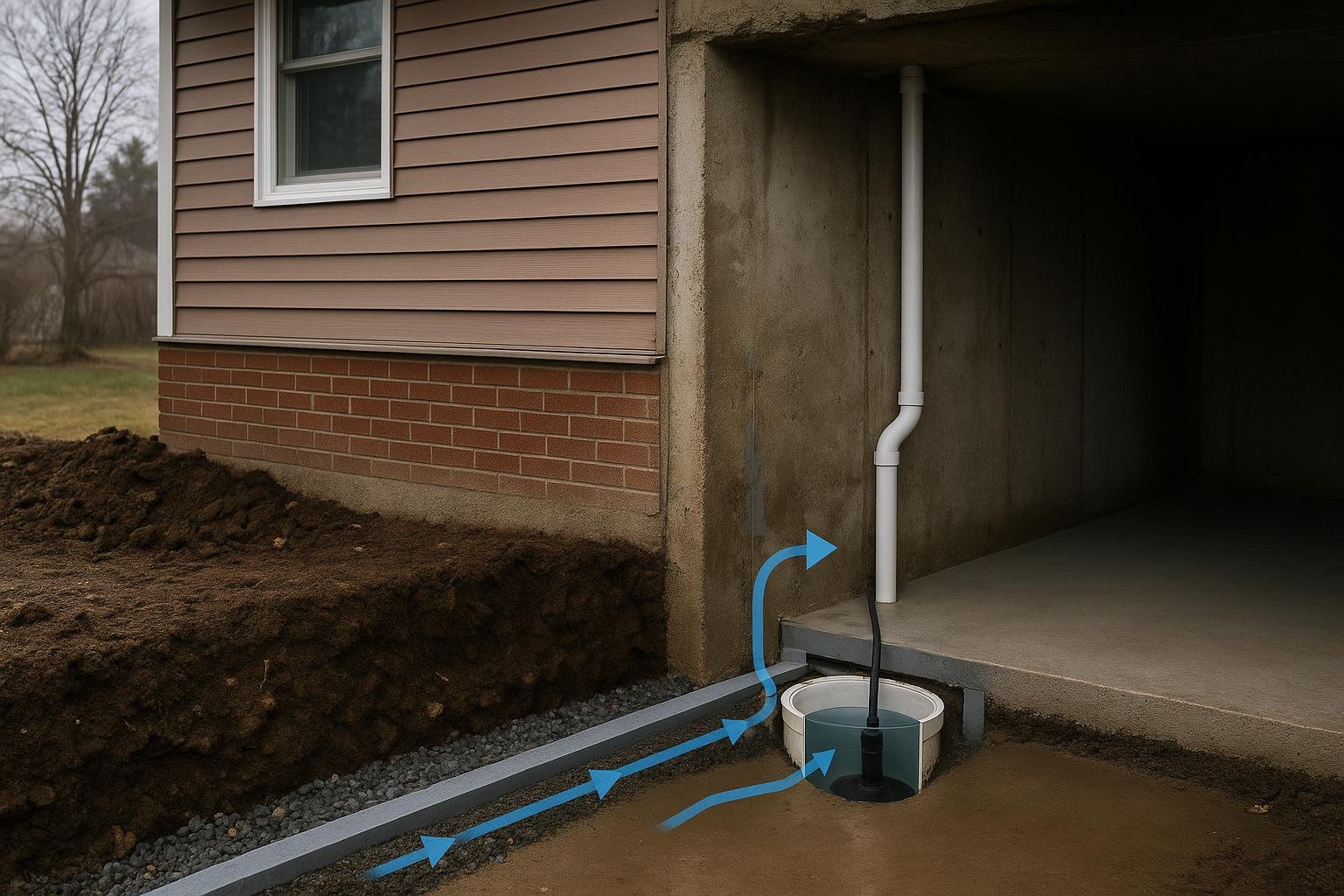
This is a full drainage solution rather than just a pump swap. A channel is cut into the concrete floor at the perimeter of the basement, a perforated pipe is laid in gravel, and the concrete is restored. All collected water drains to a central sump pit where the pump discharges it outside.
How it works: Water that seeps through the foundation wall or up through the floor joint is intercepted at the footing level and directed to the pit before it can spread across the floor. The system works passively; the pump only activates when water accumulates in the pit.
Best for: Clearview homes with chronic perimeter seepage, failed or silted exterior weeping tile, or where exterior excavation is not practical due to landscaping, driveways, or lot constraints.
Limitations: Does not stop water from entering the wall; it manages water after entry. Requires breaking and restoring the concrete floor. More disruptive and costly than a pump-only installation. See the DryShield guide on drain tile for more detail on how perimeter drainage works.
Exterior weeping tile replacement with sump pump
Where the original exterior weeping tile has failed, excavating the foundation perimeter, installing new drainage membrane and weeping tile, and connecting the system to a sump pit provides the most complete solution.
How it works: Excavation exposes the foundation wall to footing depth. A drainage board and waterproofing membrane are applied to the wall. New perforated pipe in a gravel bed collects groundwater before it reaches the wall and directs it to the sump pit or to daylight if the grade permits.
Best for: Homes with significant wall deterioration, failed damp-proofing, or where interior drainage alone is insufficient. Relevant to older Creemore and Stayner homes where original clay tile has collapsed.
Limitations: Highest cost and disruption of all options. Requires permits. Landscaping, decks, and driveways may need to be removed and restored. See the broader basement waterproofing guide for Simcoe County for context on exterior methods in this region.
Options compared
| Option | Best for | Typical considerations | Durability / limitations |
|---|---|---|---|
| Submersible pump (standard) | Most homes with existing or new pit | Requires dedicated circuit; quiet operation | 7-10 year motor lifespan; no power = no protection |
| Pedestal pump | Narrow pits; easy service access | Noisier; motor exposed to basement humidity | Comparable lifespan but less suited to high-volume use |
| Battery backup pump | Rural properties; power-outage-prone areas | Battery replacement every 3-5 years; finite runtime | 5-12 hours backup capacity per charge cycle |
| Water-powered backup | Municipal water supply; no battery preference | Not for well water; consumes municipal supply | Lower pumping rate; permit verification required |
| Interior perimeter drain + pump | Chronic perimeter seepage; failed exterior tile | Floor cutting and restoration required | Long-lasting if properly installed; manages not stops entry |
| Exterior weeping tile + pump | Failed exterior drainage; wall deterioration | Highest cost and disruption; permits required | Most complete solution; addresses source directly |
For most Clearview Township homes experiencing seasonal water intrusion, a submersible primary pump combined with a battery backup is the practical starting point. Homes with chronic perimeter seepage or failed original weeping tile will benefit from adding an interior drainage system. Exterior excavation is warranted when wall deterioration or failed damp-proofing is confirmed. No single pump option eliminates the need to address the drainage conditions that cause water to accumulate in the first place.
How to choose
The right system depends on the source of water, the property’s infrastructure, and the risk tolerance of the homeowner.
Choose a submersible pump replacement if you already have a functioning sump pit and the existing pump has reached the end of its service life, or if water entry is limited to the pit area and the surrounding drainage is still functional.
Choose a battery backup system if your property is in a rural part of Clearview Township where power outages during spring storms are a realistic risk, or if the basement contains finished space, mechanical equipment, or stored valuables that cannot tolerate even brief flooding.
Choose an interior perimeter drainage system with pump if water is entering along the base of the foundation walls, if the floor-wall joint shows seepage, or if exterior weeping tile is known to have failed and exterior excavation is not feasible.
Choose exterior weeping tile replacement if a professional inspection confirms that the foundation wall itself is deteriorating, that the original damp-proofing has failed, or that water is entering through the wall face rather than only at the footing. This is the most complete but most disruptive option.
Choose a water-powered backup only if the property is on municipal water, a battery backup is not preferred, and the local building department confirms it is permitted.
If you are unsure which source is driving water into your basement, DryShield’s basement leak diagnostic tool can help narrow down the cause before committing to a solution. The guide on whether you need a perimeter water solution is also a useful reference.
Costs & timelines
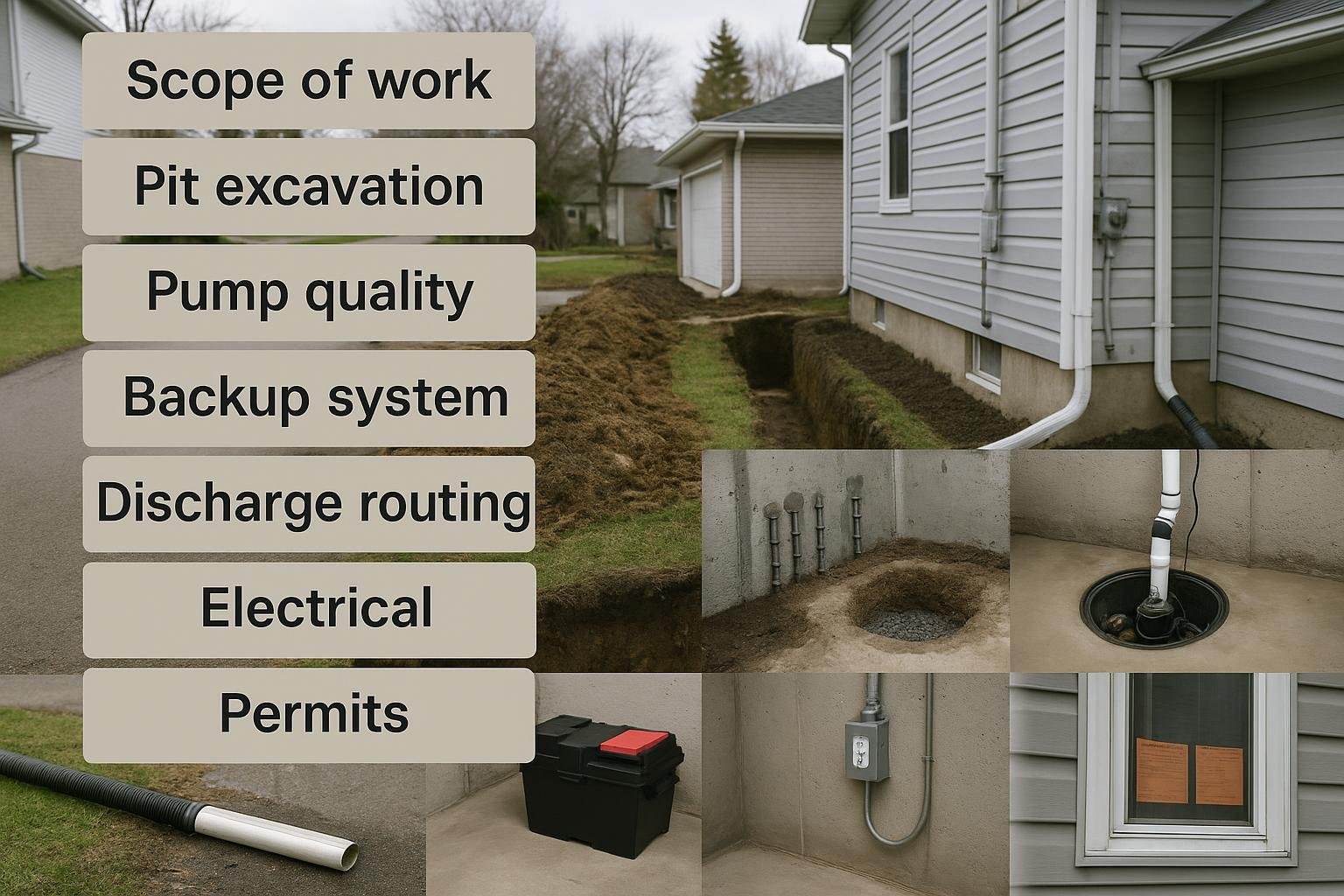
No verified current price quotes for Clearview Township are available to this guide. The following describes cost drivers ranked by their typical influence on the final scope; homeowners should obtain written quotes from licensed contractors for accurate figures.
| Cost driver | Why it matters | Relative impact |
|---|---|---|
| Scope: pump swap vs. full drainage system | A pump replacement in an existing pit is far less labour-intensive than cutting the floor and installing perimeter tile | Highest |
| Pit excavation and concrete restoration | New pit requires breaking concrete, excavating, installing liner, and patching; adds significant labour and material cost | High |
| Pump capacity and quality | Higher-horsepower pumps and cast-iron models cost more than entry-level thermoplastic units but typically last longer | Moderate |
| Backup system type | Battery backup adds cost for the secondary pump, battery, and charger; combination units cost more than add-on units | Moderate |
| Discharge route length and complexity | Longer runs, multiple bends, or routing through finished walls increase labour and material | Moderate |
| Electrical work | A dedicated GFCI-protected circuit may be required if one does not exist; licensed electrician cost applies | Low to moderate |
| Permits | Structural drainage work may require a building permit from Clearview Township; permit fees and inspection scheduling add time | Low |
A simple pump replacement in an existing pit is typically a one-day job. A full interior perimeter drainage system with a new pit can take two to four days depending on basement size. Exterior excavation projects are longer and depend on soil conditions, access, and weather. Spring is the busiest season for waterproofing contractors in Simcoe County; scheduling in late summer or fall often means shorter lead times.
Risks & common mistakes
Undersizing the pump. Choosing a pump based on price rather than the volume of water the system must handle is the most common error. A pump that cannot keep up with peak inflow during a spring thaw event will allow the pit to overflow. A contractor should calculate the required flow rate based on the drainage area and soil permeability before specifying a pump.
No backup system. A primary pump without a battery backup is a single point of failure. In rural Clearview, where power can be interrupted for hours during severe weather, this is a serious risk. The DryShield guide on battery backup and monitoring for sump pumps explains the options in detail.
Improper discharge location. Discharging within 1.5 to 2 metres of the foundation simply recirculates water back into the soil around the house. The discharge must terminate well away from the foundation and must not direct water onto a neighbouring property or into a septic system.
No check valve. Without a check valve on the discharge line, water in the pipe flows back into the pit when the pump stops, causing the pump to cycle repeatedly and wear out prematurely.
Skipping the alarm. A water-level alarm or smart sensor alerts homeowners when the pit water level rises above normal, indicating a pump failure or an inflow rate that exceeds pump capacity. In a finished basement, the cost of a sensor is trivial compared to the cost of water damage. See the guide on how to test smart sump pump sensors.
Treating the pump as the only fix. A sump pump manages water that has already reached the pit. If foundation cracks are allowing water to enter the wall above the footing, the pump will not stop that entry. Crack injection or exterior waterproofing may be needed alongside the pump. The guide on waterproofing a basement covers the full range of complementary methods.
Neglecting maintenance. Sump pumps require periodic testing, pit cleaning, and float-switch inspection. A pump that has not been tested before the spring thaw may fail at the worst possible time.
How the process works
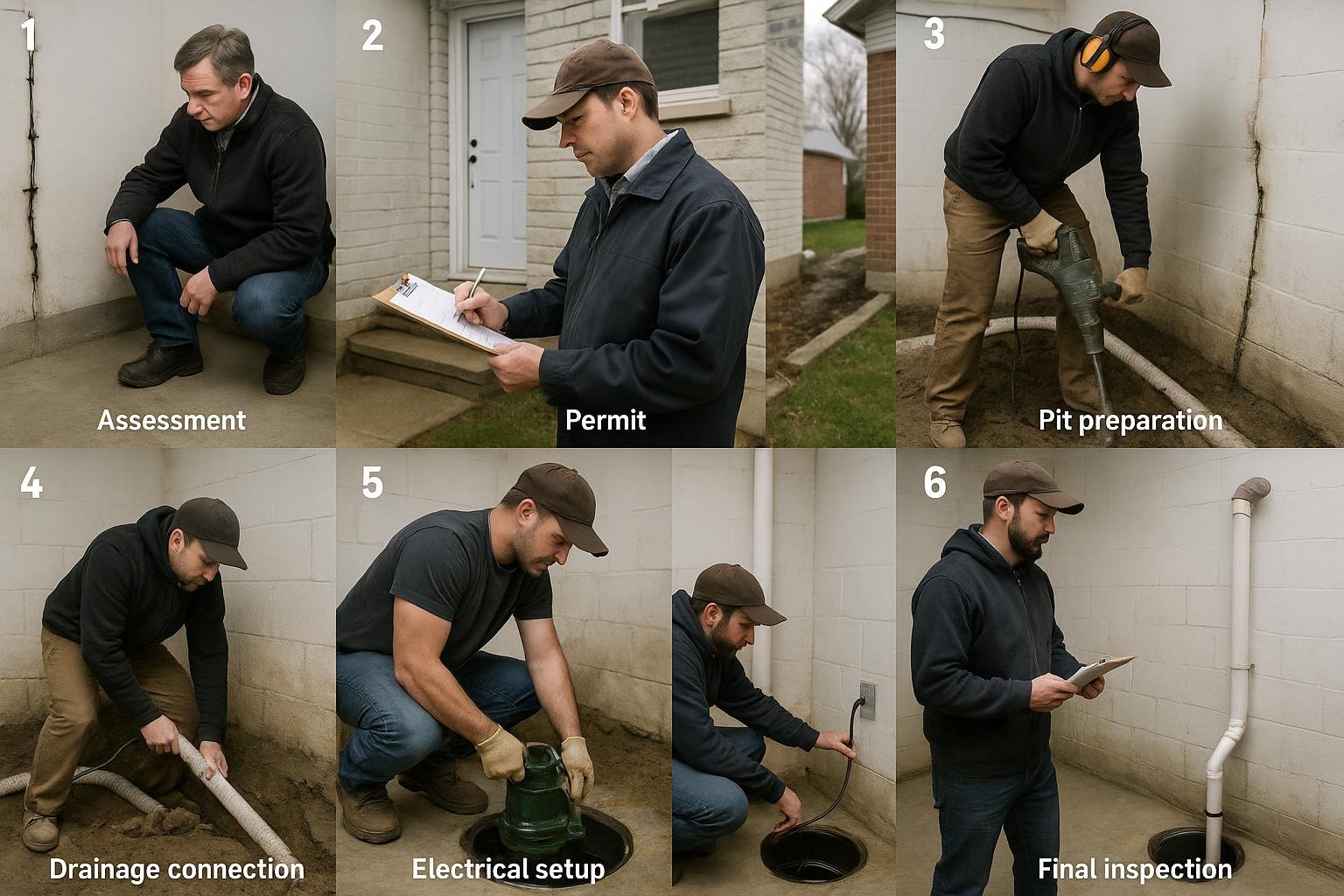
- Assessment and diagnosis. A waterproofing professional inspects the basement, identifies water entry points, evaluates the existing pit (if any), checks the discharge route, and assesses whether a drainage system is needed alongside the pump. Soil conditions and the water table depth inform pump sizing.
- Permit confirmation. For new pit excavation or drainage system installation, the contractor confirms whether a building permit is required from Clearview Township’s building department and obtains it before work begins.
- Pit preparation. If a new pit is required, concrete is cut and removed, the pit is excavated to the correct depth (typically below the footing), a perforated basin liner is installed, and gravel is packed around it. If an existing pit is being used, it is cleaned and inspected.
- Drainage connection. If an interior perimeter drain is part of the scope, the perimeter channel is cut, perforated pipe is laid in gravel, and the channel is connected to the pit. The concrete floor is then restored.
- Pump and backup installation. The primary pump is set in the pit, the float switch is adjusted to the correct activation level, and the discharge pipe is run to the exterior termination point with a check valve installed. The backup system (battery or water-powered) is connected and tested.
- Electrical and alarm setup. The pump is connected to a dedicated GFCI-protected circuit. A water-level alarm or smart sensor is installed and tested. The homeowner is shown how to test the system manually.
- Final inspection and documentation. The contractor walks through the completed system with the homeowner, confirms the discharge location is compliant, and provides documentation of the installation including any warranty terms. For DryShield’s warranty information, see the lifetime transferable warranty page.
Frequently asked questions
Do I need a permit for sump pump installation in Clearview Township?
A simple pump replacement in an existing pit generally does not require a permit. However, installing a new pit, breaking the concrete floor for a perimeter drainage system, or making alterations to foundation drainage may trigger Ontario Building Code permit requirements. Clearview Township’s building department is the authoritative source; confirm before any structural work begins. Your contractor should be familiar with local requirements and should obtain any necessary permits on your behalf.
How do I know if my existing sump pit is the right size?
A standard residential sump pit is typically 18 inches in diameter and 24 to 30 inches deep, though larger pits are used in high-inflow situations. If your pump cycles on and off very frequently (short-cycling), the pit may be too small to give the pump adequate rest time between cycles, which shortens motor life. A waterproofing professional can assess whether the pit volume is appropriate for the inflow rate your soil and drainage conditions produce.
How long does a sump pump last?
Most residential submersible sump pumps have a service life of approximately 7 to 10 years under normal operating conditions. Pumps in high-inflow environments, such as homes near the Mad River floodplain or in low-lying areas of Stayner, may cycle more frequently and wear out sooner. Annual testing and periodic pit cleaning extend service life. Replacing a pump proactively at the 8 to 10 year mark is generally less costly than an emergency replacement after a failure during a spring flood event.
What should I do if my sump pump runs constantly?
Continuous operation usually means one of three things: the water table is genuinely very high and the pump is keeping up with real inflow; the float switch is stuck in the on position; or the check valve has failed and water is cycling back into the pit. Check the float switch for obstructions first. If the pump is running continuously during dry weather, a stuck float or failed check valve is the likely cause. If it is running continuously during or after heavy rain or snowmelt, the pump may be undersized for the inflow rate.
Can I install a sump pump myself?
Replacing an existing pump in an existing pit is a task some mechanically capable homeowners undertake, but it requires correct sizing, proper check valve installation, and a safe electrical connection to a GFCI-protected circuit. Installing a new pit, connecting perimeter drainage tile, or routing a new discharge line involves concrete cutting, excavation, and potentially permit-required work that should be performed by a licensed contractor. Errors in discharge routing or pit sizing can make the problem worse rather than better.
What is the difference between a sump pump and a weeping tile system?
Weeping tile (also called a perimeter drain or drain tile) is a perforated pipe buried at or below the footing level that collects groundwater and directs it to a discharge point or sump pit. The sump pump is the active component that moves water out of the pit and away from the home. The two systems are complementary: weeping tile gathers water from around the foundation, and the sump pump removes it. A pump without functional drainage tile may not collect enough water to be effective; drainage tile without a pump relies on gravity discharge, which is not always possible. See the drain tile guide for more detail.
Will a sump pump protect my basement from all types of water entry?
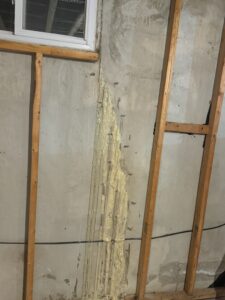
A sump pump protects against groundwater that rises into the pit through the drainage system or through the pit perforations. It does not stop water that enters through foundation wall cracks above the footing, through window wells, through the rim joist, or through surface water that enters via doors or window openings. If water is entering through a crack in the foundation wall, that crack should be addressed separately with polyurethane or epoxy injection. The guide to types of foundation cracks explains which crack types allow water entry and how each is repaired.
How far from the house should the sump pump discharge?
The discharge outlet should terminate at least 1.5 to 2 metres from the foundation wall, directed away from the house and away from neighbouring properties. In Clearview Township, where many homes are on larger rural lots, discharging to a low-lying area of the property or into a dry well is common. The discharge must not connect to a sanitary sewer and should not be directed toward a septic system or tile bed. A freeze-resistant discharge elbow or a buried discharge line that terminates below the frost line helps prevent ice blockages in winter.
Should I be concerned about my sump pump in winter?
In Clearview Township, the discharge line can freeze if it is not properly insulated or if the termination point is exposed to prolonged cold. A frozen discharge line causes the pump to run against a closed system, which can burn out the motor. Burying the discharge line below the frost line and using a freeze-resistant outlet elbow reduces this risk. The pump itself, submerged in the pit, is not at risk of freezing as long as the pit contains water. Seasonal cottage owners should follow specific winterization steps; the guide on closing and opening your cottage covers these procedures.
Does DryShield service Clearview Township?
DryShield serves Simcoe County and the broader Ontario cottage country region, including communities within Clearview Township such as Stayner, Creemore, Nottawa, and New Lowell. The Simcoe County basement waterproofing guide provides an overview of the services available across the region. Contact DryShield directly to confirm scheduling availability for your specific address.
If your Clearview Township home is showing signs of water intrusion, a rising water table, or a sump pump that is nearing the end of its service life, the DryShield team is available to assess your situation and recommend the right combination of drainage and pump solutions. Visit the sump pump installation services page or use the contact page to arrange an assessment.