Sump pump replacement is the process of removing a failed or aging pump from its pit and installing a new unit capable of managing groundwater before it enters your basement. Knowing when to replace rather than repair, and which pump type suits your home’s water load and pit configuration, prevents the single most common cause of basement flooding in Ontario: a pump that fails silently during a heavy rain event. This guide covers every decision point from diagnosis through installation.
- Most submersible sump pumps have a service life of 7 to 10 years; pedestal pumps can last longer but are noisier and less powerful.
- Replacement is usually the right call when a pump is over 7 years old, cycles constantly, runs dry, or fails to keep up with inflow.
- Choosing the correct horsepower and discharge capacity for your pit size and soil conditions matters more than brand alone.
- A battery backup or water-powered backup unit is a separate, parallel system and should be evaluated at the same time as the primary pump.
- Ontario Building Code requirements apply to new installations and may affect discharge routing; verify permit requirements with your municipality before work begins.
Definitions & scope
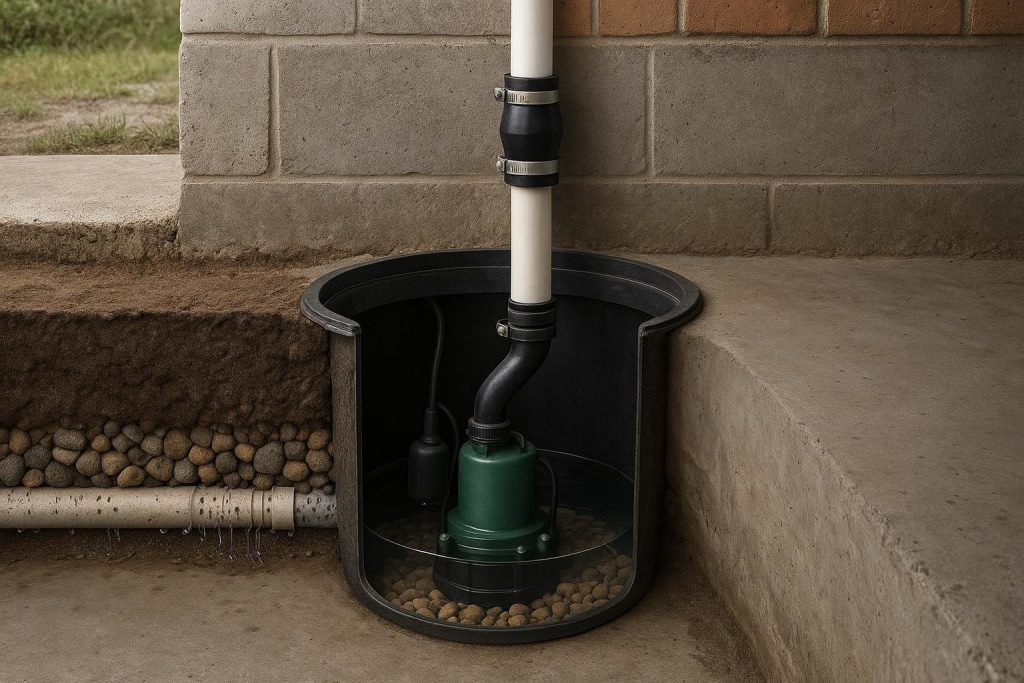
A sump pump is a motorized pump seated in a pit (the sump basin) excavated at the lowest point of a basement or crawl space. Its job is to collect groundwater that drains toward the pit through weeping tile or perforated pipe and discharge it away from the foundation through a dedicated discharge line.
Replacement refers specifically to swapping out the pump unit itself. It is distinct from full sump system installation, which involves excavating the pit, laying new weeping tile, and connecting drainage channels. Replacement may also include upgrading the basin liner, check valve, float switch, or discharge pipe if those components are worn.
Primary pump: the main electric pump that runs on household current. Backup pump: a secondary unit powered by a battery or water pressure that activates when the primary fails or loses power. Combination unit: a single assembly housing both primary and backup pumps in one basin.
This guide focuses on residential replacement decisions. For new pit excavation and full weeping tile systems, see the Sump Pump Installation Services page.
Why this matters
Ontario’s climate creates conditions that push residential sump pumps hard. Spring snowmelt, intense summer thunderstorms, and the freeze-thaw cycles common across the GTA and cottage country all generate rapid groundwater surges. A pump that is undersized, aging, or mechanically compromised will fail precisely when the load is highest.
The consequences of pump failure extend beyond a wet floor. Standing water damages framing, drywall, and stored belongings. Prolonged moisture promotes mold growth, which creates health risks and expensive remediation costs. Hydrostatic pressure that is no longer relieved by a working pump can worsen existing foundation cracks or force water through the floor slab. For a broader look at what happens when a pump fails entirely, see Sump Pump Failed and Basement Flooded: What to Do Right Now.
Many homeowners discover their pump has failed only after a flood event. Proactive replacement on a schedule tied to the pump’s age and observed performance is a more reliable strategy than waiting for a failure signal. This is especially true for seasonal or unoccupied properties, where a failed pump may go unnoticed for weeks. The guide on Sump Pumps for Seasonal & Unoccupied Cottages covers monitoring strategies for those situations.
Home insurance policies in Ontario vary widely in their coverage of sump-related flooding. Reviewing your policy before a failure occurs, rather than after, is advisable. The guide on Does Home Insurance Cover Basement Waterproofing & Foundation Cracks in Ontario? provides relevant context.
Your options
Submersible pump replacement
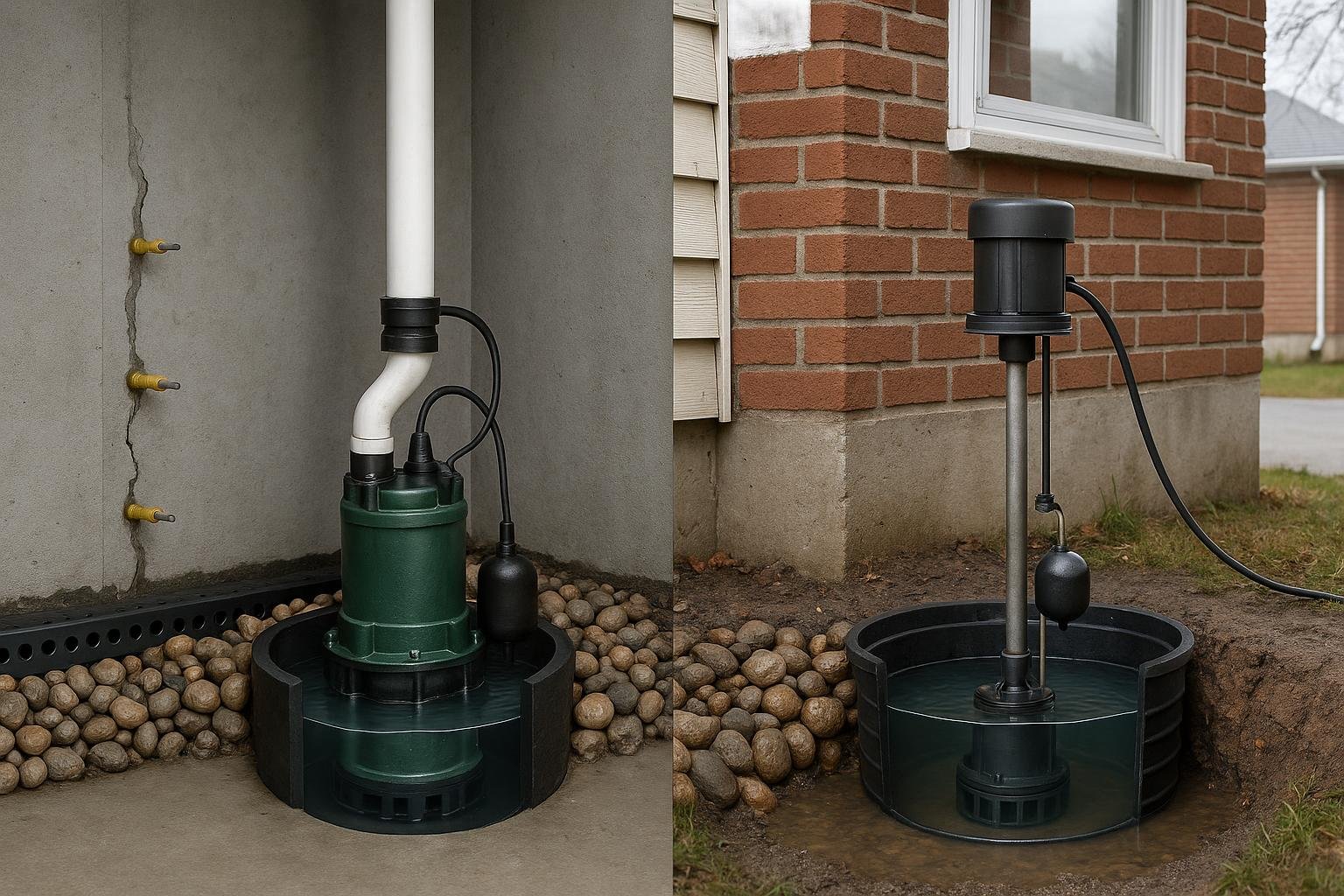
What it is: A submersible pump sits fully inside the sump pit, submerged in water during operation. The motor is sealed in a waterproof housing.
How it works: A float switch detects rising water and activates the motor. Water is drawn through an inlet screen at the base and pushed up through a discharge pipe that exits the pit and routes outside the foundation.
Best for: Most residential basements with a standard pit diameter of 45 to 60 cm. Submersible units are quieter than pedestal pumps and handle higher water volumes. They are the dominant choice for new replacements in Ontario.
Limitations: The motor operates in a wet environment, which can shorten lifespan if the pump runs dry repeatedly or if the pit collects fine sediment that clogs the inlet screen. Access for servicing requires lifting the unit out of the pit.
Pedestal pump replacement
What it is: A pedestal pump has its motor mounted on a vertical shaft above the pit, keeping the motor out of the water at all times.
How it works: The impeller at the base of the shaft sits in the water; the motor above drives it. A float arm on the shaft triggers the motor when water rises.
Best for: Narrow pits where a submersible unit will not fit, or where easy motor access for inspection is a priority.
Limitations: Pedestal pumps are louder than submersible units and generally move less water per minute at equivalent horsepower. They are less common in new residential installations but remain a practical option for constrained pit geometries.
Battery backup pump replacement or addition
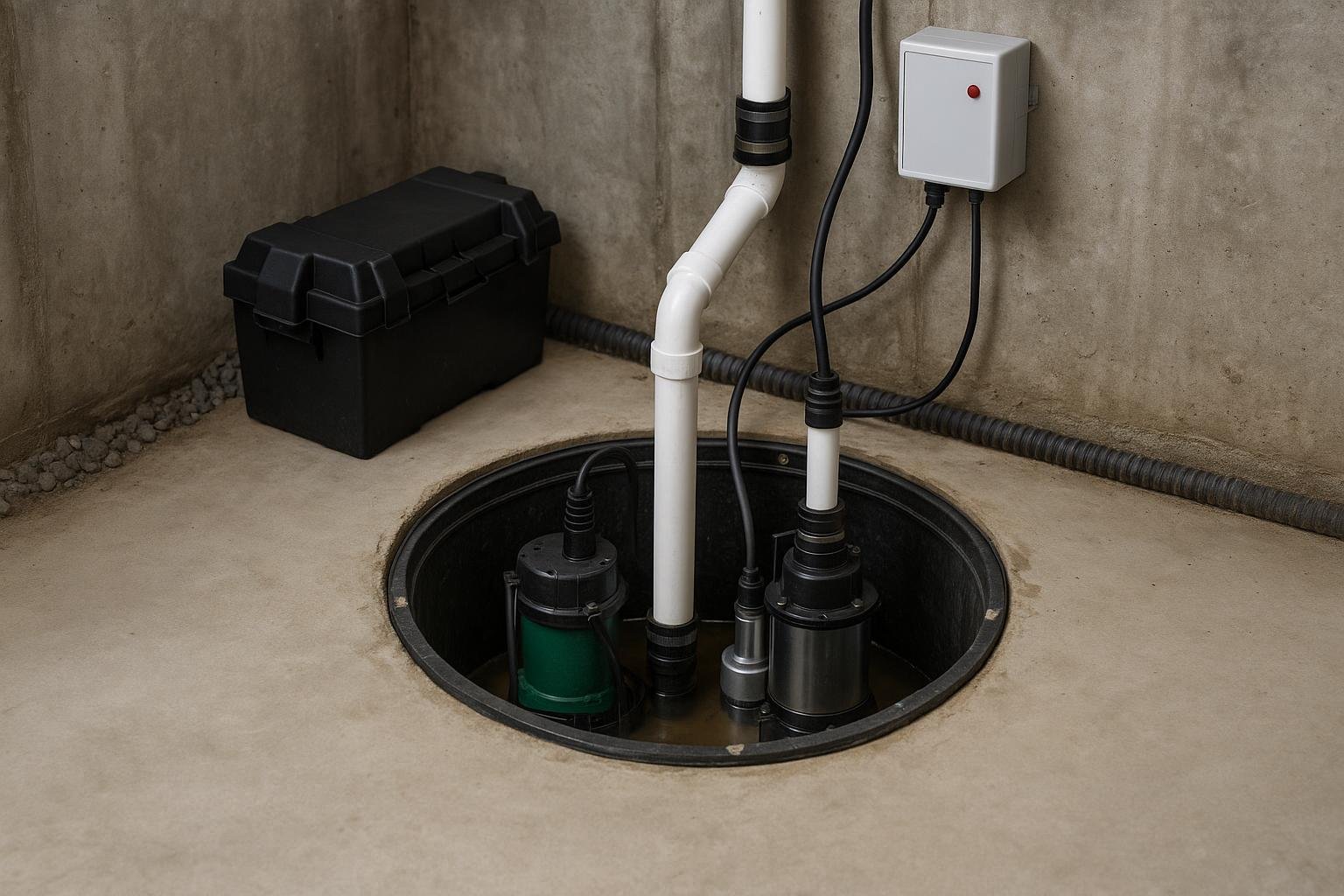
What it is: A battery-powered pump installed in the same pit as the primary pump, connected to a dedicated deep-cycle or AGM battery and charger.
How it works: The backup pump’s float is set higher than the primary pump’s float. If the primary fails or loses power, rising water reaches the backup float and the battery-powered unit activates.
Best for: Any home where power outages coincide with heavy rain events, which is a common pattern in Ontario during summer storms. Essential for unoccupied or seasonal properties.
Limitations: Battery capacity is finite. A fully charged AGM battery can typically run a backup pump for several hours of continuous operation, but actual runtime depends on inflow rate and pump draw. Batteries require periodic testing and replacement, typically every 3 to 5 years.
Water-powered backup pump
What it is: A backup pump that uses municipal water pressure rather than electricity or a battery to operate.
How it works: Venturi action created by flowing municipal water draws sump water up and out through the discharge line. No electricity is required.
Best for: Homes on municipal water supply where power outages are the primary concern and battery maintenance is undesirable.
Limitations: Water-powered backups consume municipal water during operation, which adds to water bills and may be restricted in some municipalities. They are not suitable for homes on well water. Pumping capacity is lower than battery backup units and depends on municipal water pressure.
Combination unit replacement
What it is: A single assembly that integrates a primary submersible pump and a battery backup pump in one housing, sharing a single pit.
How it works: The primary pump handles normal operation. An integrated controller monitors primary pump status and switches to the backup when the primary fails or is overwhelmed.
Best for: Homeowners replacing an aging primary pump who also want to add backup protection without installing a separate secondary pit or complex plumbing.
Limitations: If the pit is small, a combination unit may be a tight fit. Servicing one component sometimes requires disturbing the other. Cost is higher than a standalone primary replacement.
High-capacity pump upgrade
What it is: Replacing an existing pump with a unit of significantly higher horsepower or gallons-per-minute (GPM) rating to address chronic overload.
How it works: A higher-capacity pump moves more water per cycle, reducing the frequency and duration of run cycles during peak inflow events.
Best for: Homes where the existing pump runs almost continuously during rain events, where the pit fills faster than the pump can discharge, or where the property sits in a low-lying area with a persistently high water table.
Limitations: A pump that is significantly oversized for a pit will short-cycle, turning on and off rapidly, which stresses the motor and reduces lifespan. Matching pump capacity to actual inflow rate and pit volume requires an assessment of the drainage system, not just the pump specification.
Options compared
| Pump type | Best for | Typical considerations | Durability / limitations |
|---|---|---|---|
| Submersible (primary) | Standard residential pits, moderate to high water volume | Quieter operation; requires sealed motor housing | 7 to 10 years typical; inlet screen needs periodic cleaning |
| Pedestal (primary) | Narrow pits; easy motor access | Louder; motor stays dry | Can exceed 10 years; lower GPM than comparable submersible |
| Battery backup | Power-outage protection; unoccupied properties | Battery requires testing and replacement every 3 to 5 years | Hours of runtime per charge; capacity depends on inflow rate |
| Water-powered backup | Municipal water supply; no battery maintenance preference | Consumes municipal water; not for well systems | No battery to replace; lower pumping capacity than battery backup |
| Combination unit | Single-pit primary and backup integration | Higher upfront cost; pit size must accommodate unit | Dependent on battery health for backup portion |
| High-capacity upgrade | Chronic overload; high water table properties | Must match capacity to actual inflow to avoid short-cycling | Oversizing shortens motor life; proper sizing is critical |
The table above shows that no single pump type is universally superior. Submersible units suit the majority of Ontario homes with standard pit configurations, but the backup strategy is an independent decision that should be made alongside the primary pump choice. Homes in areas with frequent summer storm outages or seasonal vacancy benefit most from battery or combination backup systems. High-capacity upgrades are only appropriate when an assessment confirms the existing pump is genuinely undersized for the drainage load, not simply aging.
How to choose
Choose a submersible replacement if your existing pit is a standard diameter (45 cm or wider), your current pump is 7 or more years old and showing signs of wear, and your water volume during rain events is moderate. This is the most common replacement scenario for GTA and Ontario homeowners.
Choose a pedestal replacement if your pit is narrow and a submersible unit physically will not fit, or if you prefer a motor that is easy to inspect and service without lifting a submerged unit.
Choose a battery backup addition if you have a functioning primary pump that is not yet due for replacement but your area experiences power outages during storms. Adding a backup does not require replacing the primary. If both the primary and backup are due for replacement, a combination unit may be more economical.
Choose a water-powered backup if you are on municipal water, dislike battery maintenance, and your municipality permits the water consumption associated with backup pump operation. Confirm local bylaws before installation.
Choose a high-capacity upgrade only after a drainage assessment confirms that your current pump is genuinely undersized. If the pump is simply old, a like-for-like replacement at the same horsepower is usually the correct starting point.
Consider a full system review if your pump is failing but your weeping tile is also old or blocked. Replacing the pump without addressing a compromised drainage system that feeds it will not solve chronic wet basement problems. See Waterproofing a Basement: Your Complete Homeowner’s Guide for context on how pump replacement fits into a broader waterproofing strategy.
If you are unsure whether your problem is pump-related or originates from foundation cracks or wall seepage, the Basement Leak Diagnostic Tool can help narrow the source before you commit to a replacement.
Costs & timelines
No verified current price data for Ontario sump pump replacement has been supplied to this page. The following describes the factors that drive cost variation; for current estimates, use the Basement Waterproofing Cost Calculator or request a site assessment.
| Cost driver | Why it matters | Relative impact |
|---|---|---|
| Pump type and horsepower | Higher-capacity and combination units carry higher unit costs than standard submersible replacements | High |
| Backup system inclusion | Adding a battery backup or water-powered backup increases material and installation cost | High |
| Discharge pipe condition and routing | If the existing discharge pipe is cracked, undersized, or improperly routed, it must be replaced or re-routed | Moderate |
| Check valve and basin liner replacement | A worn check valve or cracked basin liner adds material and labour cost but is often worthwhile when replacing an aging pump | Low to moderate |
| Access difficulty | Pits in finished basements or tight mechanical rooms require more labour time | Moderate |
| Permit requirements | Some municipalities require a building permit for new installations; permit fees and inspection scheduling add cost and time | Low to moderate |
A straightforward like-for-like submersible pump swap in an accessible pit is typically a single-day job. Adding a backup system or replacing ancillary components extends the timeline modestly. Full weeping tile replacement, if required alongside the pump, is a separate and more involved scope of work.
Risks & common mistakes
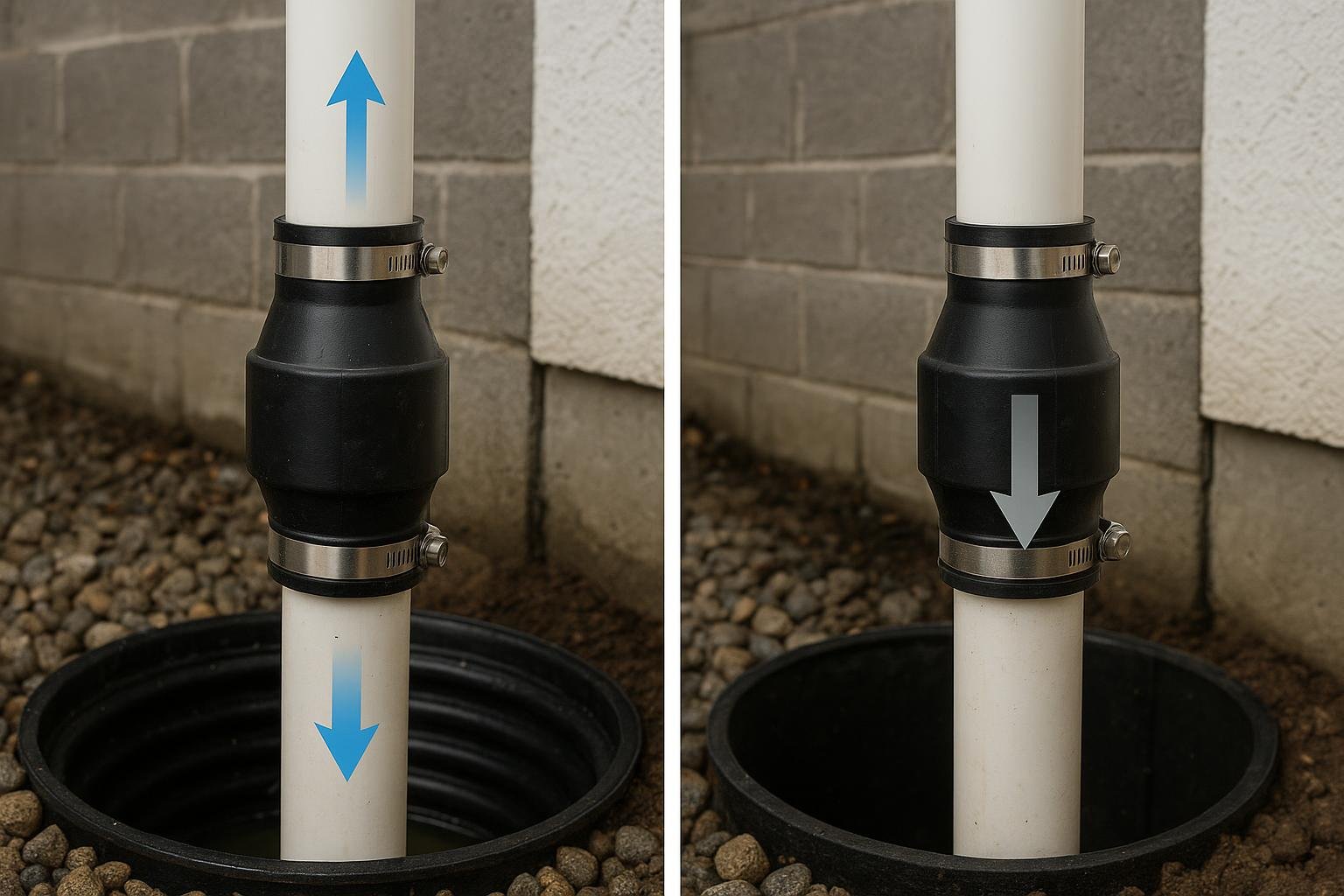
Replacing the pump without inspecting the check valve. The check valve prevents discharged water from flowing back into the pit when the pump stops. A failed check valve causes the pump to restart almost immediately after shutting off, dramatically increasing run cycles and accelerating motor wear. Always inspect and replace the check valve when replacing the pump.
Choosing the wrong horsepower. Undersizing leaves the pump unable to keep up during peak inflow. Oversizing causes short-cycling, which stresses the motor and reduces service life. Pump selection should be based on pit volume, drainage area, and observed inflow rate, not simply matching the horsepower of the outgoing unit.
Ignoring the discharge line. A discharge line that terminates too close to the foundation, drains toward the house, or is partially blocked will return water to the pit. Ontario Building Code requirements address discharge routing; verify that the new installation meets current requirements.
Skipping the backup system. A primary pump that is working perfectly today provides no protection during a power outage. Ontario summer storms frequently knock out power precisely when rainfall is heaviest. Installing a backup at the same time as a primary replacement is more cost-effective than returning for a separate installation later.
Neglecting the pit liner and float switch. A cracked or undersized basin liner allows fine soil to enter the pit and clog the pump inlet. A float switch that sticks or is positioned incorrectly will cause the pump to run dry or fail to activate. Both components should be assessed during any pump replacement.
Assuming pump replacement solves a drainage system problem. If weeping tile is collapsed, blocked with roots, or simply absent, a new pump will still be overwhelmed during heavy rain. If water is entering through wall cracks rather than through the drainage system, pump replacement alone will not keep the basement dry. See Sump Pump Not Working in Toronto? Here Is What to Check First for diagnostic steps before committing to replacement.
Failing to test the new installation. After replacement, the pump and backup system should be tested by slowly filling the pit with water to confirm float activation, check valve function, and discharge routing before the installation is considered complete.
How the process works
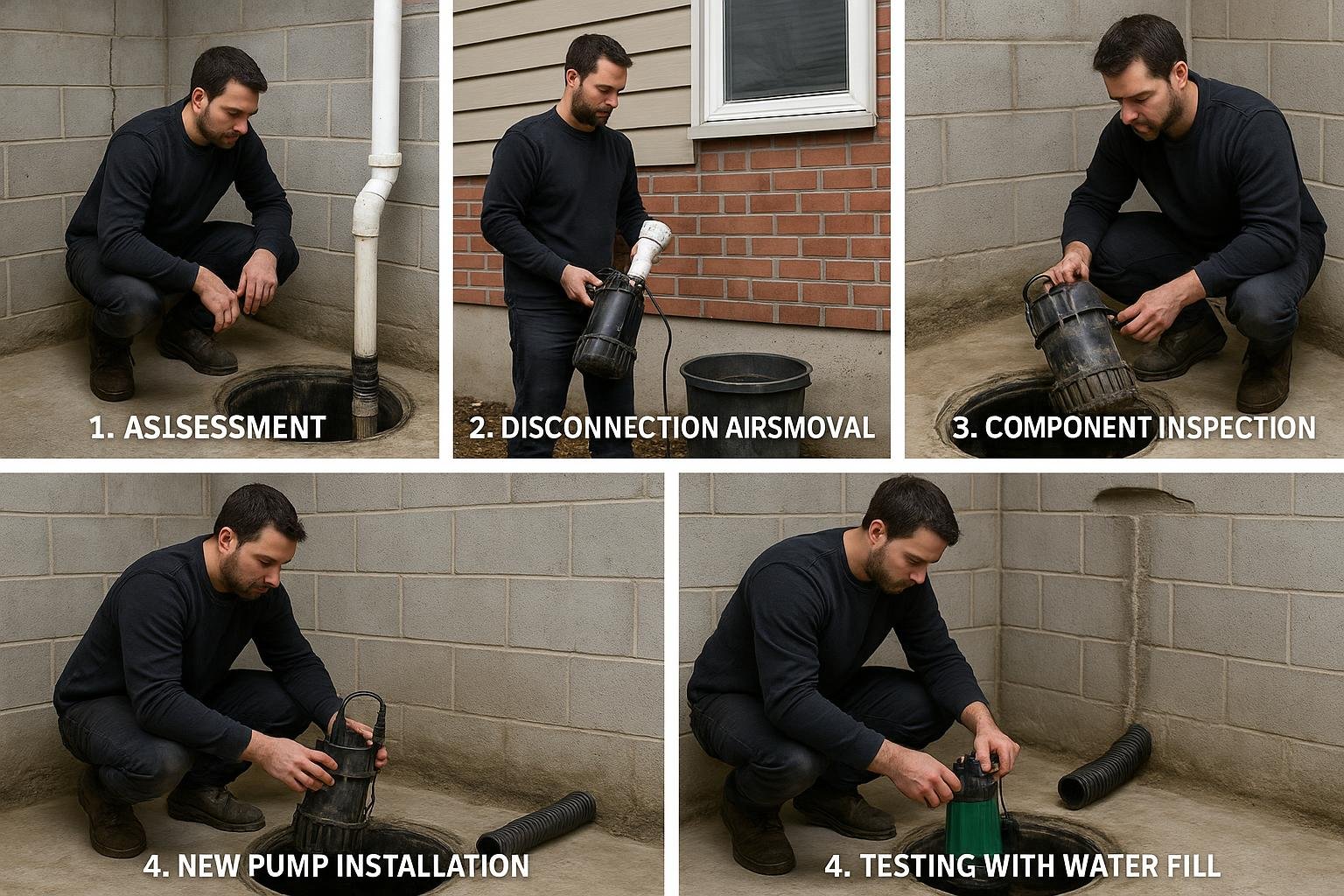
- Assessment and sizing. A technician inspects the existing pit, measures its diameter and depth, examines the condition of the basin liner, check valve, float switch, and discharge pipe, and reviews the drainage system that feeds the pit. Pump horsepower and type are selected based on this assessment, not on the outgoing pump’s nameplate alone.
- Disconnection and removal. The existing pump is disconnected from power and the discharge pipe. The unit is lifted from the pit and the pit interior is inspected for sediment accumulation, cracks in the liner, and root intrusion in the weeping tile inlet.
- Component replacement. The check valve, basin liner (if worn), and float switch are replaced as needed. The discharge pipe is inspected and repaired or re-routed if it does not meet current requirements.
- New pump installation. The replacement pump is lowered into the pit, connected to the discharge pipe, and the float switch is set at the correct activation height for the pit volume and inflow rate. If a backup system is being added, it is installed and connected at this stage.
- Testing and commissioning. The pit is filled with water to verify float activation, pump operation, check valve function, and correct discharge routing. The backup system is tested independently. The homeowner is shown how to test the system manually and advised on maintenance intervals.
Frequently asked questions
How do I know if my sump pump needs replacement rather than repair?
Replacement is generally the right choice when the pump is 7 or more years old, when it runs continuously without keeping up with inflow, when it makes grinding or rattling noises indicating bearing or impeller wear, or when it fails to activate despite water in the pit. A pump that trips its circuit breaker repeatedly or that has visible corrosion on its housing is also a replacement candidate. Repair is more appropriate for isolated issues like a stuck float switch on an otherwise young and functional unit. See Sump Pump Failure & Replacement: Warning Signs, Causes & Costs for a detailed breakdown.
How long does sump pump replacement take?
A straightforward like-for-like submersible pump replacement in an accessible pit typically takes two to four hours including testing. Adding a battery backup system or replacing ancillary components such as the check valve, basin liner, or discharge pipe extends the job. If the discharge pipe requires re-routing through the foundation wall or across the basement floor, the timeline increases further. A technician can give a more accurate estimate after inspecting the existing installation.
Do I need a permit to replace a sump pump in Ontario?
Permit requirements vary by municipality. A direct like-for-like pump swap in an existing pit is often treated as maintenance and may not require a permit, but a new installation, pit excavation, or significant discharge pipe re-routing may trigger permit requirements under the Ontario Building Code. Confirm with your local building department before work begins. A qualified contractor familiar with local requirements can advise on this during the assessment stage.
What horsepower sump pump do I need?
Most residential applications in Ontario are served by pumps in the one-third to one-half horsepower range. Homes with high water tables, large drainage areas, or properties in low-lying areas may require three-quarter horsepower or higher. The correct selection depends on the pit’s volume, the rate at which water enters the pit during a peak event, and the vertical and horizontal distance the pump must push water through the discharge line. Selecting by horsepower alone without considering these factors risks undersizing or oversizing the unit.
Can I replace a sump pump myself?
A homeowner with basic plumbing and electrical competence can perform a like-for-like submersible pump swap in an existing pit, provided the discharge pipe connection, check valve, and float switch are also inspected and replaced as needed. However, incorrect sizing, improper discharge routing, or failure to test the check valve are common DIY errors that lead to premature pump failure or continued flooding. If the pit, weeping tile, or discharge system also need attention, professional installation is strongly advisable to ensure the full system functions correctly.
How often should a sump pump be replaced?
Industry guidance generally points to a service life of 7 to 10 years for submersible pumps under normal residential use, though pumps in high-water-table areas that run frequently may wear out sooner. Pedestal pumps can last longer because the motor stays dry. Annual testing, quarterly float switch checks, and periodic inlet screen cleaning extend service life. Replacing a pump proactively at the 7 to 10 year mark is more reliable than waiting for a failure event, particularly in Ontario where spring and summer storm seasons create peak demand.
What is the difference between a primary pump and a backup pump?
The primary pump is the main electric unit that handles groundwater management under normal conditions. It runs on household current and activates automatically via a float switch. A backup pump is a secondary unit that activates only when the primary fails or loses power. Backup pumps are powered by a battery, municipal water pressure, or both. They are not a replacement for a properly functioning primary pump; they are a parallel safety system. Both should be tested independently on a regular schedule.
Will replacing my sump pump fix my wet basement?
Pump replacement resolves wet basement problems only when the pump itself is the failure point in an otherwise functional drainage system. If water is entering through foundation cracks, through the floor slab under hydrostatic pressure, or through failed exterior waterproofing, a new pump will manage the symptom but not the source. A proper diagnosis of the water entry point is the necessary first step. The guide on stopping water seeping through foundation walls covers complementary repair methods.
If you are ready to discuss sump pump replacement for your home, the DryShield team serves Toronto, the GTA, and Ontario cottage country and can assess your existing system, recommend the right pump type and capacity, and complete the installation. Visit the Sump Pump Installation Services page or contact DryShield to arrange an assessment.