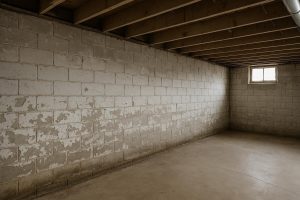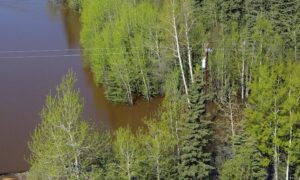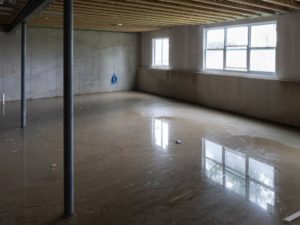
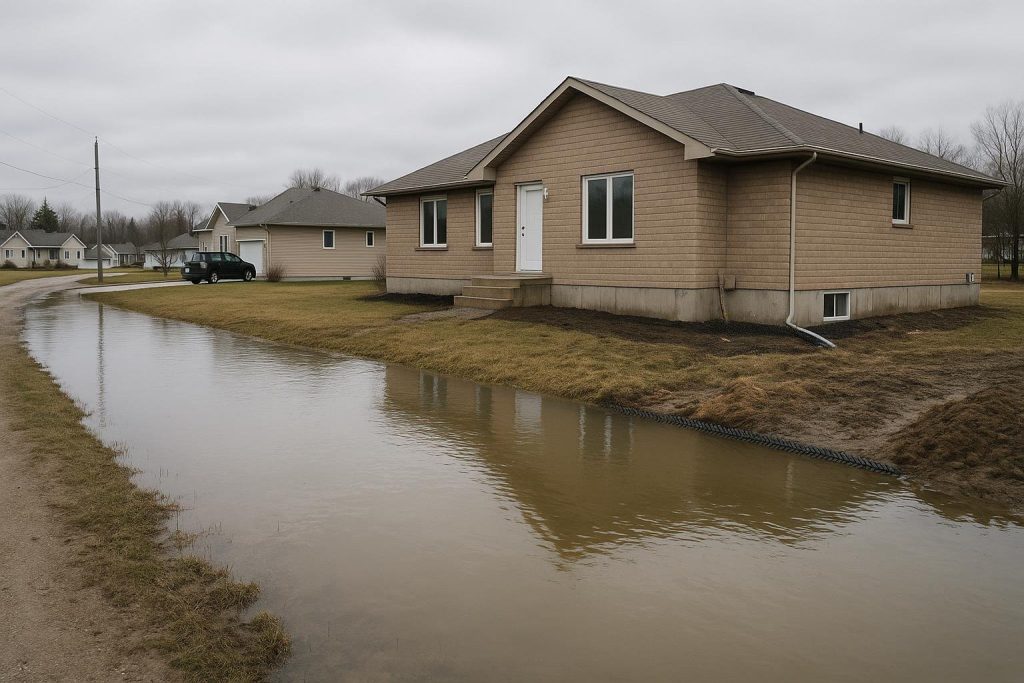
Basement flooding in Ramara is most commonly caused by the township’s proximity to Lake Simcoe and Lake Couchiching, which keeps the regional water table persistently high, combined with clay-rich glacial till soils that shed rather than absorb surface water. When spring snowmelt or heavy rain saturates the ground, hydrostatic pressure builds against foundation walls and floors, forcing water through cracks, cold joints, and failed weeping tile. The right fix depends on where water is entering, how severe the pressure is, and the age and construction type of your home.
Key takeaways
- Ramara’s low-lying lakeside terrain and clay soils create year-round hydrostatic pressure on foundations.
- Most basement flooding has a diagnosable entry point: wall cracks, floor-wall joints, floor seepage, or failed drainage.
- Interior drainage systems manage water that has already entered; exterior waterproofing stops it at the source.
- Polyurethane crack injection is often the fastest and least disruptive fix for isolated wall cracks.
- Cost is driven by access, depth of excavation, drainage scope, and soil conditions, not a flat rate.
Definitions and scope
Basement flooding in the context of this guide refers to any unwanted water entry into a below-grade living or storage space, ranging from a damp floor-wall joint after rain to standing water following snowmelt. It is distinct from sewer backup, which involves water rising through floor drains from the municipal system, though both can occur together.
Hydrostatic pressure is the force exerted by water-saturated soil against a foundation wall or slab. In Ramara, the combination of fine-grained glacial lake sediments deposited by post-glacial Lake Algonquin, the modern influence of Lake Simcoe and Lake Couchiching, and relatively flat topography in areas like Brechin, Lagoon City, and Washago means that the water table can rise to within a metre or two of the surface during wet seasons. Poured concrete foundations develop shrinkage cracks over time; block foundations have mortar joints; both are vulnerable when pressure is sustained.
This guide covers residential basement flooding causes, the main repair and waterproofing methods available to Ramara homeowners, how to choose between them, and the factors that drive cost. It does not cover sewer backup valves or municipal subsidy programs, as verified current program details for Ramara Township are not available through this route and should be confirmed directly with the Township of Ramara.
Why this matters
Ramara Township stretches along the eastern shore of Lake Simcoe and the southern shore of Lake Couchiching, taking in communities such as Brechin, Lagoon City, Washago, Gamebridge, and Uptergrove. Many properties sit on low-lying land where the distance between the ground surface and the seasonal high water table is small. Seasonal cottages and year-round homes alike face the same physics: when the ground is frozen or saturated, water has nowhere to go except laterally, toward the path of least resistance, which is often a foundation wall.
Freeze-thaw cycling compounds the problem. Ontario’s climate subjects Ramara foundations to repeated freeze-thaw events each winter, which widen existing hairline cracks incrementally. A crack that admits only a trickle in autumn can admit a steady flow by the following spring. According to the National Research Council of Canada’s guidance on building envelope performance, freeze-thaw action is one of the primary mechanisms of concrete deterioration in cold climates.
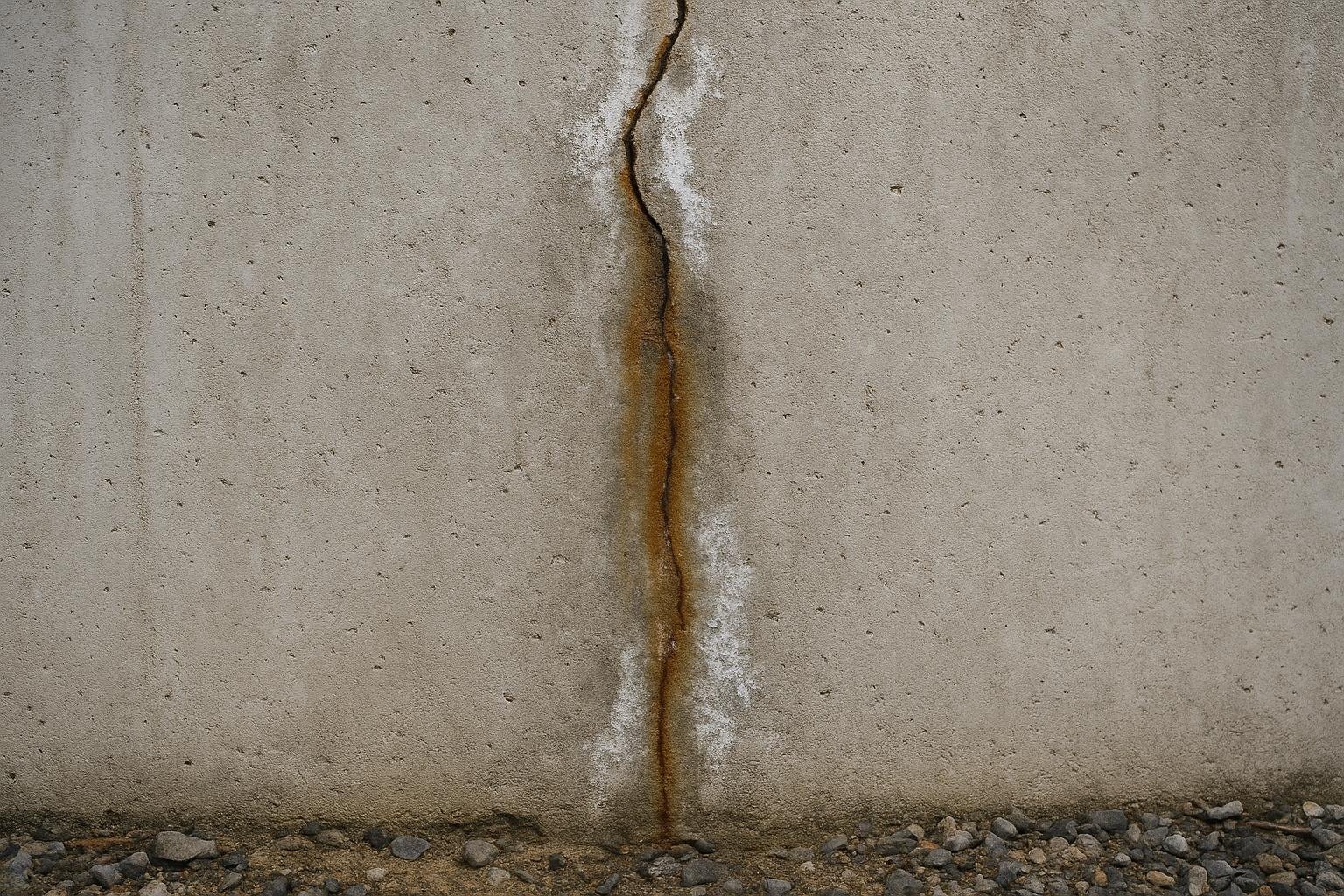
Lagoon City, a canal-side community within Ramara, presents a particular challenge: many homes there are built on fill adjacent to man-made canals, meaning the water table is effectively at canal level. Homes in Washago near the Severn River face similar conditions. Ignoring early signs of moisture, such as efflorescence, damp patches, or a musty odour, allows water to degrade insulation, promote mould growth, and eventually compromise structural integrity.
Addressing basement flooding protects the structural envelope of the home, preserves indoor air quality, and maintains the property’s marketability, which matters especially in a cottage-country market where buyers scrutinize below-grade conditions carefully.
Your options
Polyurethane crack injection
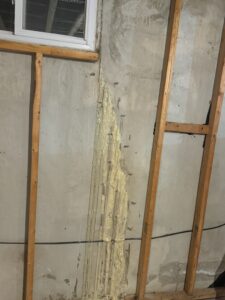
Polyurethane crack injection involves drilling ports along a foundation wall crack, then injecting a flexible polyurethane resin under low pressure. The resin expands to fill the crack completely, bonds to the concrete, and cures into a waterproof, flexible seal that accommodates minor future movement.
Best for: Isolated vertical or diagonal shrinkage cracks in poured concrete walls where the crack is the sole entry point and the surrounding wall is otherwise sound.
Limitations: Not suitable for block foundations, horizontal cracks indicating lateral pressure, or situations where the crack is a symptom of ongoing structural movement. It does not address drainage or hydrostatic pressure.
Learn more in DryShield’s guide to whether crack injection works and the comparison of hydraulic cement vs crack injection.
Interior drainage system with sump pump
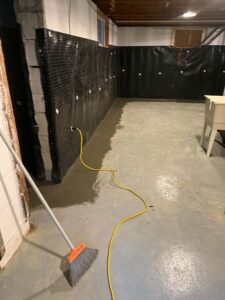
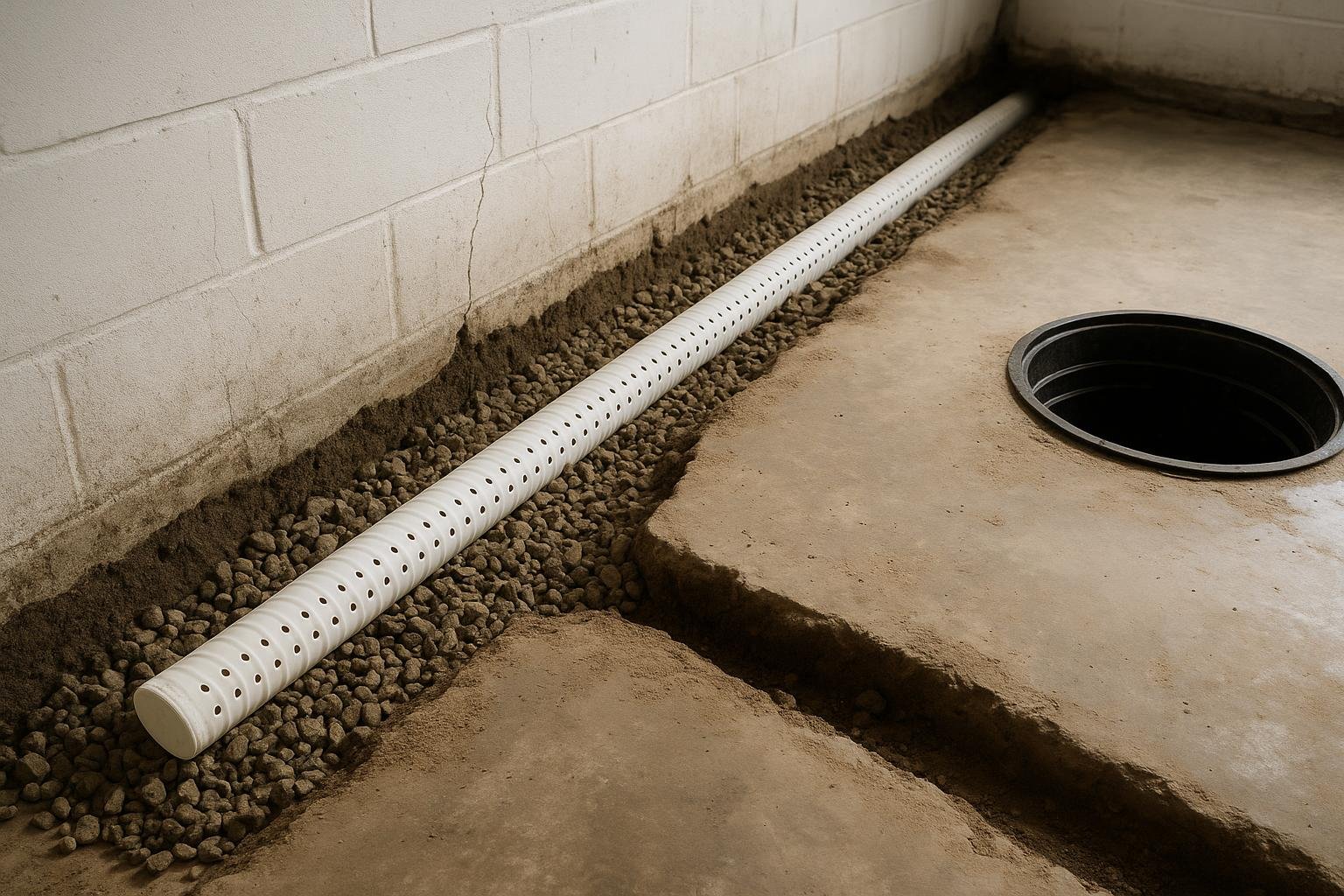
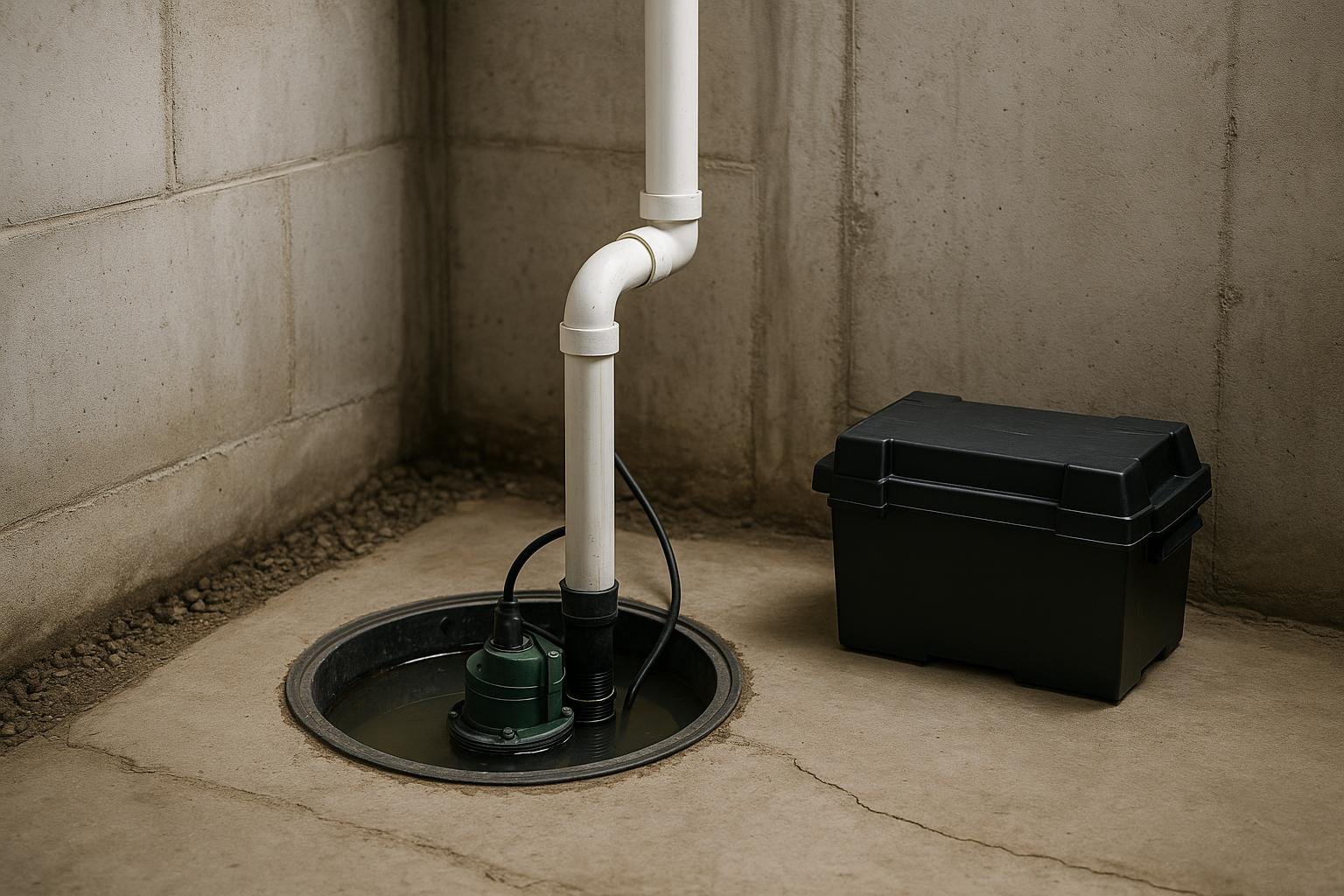
An interior drainage system, sometimes called an interior weeping tile system, involves cutting a channel around the perimeter of the basement floor, laying a perforated drainage pipe in gravel, and directing collected water to a sump pit where a sump pump discharges it away from the foundation. A drainage board or membrane on the wall face directs seeping water down to the channel rather than across the floor.
Best for: Homes with chronic perimeter seepage, failed original weeping tile, or high water tables where exterior excavation is impractical or cost-prohibitive. It is also the preferred approach for finished basements where excavation would cause major disruption.
Limitations: It manages water after it enters the wall cavity rather than stopping it at the exterior. The sump pump requires power and maintenance; a battery backup is strongly recommended in Ramara given the potential for power outages during storms.
Exterior waterproofing and weeping tile replacement
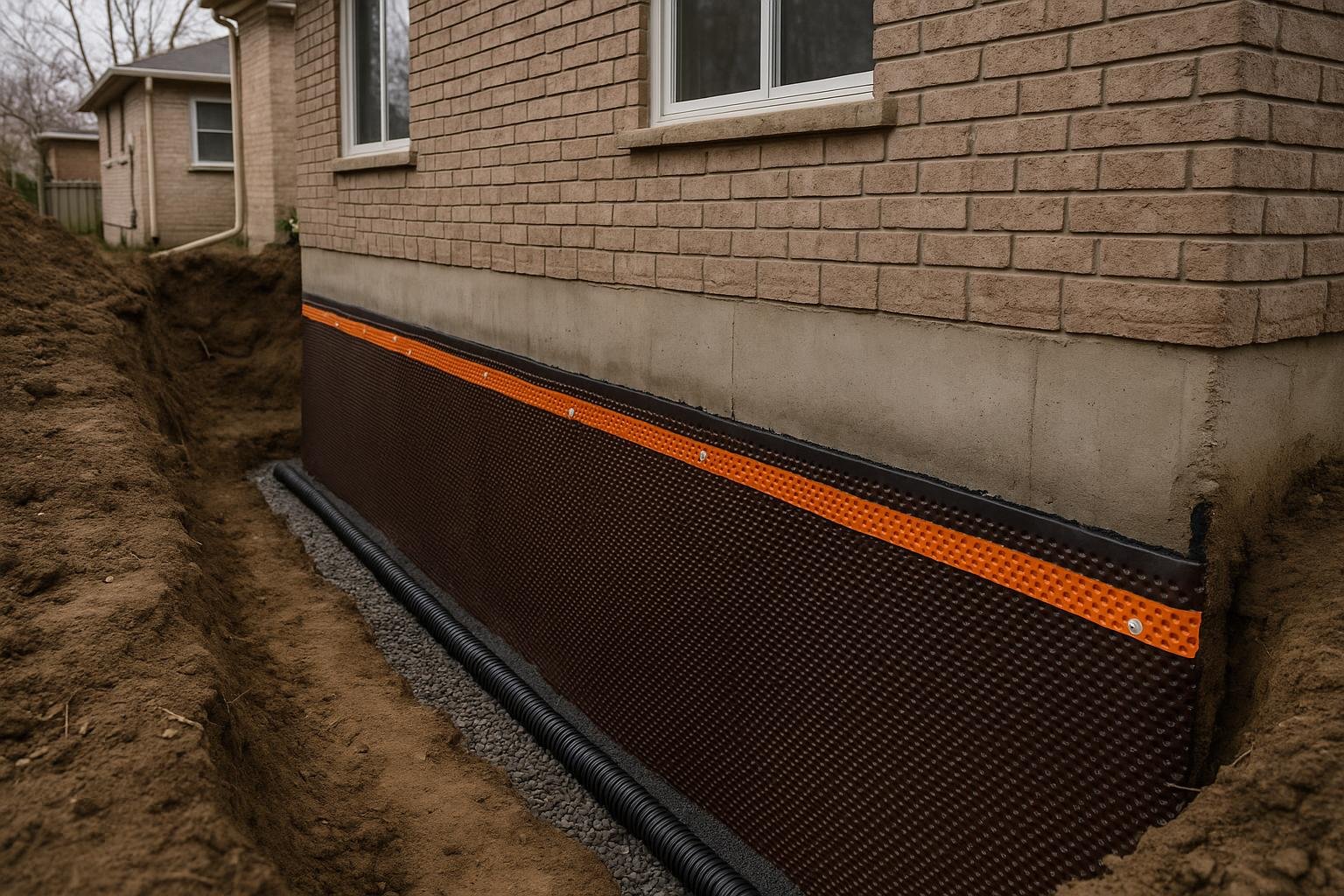
Exterior waterproofing requires excavating the soil around the foundation down to the footing, cleaning the wall surface, applying a waterproof membrane or coating, installing a drainage board, and laying new weeping tile in gravel at the footing level before backfilling. This is the most comprehensive approach because it addresses the source of water entry rather than managing it after the fact.
Best for: Homes with severely deteriorated original weeping tile, multiple wall cracks, or persistent flooding that interior methods have not resolved. Also appropriate when exterior access is available and the homeowner wants the longest-term solution.
Limitations: Excavation is disruptive, requires removal of landscaping, decks, or walkways, and is more expensive than interior methods. In Lagoon City or other canal-adjacent properties, access and soil conditions may complicate excavation.
See the full comparison at Exterior vs Interior Perimeter Waterproofing.
Sump pump installation or upgrade
A sump pump alone, without a full interior drainage system, can be appropriate when the existing drainage infrastructure is functional but the pump is undersized, aging, or lacks a backup. The pump sits in a pit at the lowest point of the basement and activates when water reaches a set level, discharging it through a pipe to daylight away from the foundation.
Best for: Homes where the drainage system is intact but the pump has failed or is nearing end of life. Also useful as a standalone measure for cottages that experience occasional flooding rather than chronic seepage.
Limitations: A sump pump cannot compensate for failed drainage tile or significant wall cracks. Power outages during the storms that cause flooding are a real risk; a battery backup or water-powered backup is advisable.
Window well drainage and grading correction
Above-grade issues, including negative grading that slopes toward the foundation, clogged window wells, and disconnected downspouts, are responsible for a meaningful share of basement flooding events. Correcting the grade so that soil slopes away from the foundation, extending downspouts, and adding window well covers and drains are low-cost first steps.
Best for: Flooding that occurs only during or immediately after heavy rain and is concentrated near windows or specific wall sections. Often appropriate as a complement to other repairs.
Limitations: Grading and drainage corrections do not address hydrostatic pressure from a high water table, failed weeping tile, or existing wall cracks.
Floor crack and cold joint repair
Water entering through the floor-wall cold joint or through floor cracks is addressed by injecting the joint with polyurethane, applying a crystalline waterproofing compound, or incorporating the joint into an interior drainage channel. The appropriate method depends on the volume of water and whether the floor itself is lifting or cracking under pressure.
Best for: Seepage that is clearly concentrated at the floor-wall joint or along floor cracks rather than through wall cracks.
Limitations: Isolated floor crack repair may not be sufficient if the underlying cause is a high water table pushing up through the slab. In those cases, a full interior drainage system with sump pump is more appropriate. See how to stop water seeping through your basement floor.
Options compared
| Method | Best for | Typical considerations | Durability and limitations |
|---|---|---|---|
| Polyurethane crack injection | Isolated poured-concrete wall cracks | Minimal disruption; interior or exterior access; no excavation | Long-lasting when crack is stable; not suitable for active structural movement |
| Interior drainage system + sump pump | Chronic perimeter seepage; high water table; failed weeping tile | Requires cutting concrete floor perimeter; pump needs power and maintenance | Effective long-term water management; does not stop water entering the wall |
| Exterior waterproofing + weeping tile | Severe or multi-point flooding; failed exterior drainage | Excavation required; landscaping disruption; higher cost | Most comprehensive; addresses source; longest service life |
| Sump pump upgrade only | Functional drainage but failed or undersized pump | Relatively low cost; fast installation | Dependent on drainage system integrity; power outage risk |
| Grading and downspout correction | Rain-event flooding near windows or specific walls | Low cost; DIY-possible in some cases | Does not address water table or failed subsurface drainage |
| Floor crack and cold joint repair | Seepage at floor-wall joint or floor cracks | Can be combined with interior drainage | Limited if cause is upward hydrostatic pressure through slab |
No single method suits every Ramara home. Properties in Lagoon City with canal-level water tables almost always require an interior drainage system with a reliable sump pump, because the water table cannot be lowered by surface corrections alone. Homes in Brechin or Gamebridge on slightly higher ground may resolve flooding with crack injection and grading improvements if the entry point is a single wall crack. Exterior waterproofing delivers the most durable outcome but is justified by the severity and extent of the problem, not as a default first step.
How to choose
Use the following framework to narrow down the appropriate repair before consulting a waterproofing professional.
Choose polyurethane crack injection if you can identify a single vertical or diagonal crack in a poured concrete wall, the crack is dry between rain events, and there is no evidence of lateral wall movement or widespread seepage.
Choose an interior drainage system with sump pump if water enters along the floor-wall perimeter, seeps through multiple points, or your original weeping tile is known to be failed or absent. This is also the practical choice when exterior excavation is blocked by a deck, addition, or neighbouring structure.
Choose exterior waterproofing and weeping tile replacement if you have exhausted interior options, the flooding is severe and recurring, or you are undertaking a major renovation that already requires excavation. It is also the preferred option when the exterior membrane is visibly failed and the home is in an area with sustained high water table pressure.
Choose a sump pump upgrade if your existing interior drainage system is functional but the pump is more than seven to ten years old, has failed during a storm, or lacks a battery backup. In Ramara, where power outages during spring storms are possible, a battery backup is not optional for properties that depend on a sump pump.
Choose grading and downspout correction first if flooding only occurs during or immediately after heavy rain, is concentrated near a window well or a specific corner, and the rest of the basement stays dry. Correct these issues before investing in more expensive measures.
If you are unsure of the entry point, use DryShield’s basement leak diagnostic tool or consult the guide to types of foundation cracks to identify what you are dealing with.
Costs and timelines
No verified current price data specific to Ramara Township has been supplied to this route. The following describes the factors that drive cost, ranked from most to least influential. For current estimates, use DryShield’s basement waterproofing cost calculator or request a site assessment.
| Cost driver | Why it matters | Relative impact |
|---|---|---|
| Method selected | Exterior excavation costs significantly more than interior drainage, which costs more than crack injection | Highest |
| Linear footage of drainage or excavation | Interior and exterior perimeter work is priced by the running foot of wall treated | High |
| Depth of foundation | Deeper foundations require more excavation, shoring, and backfill | High |
| Soil and access conditions | Clay soils, high water table, or restricted access (canal lots, decks, mature trees) increase labour and equipment costs | Moderate to high |
| Number and type of cracks | Multiple cracks or structural cracks require more material and time than a single shrinkage crack | Moderate |
| Sump pump specification | Battery backup, horsepower rating, and alarm systems add to pump cost | Moderate |
| Concrete cutting and restoration | Interior drainage requires cutting and replacing the floor perimeter; finished basements add demolition and reinstatement cost | Moderate |
Crack injection is typically the fastest repair, often completable in a single visit. Interior drainage systems generally require one to two days depending on basement perimeter. Exterior waterproofing timelines depend on excavation scope and weather; canal-adjacent or low-lying lots may require additional time for dewatering. Permits may be required for structural foundation work under the Ontario Building Code; confirm requirements with the Township of Ramara before work begins.
Risks and common mistakes
Treating symptoms rather than causes. Applying hydraulic cement or paint-on sealers to a wet wall without addressing the source of water pressure is the most common mistake. These products can slow seepage temporarily but will fail under sustained hydrostatic pressure. The underlying cause, whether a crack, failed weeping tile, or high water table, must be identified and addressed.
Ignoring the sump pump during dry seasons. Many Ramara homeowners discover their sump pump has failed only when the basement floods in spring. Test the pump quarterly by pouring water into the pit and confirming it activates and discharges correctly.
Discharging sump pump water too close to the foundation. If the discharge pipe terminates within two to three metres of the foundation, the water re-infiltrates the soil and returns to the pit, overworking the pump and potentially worsening the water table locally.
Assuming a dry summer means the problem is solved. Ramara’s water table fluctuates seasonally. A basement that stays dry from July through September may flood in April. Repairs should be assessed and completed before the high-risk spring snowmelt period.
Finishing a basement before waterproofing. Installing drywall, insulation, and flooring over a wet or at-risk foundation wall traps moisture, accelerates mould growth, and makes future repairs far more expensive. See the guide to basement crack repair before finishing your basement.
Skipping a battery backup sump pump. Power outages are most likely during the severe storms that also produce the highest water table conditions. A battery backup or water-powered backup pump is a low-cost insurance measure that is particularly important for seasonal properties that may be unoccupied during spring melt.
Not checking window wells. Blocked window well drains are a frequently overlooked cause of localized flooding. Debris accumulates over winter and can cause a window well to fill and overflow into the basement during the first heavy spring rain.
How the process works
- Inspection and diagnosis. A waterproofing professional inspects the interior and exterior of the foundation, identifies entry points, assesses crack types, checks the existing sump pit and weeping tile condition, and reviews grading and drainage. This step determines which method or combination of methods is appropriate.
- Scope and proposal. The contractor prepares a written scope of work describing the method, materials, linear footage, and any permit requirements. For Ramara properties, the proposal should address seasonal water table conditions and, where relevant, proximity to Lake Simcoe or canal systems.
- Site preparation. Depending on the method, this may involve clearing the basement perimeter, protecting finished areas, or excavating the exterior. Landscaping, decks, or walkways that obstruct exterior access are addressed at this stage.
- Repair or system installation. Crack injection, drainage channel installation, membrane application, weeping tile laying, or sump pump installation is carried out according to the agreed scope. Concrete is cut, placed, and cured as required.
- Backfill, restoration, and cleanup. Excavated areas are backfilled and compacted; interior concrete is restored; the site is cleaned. Grading is checked to confirm positive slope away from the foundation.
- Testing and commissioning. The sump pump is tested, discharge routing is confirmed, and any drainage system is checked for correct flow. The homeowner is walked through maintenance requirements.
- Warranty documentation. A reputable contractor provides written warranty terms. DryShield offers a lifetime transferable warranty on qualifying work, which is relevant for Ramara homeowners who may sell or transfer a cottage property.
Frequently asked questions
Why does my Ramara basement flood in spring but stay dry all summer?
Spring snowmelt saturates the ground rapidly, raising the water table to its seasonal peak. In low-lying Ramara communities near Lake Simcoe and Lake Couchiching, the water table can rise close to foundation level during this period, creating hydrostatic pressure that forces water through cracks and joints. By summer, evaporation and plant uptake lower the water table, reducing pressure. The problem is real and recurring, not a one-time event.
Is my Lagoon City home at higher risk than other Ramara properties?
Lagoon City properties are built on fill adjacent to man-made canals connected to Lake Simcoe. The water table in that area is effectively at canal level year-round, which means hydrostatic pressure on foundations is persistent rather than seasonal. Homes there are generally at higher risk of chronic basement seepage than properties on higher ground in Brechin or Gamebridge, and typically require a reliable interior drainage system with battery backup sump pump as a baseline measure.
Can I use a DIY crack injection kit on my Ramara foundation?
DIY polyurethane injection kits are available and can seal a stable, isolated shrinkage crack if applied correctly. However, misidentifying the crack type, injecting at incorrect pressure, or missing secondary entry points can result in a failed repair. For cracks wider than a hairline, cracks showing displacement, or any horizontal crack, professional assessment is strongly recommended. See the comparison of DIY vs professional crack injection.
Do I need a permit for basement waterproofing work in Ramara?
Permit requirements depend on the scope of work. The Ontario Building Code requires permits for structural foundation repairs and excavation that affects the structural integrity of the building. Interior drainage systems and crack injection are generally considered maintenance rather than structural alteration, but requirements can vary. Confirm with the Township of Ramara’s building department before any significant foundation work begins. DryShield can advise on what is typically required based on the proposed scope.
How long does an interior drainage system last?
A properly installed interior drainage system with quality perforated pipe and a reliable sump pump can function effectively for many years with routine maintenance. The pipe itself does not typically clog if installed with appropriate gravel and filter fabric. The sump pump is the component most likely to require replacement; most pumps have a service life of seven to twelve years depending on usage frequency and water quality. Annual inspection and testing are recommended.
Will waterproofing my basement increase my home’s value in Ramara?
A dry, documented basement is a meaningful selling point in any market, and particularly in cottage country where buyers are alert to water-related issues. A transferable warranty on waterproofing work provides additional reassurance to prospective purchasers. No verified resale data specific to Ramara Township has been supplied to this route; for broader context on the relationship between waterproofing and home value in Ontario, see DryShield’s guide on basement waterproofing and home value ROI.
What is the difference between weeping tile and a French drain?
Both terms describe perforated pipe systems designed to collect and redirect groundwater, but they are installed in different locations. Weeping tile runs at footing level around the exterior or interior perimeter of a foundation to intercept groundwater before it reaches the wall. A French drain is a broader term that can refer to any trench-and-pipe drainage system, including surface or mid-slope installations used to redirect surface runoff. For foundation flooding in Ramara, footing-level weeping tile is the relevant system. See the complete guide to drain tile.
My basement only leaks near one window. Do I need a full waterproofing system?
Not necessarily. Localized leaking near a window is often caused by a blocked or absent window well drain, a crack in the window frame or surrounding wall, or negative grading that directs water toward that corner. Inspect the window well for debris, check that the drain at the bottom is clear, and confirm the grading slopes away from the foundation. If those checks do not resolve the issue, a targeted crack injection or window well drain installation may be sufficient without a full perimeter system.
How do I know if my original weeping tile has failed?
Signs of failed weeping tile include chronic perimeter seepage that worsens in spring, a sump pump that runs continuously during wet periods, and efflorescence or mineral staining along the base of foundation walls. A waterproofing contractor can use a camera inspection of the existing drainage system to confirm whether the tile is collapsed, root-infiltrated, or silted. In older Ramara homes, original clay or concrete weeping tile may be decades old and well past its service life.
Can a seasonal cottage in Ramara be waterproofed if it is unoccupied in winter?
Yes. Exterior waterproofing and crack injection can be performed during the construction season when the ground is accessible. Interior drainage systems can also be installed in an unoccupied cottage. The more important consideration for seasonal properties is ensuring the sump pump has a battery backup and, ideally, a remote monitoring alarm so that flooding during spring melt is detected even when the property is unoccupied. See the guide to sump pumps for seasonal and unoccupied cottages.
If your Ramara basement has shown any signs of water entry, whether a damp patch, a crack, or recurring spring flooding, the best next step is a professional assessment to identify the entry point and the appropriate fix. DryShield has served communities across Simcoe County and cottage country for over 25 years. Contact DryShield to arrange an inspection, or use the cost calculator for a preliminary estimate.