Water Powered Sump Pump: Complete Homeowner's Guide
A water powered sump pump is a backup that uses municipal water pressure, not electricity, to empty a sump pit when the primary pump fails or power goes out. It needs a municipal supply and a backflow preventer, and works best beside a properly sized electric pump. Learn how it works and what to ask at a free estimate.
Book a free estimate or call 1.800.277.5411.

Rated 4.9 Starson Google (300+ reviews)
25+ years of experience
A water powered sump pump is a backup device that uses municipal water pressure rather than electricity to move water out of a sump pit when the primary electric pump fails or the power goes out. It needs no battery, no charging cycle, and no electrical connection. This guide explains how the device works, how it compares with battery backup and combination systems, and how to decide whether one belongs in your basement protection plan.
- These units run entirely on municipal water pressure and have no electrical components to fail or batteries to replace.
- They consume municipal water while operating, which adds to the water bill and requires a municipal supply; they cannot be used with well water.
- Pumping capacity is lower than most electric primaries, so the device is best suited as a backup, not a sole pump.
- Local plumbing codes and municipal bylaws govern installation; a backflow preventer is typically required.
- A water powered backup works best alongside a properly sized primary electric pump and, where appropriate, a perimeter drainage system.

What Our Customers Say
DryShield has a 4.9-star rating from 300+ Google reviews across the GTA and Ontario.


How the process works
The steps below describe a typical venturi backup installation by a licensed plumber. This is general guidance, not a DryShield installation list.
- Assessment and code check
The installer reviews the existing sump pit, primary pump configuration, municipal water supply location, and local plumbing code requirements, including backflow preventer type and discharge rules. - Supply line tap
A connection is made to the cold-water municipal supply line, typically in the mechanical room near the pit. A shut-off valve is installed so the backup can be isolated for maintenance. - Backflow preventer installation
A certified backflow preventer is installed on the supply line between the municipal tap and the venturi device, as required by code. - Venturi unit mounting and float setup
The pump body is mounted in or above the pit. The float is set at a level above the primary pump’s activation point so the backup only engages when the primary is not keeping up. - Discharge connection
The backup’s discharge outlet is connected to the existing discharge line or a separate approved outlet, directed away from the foundation to a permitted discharge point. - Pressure and function test
The installer verifies supply pressure, manually activates the float, and confirms the venturi draws pit water and discharges correctly without backflow. - Documentation and homeowner briefing
The installer explains how to test the unit annually, where the shut-off valve is located, and what to do if the backup activates during an event.
If you want help sizing a primary electric pump and planning a backup, book a free estimate with DryShield.
Definitions and scope
A sump pump is a submersible or pedestal device installed in a pit at the lowest point of a basement or crawl space. Its job is to collect groundwater that accumulates around the foundation and discharge it away from the building before it can flood the floor.
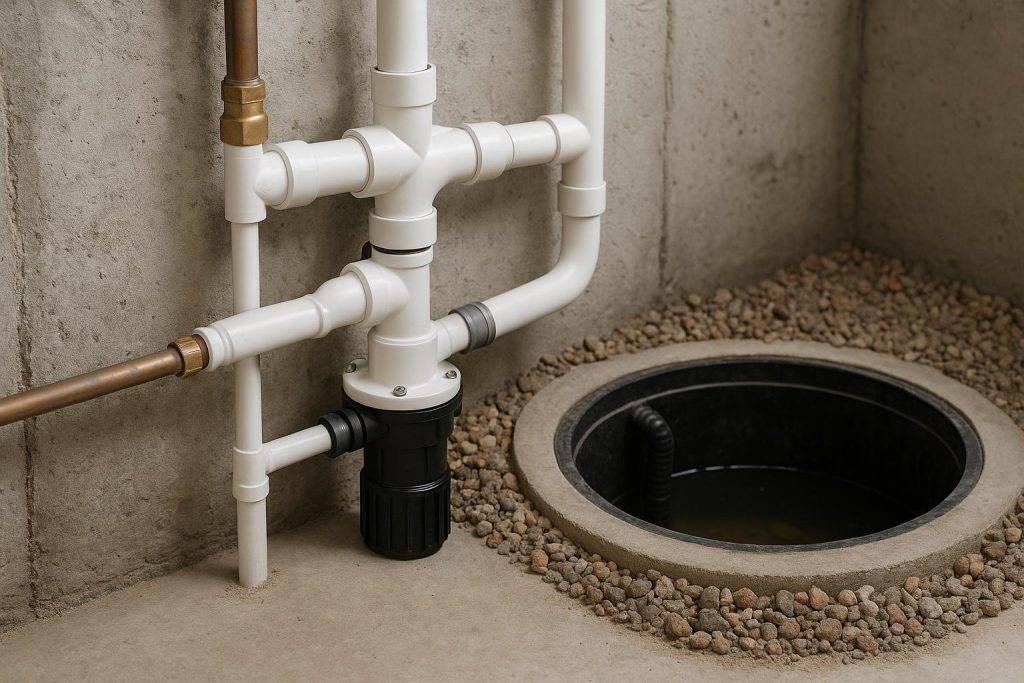
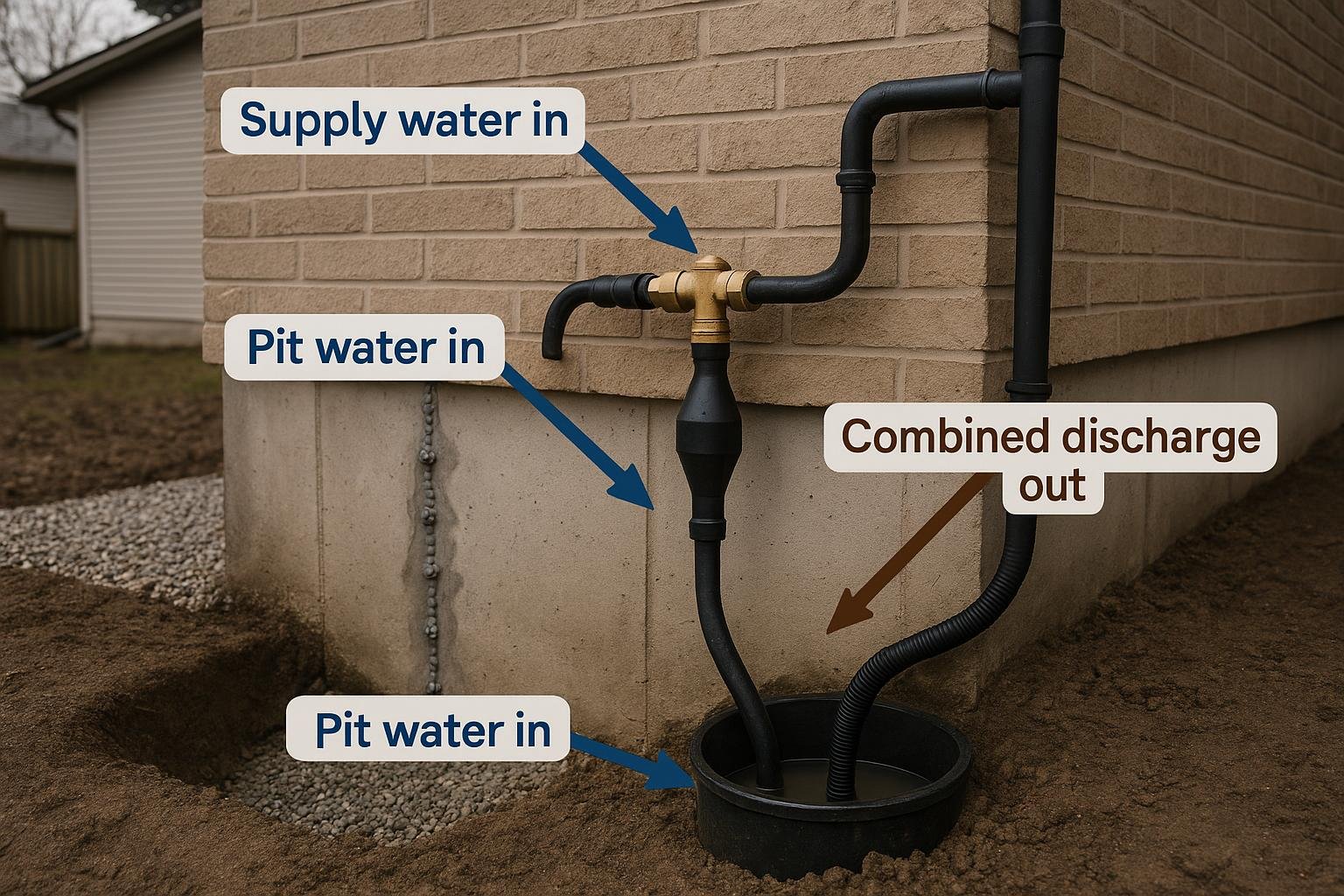
A venturi-driven backup unit uses the venturi principle: pressurized municipal water flows through a narrow nozzle, creating a low-pressure zone that draws pit water up through an intake and pushes the combined flow out through the discharge line. There is no motor, battery, or inverter. The device activates when a float rises to a set level in the pit, opening a valve that allows municipal water to flow.
This guide covers residential applications in Ontario homes connected to municipal water systems. It does not address commercial sump systems, sewage ejector pumps, or well-water properties, where this type of backup is generally not suitable or permitted. For broader context on sump pump installation, see the Sump Pump Installation Services page.
Why this matters
Power outages and pump failures tend to coincide with the worst possible moments: heavy rainstorms, spring snowmelt, and the overnight hours when no one is watching. In Ontario, freeze-thaw cycles and intense spring melt can saturate soil around foundations very quickly, sending large volumes of water toward the sump pit in a short window. If the primary pump fails at that moment, even a few hours without backup protection can result in significant basement flooding.
A flooded basement can damage finishes, mechanical systems, and stored belongings, and in some cases the foundation itself. Mold can begin developing within 24 to 48 hours of a water event. Home insurance policies vary widely in what they cover for sump pump failure; review your policy carefully. For coverage questions, see our article on home insurance and basement waterproofing in Ontario.
A venturi backup addresses the power-outage failure mode without the maintenance burden of a battery system. Understanding its real capabilities and limits helps you make an informed choice rather than assuming any backup is equivalent to any other. The right backup strategy depends on your home’s water supply type, local municipal rules, pit size, and the volume of water your basement typically manages.
For homes that have already had a sump pump failure and basement flooding, adding a reliable backup is often the first recommendation after the primary pump is restored.
Your options
Water powered backup (venturi type)
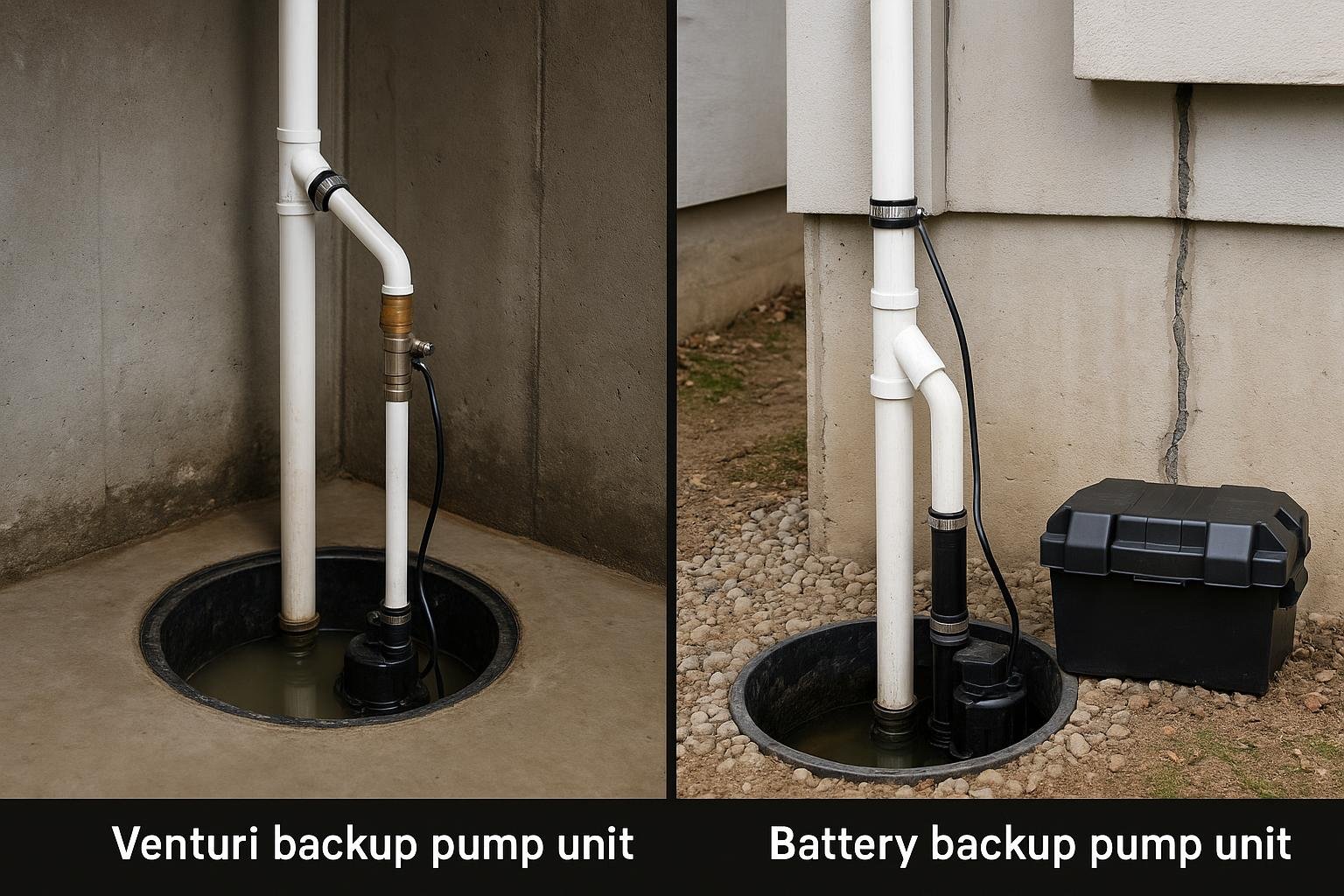
A venturi-driven device connected to the municipal cold-water supply. When the float rises, a valve opens, municipal water flows through the venturi nozzle, and suction draws pit water into the discharge line alongside the municipal water. Both streams exit through the discharge pipe to the exterior or storm drain.
Best for: Homes on municipal water with reliable supply pressure (manufacturers often cite about 40 psi as a minimum, but you should verify the specification for the model you are considering). Useful as a backup for extended or frequent power outages when battery recharging is a concern.
Limitations: Uses municipal water while running. Pumping capacity is limited by supply pressure and is generally lower than a primary electric pump. It cannot be used with well water or where municipal pressure is low. A certified backflow preventer is required by most Ontario plumbing codes so pit water cannot contaminate the potable supply. Discharge of the combined stream must comply with local bylaws.
Battery backup sump pump
A secondary electric pump powered by a dedicated 12V or 24V deep-cycle battery and charger. The charger keeps the battery topped up from the home’s electrical supply during normal operation. When power fails, the battery powers the pump directly.
Best for: Homes on well water, homes where municipal pressure is too low for a venturi system, and situations where you want a backup that does not consume water. Also suitable where outages are typically short (hours rather than days).
Limitations: Battery capacity is finite. During a severe, prolonged event with high inflow, the battery may be depleted before power is restored. Batteries need periodic testing and typical replacement every few years, often in the three-to-five-year range depending on type and use. Charger and battery connections must be maintained.
Combination pump system
A single unit that integrates a primary electric pump and a battery backup pump in one assembly, sharing a single discharge line. Some combination units also include monitoring and alarm features.
Best for: Homeowners replacing an aging primary pump who want a complete system in one installation. It simplifies plumbing by using one discharge line.
Limitations: Higher upfront cost than adding a standalone backup to an existing primary. Battery limits still apply to the backup component. If the combined unit fails mechanically, both primary and backup may be affected.
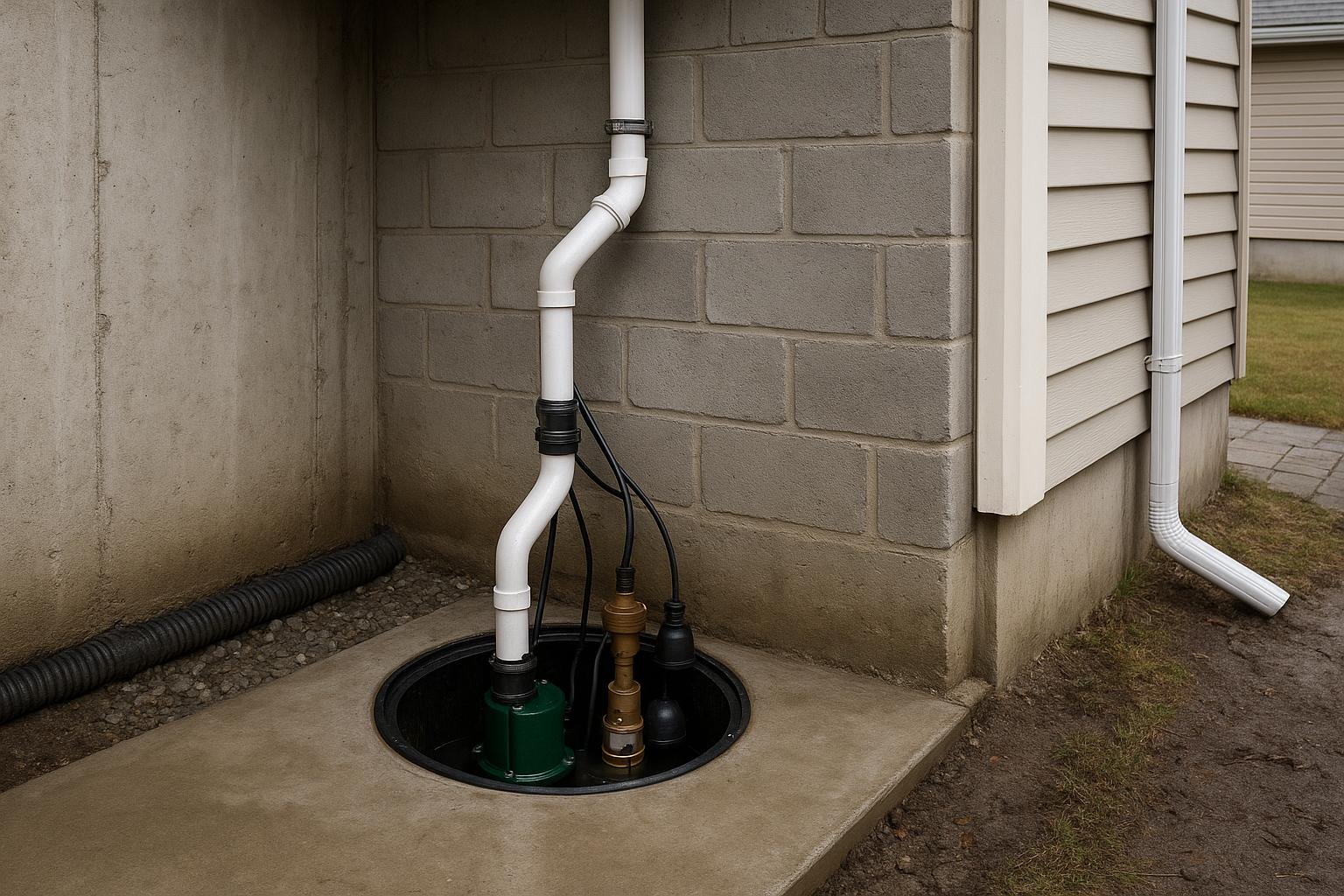
Generator-powered primary pump
A portable or standby generator supplies power to the existing primary electric pump during an outage.
Best for: Homes with high-volume sump needs where neither battery capacity nor venturi flow rates are enough, and for whole-home power backup beyond the sump pump.
Limitations: Portable generators require manual setup and fuel management during an outage. Standby generators involve a significant installation cost. Neither option is a dedicated sump backup; they address the broader power outage problem.
Smart monitoring with alarm
A water sensor or float-triggered alarm that alerts you by sound or smartphone notification when the pit water level rises above a set point, which means the primary pump is not keeping up.
Best for: Any sump installation as a supplementary layer. Particularly valuable for seasonal or unoccupied cottages where no one is present to notice a failure.
Limitations: An alarm does not pump water. It provides warning time only; someone must act on the alert. Use it with one of the backup methods above, not as a standalone backup.
No backup (primary pump only)
Relying solely on the primary electric pump with no redundancy.
Best for: Homes with very low groundwater infiltration where the sump pit rarely activates and flooding risk is minimal.
Limitations: Any single point of failure, whether a power outage, pump motor burnout, float failure, or a tripped breaker, leaves the pit unprotected. For most Ontario homes that depend on a sump pump to stay dry, no backup is the highest-risk configuration. See our guide on sump pump failure and replacement for warning signs to watch for.
Options compared
| Option | Best for | Typical considerations | Durability / limitations |
|---|---|---|---|
| Venturi (water powered) backup | Municipal water, frequent or long outages | Requires a backflow preventer; consumes water; pressure-dependent | No battery to replace; mechanical simplicity; limited flow rate |
| Battery backup pump | Well water homes; short outages | Battery replacement and charger maintenance | Finite runtime per charge; capacity depletes under heavy inflow |
| Combination pump system | Full replacement with integrated backup | Higher upfront cost; single discharge line | Battery limits apply; single-unit failure risk |
| Generator (portable or standby) | High-volume needs; whole-home backup | Fuel management; standby units have a significant install cost | Portable units need manual setup; standby is more automatic |
| Smart alarm / monitor only | A supplementary layer for any system | Requires a human response; does not pump water | Useful if maintained; no pumping capability |
| No backup | Very low infiltration only | Single point of failure; highest risk | Any pump failure leaves the pit unprotected |
No single backup option is universally superior. A venturi backup has a clear advantage in a long power outage on municipal water, because it does not depend on stored energy. The trade-off is water use and lower flow. Battery backups work on more supply types but need maintenance and have a finite runtime. For many Ontario homes on municipal water, either option is reasonable; the decision comes down to pressure, outage patterns, and maintenance preference.
How to choose
Use the following framework to identify a backup strategy that fits your situation.
Choose a water powered sump pump if: your home is connected to a municipal water supply with adequate and consistent pressure; you are concerned about extended power outages during storms; you want to avoid the recurring maintenance of battery replacement; and your local municipality and plumbing code permit the installation with a certified backflow preventer. Confirm your supply pressure meets the manufacturer’s minimum specification before purchasing.
Choose a battery backup pump if: your home uses a well rather than municipal water; your municipal water pressure is variable or below the threshold required by venturi units; your typical power outages are short; or you prefer a system that does not add to your water bill during operation. Budget for battery replacement and annual testing.
Choose a combination pump system if: your primary pump is aging and due for replacement anyway, and you want to consolidate into a single, purpose-built unit with integrated backup. This avoids retrofitting a backup onto an existing primary and simplifies the discharge plumbing.
Choose a generator if: your basement manages very high water volumes that exceed what a battery or venturi backup can handle, or if you want whole-home power resilience beyond the sump pump. A standby generator with an automatic transfer switch is the most seamless option, and also the most involved to install.
Consider adding a smart alarm regardless of which backup you choose. An alarm is a relatively small add-on and provides early warning if the backup itself is not keeping up. This matters especially for cottage and seasonal properties that may be unoccupied during a storm.
If your basement has a history of water entry through wall cracks or floor seams in addition to sump pit overflow, a backup pump alone will not address those entry points. Review how to stop water seeping through foundation walls to understand whether crack repair or perimeter drainage is also needed.
Costs and timelines
Prices vary by product, supplier, and installation complexity, and DryShield does not publish a current price for water-powered backup pumps on this page. The table below describes cost drivers only. Ask a licensed plumber or waterproofing contractor for a current quote, and book a free estimate to review how a backup fits your primary pump and drainage system.
| Driver | Why it affects cost | Relative impact |
|---|---|---|
| Device quality and brand | Higher-capacity venturi units with better materials cost more; budget units may have lower flow ratings | High |
| Backflow preventer requirement | A certified backflow preventer is typically required by code; cost varies by type and local requirements | High |
| Plumbing labour | Tapping the municipal cold-water line, running supply tubing to the pit, and connecting discharge adds labour time | High |
| Existing pit and discharge condition | If the pit is undersized or the discharge line needs modification, additional work is required | Medium |
| Permit requirements | Some municipalities require a plumbing permit for the water supply connection; permit fees vary | Low to medium |
| Ongoing water consumption | The device uses municipal water while running; cost depends on how often the backup activates and local water rates | Variable (operational) |
A straightforward retrofit to an existing pit is generally faster than a full interior waterproofing system. Pit or discharge changes take longer. For broader installation context, see Putting In a Sump Pump: The Complete Homeowner’s Guide.
Risks and common mistakes
Installing without a backflow preventer. This is the most serious error. Without a certified backflow preventer on the municipal supply line, contaminated pit water could be siphoned back into the potable water supply under certain pressure conditions. Most Ontario plumbing codes require a backflow preventer; verify local requirements before installation.
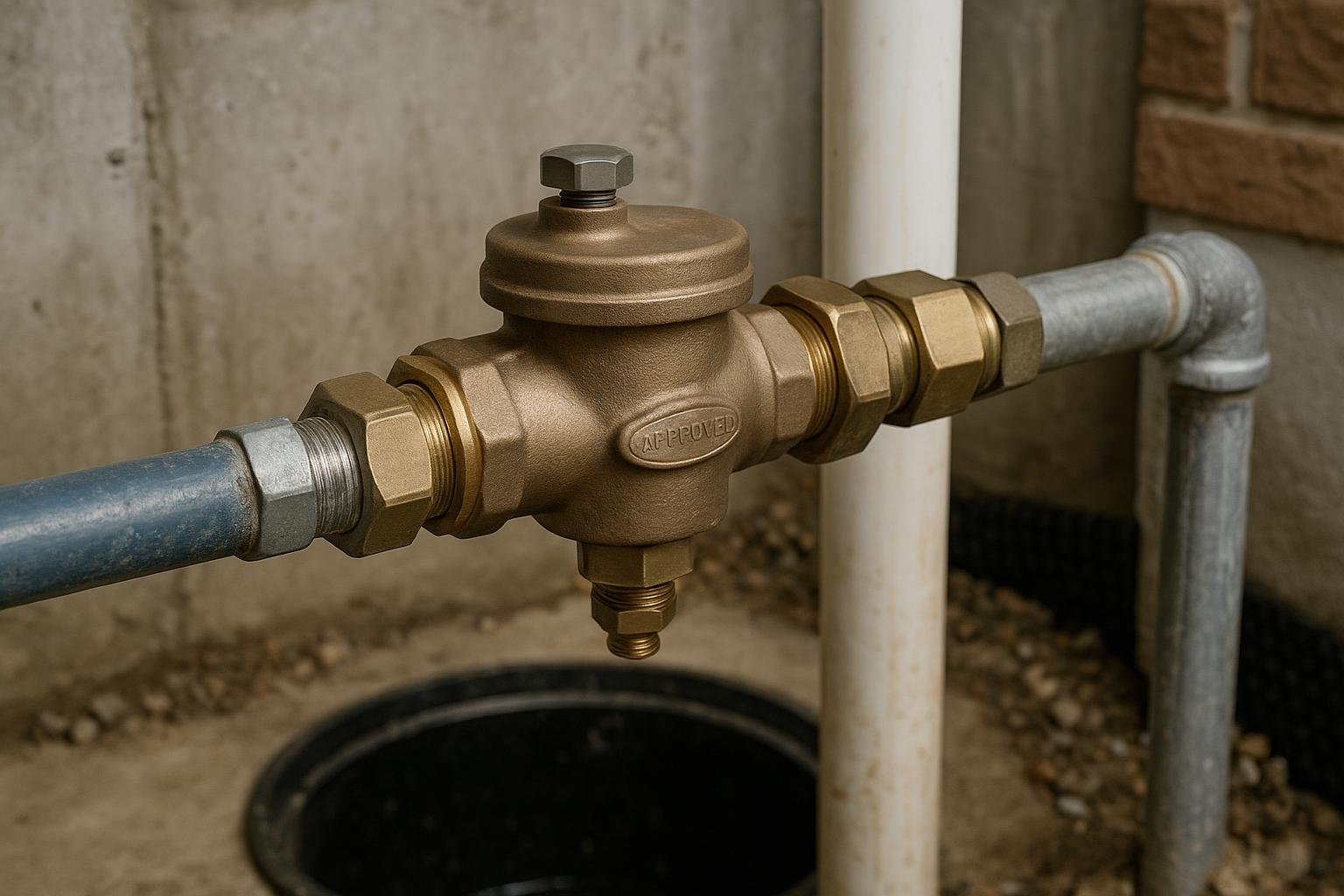
Assuming any municipal pressure is sufficient. Venturi units need a minimum supply pressure to operate effectively. Homes with low or variable municipal pressure may find the device underperforms or fails to activate reliably. Check your home’s static water pressure before selecting a unit.
Using on a well water system. Well water is not suitable for these devices. The venturi mechanism needs consistent pressure that most residential well systems do not provide, and drawing well water through the pump during an event can deplete the well or damage the well pump.
Neglecting discharge compliance. The combined discharge stream (municipal water plus pit water) must be directed to an appropriate outlet. Discharging to a sanitary sewer may be prohibited by local bylaw; confirm the permitted discharge point with your municipality before installation.
Treating the backup as a substitute for a functioning primary. A venturi backup has lower flow capacity than most primary electric pumps. If the primary pump fails during a high-inflow event, the backup may not keep pace on its own. The primary pump should be maintained and replaced proactively. See Sump Pump Not Working: What to Check First for diagnostic steps.
Ignoring the underlying water management system. A sump pump, primary or backup, is the last line of defence. If the perimeter drainage (weeping tile) is collapsed or blocked, or if foundation cracks allow direct water entry, the pump can be overwhelmed regardless of its type. Address the full drainage system, not just the pump. Our drain tile guide explains how the perimeter system works alongside the sump.
Skipping annual testing. A backup pump that has never been tested may fail silently. Test the unit at least once a year by manually raising the float to confirm the venturi activates and water discharges correctly.
Get Your Free Estimate
Reviewed by Jason Carrillo, DryShield · 25+ years of experience · Call 1.800.277.5411
Related sump pump guides
Frequently asked questions
Does a water powered sump pump work during a power outage?
Yes. Because it uses municipal water pressure rather than electricity, the device continues to operate when the home has no power, as long as municipal water pressure is maintained. Local outages usually do not stop city water, which often has its own backup power, but a wider infrastructure emergency could still affect pressure.
How much water does a water powered sump pump use?
The amount of municipal water consumed depends on the unit’s design and how long it runs. Venturi devices typically use more municipal water than the pit water they remove, so the combined discharge volume is larger than the water taken from the pit. Manufacturers publish flow ratios for each product. There is no single figure that applies to every model, and frequent or long run times will show up on the water bill.
Can I use a water powered sump pump if I have a well?
No. This type of backup needs consistent municipal supply pressure to run the venturi. Well systems typically cannot provide that sustained pressure, and drawing large volumes through the device during a storm could strain or deplete the well pump. Homeowners on well water should look at a battery backup pump instead.
Do I need a permit to install a water powered sump pump?
Requirements vary by municipality. In Ontario, a connection to the municipal water supply often falls under plumbing rules, and a backflow preventer is generally required. Contact your local building or plumbing department before work begins, or work with a licensed plumber who knows the local requirements. Installing without a required permit can complicate insurance claims and a future sale.
What water pressure do I need for a water powered sump pump to work?
Most manufacturers specify a minimum static supply pressure, commonly around 40 psi, though this varies by product. Measure your home’s static water pressure and compare it with the specification for the unit you are considering. Pressure that stays below the minimum can reduce pumping capacity or make activation unreliable. A licensed plumber can measure supply pressure and advise on suitability.
How does a water powered sump pump compare to a battery backup?
The energy source is the main difference. A venturi unit runs on municipal water pressure, which does not deplete during an outage, but it uses water and has a flow rate limited by supply pressure. A battery backup uses stored electricity, so it does not add to the water bill, but runtime is finite and the battery needs periodic testing and replacement. The better choice depends on your water supply, typical outage length, and how you want to maintain the system. See the comparison table above.
Will a water powered sump pump keep up with heavy spring flooding?
It depends on the unit’s rated capacity and how much water is entering the pit. Venturi backups generally move less water than a primary electric pump. During a severe spring melt or storm with high inflow, the backup may not keep pace if the primary pump has failed. Treat it as a failsafe for moderate inflow during an outage, not a replacement for a properly sized primary pump. For spring flooding context, see basement flooding prevention tips.
Does a water powered sump pump need maintenance?
These units have fewer moving parts than electric pumps and no battery to replace, but they are not maintenance-free. Test the float at least once a year by raising it to confirm the venturi activates. Have the backflow preventer inspected as required by local code or the manufacturer. Exercise the supply shut-off valve now and then so it does not seize, and check that the discharge outlet is clear, especially before spring.
Can a water powered sump pump be my only sump pump?
It is not recommended as the sole pump in most situations. Flow rates are lower than primary electric pumps, and the device is designed as a backup. If you rely on it as the primary pump, the basement has no redundancy when municipal water is interrupted or pressure drops. A properly sized primary electric pump should be the first line of defence. For help selecting a primary pump, visit the Sump Pump Installation Services page.
What happens to the water the backup pump discharges?
The discharge is a mixture of municipal water and pit water. It must go to an approved outlet, typically the exterior away from the foundation, a storm sewer connection if permitted, or another approved drainage point. Discharging to the sanitary sewer is prohibited in many Ontario municipalities. Confirm the permitted discharge point with your municipality before installation.
If you are reviewing your basement’s water management system, including primary pump sizing, perimeter drainage, and foundation crack repair, book a free estimate with DryShield or visit the Sump Pump Installation Services page.
By Jason Carrillo, DryShield. Reviewed November 21, 2026. 25+ years of experience.