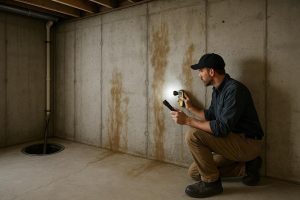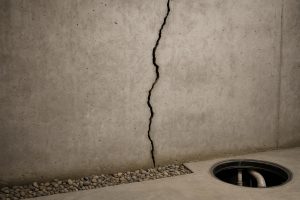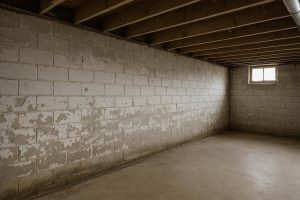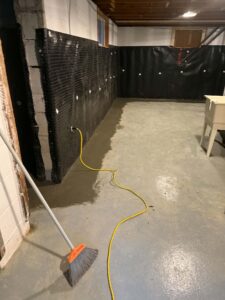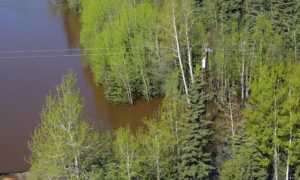
Foundation crack repair in Tay Township means identifying the crack type, understanding what is driving it, and matching the right repair method to the specific failure. Tay sits on Georgian Bay’s eastern shore in Simcoe County, where clay-rich glacial till, seasonal freeze-thaw cycling, and spring snowmelt from the surrounding uplands combine to put persistent hydrostatic pressure on poured-concrete and concrete-block foundations. Most wall cracks can be sealed permanently from the interior using polyurethane injection; wider, active or structural cracks may require exterior excavation or a drainage solution alongside the repair.
- Crack type (vertical, diagonal, horizontal, stair-step) determines urgency and the correct repair method.
- Tay’s clay soils and Georgian Bay proximity keep the water table elevated through spring and after heavy rain, increasing hydrostatic pressure on basement walls.
- Polyurethane crack injection is the most common interior repair for non-structural poured-concrete cracks.
- Horizontal or bowing cracks signal lateral soil pressure and require structural assessment before any waterproofing work.
- Ignoring a crack allows water infiltration, efflorescence, mould growth, and progressive structural deterioration.
Definitions & scope
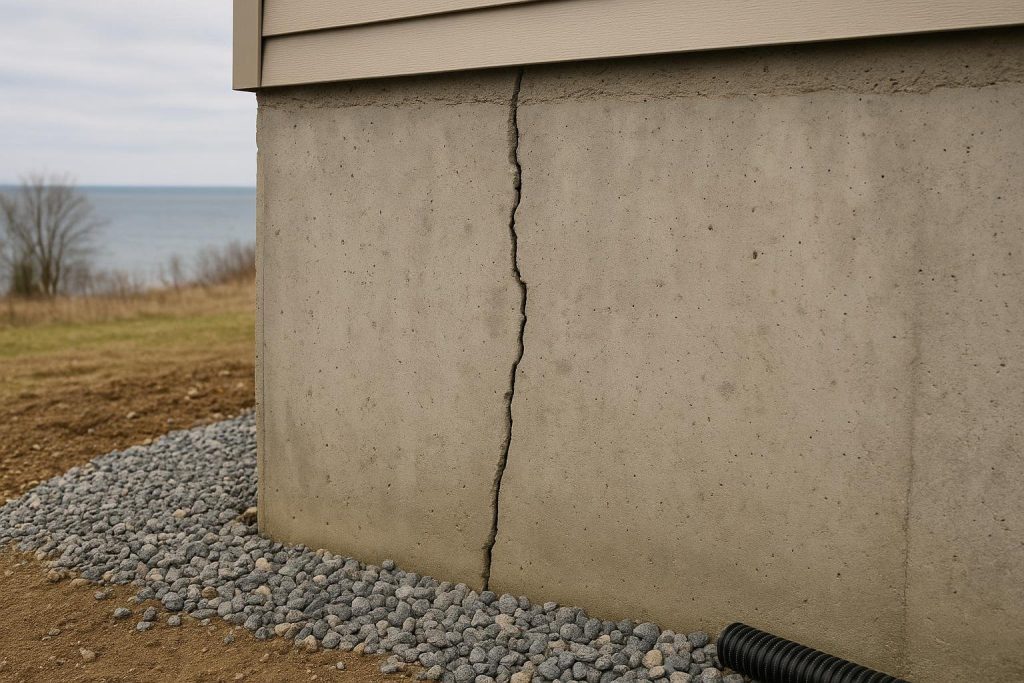
A foundation crack is any fracture in a basement wall or footing that breaks the continuity of the concrete or masonry. Cracks range from hairline shrinkage fractures that are cosmetic to wide, displaced separations that compromise structural integrity. The repair scope depends on three factors: the crack’s geometry (width, length, depth, displacement), whether it is active (still moving) or dormant, and whether water is passing through it.
In Tay Township, most residential foundations are poured concrete, though older homes in Victoria Harbour, Port McNicoll, and Waubaushene may have concrete-block or stone foundations that crack and leak differently. Understanding the type of foundation crack is the essential first step before any repair decision is made. Repairs covered in this guide include polyurethane injection, epoxy injection, hydraulic cement, exterior crack excavation, and interior drainage as a complementary measure where water management is needed alongside crack sealing.
Why this matters
Tay Township experiences some of the most demanding conditions for residential foundations in Simcoe County. Georgian Bay generates significant lake-effect precipitation, and the municipality’s low-lying areas around Midland Bay, Hogg Bay, and the Wye River corridor can see prolonged ground saturation after rain or snowmelt. Clay-rich glacial till, which is common throughout the township, expands when wet and contracts when dry, creating cyclical lateral pressure on basement walls. In winter, frost penetrates deeply into saturated clay, and the resulting freeze-thaw action widens existing cracks and initiates new ones.
Homes in Port McNicoll and Victoria Harbour that were built on or near former industrial or filled land may also sit on variable fill soils that settle unevenly, producing diagonal cracking at corners and around window openings. Seasonal cottages in the township face an additional risk: an unheated foundation that freezes solid through winter and then thaws rapidly in spring can experience accelerated crack propagation compared with a continuously heated home.
Water entering through a crack does not stay in the crack. It migrates behind finishes, saturates insulation, and creates conditions for mould growth within days. Structural cracks left unrepaired allow soil and water to erode the crack edges, widening the opening over successive seasons. Early repair is consistently less costly than deferred repair. See how to read the warning signs of a serious foundation crack for a practical triage guide.
Your options
Polyurethane crack injection
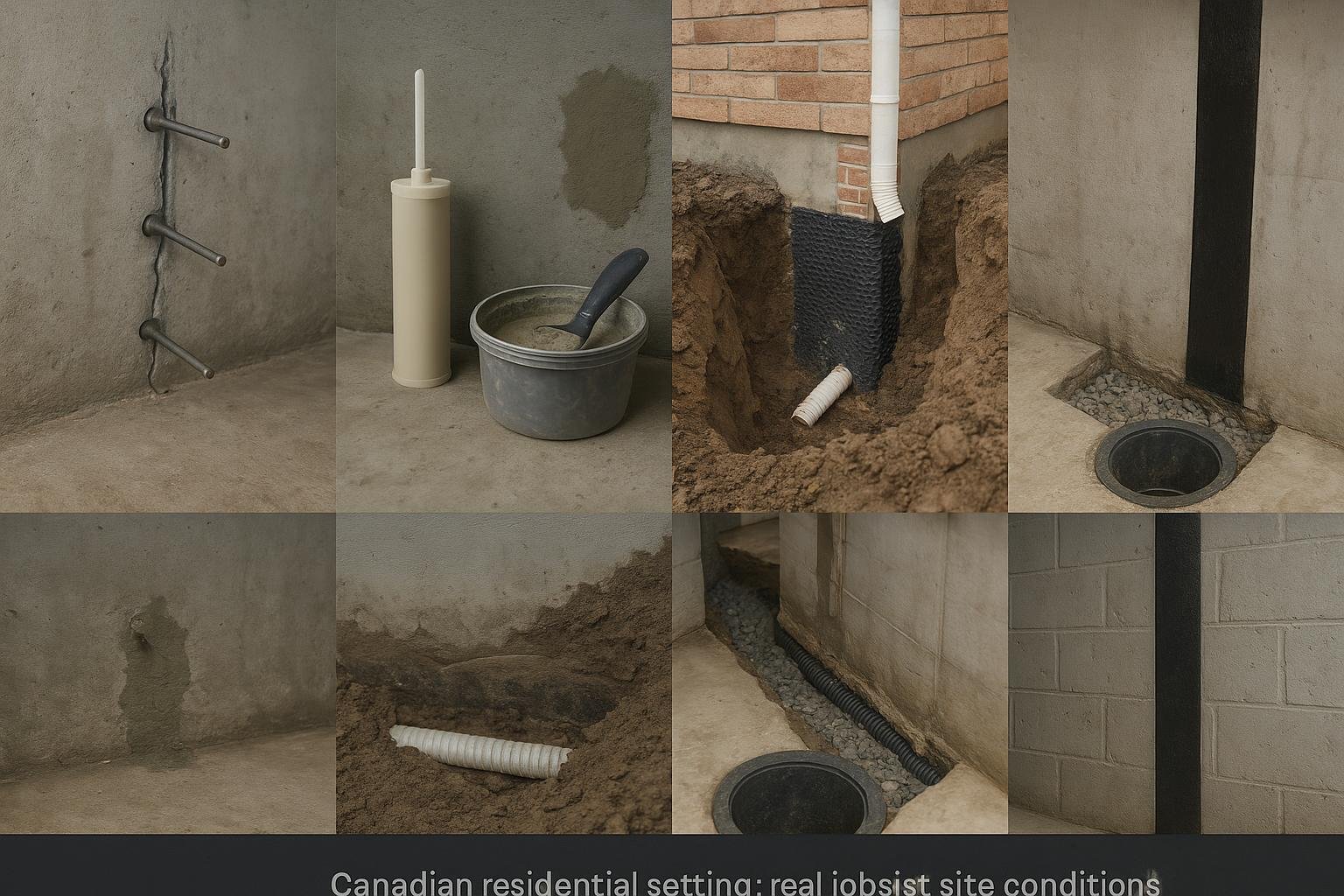
Polyurethane injection is the standard interior repair for active, water-bearing cracks in poured-concrete walls. A low-viscosity polyurethane resin is injected under controlled pressure through ports drilled or surface-mounted along the crack. The resin expands as it cures, filling the full depth of the crack and bonding to the concrete on both sides. The cured foam remains flexible, accommodating minor future movement without re-cracking at the same location.
Best for: Vertical and diagonal non-structural cracks in poured-concrete walls, particularly where active water infiltration is present.
Limitations: Not suitable for cracks with significant displacement, horizontal cracks indicating lateral pressure, or cracks in concrete-block walls where voids between blocks prevent full resin travel. See the full comparison at polyurethane injection for foundation cracks.
Epoxy crack injection
Epoxy injection uses a two-part structural adhesive injected at low pressure into dry or damp (not actively wet) cracks. Cured epoxy is rigid and achieves compressive strength that can exceed the original concrete. It is used when the crack must be structurally restored, not just waterproofed.
Best for: Dormant structural cracks in poured-concrete walls or slabs where load transfer across the crack must be restored and the crack is not actively leaking at time of repair.
Limitations: Epoxy does not tolerate active water flow during injection; the crack must be dried before application. It is rigid, so if the underlying cause of movement has not been addressed, a new crack may form adjacent to the repair. Review hydraulic cement vs crack injection for a side-by-side comparison of fast-set options.
Hydraulic cement
Hydraulic cement is a fast-setting, expansive mortar applied by hand to actively leaking cracks or holes. It sets in minutes and physically plugs the opening. It is often used as a temporary measure to stop active water flow before a permanent injection repair is completed.
Best for: Emergency situations with active water flow through a crack or pipe penetration; also used for honeycombed concrete patches.
Limitations: Hydraulic cement is a plug, not a bond. It does not penetrate the full crack depth, does not flex, and can be pushed out by sustained hydrostatic pressure. It is not a permanent waterproofing solution on its own.
Exterior crack excavation and membrane repair
Exterior repair involves excavating the soil alongside the foundation wall down to the footing, cleaning the crack, applying a waterproof membrane or coating to the exterior face, and backfilling with granular material to improve drainage. This approach addresses the crack from the water-entry side and is the most thorough single-crack repair available.
Best for: Cracks that have failed a previous interior injection, cracks with significant displacement or width, and situations where exterior drainage improvement is needed at the same time. Learn more at stopping foundation leaks permanently with exterior waterproofing.
Limitations: Excavation is disruptive, weather-dependent, and more costly than interior injection. Access may be limited by decks, landscaping, or proximity to neighbouring structures.
Interior drainage system (weeping tile and sump pump)
Where hydrostatic pressure is the primary driver of water infiltration, an interior perimeter drainage channel installed at the base of the wall, connected to a sump pit and pump, relieves pressure before water can force its way through cracks. This is a water-management system, not a crack sealer, and is typically combined with crack injection rather than used as a standalone crack repair.
Best for: Basements with multiple cracks, cove joint leaks, or chronic seepage driven by a persistently high water table, as is common in low-lying parts of Tay Township near Georgian Bay.
Limitations: Requires breaking the concrete floor perimeter, is more invasive than injection alone, and depends on a functioning sump pump. See sump pump replacement guide for pump selection and maintenance context.
Carbon fibre straps and wall anchors (structural stabilisation)
Horizontal cracks or inward-bowing walls indicate that lateral soil pressure has overcome the wall’s bending resistance. Carbon fibre straps bonded vertically across the crack, or wall anchors driven into stable soil beyond the active pressure zone, stabilise the wall and prevent further inward movement. These are structural interventions, not waterproofing methods, and are typically recommended by a structural engineer.
Best for: Horizontal cracks, stair-step cracks in block walls with visible inward bow, or any crack accompanied by measurable wall deflection.
Limitations: Carbon fibre straps prevent further movement but do not restore a wall to its original position; wall anchors can gradually straighten a wall over time but require adequate yard space for anchor placement. Neither method replaces the need to also waterproof the crack. See bowing basement foundation wall causes and fixes.
Options compared
| Repair method | Best for | Typical considerations | Durability / limitations |
|---|---|---|---|
| Polyurethane injection | Active, water-bearing vertical / diagonal cracks in poured concrete | Interior access only; minimal disruption; completed in hours | Flexible cure; long-lasting when crack is non-structural and cause is addressed |
| Epoxy injection | Dormant structural cracks requiring load transfer; dry crack at time of repair | Crack must be dry; rigid cure; higher material cost than polyurethane | Very high compressive strength; may re-crack adjacent to repair if movement continues |
| Hydraulic cement | Emergency active-flow plug; temporary measure | Fast set; hand-applied; no special equipment | Not a permanent fix; can be displaced by sustained pressure |
| Exterior excavation and membrane | Failed interior repairs; wide or displaced cracks; combined drainage upgrade | Excavation required; weather-dependent; higher cost and disruption | Most thorough single-crack repair; addresses water at source |
| Interior drainage and sump pump | Multiple cracks; chronic high water table; cove joint leaks | Floor perimeter must be broken; sump pump dependency | Manages water rather than sealing it; effective long-term with pump maintenance |
| Carbon fibre straps / wall anchors | Horizontal cracks; bowing walls; structural stabilisation | Structural engineer assessment recommended; yard access needed for anchors | Prevents further movement; does not restore original position without anchors |
Polyurethane injection handles the majority of Tay Township crack repairs efficiently and with minimal disruption. Exterior excavation becomes the better choice when interior injection has been tried and failed, or when the crack is wide enough that full-depth resin travel cannot be confirmed. Structural options (carbon fibre, anchors) are not interchangeable with waterproofing methods; a bowing wall needs both stabilisation and sealing. Interior drainage is most cost-effective when multiple entry points exist rather than a single isolated crack.
 How to choose
Use the following framework to narrow your options before requesting a professional assessment.
Choose polyurethane injection if the crack is vertical or diagonal, runs through a poured-concrete wall, is less than approximately 6 mm wide, and water is actively seeping or has left staining. This is the most common scenario in Tay Township residential basements and is the starting point for most crack repair consultations.
Choose epoxy injection if the crack is dormant (no recent movement, no active water), the wall carries a structural load across the crack, and the crack is dry at the time of repair. Epoxy restores tensile strength that polyurethane foam does not provide.
Choose exterior excavation if a previous interior injection has re-leaked, the crack is wider than approximately 6 mm or shows displacement (one side higher than the other), or you are already planning exterior drainage improvements. Combining excavation with new weeping tile and a membrane coating addresses both the crack and the drainage in a single mobilisation.
Choose interior drainage alongside crack repair if water enters at multiple locations, the cove joint (where the floor meets the wall) is also leaking, or the basement has a history of seasonal flooding driven by a high water table. In low-lying Tay areas near Georgian Bay, interior drainage is often the most practical long-term solution. See waterproofing vs foundation repair to clarify which problem you are actually solving.
Choose structural stabilisation first if the crack is horizontal, the wall visibly bows inward, or you can measure progressive inward movement over successive inspections. No waterproofing method is appropriate until wall movement is arrested. Consult a structural engineer or an experienced foundation contractor before proceeding. See how to tell if a foundation crack is structural for assessment criteria.
If you are unsure, use the foundation crack diagnosis tool to classify your crack before booking a contractor visit.
Costs & timelines
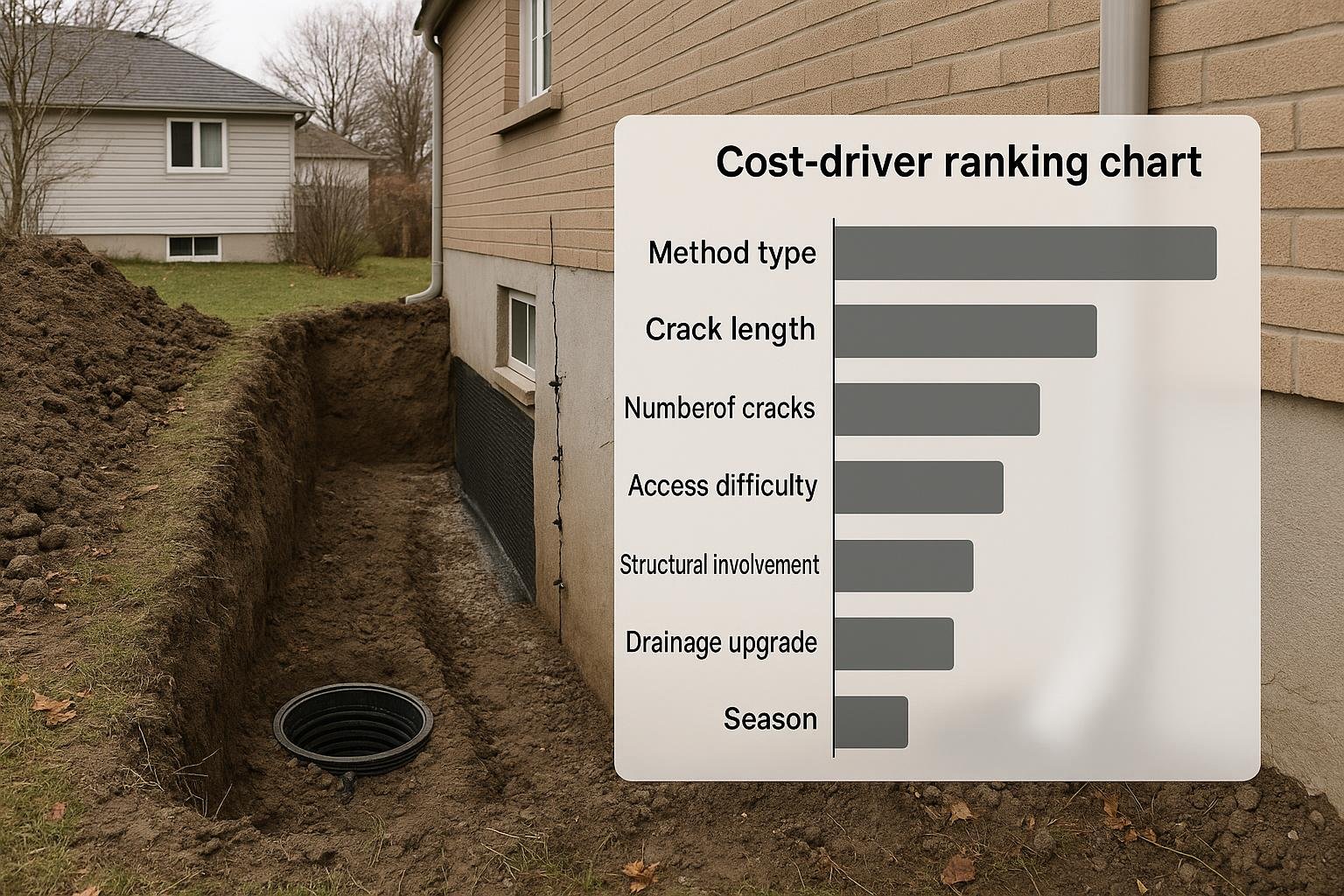
No verified current price data specific to Tay Township has been supplied to this guide. The following describes the cost drivers that contractors use to estimate crack repair work; actual quotes will vary by contractor, season, site conditions, and scope.
| Cost driver | Why it affects price | Relative impact |
|---|---|---|
| Repair method selected | Interior injection requires less labour and equipment than exterior excavation | High |
| Crack length and depth | More resin, more ports, more labour time | High |
| Number of cracks | Mobilisation cost is shared; per-crack cost may decrease with multiple repairs | Medium |
| Access difficulty | Finished walls, low ceilings, or landscaping obstructing exterior access add labour | Medium |
| Structural involvement | Carbon fibre, anchors, or engineer involvement adds significant cost | High |
| Drainage upgrade required | Adding weeping tile and a sump pump substantially increases scope and cost | High |
| Season and site conditions | Frozen ground limits exterior work; active water flow may require pre-treatment | Low to medium |
Interior polyurethane injection is typically the fastest repair, often completed in a single visit of a few hours. Exterior excavation requires a larger crew, heavy equipment, and at least a full day on site, with additional time for membrane curing and backfill. Interior drainage installation is the most time-intensive interior option, typically taking one to two days depending on basement perimeter length. For a broader cost framework, see foundation crack sealing cost in Ontario.
Risks & common mistakes
The most frequent mistake Tay Township homeowners make is treating a crack as a cosmetic problem and applying a surface sealant from a hardware store. Hydraulic cement or caulk applied to the interior face of a crack does not penetrate the full wall thickness. Hydrostatic pressure from saturated clay soil will eventually push water around or through any surface-only repair, often within one or two wet seasons.
A second common error is repairing a crack without identifying its cause. A vertical crack caused by differential settlement will continue to widen if the settlement has not stabilised. Injecting such a crack seals it temporarily but does not stop the underlying movement. A professional assessment should confirm whether the crack is dormant or active before injection proceeds.
Horizontal cracks are the most dangerous category and the most frequently misidentified by homeowners as minor. A horizontal crack in a poured-concrete wall indicates that the wall is being pushed inward by lateral soil pressure. Applying waterproofing to a wall that is actively deflecting can mask the structural problem and delay intervention until the wall fails. See what to do if your foundation crack is getting wider.
Delaying repair through winter is another risk specific to Tay’s climate. Water that enters a crack in autumn freezes inside the crack, expands, and widens the opening. By spring, what was a 2 mm crack may be 4 mm or more. Crack injection can be performed in cold weather on the interior, but the resin must be kept above its minimum application temperature; a qualified contractor will manage this. See whether basement waterproofing can be done in winter for context.
Finally, skipping a warranty review is a risk worth noting. A reputable contractor will offer a written warranty on injection repairs. Confirm that the warranty is transferable if you sell the property, as this can be a factor in a real estate transaction. See DryShield’s lifetime transferable warranty for the terms offered on qualifying repairs.
How the process works
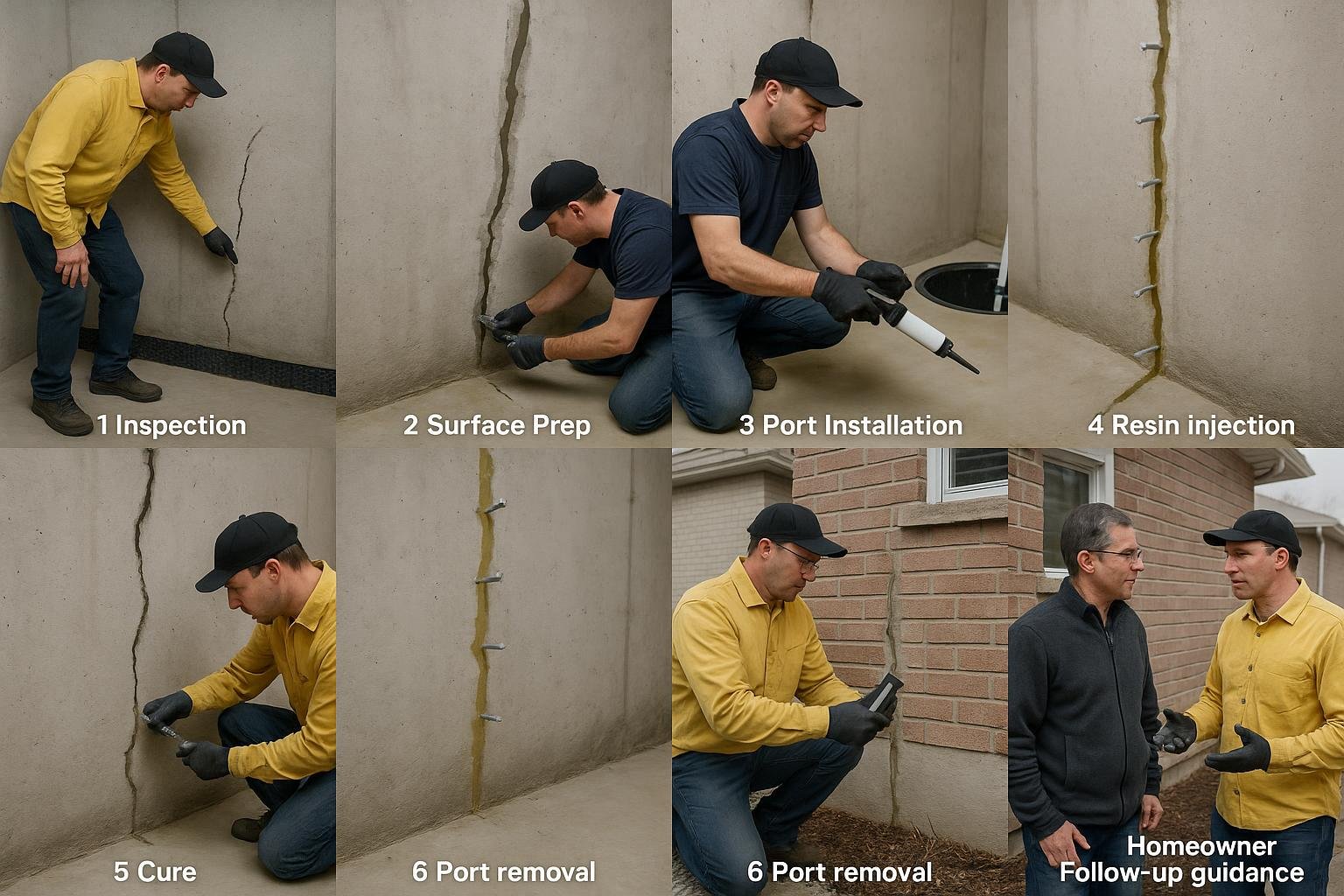
- Inspection and crack classification. A technician examines the crack’s geometry, measures width and length, checks for displacement, tests for active water flow, and assesses the surrounding wall for signs of structural movement. The crack type (vertical, diagonal, horizontal, stair-step) and foundation material (poured concrete, block, stone) determine the repair path.
- Surface preparation. The crack face is cleaned of loose material, efflorescence, and any previous sealant that would prevent resin adhesion. For injection, port locations are marked at regular intervals along the crack length.
- Port installation. Surface-mounted injection ports or drilled ports are set into the crack at the marked intervals. The spacing depends on wall thickness and crack width; closer spacing is used for narrow cracks to ensure full resin travel.
- Resin injection. Polyurethane or epoxy resin is injected under low, controlled pressure starting at the lowest port and working upward. The technician monitors each port for resin breakthrough at the adjacent port, confirming the crack is filled at that interval before moving on.
- Cure and port removal. The resin is allowed to cure. Polyurethane foam cures within minutes; epoxy requires longer. Ports are removed and the surface is finished flush with the wall face.
- Quality check and documentation. The repaired crack is inspected, and the technician documents the repair for warranty purposes. Any areas of concern identified during inspection that fall outside the repair scope are noted for the homeowner.
- Follow-up guidance. The homeowner receives advice on monitoring the repair, grading and downspout management to reduce surface water loading, and the conditions under which a follow-up visit would be warranted.
Frequently asked questions
What types of foundation cracks are most common in Tay Township?
Vertical shrinkage cracks are the most common in poured-concrete foundations throughout Simcoe County, including Tay. They typically form within the first few years after construction as concrete cures and dries. Diagonal cracks at corners of window openings are also frequent and usually indicate differential settlement. Horizontal cracks are less common but more serious, indicating lateral soil pressure. Older block or stone foundations in Victoria Harbour and Port McNicoll may show stair-step cracking along mortar joints.
Can I inject a foundation crack myself using a DIY kit?
DIY polyurethane injection kits are available and can seal a simple, accessible vertical crack in a poured-concrete wall. However, the quality of the result depends on correct port spacing, injection pressure, and resin selection. Errors in technique leave voids in the crack that allow water to bypass the repair. For a crack that is actively leaking or longer than about 300 mm, professional injection is more reliable. See DIY kit vs professional crack injection for a detailed comparison.
How long does polyurethane injection last?
A properly executed polyurethane injection into a non-structural, dormant or slowly active crack in a stable poured-concrete wall is expected to last for many years. The repair can fail if the underlying cause of cracking continues to drive movement, if the resin did not fully penetrate the crack depth, or if the crack was misclassified and is actually structural. Reputable contractors back injection repairs with a written warranty; confirm the warranty terms before work begins.
Does a foundation crack affect my home insurance in Ontario?
Most standard Ontario home insurance policies exclude gradual water damage and foundation deterioration from coverage. A sudden, accidental event such as a burst pipe may be covered, but water seeping through a crack over time typically is not. Some insurers may decline to renew or may add exclusions if a known foundation crack is not repaired. For a detailed overview of what is and is not covered, see home insurance and foundation cracks in Ontario.
Should I repair a crack before finishing my basement?
Yes. Any known crack should be repaired and confirmed dry before framing, insulating, or drywalling a basement. Water that enters a finished basement is far more damaging and costly to remediate than water entering an unfinished space. Framing and insulation trap moisture against the foundation wall, accelerating mould growth. See basement crack repair before finishing your basement for a complete pre-finishing checklist.
Is a crack found during a home inspection in Tay Township a deal-breaker?
Not necessarily. A single vertical shrinkage crack that has been professionally injected and carries a transferable warranty is a manageable finding. An unrepaired horizontal crack, a crack with significant displacement, or multiple active cracks without any repair history are more serious and warrant further investigation by a foundation specialist before closing. See what to do when a foundation crack is found during a home inspection.
How does Tay Township’s proximity to Georgian Bay affect foundation crack risk?
Georgian Bay’s influence on local precipitation and ground saturation is a genuine factor for Tay Township foundations. Lake-effect weather systems deliver concentrated rainfall and snowfall to the eastern Georgian Bay shoreline. Low-lying areas near Midland Bay, Hogg Bay, and the Wye River corridor experience prolonged ground saturation after these events, raising the local water table and increasing hydrostatic pressure on basement walls. Homes in these areas may benefit from interior drainage systems in addition to crack injection, rather than crack repair alone.
Can foundation cracks in a seasonal cottage be repaired in spring?
Spring is a practical time to repair cottage foundation cracks in Tay Township because the freeze-thaw cycle has completed and any winter crack propagation is visible. However, active snowmelt can mean the crack is wet or actively flowing at the time of inspection, which affects resin selection. Polyurethane injection can be performed in a wet crack; epoxy cannot. A contractor experienced with seasonal properties will assess the crack condition and select the appropriate resin. See freeze-thaw foundation cracks in cottage country for seasonal context.
What is the difference between a crack repair and basement waterproofing?
Crack repair seals a specific opening in the foundation wall to stop water entry at that point. Basement waterproofing is a broader system that may include exterior membranes, interior drainage channels, weeping tile, and sump pumps to manage water around and beneath the entire foundation. A single crack in an otherwise dry basement may need only crack repair. A basement with chronic seepage from multiple sources, a high water table, or failed original drainage typically needs a waterproofing system. See waterproofing vs foundation repair for a full explanation.
If you have identified a crack in your Tay Township foundation and are ready to discuss repair options, contact DryShield to arrange an assessment. DryShield has 25+ years of experience serving Simcoe County homeowners and covers Tay Township as part of its Simcoe County waterproofing service area. Repairs on qualifying cracks are backed by a lifetime transferable warranty.