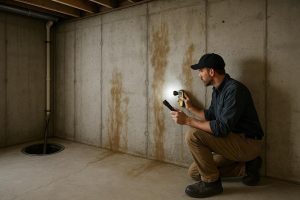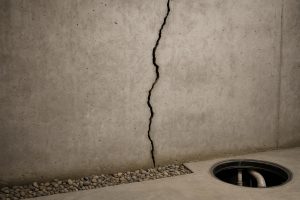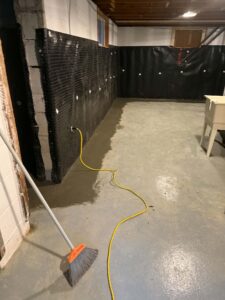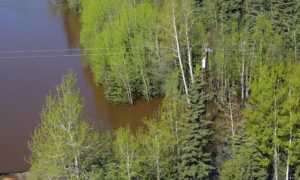
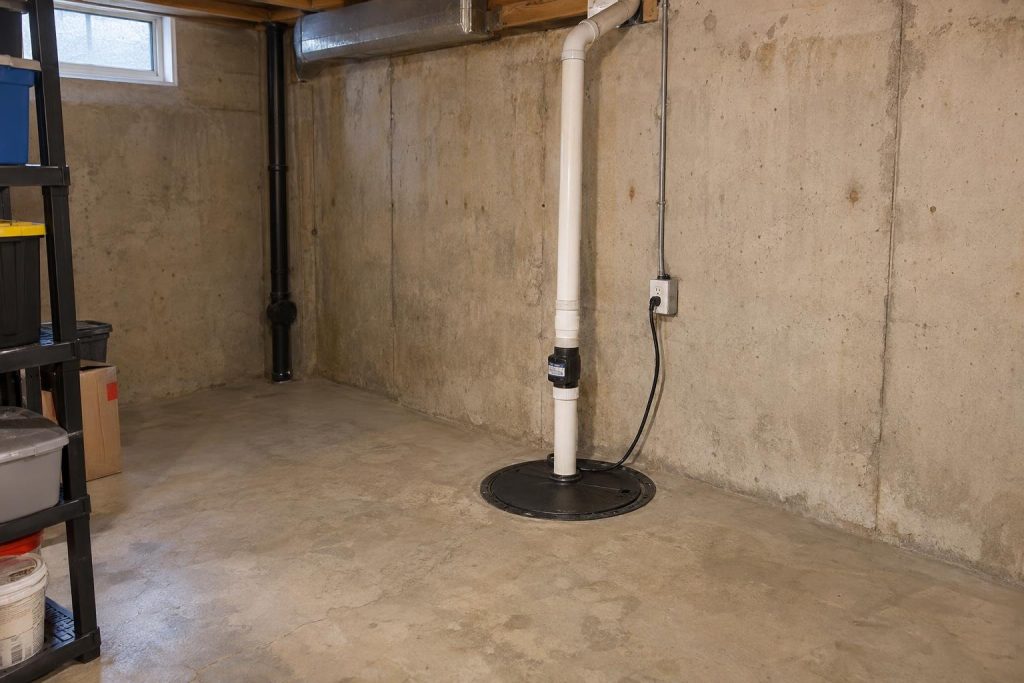
Sump pump selection for Uxbridge homes requires matching pump capacity, backup type and pit design to the specific demands of clay-rich glacial soils, a seasonally high water table on the Oak Ridges Moraine, and rural power outages that can coincide with the heaviest inflow events. A pump that is correctly sized and paired with the right drainage system is the last line of defence against a flooded basement; one that is undersized, unbacked or installed without proper drainage tile will fail at the worst possible moment. This guide covers every decision a homeowner needs to make.
- Clay soils around Uxbridge drain slowly, keeping hydrostatic pressure elevated for days after rain or snowmelt and demanding sustained pump capacity rather than brief peak output.
- Spring thaw on the Oak Ridges Moraine can raise the water table rapidly, overwhelming an undersized or aging pump within hours.
- Rural power outages during severe storms make a battery or water-powered backup pump essential, not optional.
- A sump pump works best when paired with a drainage system that channels water to the pit; a pump alone cannot compensate for failed weeping tile.
- Pump lifespan, maintenance schedule and warranty coverage all affect the true cost of ownership over the life of the home.
Definitions & scope
A sump pump is a submersible or pedestal mechanical device installed in a pit (the sump) cut into the lowest point of the basement floor. Its function is to collect groundwater that enters the pit, either through the soil directly or through a connected drainage system, and eject it through a discharge pipe to a safe outlet away from the foundation.
This guide covers residential sump pump selection, installation and maintenance for homes in Uxbridge and the surrounding rural properties in Durham Region. It addresses submersible and pedestal primary pumps, battery backup systems, water-powered backups and combination units. It does not cover commercial or industrial sump applications, nor does it address municipal sewer backup, which requires a backwater valve and is governed separately by the Township of Uxbridge’s infrastructure.
The guide is relevant whether you are installing a pump for the first time, replacing a failed unit, or evaluating whether your existing pump is adequate for your home’s drainage load. For the broader context of basement water management in Uxbridge, see the Uxbridge basement leak repair guide.
Why this matters
Uxbridge sits north of the Oak Ridges Moraine in Durham Region, on glacially deposited soils that include silty clay, sandy loam and gravel lenses. These soils vary within short distances, but the clay-dominant profiles that are common across the township drain slowly. After a significant rain event or during spring snowmelt, the water table can rise quickly and remain elevated for days or weeks, maintaining sustained hydrostatic pressure against foundation walls and floors.
The spring thaw is the highest-risk period. Snowpack on the moraine can be substantial, and when temperatures rise quickly, large volumes of meltwater enter the soil before it has fully thawed at depth. This creates a perched water table that sits against foundations for extended periods. A sump pump that is correctly sized for average conditions may be overwhelmed during these peak events if it was not selected with spring melt volumes in mind.
Rural Uxbridge also experiences power outages during severe storms more frequently than urban areas with underground utilities. The moment a primary pump loses power during a storm is precisely the moment inflow is at its highest. Without a backup system, a flooded basement can result within hours. Health Canada guidance on indoor air quality notes that mould can begin developing within 24 to 48 hours of a flooding event, making rapid pump restoration critical.
From a property value standpoint, a documented and functional sump system is increasingly expected by home buyers and insurers. Ontario home insurance policies vary in how they treat water damage, and some exclude gradual seepage. Our guide on home insurance coverage for basement waterproofing and foundation cracks in Ontario explains how waterproofing decisions interact with coverage.
Your options
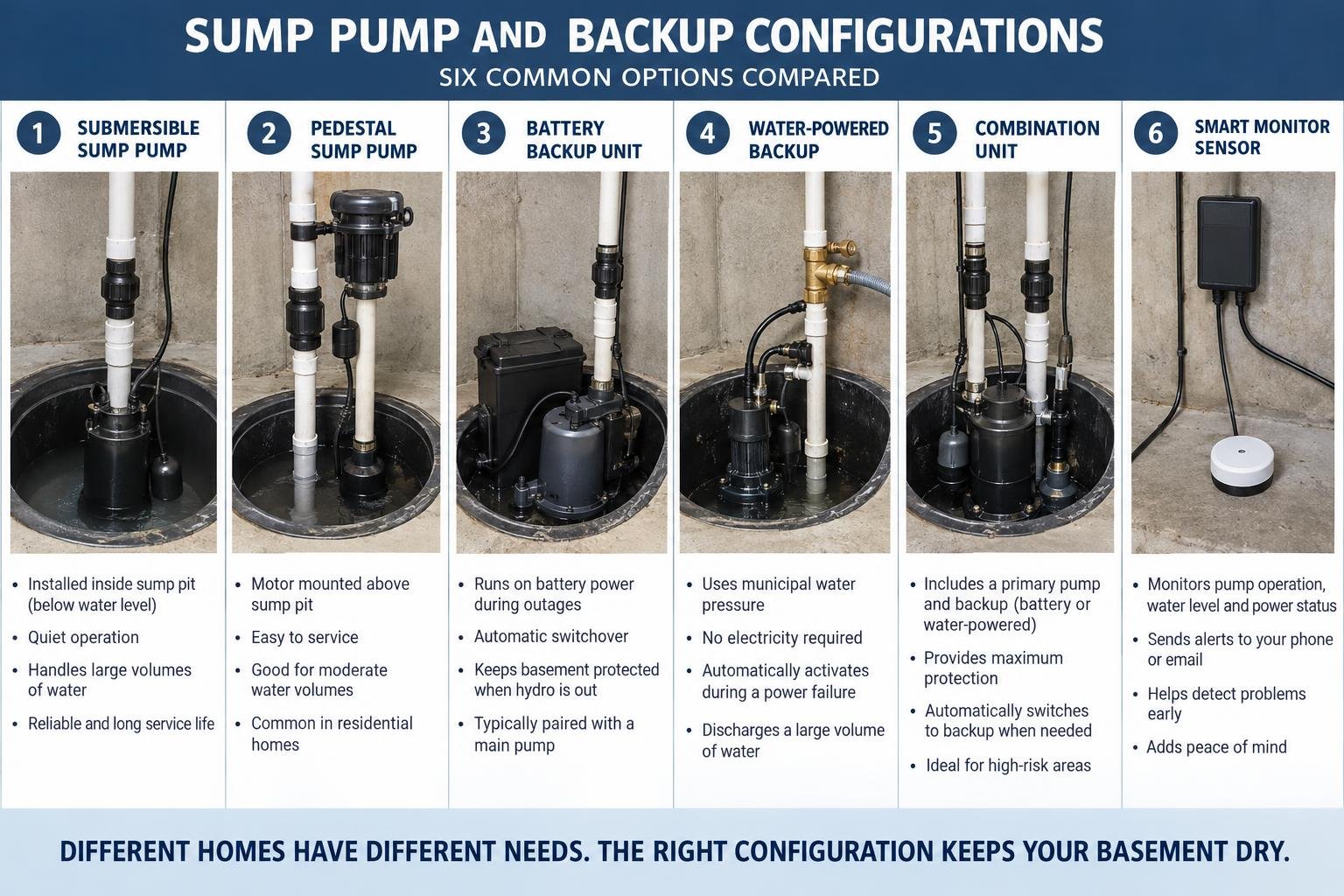
Submersible primary pump
A submersible pump sits inside the sump pit, fully submerged when operating. The motor is sealed against water ingress, and the unit is quieter than a pedestal pump because it operates below floor level. Submersible pumps are the most common choice for residential basements and are available in a wide range of horsepower ratings to match different drainage loads.
Submersible pumps are best suited to finished or semi-finished basements where noise is a concern, and to pits that receive drainage from a perimeter tile system. Their main limitation is that the motor runs in water, which generates heat; units that run continuously during high-inflow periods can experience shortened motor life if not rated for sustained operation. Look for a cast-iron housing rather than thermoplastic for durability in high-demand applications.
Pedestal primary pump
A pedestal pump has its motor mounted on a vertical shaft above the pit, with only the impeller submerged. The motor is accessible for inspection and runs cooler because it is exposed to air. Pedestal pumps are generally less expensive than submersible units of equivalent capacity and have a longer motor life in some applications because the motor does not sit in water.
The trade-off is noise: a pedestal pump is audible during operation. It is best suited to unfinished utility basements where noise is not a concern and where the pit is narrow, making a submersible unit difficult to service. Pedestal pumps are less common in new installations but remain a practical choice for replacement in existing narrow pits.
Battery backup sump pump
A battery backup system consists of a secondary pump connected to a deep-cycle marine or AGM battery, with a charger that keeps the battery topped up from the home’s electrical supply. When the primary pump loses power or is overwhelmed, the backup activates automatically. Most residential battery backup units can sustain several hours of pumping at rated capacity on a full charge, though actual runtime depends on inflow rate and pump draw.
For Uxbridge properties, a battery backup is strongly advisable given the combination of high spring inflow and rural power outage risk. The battery requires periodic testing and replacement, typically every three to five years depending on the unit and usage. Some systems include an alarm that alerts the homeowner when the backup activates or when the battery charge drops below a threshold.
Water-powered backup pump
A water-powered backup pump uses municipal water pressure to create suction through a venturi effect, drawing water from the pit without any electrical power. It requires no battery and has no moving parts to wear out. The limitation is that it requires adequate municipal water pressure to function and consumes water during operation, which adds to the water bill during an extended outage event.
Water-powered backups are best suited as a secondary redundancy layer in homes that already have a battery backup, or as a primary backup in areas with reliable municipal water pressure. In rural Uxbridge properties on well water, a water-powered backup is generally not appropriate because well pumps also lose power during an outage.
Combination primary and backup unit
Combination units integrate a primary submersible pump and a battery backup into a single assembly sharing one pit. They simplify installation and reduce the number of components to maintain. They are a practical choice for new installations where the pit is being designed from scratch and where the homeowner wants a single-vendor solution with integrated monitoring.
The limitation is that if the primary pump fails mechanically rather than due to a power outage, the backup may not activate unless the unit is designed to detect primary pump failure as well as power loss. Verify the failure-detection logic before selecting a combination unit. See our sump pump replacement guide for a detailed comparison of unit types and sizing guidance.
Smart monitoring and alarm systems
Smart sump pump monitors connect to the pump system and send alerts to a smartphone when the pump activates, when the backup engages, when water in the pit rises above a set level, or when the battery charge is low. For Uxbridge homeowners with seasonal properties or who travel during spring melt, remote monitoring can provide early warning of a developing problem before it becomes a flooded basement.
Monitoring is an add-on, not a replacement for proper pump sizing and backup. It is most valuable when paired with a reliable primary and backup system. Our guide on how to test smart sump pump sensors covers setup and diagnostic steps.
Options compared
| Option | Best for | Key considerations | Durability / limitations |
|---|---|---|---|
| Submersible primary pump | Most residential basements; finished spaces; pits connected to drainage tile | Quieter; wide capacity range; cast-iron preferred for sustained use | 7-15 year lifespan typical; motor runs in water; requires periodic testing |
| Pedestal primary pump | Narrow pits; unfinished basements; budget-conscious replacement | Noisier; motor above water; easier to service | Often longer motor life; less common in new installs; audible operation |
| Battery backup pump | Any home with power outage risk; Uxbridge rural properties | Battery needs replacement every 3-5 years; alarm recommended | Several hours runtime on full charge; runtime drops as battery ages |
| Water-powered backup | Municipal water supply; secondary redundancy layer | Not suitable for well-water properties; consumes water during operation | No battery to replace; no moving parts; depends on water pressure |
| Combination unit | New installations; single-vendor preference; integrated monitoring | Verify failure-detection logic covers mechanical primary failure | Convenient; backup runtime same as standalone battery unit |
| Smart monitoring | Seasonal or unoccupied properties; remote homeowners | Add-on only; requires reliable cellular or Wi-Fi signal at the property | No mechanical durability concern; app and connectivity dependent |
No single pump configuration suits every Uxbridge home. A submersible primary with a battery backup is the most common and practical combination for a year-round residence on municipal water. A well-water property needs a generator-capable backup strategy rather than a water-powered unit. A seasonal cottage benefits most from smart monitoring paired with a battery backup so that spring melt problems are detected before the owner arrives. The right combination depends on the home’s water supply, occupancy pattern and drainage system design.
How to choose
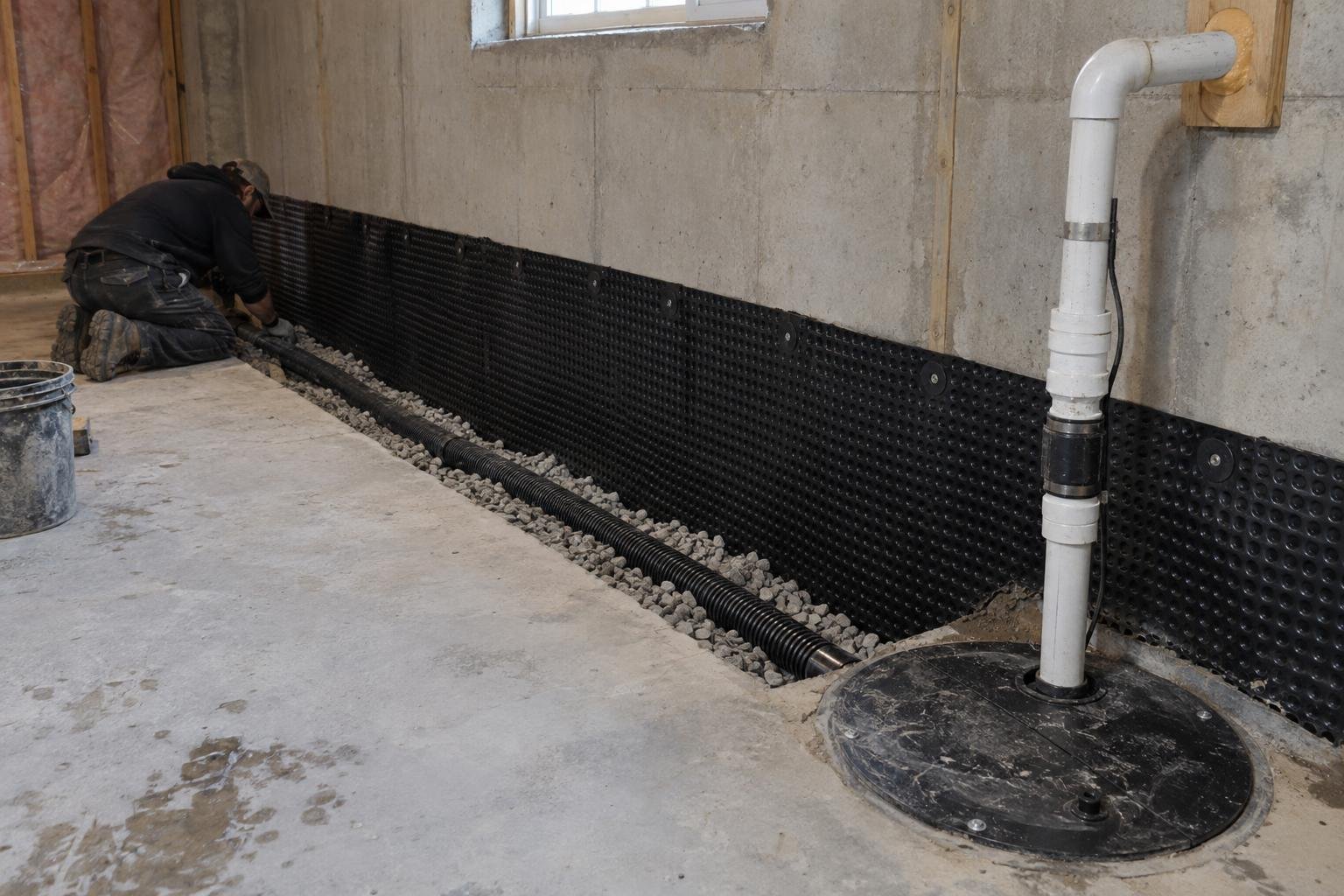
Start by identifying the drainage load your pump must handle. A pit that receives water only through soil seepage has a different demand profile than one connected to a full perimeter interior drainage system. If you are unsure, our basement leak diagnostic tool can help identify the source and volume of water entry before you select a pump.
Choose a submersible primary pump if your basement is finished or semi-finished, your pit is standard diameter, and you want quiet operation. Select a cast-iron unit if the pump runs frequently during wet periods.
Choose a pedestal pump if your existing pit is narrow, your basement is unfinished, and noise is not a concern. It is a practical replacement option when the pit geometry makes submersible service difficult.
Choose a battery backup for any Uxbridge property on municipal water. The combination of spring melt inflow and rural power outage risk makes a backup essential rather than optional. Replace the battery on schedule regardless of apparent condition.
Choose a water-powered backup only if your property is on municipal water and you want a secondary redundancy layer that requires no battery maintenance. Do not use it as the sole backup on a well-water property.
Choose a combination unit if you are installing a new pit and want an integrated solution. Confirm that the unit detects mechanical primary failure, not only power loss.
Add smart monitoring if the property is seasonal, unoccupied for extended periods, or if you want early warning during spring melt. Pair it with a reliable primary and backup, not as a substitute for either.
If your existing weeping tile is failed or absent, no pump will fully compensate. Address the drainage system first. Our guide on interior vs exterior weeping tile explains the options for restoring proper drainage before or alongside pump installation.
Costs & timelines
No verified current price data specific to Uxbridge has been supplied to this page. The following cost drivers are ranked by their typical influence on the final scope. For an estimate specific to your home, use the basement waterproofing cost calculator.
| Cost driver | Why it matters | Direction of influence |
|---|---|---|
| Pump type and horsepower rating | Cast-iron submersible units cost more than thermoplastic; higher horsepower adds cost | Highest impact on pump unit cost |
| Backup system selected | Battery backup adds cost of unit plus battery; combination units bundle both | High impact |
| Pit excavation or enlargement | New pit requires concrete cutting and excavation; existing pit may need enlargement for combination unit | High impact if pit work required |
| Discharge pipe routing | Longer runs, check valves, freeze-protection sleeves and exterior outlet location all add labour and material | Moderate impact |
| Drainage system connection | Connecting the pump to a new or existing interior drainage system adds scope and cost | Moderate to high if drainage work is included |
| Smart monitoring hardware | Sensor and connectivity hardware adds a modest fixed cost | Lower impact on total project |
Timeline for a straightforward pump replacement in an existing pit is typically a single visit of a few hours. A new pit installation with drainage connection takes one to two days. If the pump installation is part of a larger interior drainage system project, allow one to three days for the combined scope. Permit requirements for structural or excavation work should be confirmed with the Township of Uxbridge before work begins.
Risks & common mistakes
Undersizing the pump for spring melt conditions. A pump rated for average inflow may be overwhelmed during the peak spring thaw period when the water table rises rapidly. Sizing should account for the highest expected inflow rate, not the average. If the pump runs continuously for extended periods during wet weather, it may be undersized for the drainage load.
Skipping the battery backup. In Uxbridge, power outages during severe storms are a real risk. A primary pump that loses power during the heaviest inflow of the year provides no protection. A battery backup is a low-cost addition relative to the cost of a flooded basement and the mould remediation that follows.
Installing a pump without addressing drainage. A sump pump installed in a pit that receives no drainage tile will only activate when the water table rises above the pit floor. If water is entering through wall cracks or a failed weeping tile system, the pump does not address those entry points. Pair the pump with the appropriate drainage solution. See our guide on stopping foundation leaks permanently with exterior waterproofing for cases where the drainage system needs full replacement.
Neglecting discharge pipe freeze protection. In Uxbridge winters, a discharge pipe that exits through the foundation wall or a short exterior run can freeze, blocking the pump outlet and causing the pit to overflow. The discharge pipe should be routed to a frost-free depth or fitted with a freeze-protection outlet that allows water to escape even if the pipe is partially frozen.
Failing to test the backup system. A battery backup that has never been tested may have a depleted or failed battery. Test the backup at least once per year by disconnecting the primary pump and confirming the backup activates and pumps water. Replace the battery on the manufacturer’s recommended schedule. Our guide on sump pump maintenance covers a full annual testing checklist.
Ignoring a pump that runs continuously. A sump pump that runs without stopping during wet periods is a signal, not a normal condition. It may indicate the pump is undersized, the drainage system is overwhelmed, or there is an active water entry point that the pump is compensating for. Investigate the cause rather than simply replacing the pump with an identical unit. See our guide on why your sump pump keeps running for diagnostic steps.
How the process works
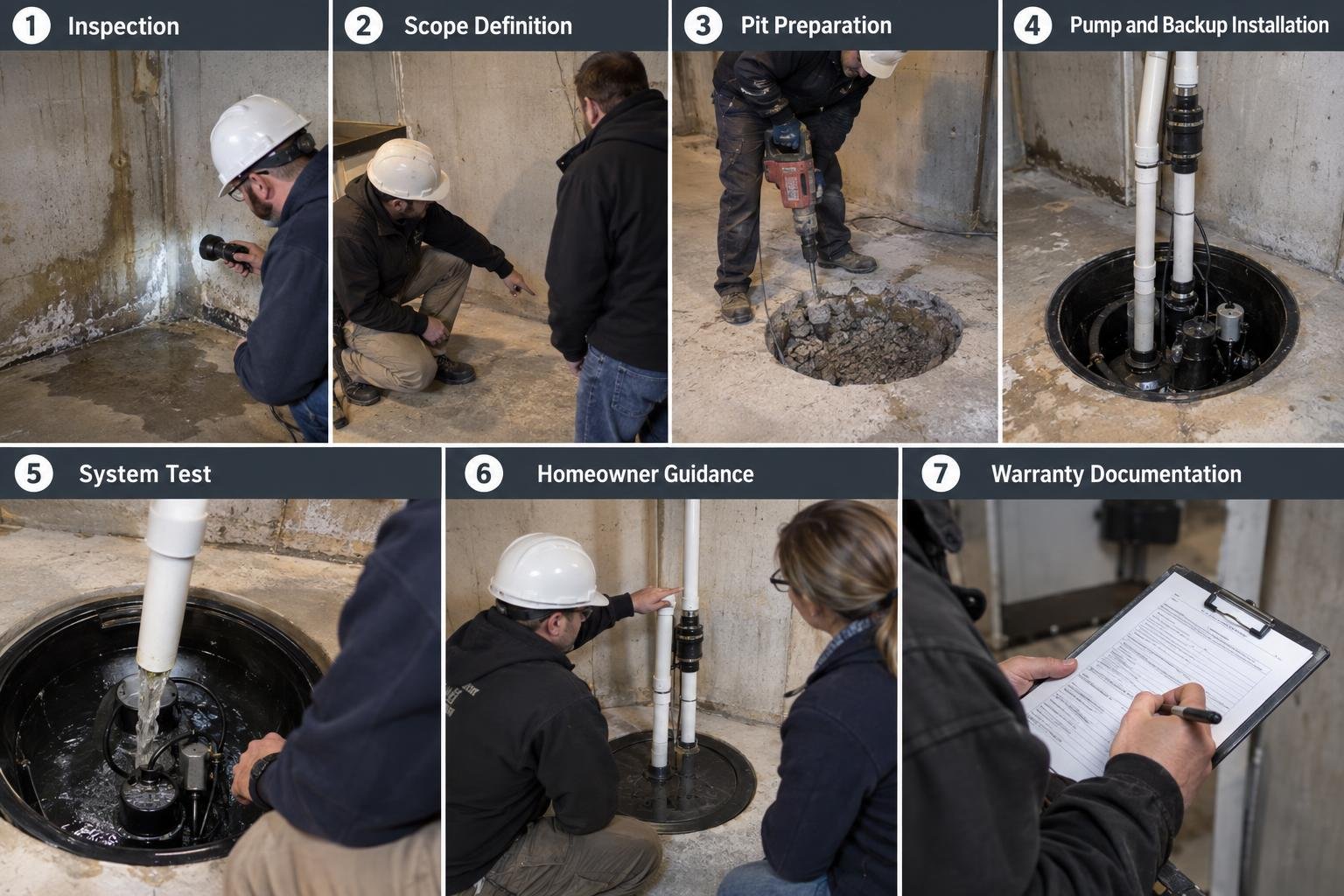
- Inspection and drainage assessment. A technician inspects the existing pit, pump condition, discharge routing and any connected drainage tile. They assess whether the pit is correctly located, sized and connected to the drainage system, and whether the existing pump is appropriate for the drainage load.
- Scope definition. Based on the inspection, the appropriate pump type, capacity, backup configuration and any drainage or pit work is identified. The homeowner receives a written scope before any work begins.
- Pit preparation. If a new pit is required, concrete is cut and excavated to the correct depth and diameter. If an existing pit is being used, it is cleaned and inspected for cracks or deterioration.
- Pump and backup installation. The primary pump is set in the pit, the float switch is adjusted for the correct activation level, and the discharge pipe is connected and routed to the exterior outlet. The backup system is installed and connected to the charger.
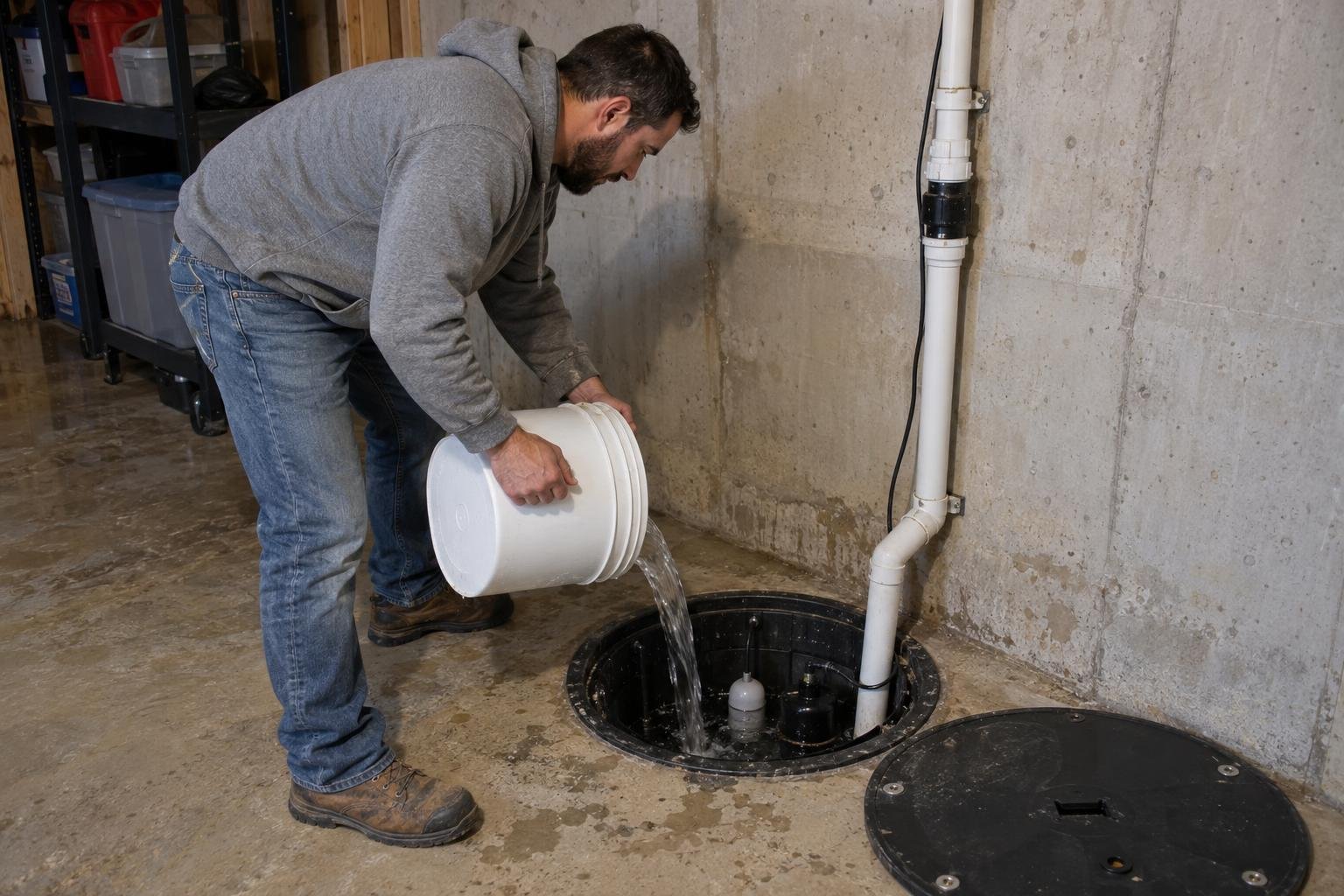
- System test. Water is introduced to the pit to confirm the primary pump activates at the correct level, pumps to the exterior outlet without restriction, and shuts off at the correct level. The backup is tested by simulating a power loss.
- Homeowner guidance. The homeowner is shown how to test the pump manually, how to check the backup battery charge, and what warning signs indicate a problem. Maintenance intervals are explained.
- Warranty documentation. DryShield provides a lifetime transferable warranty on qualifying work, which transfers to a new owner if the home is sold.
Frequently asked questions
What size sump pump do I need for an Uxbridge home?
Pump sizing depends on the drainage area, soil permeability and the volume of water the system must handle during peak inflow. Clay soils around Uxbridge drain slowly but can sustain elevated water tables for extended periods, requiring a pump rated for sustained operation rather than brief peak output. A 1/2 horsepower submersible unit is a common starting point for a standard residential basement, but homes with large drainage areas or a history of high spring inflow may require a 3/4 or 1 horsepower unit. A site assessment is the only reliable way to determine the correct size for a specific property.
How often should I replace my sump pump?
Most residential sump pumps have a service life of seven to fifteen years depending on the quality of the unit, how frequently it runs and whether it has been maintained. A pump that runs continuously during wet periods will wear faster than one that cycles briefly. Annual testing, cleaning the pit of debris and checking the float switch for free movement extend service life. If the pump is more than ten years old, runs continuously during wet periods, or has failed during a storm, replacement is advisable rather than waiting for the next failure. Our sump pump failure and replacement guide covers warning signs in detail.
Do I need a battery backup if I have a generator?
A generator that is manually started provides no protection during the first hours of a power outage if the homeowner is away or asleep. A battery backup activates automatically without any human intervention. If you have an automatic standby generator that starts within seconds of a power loss and is sized to run the sump pump, a battery backup may be redundant. If your generator is portable and requires manual starting, a battery backup remains advisable as an automatic first response while the generator is being set up.
Can I install a sump pump myself?
Replacing an existing pump in an existing pit with an identical or equivalent unit is within the capability of a mechanically confident homeowner. Cutting a new pit, routing a new discharge line through the foundation wall, or connecting the pump to a drainage system involves concrete work, waterproofing penetrations and drainage design that benefit from professional installation. Improper discharge routing, incorrect float switch adjustment or a pit that is too shallow for the drainage load can result in pump failure or basement flooding. Our guide on putting in a sump pump outlines what each stage involves.
Where should the sump pump discharge?
The discharge pipe should terminate at least 1.5 to 2 metres from the foundation wall, directed away from the house and toward a drainage swale, dry well or municipal storm outlet where permitted. Discharging too close to the foundation recirculates water back toward the pit, increasing pump run time and defeating the purpose of the system. In Uxbridge, the discharge outlet should be protected against freezing with a freeze-protection fitting or by routing the pipe to a frost-free depth before exiting the foundation. Check with the Township of Uxbridge regarding any local requirements for discharge outlet location.
What happens if my sump pump fails during a storm?
If the primary pump fails during a storm and no backup is present, the pit will fill and water will overflow onto the basement floor. The speed of flooding depends on the inflow rate and the volume of the pit. In a high-inflow event during spring melt, a basement can take on significant water within hours. If you arrive at a flooded basement, our guide on what to do when your sump pump fails and the basement floods covers immediate steps including safety, water removal and documentation for insurance purposes.
Is my sump pump connected to my weeping tile?
In a properly designed system, the sump pit receives water from a perimeter drainage pipe (weeping tile) that collects groundwater at the footing level and directs it to the pit. In older Uxbridge homes, the original weeping tile may be clay or concrete that has collapsed or silted up, meaning the pit receives water only through soil seepage rather than through a functioning drainage system. If your pump runs infrequently despite a wet basement, the weeping tile may be bypassing the pit entirely. A camera inspection or excavation can confirm the condition of the existing tile. See our guide on interior vs exterior weeping tile for replacement options.
Does a sump pump affect my home insurance?
Some Ontario home insurance policies offer premium discounts or improved coverage terms for homes with functioning sump pumps and battery backups, particularly for overland water and sewer backup endorsements. Coverage terms vary significantly between insurers and policies. A functioning, documented sump system demonstrates that the homeowner has taken reasonable steps to mitigate water damage risk. Our guide on home insurance and basement waterproofing in Ontario provides a broader overview of how waterproofing decisions interact with coverage.
If your Uxbridge home needs a new sump pump, a backup system or a full drainage assessment, the DryShield team serves the Uxbridge area and can evaluate your existing system and recommend the right configuration. Visit our Uxbridge waterproofing and foundation crack repair page or our sump pump installation service page to learn more, or use our contact page to request an assessment.